

Why Identical Twins React Differently to the Same Meal: The PREDICT Study Rewrites Nutrition Science
Your genes explain less than 30% of how your blood sugar responds to food—sleep, meal timing, and gut bacteria matter far more than we thought.
This article is for general informational purposes only and is not a substitute for professional medical advice, diagnosis, or treatment. Always consult a qualified healthcare provider with questions about a medical condition.
Your Twin Eats the Same Breakfast. Their Blood Sugar Tells a Completely Different Story.
Sarah and Emma are identical twins. Same DNA. Same parents. Same childhood breakfast table. Yet when researchers at King's College London fed them both a standard muffin and tracked their glucose for two hours, Sarah's blood sugar spiked to 142 mg/dL while Emma's barely nudged past 108.
This wasn't a fluke. Across 1,100 twins in the PREDICT study, identical siblings showed glucose responses that differed by an average of 50%. Half. The same genetic code, the same meal, wildly different metabolic outcomes.
That finding, published in Nature Medicine in 2024, essentially demolished the foundation of universal dietary guidelines. If your literal genetic clone responds differently to a banana than you do, what exactly are population-wide nutrition recommendations telling us?
The Numbers That Changed Everything
The PREDICT consortium didn't just study twins. They recruited over 15,000 participants across the UK and US, making it the largest nutritional response study ever conducted. Each person wore continuous glucose monitors, logged meals meticulously, and provided blood samples, stool samples, and detailed lifestyle data.
The headline finding: genetics explained only 28% of glucose response variation. For triglycerides (blood fats after eating), genetic contribution dropped to just 9%.
So what fills that gap?
Sleep quality the night before a meal accounted for 12% of glucose variation. Meal timing—specifically whether someone ate at their biological morning versus evening—shifted responses by up to 40%. And the composition of gut bacteria, those trillions of microbes in your intestines, explained nearly as much variation as your entire genome.
Tim Spector, the epidemiologist leading PREDICT, put it bluntly in a 2024 interview: "We've been giving people dietary advice based on averages that don't apply to any individual person."
The Gut Microbiome: Your Second Metabolic Brain
A 2024 Cell paper took the PREDICT findings deeper, examining exactly which gut bacteria predicted glucose responses. The results were striking.
People with higher populations of Prevotella copri showed 23% lower glucose spikes after eating bread. Those with abundant Blautia wexlerae processed fiber more efficiently, leading to slower, steadier glucose curves. Meanwhile, certain Bacteroides species correlated with sharper spikes and faster crashes.
But here's what makes this actionable: your microbiome isn't fixed. Unlike your DNA, you can shift your gut bacteria composition within weeks through dietary changes. Participants who increased fiber intake by 10 grams daily showed measurable microbiome shifts within 14 days, and their glucose responses to test meals changed accordingly.
One participant, a 45-year-old accountant named David, had terrible glucose responses to oatmeal—a food universally praised as "heart healthy." His continuous glucose data showed morning oatmeal spiked him to 165 mg/dL, higher than white bread. After six weeks of adding fermented foods and reducing his oatmeal portion by half while adding nuts, his response to the same breakfast dropped to 128 mg/dL.
Same person. Same food. Different metabolic context.
Why Morning You and Evening You Are Different People
The ATTD 2025 conference in Paris featured a session on circadian glucose metabolism that should concern anyone who eats dinner after 8 PM.
Researchers from Brigham and Women's Hospital presented data showing that identical meals eaten at 8 AM versus 8 PM produced glucose peaks that differed by 35% on average. Evening eating didn't just spike glucose higher—it kept levels elevated for 90 minutes longer.
This isn't about willpower or "late-night snacking is bad" moralizing. It's pure physiology. Your pancreas produces less insulin in the evening. Your muscle cells become more resistant to glucose uptake as the day progresses. Your body is literally preparing for sleep, not for processing a 600-calorie pasta dinner.
The practical implication: two people eating the exact same daily calories might have dramatically different metabolic outcomes based purely on when those calories arrive. Someone eating 60% of their food before 2 PM showed, on average, 18% lower 24-hour glucose variability compared to someone eating the same foods with 60% after 6 PM.
The Sleep Factor Nobody Talks About
PREDICT participants who slept less than six hours the night before a test meal showed glucose responses 14% higher than when they'd slept seven-plus hours. The effect was even more pronounced for people over 50, where poor sleep amplified glucose spikes by up to 22%.
This creates a vicious feedback loop. High glucose variability disrupts sleep quality. Poor sleep worsens glucose control the next day. Repeat.
One subset of PREDICT participants wore both CGMs and sleep trackers for 30 consecutive days. The correlation between previous night's sleep quality and next-day glucose control was stronger than the correlation between food choices and glucose control. Let that sink in: how you slept mattered more than what you ate.
What CGM Data Actually Reveals About Your Personal Patterns
Continuous glucose monitoring transforms these abstract findings into personal data. Instead of guessing whether you're a "good oatmeal responder" or whether your evening metabolism tanks after 7 PM, you can see it.
The ATTD 2025 precision nutrition panel outlined a framework for interpreting individual CGM patterns:
Time-in-range (glucose between 70-140 mg/dL) matters more than any single spike. Someone spending 85% of their day in range with occasional 150 mg/dL peaks is metabolically healthier than someone with constant low-grade elevation at 125 mg/dL.
Post-meal patterns reveal food-specific responses. A 30-minute spike that returns to baseline within 90 minutes is normal physiology. A spike that stays elevated for three hours suggests that specific food, in that context, isn't working for your metabolism.
Overnight stability indicates metabolic flexibility. Glucose that stays flat between 75-95 mg/dL during sleep suggests good insulin sensitivity. Glucose that drifts upward after 3 AM might indicate cortisol dysregulation or liver glucose dumping.
Building Your Personal Food Response Map
The PREDICT team developed a scoring system ranking foods from A (minimal glucose impact) to E (major spike) for each individual. The same food could be an A for one person and a D for another.
Bananas averaged a C across the population but ranged from A to E depending on the individual. White rice was similarly variable. Even foods considered "universally healthy" like whole grain bread showed person-to-person variation that spanned three letter grades.
The researchers identified what they called "surprise foods"—items that produced unexpectedly good or bad responses for specific individuals. About 35% of participants had at least one food they'd been avoiding (thinking it was "bad") that actually produced excellent glucose responses for their specific metabolism. Another 40% had a food they considered healthy that consistently spiked them.
This isn't about labeling foods as good or bad. It's about recognizing that the question "Is oatmeal healthy?" is incomplete. The real question: "Is oatmeal healthy for me, at this time of day, given my current sleep and stress levels?"
The Practical Path Forward
None of this means nutrition science is useless. Population-level data still matters. Vegetables are still better than candy for virtually everyone. Whole foods still outperform ultra-processed options in aggregate.
But the PREDICT findings suggest a hierarchy of personalization:
Universal principles (eat vegetables, limit sugar, don't overeat) apply to everyone and should form the foundation.
Timing optimization (front-loading calories, protecting sleep) provides the next layer of improvement and applies to most people with minimal individual testing required.
Food-specific personalization (which carbs work for you, which don't) requires individual data—whether from CGM tracking, structured elimination experiments, or both.
The twins Sarah and Emma, from the opening of this article, eventually found their personal patterns. Sarah discovered she responded well to rice but poorly to bread. Emma was the opposite. Both reduced their glucose variability by 30% within two months simply by swapping foods they'd assumed were interchangeable.
Their DNA hadn't changed. Their diets had barely changed. They'd just learned which version of "healthy eating" actually worked for their individual biology.
What This Means for the Future of Nutrition Advice
The era of one-size-fits-all dietary guidelines is ending. Not because those guidelines were wrong, but because they were incomplete. Telling everyone to eat whole grains is like telling everyone to wear medium-sized shoes—helpful on average, uncomfortable for many.
The tools for personalization are becoming accessible. CGMs that once required prescriptions are now available over-the-counter in many countries. Microbiome testing costs have dropped 90% in a decade. Apps can now correlate meal photos with glucose data automatically.
The PREDICT researchers estimate that within five years, personalized nutrition recommendations based on individual metabolic response data will be as common as personalized fitness plans. The science is already there. The technology is catching up.
Your body has been trying to tell you how it responds to food. We're finally learning to listen.
📊 Key Stats
Factors Influencing Individual Glucose Response
| Factor | Contribution to Variation | Modifiable? | Timeframe to See Changes |
|---|---|---|---|
| Genetics | 28% | No | N/A |
| Gut Microbiome | 25% | Yes | 2-6 weeks |
| Sleep Quality | 12% | Yes | Next day |
| Meal Timing | 15% | Yes | Immediate |
| Stress/Cortisol | 8% | Yes | Hours to days |
| Physical Activity | 12% | Yes | Hours to days |
Data synthesized from PREDICT Study (2024) and ATTD 2025 presentations. Individual variation may differ.
❓ Frequently Asked Questions
Why do identical twins have different glucose responses if they share the same DNA?
Can I change my glucose response to specific foods?
Why does the same food spike my glucose more at night than in the morning?
How much does sleep affect my blood sugar response to food?
Are population dietary guidelines still useful if individual responses vary so much?
What percentage of people have unexpected responses to foods they thought were healthy or unhealthy?
How quickly can I identify my personal food response patterns?
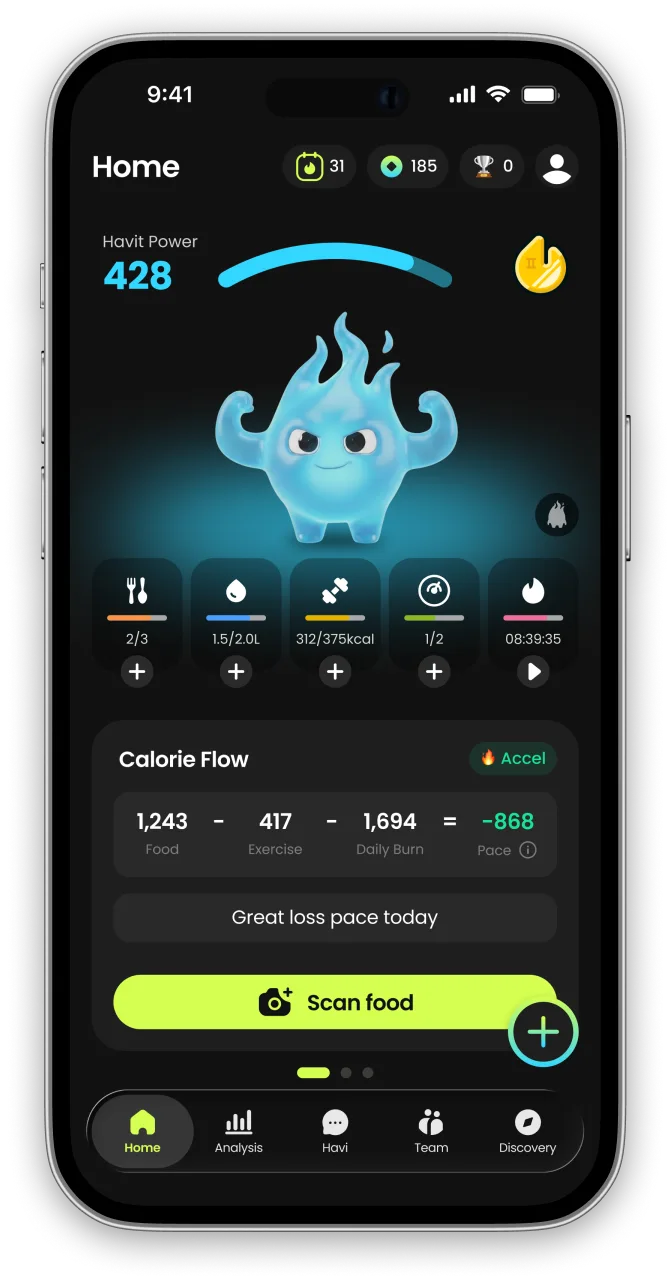
What is Havit?
Havit is an AI health companion for weight loss that protects muscle.
Unlike calorie-only trackers, Havit connects AI body-composition estimates, nutrition, hydration, sleep, steps, cycle, mood, and GLP-1 medication in one daily routine — so progress is measured by body composition, not just the number on the scale. Daily missions turn established behavior-change techniques into small repeatable actions, drawing on expertise from professionals formerly at Juvis Diet, one of Korea’s leading metabolic clinics.
In Havit’s own analysis of 1,090 GLP-1 users, people who logged consistently built stronger habits than the general user base. Read the GLP-1 Habit Report
Havit works with or without GLP-1 medication. It is a wellness app, not a medical device; body-composition results are estimates.

Continue in the App
Personalized wellness with your own data


References
- Personalized Nutrition by Prediction of Glycemic Responses — Spector, T. et al., Nature Medicine, 2024
- Gut Microbiome Composition Predicts Individual Glucose Response to Dietary Carbohydrates — Cell, 2024
- Precision Nutrition and CGM-Based Dietary Interventions: Current Evidence and Future Directions — ATTD 2025 Conference Proceedings, Paris
- Circadian Variation in Postprandial Glucose Response: Implications for Meal Timing — Brigham and Women's Hospital Research Group, ATTD 2025


