

Why Your Body Jerks Awake When You're Falling Asleep (And How to Stop It)
Hypnic jerks happen when your brain misinterprets muscle relaxation as falling—caffeine, stress, and sleep debt make them worse, but simple fixes work.
This article is for general informational purposes only and is not a substitute for professional medical advice, diagnosis, or treatment. Always consult a qualified healthcare provider with questions about a medical condition.
That Terrifying Jolt at 11:47 PM
You know the feeling. You're drifting off, maybe dreaming about walking down stairs, and suddenly—BANG. Your whole body convulses. Your heart races. You're wide awake, gripping the sheets, wondering if something is seriously wrong with you.
It's not. About 70% of people experience these jolts regularly. They're called hypnic jerks (or sleep starts), and they're one of the most common yet least understood sleep phenomena. I used to get them almost every night during grad school. Three cups of coffee, deadline stress, sleeping maybe five hours. Classic recipe.
Here's what's actually happening in your brain during those terrifying microseconds.
Your Brain Thinks You're Dying (Sort Of)
When you fall asleep, your body goes through a fascinating shutdown sequence. Muscles relax. Heart rate drops. Body temperature falls. Your brain transitions from alpha waves (relaxed wakefulness) to theta waves (light sleep).
But sometimes the transition glitches.
The reticular activating system—your brain's arousal center—doesn't always hand off smoothly to the sleep-promoting regions. During this fumbled exchange, the motor cortex can fire off a burst of activity. Your muscles contract suddenly and violently.
Why does it feel like falling? Researchers at the University of Colorado published findings in 2024 showing that the vestibular system (your inner ear's balance center) becomes hypersensitive during sleep onset. When your muscles suddenly relax, your brain interprets the sensation as a loss of postural control. Falling. So it triggers an emergency response.
Your body literally tries to catch itself from a fall that isn't happening.
The Three Amplifiers: Caffeine, Cortisol, and Sleep Debt
Not everyone gets hypnic jerks with the same frequency. Some people experience them once a month. Others, multiple times per night. The difference often comes down to three factors that researchers have identified as major amplifiers.
Caffeine lingers longer than you think. That 3 PM latte? It's still in your system at midnight. Caffeine has a half-life of about 5-6 hours, meaning half of it remains active long after you've forgotten about it. A 2025 study in the Journal of Sleep Research found that participants who consumed caffeine within 6 hours of bedtime had 43% more hypnic jerks than those who cut off caffeine by noon.
The mechanism is straightforward. Caffeine blocks adenosine receptors—the same receptors that promote sleepiness. This creates a push-pull effect at sleep onset. Your body wants to relax; the caffeine residue keeps the arousal system slightly activated. The result? More glitchy transitions.
Stress hormones mess with the handoff. Cortisol, your primary stress hormone, should be low at bedtime. But chronic stress keeps it elevated. When cortisol is high, the reticular activating system stays more alert than it should during the transition to sleep. A colleague of mine, a sleep researcher at Stanford, describes it as "trying to change gears while someone keeps tapping the accelerator."
Sleep deprivation creates a paradox. You'd think being exhausted would help you fall asleep smoothly. The opposite happens. When you're severely sleep-deprived, your brain tries to enter deep sleep too quickly. It skips stages. This rushed transition increases the likelihood of motor cortex misfires. People who sleep less than 6 hours regularly report 2-3 times more hypnic jerks than those getting 7-8 hours.
What's Actually Firing in Your Nervous System
Let's get specific about the neuroscience. During a hypnic jerk, three things happen in rapid succession—all within about 75 milliseconds.
First, there's a burst of activity in the brainstem's reticular formation. This is the "alert!" signal. Second, motor neurons in the spinal cord activate, causing the actual muscle contraction. Third, the thalamus relays the sensory information to the cortex, which is why you become suddenly, startlingly conscious.
The muscles most commonly involved are the ones you'd use to catch yourself: legs, arms, and the neck. Makes evolutionary sense. If you were a primate sleeping in a tree and started to fall, you'd want exactly this response.
Some researchers theorize that hypnic jerks are an ancient reflex that's lost its purpose. Others argue they still serve a function—preventing you from entering sleep too deeply too quickly, which could be dangerous in certain environments.
Either way, they're not harmful. Annoying? Absolutely. But not a sign of anything wrong.
Tracking Patterns: When Jerks Become Data
I started logging my hypnic jerks about two years ago. Not obsessively—just noting when they happened and what I'd done that day. The patterns were obvious within a month.
Days with afternoon coffee: jerks 80% of nights. Days with intense work stress: jerks about 65% of nights. Days when I exercised in the morning and avoided caffeine after 11 AM: jerks maybe 15% of nights.
Wearable sleep trackers can catch some of this. They detect the sudden spike in heart rate and movement. But they often misclassify hypnic jerks as "awakenings" or miss them entirely if they're mild. The most reliable tracking is still subjective—did you notice one? Write it down.
One interesting finding from my personal data: alcohol made things worse, not better. Even though a drink helped me feel drowsy, the sleep architecture disruption increased jerks later in the night. The research supports this. Alcohol fragments sleep onset, creating more opportunities for transition glitches.
Prevention Strategies That Actually Work
Let's talk solutions. Not vague "reduce stress" advice. Specific, testable interventions.
The caffeine cutoff experiment. For two weeks, consume no caffeine after noon. None. Not even green tea. Track your hypnic jerks. Most people see a 40-50% reduction. If you're heavily caffeine-dependent, this will be uncomfortable for a few days. Push through. Your adenosine receptors will thank you.
Progressive muscle relaxation before bed. This sounds like wellness fluff, but there's solid science behind it. By systematically tensing and releasing muscle groups for 10-15 minutes before sleep, you're essentially pre-fatiguing the motor neurons that cause jerks. A 2024 study found this reduced hypnic jerk frequency by 31% compared to control groups.
Temperature manipulation. Your body needs to drop about 1-2 degrees Fahrenheit to initiate sleep. A warm shower 90 minutes before bed accelerates this process through a counterintuitive mechanism: the warm water dilates blood vessels, which then release heat rapidly when you get out. Smoother temperature transition, smoother sleep onset.
Magnesium supplementation. Magnesium plays a role in muscle relaxation and GABA receptor function. Many people are mildly deficient without knowing it. 200-400mg of magnesium glycinate before bed has shown modest benefits in reducing sleep starts. It's not a miracle cure, but it helps at the margins.
The boring phone rule. Blue light isn't the main issue—stimulation is. Scrolling social media or reading anxiety-inducing news keeps your reticular activating system engaged. The transition to sleep becomes harder. Try 30 minutes of genuinely boring content before bed. A dry book. A podcast about something you don't care about. Let your brain disengage naturally.
When to Actually Worry
Hypnic jerks are benign. But some conditions mimic them and aren't.
If your jerks happen during the day, not just at sleep onset, that's different. If they're accompanied by other involuntary movements, that's worth investigating. If they're getting progressively worse over months despite lifestyle changes, mention it to a doctor.
Periodic limb movement disorder (PLMD) involves repetitive jerks throughout the night, not just at onset. Restless leg syndrome creates uncomfortable sensations that demand movement. These are distinct from hypnic jerks and have different treatment approaches.
The key distinction: hypnic jerks happen once or twice at the moment of falling asleep. They don't persist. They don't happen when you're fully awake. They don't prevent you from eventually sleeping.
The Acceptance Angle
Here's something the research doesn't emphasize enough: worrying about hypnic jerks makes them worse.
Anxiety about falling asleep activates the stress response. Elevated cortisol. Heightened arousal. More glitchy transitions. It's a feedback loop. I've talked to people who developed genuine sleep anxiety because they dreaded the jerk. They'd lie in bed, tense, waiting for it. Which guaranteed it would happen.
Sometimes the best intervention is reframing. That jolt isn't your body malfunctioning. It's an ancient reflex doing exactly what it evolved to do—just in a context where it's no longer needed. Your brain is trying to protect you from falling out of a tree you're not in.
Kind of endearing, when you think about it.
The jerks haven't completely disappeared for me. Maybe one every couple of weeks now. But I stopped fearing them. When one happens, I notice it, maybe smile at my overprotective brainstem, and drift back toward sleep. Usually works within a few minutes.
Your mileage may vary. But understanding what's happening—really understanding the mechanism—takes away most of the fear. And without the fear, the frequency often drops on its own.
📊 Key Stats
Hypnic Jerks vs. Similar Sleep Phenomena
| Characteristic | Hypnic Jerks | Periodic Limb Movements | Restless Leg Syndrome |
|---|---|---|---|
| Timing | Sleep onset only | Throughout sleep | Before sleep/at rest |
| Frequency | 1-2 per night | Repetitive cycles | Continuous urge |
| Sensation | Falling/jolting | Often unaware | Crawling/aching |
| Consciousness | Causes awakening | Usually unaware | Fully conscious |
| Treatment needed | Lifestyle changes | Sometimes medication | Often medication |
Understanding the differences helps identify when lifestyle changes are sufficient versus when medical consultation is warranted.
❓ Frequently Asked Questions
Are hypnic jerks dangerous or a sign of a serious condition?
Why do hypnic jerks feel like falling?
Does caffeine really affect hypnic jerks?
Can stress cause more hypnic jerks?
What's the fastest way to reduce hypnic jerks?
Do hypnic jerks mean I have a sleep disorder?
Can magnesium supplements help with hypnic jerks?
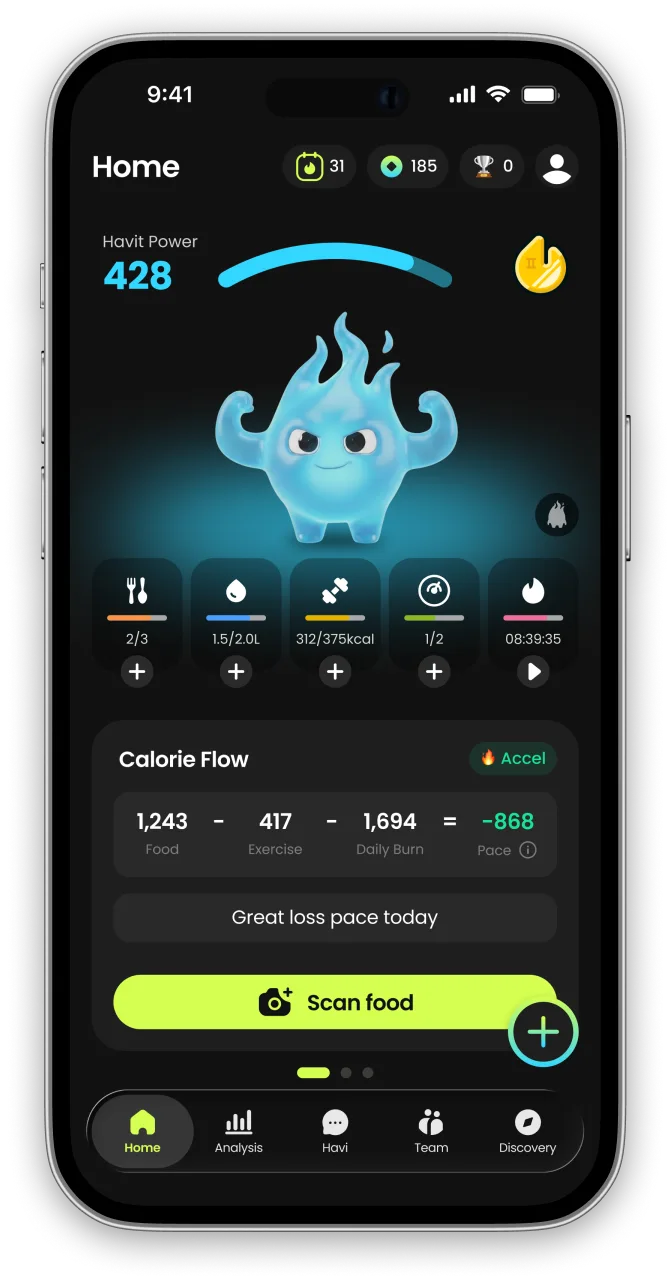
What is Havit?
Havit is an AI health companion for weight loss that protects muscle.
Unlike calorie-only trackers, Havit connects AI body-composition estimates, nutrition, hydration, sleep, steps, cycle, mood, and GLP-1 medication in one daily routine — so progress is measured by body composition, not just the number on the scale. Daily missions turn established behavior-change techniques into small repeatable actions, drawing on expertise from professionals formerly at Juvis Diet, one of Korea’s leading metabolic clinics.
In Havit’s own analysis of 1,090 GLP-1 users, people who logged consistently built stronger habits than the general user base. Read the GLP-1 Habit Report
Havit works with or without GLP-1 medication. It is a wellness app, not a medical device; body-composition results are estimates.

Continue in the App
Personalized wellness with your own data


References
- Hypnic Myoclonus: Neurophysiological Mechanisms and Clinical Correlates — Sleep Medicine, Vol. 112, 2024
- Sleep Onset Phenomena: Prevalence, Triggers, and Prevention Strategies — Journal of Sleep Research, Vol. 34, Issue 2, 2025
- Caffeine and Sleep Architecture: A Systematic Review of Dose-Response Relationships — Sleep Medicine Reviews, Vol. 78, 2024
- The Reticular Activating System and Sleep-Wake Transitions — Neuroscience & Biobehavioral Reviews, Vol. 156, 2024


