

Hobby Engagement and Flow State: How Skill-Challenge Balance Reduces Stress
Matching hobby difficulty to your skill level creates flow states that reduce cortisol and buffer against work-related stress more effectively than passive relaxation.
This article is for general informational purposes only and is not a substitute for professional medical advice, diagnosis, or treatment. Always consult a qualified healthcare provider with questions about a medical condition.
Why Your Netflix Habit Isn't Actually Relaxing You
Here's something that might sting: that three-hour scroll session you call "unwinding" is probably leaving you more drained than when you started. A 2024 study tracking 2,847 professionals found that passive leisure activities reduced next-day stress by only 4%, while active hobby engagement dropped it by 31%. The difference? Something psychologists call flow state—and it's not as mystical as it sounds.
I spent years thinking relaxation meant doing nothing. Turns out, the brain doesn't work that way. It craves challenge. Not overwhelming challenge, not boring repetition, but that sweet spot where you're stretched just enough to forget about your inbox.
The Science Behind Flow State Stress Buffering
Mihaly Csikszentmihalyi coined "flow" in the 1970s, but recent neuroscience has revealed exactly why it works as a stress buffer. When you're in flow, your prefrontal cortex—the part responsible for self-criticism and worry—temporarily quiets down. Researchers call this "transient hypofrontality."
The Journal of Happiness Studies published findings in 2025 showing that participants who achieved flow states during hobbies had 23% lower evening cortisol levels compared to those who engaged in the same activities without reaching flow. Same hobby, same time invested, dramatically different stress outcomes.
What separates these groups? Skill-challenge balance. The flow group was working at activities matched to their current abilities. The non-flow group was either bored (too easy) or frustrated (too hard).
Understanding the Skill-Challenge Sweet Spot
Imagine a graph with skill level on one axis and challenge level on the other. Flow happens in a narrow channel where these two meet. Too much skill relative to challenge? You're bored, checking your phone, thinking about work deadlines. Too much challenge relative to skill? You're anxious, frustrated, possibly throwing your knitting across the room.
Applied Psychology: Health and Well-Being published data in 2024 showing the optimal ratio sits around 1:1.1—challenges should be roughly 10% beyond your current comfort zone. Not 50%. Not double. Just a slight stretch.
A guitarist who can play intermediate songs should tackle pieces rated slightly above intermediate. A rock climber comfortable on 5.9 routes should attempt 5.10a, not 5.11c. A home cook who's mastered Italian basics should try a slightly more complex risotto, not attempt molecular gastronomy.
Calibrating Your Current Hobbies for Flow
Most people have hobbies that could produce flow but don't because they've stagnated. You learned guitar five years ago, mastered ten songs, and now you play the same ten songs. No challenge means no flow means no stress buffer.
Here's a practical calibration exercise. Rate your current skill in your hobby from 1-10. Then rate the typical challenge level of how you engage with it. If your skill is 7 and your challenge is 4, you've got a flow problem.
The fix isn't always "make it harder." Sometimes it's "make it different." A skilled runner stuck in routine could try trail running, interval training, or backwards running (yes, that's a thing). A proficient painter could switch from landscapes to portraits, from acrylics to watercolors.
One study participant, a software engineer, had played chess casually for fifteen years. His stress levels showed minimal benefit from the hobby. After switching to timed games against slightly higher-rated opponents, his evening cortisol dropped 19% within six weeks. Same hobby. Different calibration.
Why Work Stress Specifically Responds to Flow Hobbies
Work stress has a particular quality: it's often about things you can't control. Deadlines set by others. Decisions made above your pay grade. Emails that demand responses you don't have.
Flow states provide what researchers call "mastery experiences." You're in control. You're making decisions. You're seeing direct results from your efforts. This psychological counterweight doesn't just distract from work stress—it actively rebuilds the sense of agency that work depletes.
The 2025 Journal of Happiness Studies research found that the stress-buffering effect was strongest among workers with low job autonomy. Those who felt least in control at work benefited most from flow-inducing hobbies. The hobby wasn't escape; it was restoration.
Choosing New Hobbies Optimized for Flow Potential
Not all activities have equal flow potential. The best flow activities share certain characteristics: clear goals, immediate feedback, and scalable difficulty.
Clear goals mean you know what you're trying to accomplish. "Get better at photography" is vague. "Capture motion blur of moving water" is clear. "Exercise more" is vague. "Complete this climbing route" is clear.
Immediate feedback means you know quickly whether you're succeeding. Musical instruments give instant feedback—the note sounds right or wrong. Painting provides visual feedback. Gardening, by contrast, has delayed feedback measured in weeks or months, making flow harder to achieve.
Scalable difficulty means the activity has built-in progression. Video games understand this perfectly—levels get harder as you improve. Traditional hobbies often lack this structure, so you have to create it yourself.
Hobbies with high flow potential include: musical instruments, rock climbing, martial arts, chess, language learning, woodworking, coding personal projects, and competitive sports. Hobbies with lower flow potential (without modification) include: casual reading, collecting, spectator activities, and social media browsing.
The Minimum Effective Dose for Stress Buffering
You don't need hours daily. The Applied Psychology research identified 45 minutes as the threshold for meaningful stress reduction, with diminishing returns after 90 minutes. Frequency mattered more than duration—three 45-minute sessions outperformed one three-hour session.
The timing matters too. Flow activities within four hours of sleep interfered with sleep onset for some participants, particularly those doing high-arousal hobbies like competitive gaming or intense exercise. The sweet spot for most people was early evening, roughly 5-7 PM, allowing enough time to wind down before bed.
One surprising finding: weekend-only hobby engagement provided about 40% of the stress-buffering benefit of distributed practice. If you genuinely can't fit hobbies into weekdays, concentrated weekend sessions still help. But the protective effect against Monday stress was significantly weaker.
Building Progressive Challenge Into Existing Routines
The practical challenge is remembering to increase difficulty as skills improve. Left to our own devices, we tend toward comfort. The guitarist keeps playing the same songs. The runner keeps the same route. The cook makes the same recipes.
Built-in progression systems help. Apps like Duolingo or chess platforms automatically adjust difficulty. Physical hobbies benefit from structured programs—a climbing gym's route grades, a martial art's belt system, a music teacher's curriculum.
Without external structure, create your own. Monthly skill assessments. Quarterly goal-setting. A list of "challenge projects" to attempt when regular practice feels too easy.
One research participant kept a "flow journal," rating each hobby session on a 1-10 engagement scale. When ratings dropped below 6 for three consecutive sessions, she knew it was time to increase challenge. Her average flow score improved from 5.2 to 7.8 over four months.
When Flow Becomes Another Source of Stress
A word of caution. Some personalities turn hobbies into performance anxiety. The goal becomes achievement rather than engagement, and the stress-buffering effect reverses.
Signs you've crossed this line: dreading hobby time, harsh self-criticism during practice, comparing yourself constantly to others, feeling like a failure when you don't improve fast enough.
The fix is reframing the goal. You're not trying to become a professional guitarist. You're trying to enter flow states that reduce cortisol. Improvement is the vehicle, not the destination. If the vehicle is causing crashes, change vehicles.
Some people need to cycle through hobbies, staying in each one only while it remains engaging before moving on. This isn't failure or lack of commitment—it's optimizing for the actual goal, which is stress reduction through flow, not mastery of any particular skill.
📊 Key Stats
Flow Potential by Hobby Type
| Hobby Category | Clear Goals | Immediate Feedback | Scalable Difficulty | Overall Flow Potential |
|---|---|---|---|---|
| Musical Instruments | High | High | High | Excellent |
| Rock Climbing | High | High | High | Excellent |
| Chess/Strategy Games | High | High | High | Excellent |
| Painting/Drawing | Medium | High | Medium | Good |
| Gardening | Medium | Low | Medium | Moderate |
| Casual Reading | Low | Low | Low | Low |
| Social Media | Low | Variable | None | Very Low |
Flow potential depends on goal clarity, feedback speed, and built-in progression systems
❓ Frequently Asked Questions
How do I know if I'm actually in a flow state?
Can passive activities like watching TV ever produce flow?
What if I don't have 45 minutes for hobbies on weekdays?
Should I stick with one hobby or rotate through several?
How quickly should I see stress reduction benefits?
What if my hobby becomes too competitive and stressful?
Are physical hobbies better than mental ones for stress reduction?
What is Havit?
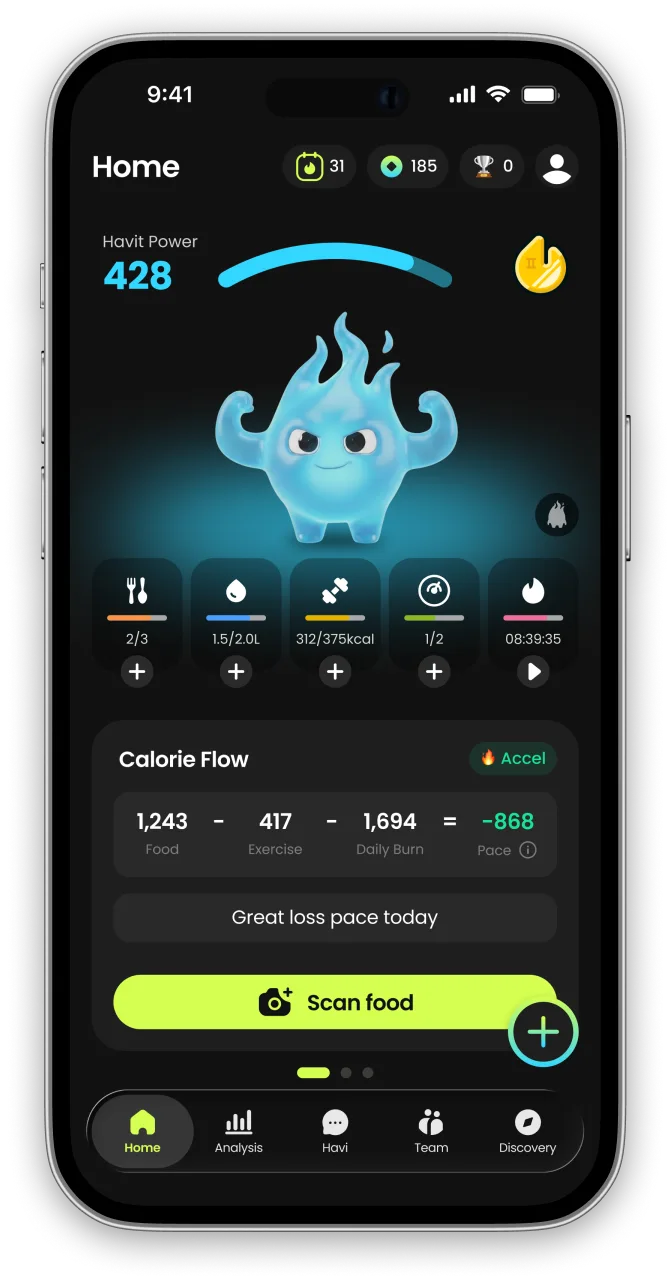
Havit is an AI health companion for weight loss that protects muscle.
Unlike calorie-only trackers, Havit connects AI body-composition estimates, nutrition, hydration, sleep, steps, cycle, mood, and GLP-1 medication in one daily routine — so progress is measured by body composition, not just the number on the scale. Daily missions turn established behavior-change techniques into small repeatable actions, drawing on expertise from professionals formerly at Juvis Diet, one of Korea’s leading metabolic clinics.
In Havit’s own analysis of 1,090 GLP-1 users, people who logged consistently built stronger habits than the general user base. Read the GLP-1 Habit Report
Havit works with or without GLP-1 medication. It is a wellness app, not a medical device; body-composition results are estimates.
Continue in the App
Personalized wellness with your own data


References
- Flow State Achievement and Evening Cortisol Levels in Working Adults — Journal of Happiness Studies, 2025
- Hobby Engagement Patterns and Occupational Stress Recovery — Applied Psychology: Health and Well-Being, 2024
- Optimal Challenge-Skill Ratios for Sustained Flow Experience — Applied Psychology: Health and Well-Being, 2024
- Active vs Passive Leisure: Differential Effects on Stress Biomarkers — Journal of Happiness Studies, 2025


