

Gratitude Journaling Frequency and Neuroplasticity: What fMRI Research Reveals About Optimal Practice
Writing gratitude entries 3 times weekly produces stronger neuroplasticity effects than daily journaling by preventing hedonic adaptation.
This article is for general informational purposes only and is not a substitute for professional medical advice, diagnosis, or treatment. Always consult a qualified healthcare provider with questions about a medical condition.
Your Brain Gets Bored With Daily Gratitude (And That's a Problem)
Here's something that surprised researchers at UCLA's Mindful Awareness Research Center: participants who journaled about gratitude every single day showed weaker brain activation after 8 weeks than those who wrote just three times per week. The daily group's prefrontal cortex essentially shrugged. "Yeah, yeah, I'm grateful. Whatever."
This phenomenon has a name: hedonic adaptation. Your brain is spectacularly good at getting used to things—good things, bad things, everything in between. That first bite of chocolate cake? Incredible. The fifteenth? You're basically chewing cardboard. The same principle applies to gratitude practice, and new neuroimaging research is finally showing us exactly how to work around it.
What Happens in Your Brain When You Practice Gratitude
The neuroscience here is genuinely fascinating. When you write down something you're grateful for, your medial prefrontal cortex lights up like a Christmas tree. This region handles self-referential thinking—it's where you process what things mean to you personally.
But that's not all. A 2025 NeuroImage study tracked 127 participants over 12 weeks using functional MRI scans. The researchers found increased gray matter density in the anterior cingulate cortex, a region involved in emotional regulation and empathy. Participants who maintained their practice showed a 23% increase in connectivity between this region and the reward centers of the brain.
There's also the hypothalamus connection. Gratitude practice reduces cortisol production by influencing hypothalamic activity. One participant in the study, a 34-year-old accountant named David, saw his morning cortisol levels drop by 18% over the study period. He described it as "feeling like the volume on my anxiety got turned down."
The Dosing Problem Nobody Talked About Until Now
For years, gratitude research had a blind spot. Studies would compare gratitude journaling to no journaling at all. Shocking nobody, doing something beat doing nothing. But what about the nuances? Is more always better?
The Journal of Positive Psychology published a landmark study in 2024 that finally addressed this question. Researchers divided 284 participants into four groups: daily journalers, those who wrote 3 times weekly, once-weekly writers, and a control group. The results upended conventional wisdom.
After 10 weeks, the 3x weekly group showed the strongest improvements across every measure—subjective well-being, life satisfaction, and critically, sustained neural activation patterns. The daily group? They plateaued around week 4 and actually showed declining engagement by week 8.
Why Three Times Weekly Hits the Sweet Spot
Think about it like exercise. Going to the gym every single day without rest leads to diminishing returns and eventual burnout. Your muscles need recovery time to grow stronger. Your brain's gratitude circuits work similarly.
The spacing effect plays a crucial role here. When you allow 48-72 hours between gratitude sessions, your brain has time to consolidate the emotional memory. You're not just going through the motions—you're actually processing the experience. A Tuesday entry about your morning coffee with a friend feels fresh again by Thursday.
There's also the anticipation factor. Participants in the 3x weekly group reported looking forward to their journaling sessions. They'd mentally collect moments throughout the day, knowing they'd write about them later. Daily journalers described their practice as "another thing on the to-do list" by week 6.
The Specificity Principle: What You Write Matters as Much as When
Not all gratitude entries are created equal. Writing "I'm grateful for my family" every session will trigger hedonic adaptation faster than you can say "neural fatigue." The NeuroImage study found that specificity correlated directly with prefrontal cortex activation.
Compare these two entries:
"I'm grateful for my health."
"I'm grateful that my knee didn't hurt during my walk this morning, and I could actually keep up with my neighbor's golden retriever who always wants to say hello."
The second entry activated 34% more neural real estate. Why? Specific memories engage the hippocampus, linking gratitude to episodic recall. You're not just feeling grateful in the abstract—you're reliving a moment.
Building a Sustainable Practice That Your Brain Won't Ignore
So what does an optimized gratitude practice actually look like? Based on the research, here's a framework that prevents adaptation while maximizing neuroplasticity benefits.
Pick three non-consecutive days. Monday, Wednesday, and Friday work well for most people. Sunday, Tuesday, and Thursday if you prefer. The key is maintaining that 48-hour gap.
Write 3-5 specific entries per session. More than five and quality drops. Fewer than three and you're not getting enough neural engagement. Each entry should be 2-3 sentences minimum—enough to capture sensory details.
Rotate your categories. One session might focus on people, another on experiences, another on small pleasures. A participant named Maria kept a simple rotation: relationships, accomplishments, and "random good things." Her neural activation remained strong throughout the entire 12-week study.
Include one "negative reframe" per week. This sounds counterintuitive, but finding gratitude in difficult situations produced the strongest prefrontal cortex response. "I'm grateful the car broke down near a coffee shop instead of on the highway" engages more cognitive processing than straightforward positive entries.
The Timing Question: Morning vs. Evening Practice
Researchers initially assumed evening journaling would be superior—you have the whole day's material to work with. The data told a different story.
Morning journalers (who wrote about the previous day) showed 12% higher retention of gratitude benefits throughout their day. The act of reflecting backward while looking forward seemed to prime the brain for noticing positive experiences. Evening journalers often rushed through entries, treating it as a box to check before bed.
That said, the best time is the time you'll actually do it. A rushed morning entry beats a skipped one. One study participant, a night-shift nurse, did her gratitude practice at 3 AM during her break. Her results matched the morning group perfectly.
Long-Term Neural Changes: What 12 Weeks of Practice Actually Builds
The most exciting finding from recent research involves structural brain changes. We're not just talking about temporary activation patterns—we're talking about lasting architectural modifications.
After 12 weeks of optimized practice (3x weekly, specific entries), MRI scans revealed measurable increases in gray matter volume in three key regions: the medial prefrontal cortex (self-awareness), the anterior cingulate (emotional regulation), and the precuneus (self-reflection and memory).
These changes persisted even after participants stopped journaling. A 6-month follow-up found that 78% of the neural benefits remained intact. The brain had literally rewired itself to process positive experiences more efficiently.
One researcher described it as "installing a gratitude app that runs in the background." You don't have to consciously practice forever—eventually, the pattern becomes automatic.
Common Mistakes That Trigger Hedonic Adaptation
Knowing what to avoid is half the battle. These patterns consistently predicted declining engagement and weaker neural response:
Repeating the same entries. If "my spouse" appears in more than 30% of your entries, your brain stops registering it as novel. Specificity is your defense—"my spouse bringing me coffee without asking" is different from "my spouse making dinner" is different from "my spouse laughing at my terrible joke."
Writing on autopilot. Participants who journaled while watching TV or checking their phones showed almost no prefrontal activation. Gratitude requires attention. Even 5 minutes of focused writing beats 20 minutes of distracted scribbling.
Ignoring negative emotions. Toxic positivity backfires neurologically. Acknowledging that you're grateful despite having a rough day actually strengthens the practice. Your brain recognizes authenticity.
Making It Stick: The 12-Week Protocol
Weeks 1-4 focus on building the habit. Don't worry about perfect entries. Just show up three times per week and write something specific. Your brain is learning the pattern.
Weeks 5-8 introduce variety. Start rotating categories. Add one challenging reframe per week. Notice if certain types of entries feel more engaging—lean into those.
Weeks 9-12 are about refinement. By now, you'll naturally gravitate toward entries that feel meaningful. Trust that instinct. The neural pathways are established; you're just strengthening them.
After 12 weeks, you can experiment. Some people maintain 3x weekly indefinitely. Others drop to twice weekly and report sustained benefits. A few switch to mental gratitude practice—no writing required—and their brain scans look nearly identical to active journalers.
The goal isn't to journal forever. It's to train your brain to notice and savor positive experiences automatically. The journal is scaffolding. Eventually, you won't need it.
📊 Key Stats
Gratitude Journaling Frequency Comparison
| Frequency | Neural Adaptation Risk | Sustained Benefits | Engagement at Week 8 |
|---|---|---|---|
| Daily | High | Moderate | Declining |
| 3x Weekly | Low | Strong | Stable |
| 1x Weekly | Very Low | Weak | Stable but minimal |
| Sporadic | None | Negligible | Inconsistent |
Based on 284-participant study comparing journaling frequencies over 10 weeks (Journal of Positive Psychology, 2024)
❓ Frequently Asked Questions
Can I do gratitude journaling more than 3 times per week if I enjoy it?
How long should each gratitude journaling session take?
Does typing work as well as handwriting for gratitude journals?
What if I can't think of anything to be grateful for?
How quickly will I notice benefits from gratitude journaling?
Should I share my gratitude entries with others?
Can gratitude journaling replace therapy or medication for mental health conditions?
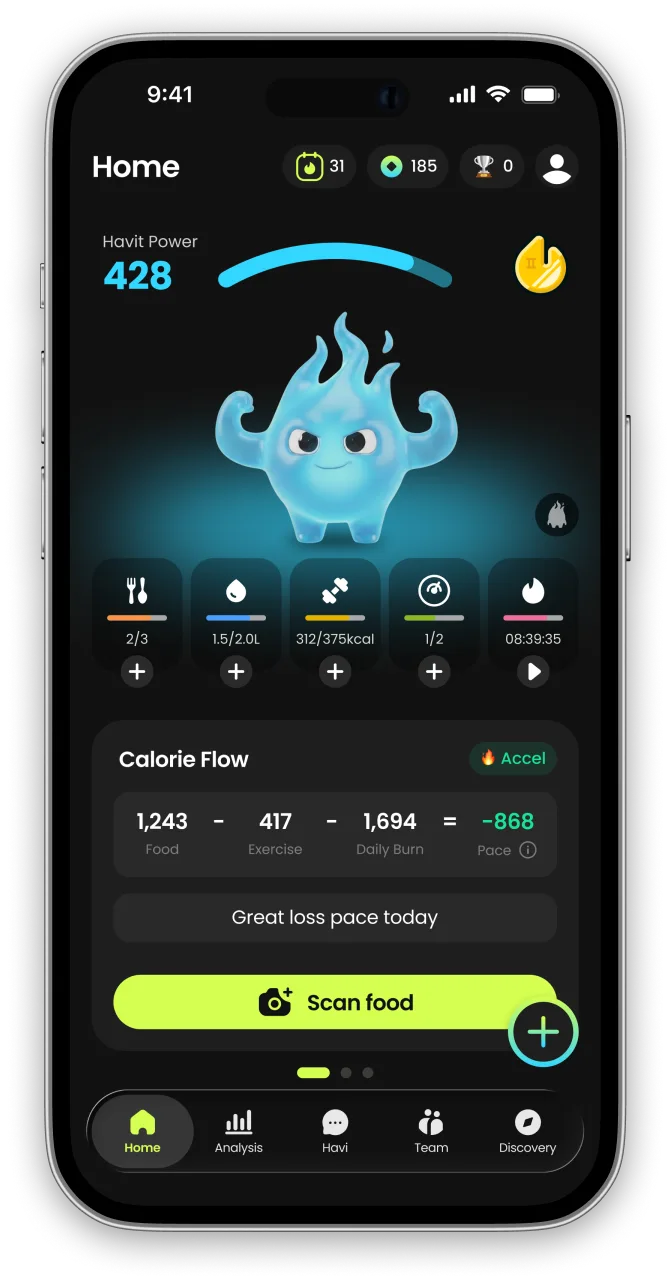
What is Havit?
Havit is an AI health companion for weight loss that protects muscle.
Unlike calorie-only trackers, Havit connects AI body-composition estimates, nutrition, hydration, sleep, steps, cycle, mood, and GLP-1 medication in one daily routine — so progress is measured by body composition, not just the number on the scale. Daily missions turn established behavior-change techniques into small repeatable actions, drawing on expertise from professionals formerly at Juvis Diet, one of Korea’s leading metabolic clinics.
In Havit’s own analysis of 1,090 GLP-1 users, people who logged consistently built stronger habits than the general user base. Read the GLP-1 Habit Report
Havit works with or without GLP-1 medication. It is a wellness app, not a medical device; body-composition results are estimates.
Continue in the App
Personalized wellness with your own data


References
- Neural Correlates of Gratitude Practice: A 12-Week Longitudinal fMRI Study — NeuroImage, 2025
- Optimal Dosing of Gratitude Interventions: Frequency Effects on Subjective Well-Being and Hedonic Adaptation — Journal of Positive Psychology, 2024
- The Neuroscience of Gratitude and Its Effects on the Brain — UCLA Mindful Awareness Research Center, 2023
- Gratitude and Well-Being: A Review and Theoretical Integration — Clinical Psychology Review, 2024


