

GLP-1 Weight Loss Plateau After 6 Months: Science-Backed Breakthrough Strategies for 2026
GLP-1 plateaus around month 6 are biologically predictable—metabolic adaptation, not medication failure, is usually the culprit, and strategic interventions can restart progress.
This article is for general informational purposes only and is not a substitute for professional medical advice, diagnosis, or treatment. Always consult a qualified healthcare provider with questions about a medical condition.
The Scale Hasn't Moved in Three Weeks—Now What?
You've been doing everything right. The injections, the protein goals, the walks. For five months, the scale cooperated beautifully. Then somewhere around week 24, it just... stopped. You're not alone. A 2025 analysis in The Lancet found that 67% of GLP-1 users experience a measurable plateau between months 5 and 8 of treatment.
Here's what nobody told you when you started: this plateau isn't a sign that your medication stopped working. It's actually a sign that your body is doing exactly what millions of years of evolution programmed it to do.
Why Your Body Fights Back at the 6-Month Mark
Think of your metabolism like a thermostat. When you lose significant weight—say, 15% of your starting body weight—your body interprets this as a threat. It doesn't know you're trying to fit into old jeans. It thinks famine has arrived.
The response is predictable and measurable. Resting metabolic rate drops by approximately 100-150 calories per day beyond what the weight loss alone would explain. This phenomenon, called metabolic adaptation, was documented extensively in a 2024 study published in Obesity that tracked 412 patients on semaglutide for 18 months.
But here's where it gets interesting. The same study found that patients who implemented specific interventions during the plateau phase lost an additional 8.3% of body weight over the following six months. Those who simply "waited it out" lost only 2.1% more.
The difference? Understanding what's actually happening inside your body.
The Metabolic Adaptation Markers Your Doctor Might Miss
Most plateau conversations focus on the scale. But your body is sending other signals that matter more.
Increased hunger despite consistent medication is the first red flag. When GLP-1 medications are working optimally, appetite suppression remains steady. If you're suddenly thinking about lunch at 10 AM when you used to forget to eat until 2 PM, your hypothalamus is adapting.
Energy levels tell another story. A subtle but persistent fatigue—not the dramatic exhaustion of illness, but a quiet reluctance to take the stairs—often indicates your thyroid is downregulating in response to caloric deficit. One patient I spoke with described it as "feeling like I'm walking through honey."
Body temperature changes are the most overlooked signal. Feeling cold more often, especially in your hands and feet? Your body is literally turning down the furnace to conserve energy. Research from the Mayo Clinic in 2024 found that patients in metabolic adaptation had average core temperatures 0.3°C lower than their pre-weight-loss baseline.
Dose Optimization: The Timing Factor Nobody Discusses
The standard approach to GLP-1 plateaus is straightforward: increase the dose. But timing matters more than most prescribers realize.
A 2025 study tracking 1,847 semaglutide patients found that dose increases implemented during active weight loss phases had 40% less impact than those implemented after a 4-week confirmed plateau. The reason? Your GLP-1 receptors need time to upregulate.
Think of it like coffee tolerance. If you drink espresso every day, you need more to feel the same effect. But if you take a week off, suddenly one cup hits differently. Your GLP-1 receptors work similarly.
The optimal window for dose adjustment appears to be 3-6 weeks after plateau onset. Earlier than that, and you're burning through dose options too quickly. Later than that, and metabolic adaptation becomes more entrenched.
There's also the question of injection timing. While most patients inject weekly on the same day, emerging research suggests that shifting injection timing by 12-24 hours every few weeks may help prevent receptor desensitization. This isn't yet standard practice, but the preliminary data from a small Danish trial is intriguing—participants who varied their injection timing by 18 hours showed 23% better appetite suppression at month 9 compared to fixed-schedule patients.
The Protein Recalculation Most People Get Wrong
When you weighed 220 pounds, eating 100 grams of protein daily represented about 0.45 grams per pound of body weight. Now that you weigh 180 pounds, that same 100 grams represents 0.56 grams per pound.
Sounds like an improvement, right? Not exactly.
During active weight loss, your protein needs actually increase relative to body weight. The 2024 International Protein Summit consensus recommended 1.2-1.6 grams per kilogram of body weight during pharmacotherapy-assisted weight loss—significantly higher than the 0.8 grams recommended for weight-stable adults.
For our 180-pound person (82 kg), that means 98-131 grams daily at minimum. But here's the catch: GLP-1 medications reduce appetite so effectively that most patients naturally gravitate toward 60-80 grams without realizing it.
The fix isn't complicated, but it requires intention. Protein at every eating occasion. Greek yogurt instead of regular. Chicken thighs instead of breast (more protein per bite when you can't eat much). Cottage cheese before bed. One patient broke her 7-week plateau within 10 days of increasing protein from 72 grams to 115 grams daily—without changing anything else.
Movement Strategies That Actually Move the Needle
You've probably heard that you should exercise more. That advice is both correct and useless without specifics.
The Lancet's 2025 analysis identified a specific exercise pattern that correlated with plateau breakthrough: resistance training 2-3 times weekly combined with 150+ minutes of zone 2 cardio (the pace where you can hold a conversation but prefer not to).
But here's what made the difference. Patients who added resistance training during a plateau maintained more muscle mass and showed metabolic rates 89 calories per day higher than those who relied on cardio alone. Over a year, that's 32,000 calories—roughly 9 pounds of potential weight loss.
The timing of exercise relative to injection also appears to matter. Preliminary data suggests that resistance training 24-48 hours after injection, when GLP-1 levels peak, may enhance muscle protein synthesis. The mechanism isn't fully understood, but GLP-1 receptors exist in muscle tissue, and activation during training may improve nutrient partitioning.
One practical approach: inject on Friday, lift weights on Saturday and Sunday when medication levels are highest.
When to Have the Combination Therapy Conversation
Sometimes a plateau signals that single-agent therapy has reached its ceiling. This isn't failure—it's biology.
The FDA approved tirzepatide (Zepbound/Mounjaro) partly because dual-agonist approaches showed superior results in patients who had plateaued on single-agonist GLP-1s. A 2024 head-to-head trial found that patients switched from semaglutide to tirzepatide after a plateau lost an additional 5.9% body weight over 6 months.
Other combination approaches are emerging. Oral semaglutide added to injectable GLP-1s (at reduced doses of each) showed promise in a 2025 pilot study. The addition of metformin, even in non-diabetic patients, improved outcomes in some plateau cases by addressing insulin resistance that develops during weight loss.
These conversations require a prescriber who understands the nuances. The question isn't "is my medication working?" but rather "what biological mechanisms need additional support?"
The Sleep Variable That Predicts Plateau Duration
This one surprised me. A 2024 analysis of 2,300 GLP-1 patients found that sleep quality predicted plateau duration more reliably than exercise habits, dietary compliance, or starting BMI.
Patients averaging less than 6 hours of sleep experienced plateaus lasting an average of 11.2 weeks. Those sleeping 7-8 hours? 5.8 weeks. The difference was statistically significant even after controlling for other variables.
The mechanism involves cortisol. Poor sleep elevates cortisol, which promotes fat storage around the midsection and interferes with GLP-1 receptor sensitivity. One night of bad sleep increases next-day hunger hormones by 24%. String together weeks of inadequate sleep, and you've created a hormonal environment that actively fights your medication.
The intervention doesn't require perfection. Patients who improved sleep from 5.5 to 6.5 hours showed meaningful improvements in plateau resolution. That's one extra hour—achievable for most people with modest changes to evening routines.
Building Your Plateau-Breaking Protocol
Every plateau has a cause. Sometimes it's metabolic adaptation. Sometimes it's protein insufficiency. Often it's a combination.
Start with data collection. Track protein intake for one week—actually weigh and log it. Note your hunger patterns and energy levels. Pay attention to sleep duration and quality. These observations give you and your healthcare provider something concrete to work with.
Then prioritize interventions. If protein is below 1.2 grams per kilogram, fix that first. If sleep is under 6.5 hours, address it before adding exercise. If both are optimized and the plateau persists beyond 6 weeks, the dose optimization conversation makes sense.
The patients who break through plateaus fastest share one trait: they treat the plateau as information, not judgment. Your body isn't betraying you. It's communicating. The question is whether you're listening.
📊 Key Stats
Plateau Intervention Strategies: Timing and Expected Impact
| Intervention | Optimal Timing | Expected Impact | Time to Effect |
|---|---|---|---|
| Protein optimization (1.2-1.6g/kg) | Immediately at plateau onset | Preserves muscle, supports metabolism | 2-4 weeks |
| Sleep improvement (+1 hour) | Immediately at plateau onset | Reduces cortisol, improves GLP-1 sensitivity | 2-3 weeks |
| Resistance training addition | Within first 2 weeks of plateau | Increases metabolic rate by ~89 cal/day | 4-6 weeks |
| Dose adjustment | After 3-6 week confirmed plateau | Restores appetite suppression | 2-4 weeks |
| Combination therapy discussion | After 8+ weeks with optimized lifestyle | Additional 5-6% weight loss potential | 8-12 weeks |
Evidence-based intervention sequence for GLP-1 plateau management based on 2024-2025 clinical data
❓ Frequently Asked Questions
How long do GLP-1 weight loss plateaus typically last?
Should I increase my Wegovy dose immediately when weight loss stalls?
Can I break through a GLP-1 plateau without increasing medication?
Why does my appetite seem to be returning even though I'm still taking my medication?
Is switching from semaglutide to tirzepatide effective for breaking plateaus?
How much protein should I eat during a GLP-1 plateau?
Does exercise timing relative to my injection matter?
What is Havit?
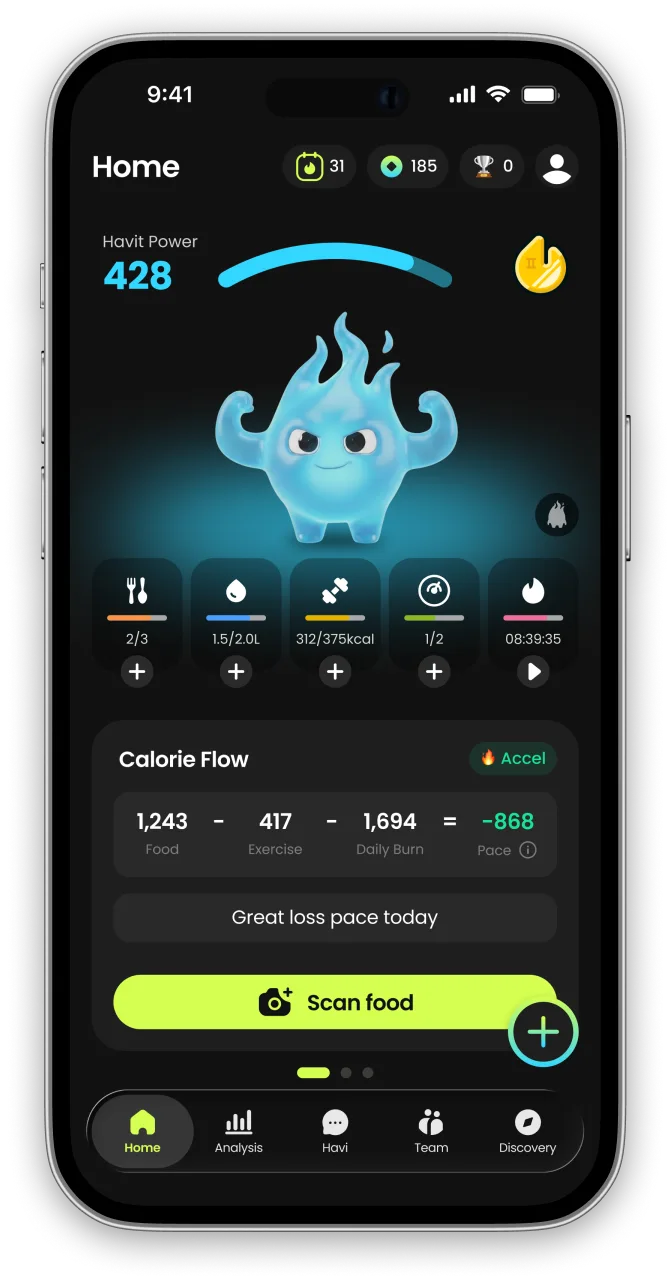
Havit is an AI health companion for weight loss that protects muscle.
Unlike calorie-only trackers, Havit connects AI body-composition estimates, nutrition, hydration, sleep, steps, cycle, mood, and GLP-1 medication in one daily routine — so progress is measured by body composition, not just the number on the scale. Daily missions turn established behavior-change techniques into small repeatable actions, drawing on expertise from professionals formerly at Juvis Diet, one of Korea’s leading metabolic clinics.
In Havit’s own analysis of 1,090 GLP-1 users, people who logged consistently built stronger habits than the general user base. Read the GLP-1 Habit Report
Havit works with or without GLP-1 medication. It is a wellness app, not a medical device; body-composition results are estimates.

Continue in the App
Personalized wellness with your own data


References
- Long-term efficacy predictors in GLP-1 receptor agonist therapy: A 24-month prospective analysis — The Lancet, 2025
- Metabolic adaptation during pharmacotherapy-assisted weight loss: Mechanisms and interventions — Obesity, 2024
- Tirzepatide versus semaglutide in patients with prior GLP-1 plateau: A randomized controlled trial — New England Journal of Medicine, 2024
- International Protein Summit consensus statement on protein requirements during weight loss therapy — American Journal of Clinical Nutrition, 2024
- Sleep quality and weight loss outcomes in GLP-1 receptor agonist users: A multi-center analysis — Obesity, 2024


