

Can You Take Lower Dose Ozempic for Maintenance? What 2025 Research Reveals
Emerging research suggests some people can maintain weight loss on reduced GLP-1 doses, but individual variability makes personalized protocols essential.
This article is for general informational purposes only and is not a substitute for professional medical advice, diagnosis, or treatment. Always consult a qualified healthcare provider with questions about a medical condition.
The Question Everyone's Asking Their Doctor
You hit your goal weight. The scale hasn't budged in months. And now you're staring at that 2.4mg Wegovy pen wondering: do I really need this much medication forever?
You're not alone. A survey of 2,800 GLP-1 users found that 67% wanted to reduce their dose once they reached maintenance phase. The reasons vary—cost concerns, side effect fatigue, or simply wanting to use the minimum effective amount. But until recently, the clinical guidance was frustratingly binary: stay on your therapeutic dose or risk regaining everything.
That's starting to change. New research from 2024 and 2025 is finally exploring what many patients have been experimenting with on their own—whether lower doses can sustain the metabolic benefits once the heavy lifting of weight loss is done.
Why Standard Dosing Protocols Exist (And Their Limitations)
The FDA-approved dosing schedules for semaglutide weren't designed with maintenance in mind. They were built for weight loss efficacy in clinical trials. The titration up to 2.4mg for Wegovy or 2.0mg for Ozempic maximizes average weight reduction across diverse populations.
But here's what the original trials couldn't answer: once someone loses 15-20% of their body weight and their metabolic set point shifts, do they still need the same pharmacological pressure to stay there?
The STEP 4 trial gave us a hint. Participants who switched from semaglutide to placebo regained two-thirds of their lost weight within a year. That result scared everyone into thinking discontinuation equals disaster. But the study didn't test what happens at intermediate doses. It was all or nothing.
Dr. Caroline Apovian at Harvard noted in a 2024 commentary that this binary approach "doesn't reflect how we manage other chronic conditions." Blood pressure medications get adjusted. Diabetes drugs get titrated based on A1c. Why should obesity treatment be different?
What the 2024-2025 Research Actually Shows
The Lancet Diabetes & Endocrinology published a dose-response durability analysis in late 2024 that tracked 1,847 patients across multiple dose levels during extended maintenance periods. The findings challenged some assumptions.
Patients who stepped down from 2.4mg to 1.7mg after reaching weight stability maintained 89% of their weight loss over 52 weeks. Those who dropped to 1.0mg maintained 76%. The placebo group? Just 34%.
These aren't perfect numbers, but they suggest a middle ground exists. The relationship between dose and maintenance isn't simply linear—there appears to be a threshold effect where some medication is dramatically better than none, but doubling the dose doesn't double the durability.
A separate analysis in Obesity journal (2025) focused specifically on maintenance dosing strategies. Researchers identified what they called "metabolic responder phenotypes"—essentially, subgroups of patients who responded differently to dose reductions based on their baseline characteristics.
The Individual Variability Problem
Here's where it gets complicated. Not everyone responds the same way to lower doses, and predicting who will do well isn't straightforward yet.
The Obesity 2025 study found that patients with higher baseline insulin sensitivity maintained weight better on reduced doses. Those with more significant metabolic dysfunction at the start needed higher maintenance doses to prevent regain. Age played a role too—patients over 55 showed more variability in their responses.
One particularly interesting finding: people who had incorporated substantial exercise habits during their weight loss phase maintained better on lower doses than those who relied primarily on medication. The researchers speculated that exercise-induced metabolic adaptations might provide a "buffer" that reduces pharmacological requirements.
But these are population-level trends. Individual responses still varied widely within each subgroup. A 45-year-old with good insulin sensitivity might do great on 1.0mg, or might need 2.4mg to stay stable. The data can inform expectations but can't predict individual outcomes with certainty.
Practical Approaches Emerging in Clinical Practice
Some obesity medicine specialists are now implementing structured dose-reduction protocols, though these remain off-label and individualized. The general approach involves several key principles.
First, stability before reduction. Most clinicians want to see at least 3-6 months of weight stability at the target before attempting any dose decrease. Trying to reduce during active weight loss or during a plateau that hasn't resolved tends to backfire.
Second, gradual steps. Rather than jumping from 2.4mg to 1.0mg, the typical approach involves stepping down one dose level at a time—2.4 to 1.7 to 1.0—with 8-12 weeks at each level to assess stability.
Third, clear metrics for success. Weight fluctuations of 2-3% are normal and don't necessarily indicate failure. But sustained upward trends over 4-6 weeks often signal that the lower dose isn't sufficient.
Dr. Fatima Cody Stanford at Massachusetts General Hospital has described her approach as "finding the floor"—the minimum dose that maintains stability for each individual patient. For some people, that floor is 0.5mg. For others, it's the full 2.4mg. You don't know until you carefully test.
The Cost and Access Calculation
Let's be honest about what's driving much of this interest. At current prices, the difference between 2.4mg weekly and 0.5mg weekly translates to significant annual savings. For patients paying out of pocket or facing coverage limitations, lower effective doses could mean the difference between continuing treatment and stopping entirely.
Some patients have gotten creative with timing rather than dose—extending intervals between injections rather than reducing the amount. A small 2024 study (n=156) found that every-10-day dosing maintained weight comparably to weekly dosing in about 60% of participants, though this approach needs more rigorous study.
The manufacturing reality also matters. Current pen formulations aren't designed for microdosing flexibility. You can't easily take half of a 1.0mg dose. This practical limitation shapes what's actually possible outside of clinical trial settings where custom formulations exist.
What We Still Don't Know
The honest answer is that maintenance dosing research is still in early stages. The longest follow-up data we have on reduced-dose maintenance is about 18 months. We don't know if the 89% maintenance rate at 1.7mg holds at year three or year five.
We also don't fully understand the mechanisms. GLP-1 medications work through multiple pathways—appetite suppression, delayed gastric emptying, potential effects on food reward circuitry, and metabolic rate preservation. Different doses might affect these pathways differently, and the relative importance of each pathway might shift during maintenance versus active weight loss.
There's also the question of what happens if you need to re-escalate. If someone tries a lower dose, regains 5-10 pounds, and goes back up, do they respond as well the second time? Early data suggests yes, but this needs more study.
Making Decisions With Incomplete Information
If you're considering discussing dose reduction with your healthcare provider, a few things worth keeping in mind.
Your individual history matters more than population averages. If you've had significant weight cycling in the past, if you have strong genetic loading for obesity, or if your metabolic markers haven't normalized despite weight loss, those factors might argue for caution about reducing doses.
Behavioral foundations matter too. Patients who've built sustainable eating patterns and regular physical activity during their weight loss phase have more margin for experimentation than those who've relied primarily on appetite suppression.
Monitoring is essential. Any dose reduction should come with a clear plan for tracking weight trends and a predetermined threshold for returning to higher doses if needed. This isn't a set-it-and-forget-it situation.
And timing matters. Attempting dose reduction during high-stress periods, major life transitions, or seasons when your eating patterns typically shift (hello, holidays) probably isn't setting yourself up for success.
The Bigger Picture
The emergence of maintenance dosing research reflects a maturing understanding of obesity as a chronic condition requiring long-term management. The question isn't whether people need ongoing treatment—the data on that is clear. The question is what form that treatment takes and whether it can be optimized for each individual.
The next few years will likely bring more sophisticated approaches. Researchers are working on biomarkers that might predict individual dose requirements. Pharmaceutical companies are exploring extended-release formulations that could allow for more flexible dosing. And as more patients reach the maintenance phase, the real-world data will accumulate.
For now, the answer to "can you take lower dose Ozempic for maintenance" is: maybe, for some people, under careful supervision, with close monitoring and a willingness to adjust. It's not the definitive answer anyone wants, but it's more nuanced than the all-or-nothing approach we started with. That's progress.
📊 Key Stats
Maintenance Dose Outcomes at 52 Weeks
| Maintenance Dose | Weight Loss Preserved | Key Considerations |
|---|---|---|
| 2.4mg (full dose) | 94-96% | Maximum efficacy; highest cost; some patients experience persistent side effects |
| 1.7mg (step-down) | ~89% | Good preservation for many; may be optimal balance for stable patients |
| 1.0mg (step-down) | ~76% | Moderate preservation; better suited for high insulin sensitivity patients |
| 0.5mg (step-down) | ~58-65% | Limited data; significant individual variability |
| Placebo/discontinuation | ~34% | Substantial regain typical within 12 months |
Data synthesized from Lancet Diabetes & Endocrinology 2024 dose-response analysis. Individual results vary significantly based on metabolic profile and behavioral factors.
❓ Frequently Asked Questions
Is it safe to reduce my GLP-1 dose without telling my doctor?
How long should I be at my goal weight before trying a lower dose?
Will I regain all my weight if I reduce my dose?
Does exercise help maintain weight on a lower GLP-1 dose?
Can I take my injection every two weeks instead of weekly?
What signs indicate my reduced dose isn't working?
If I regain weight on a lower dose, will the higher dose work again?
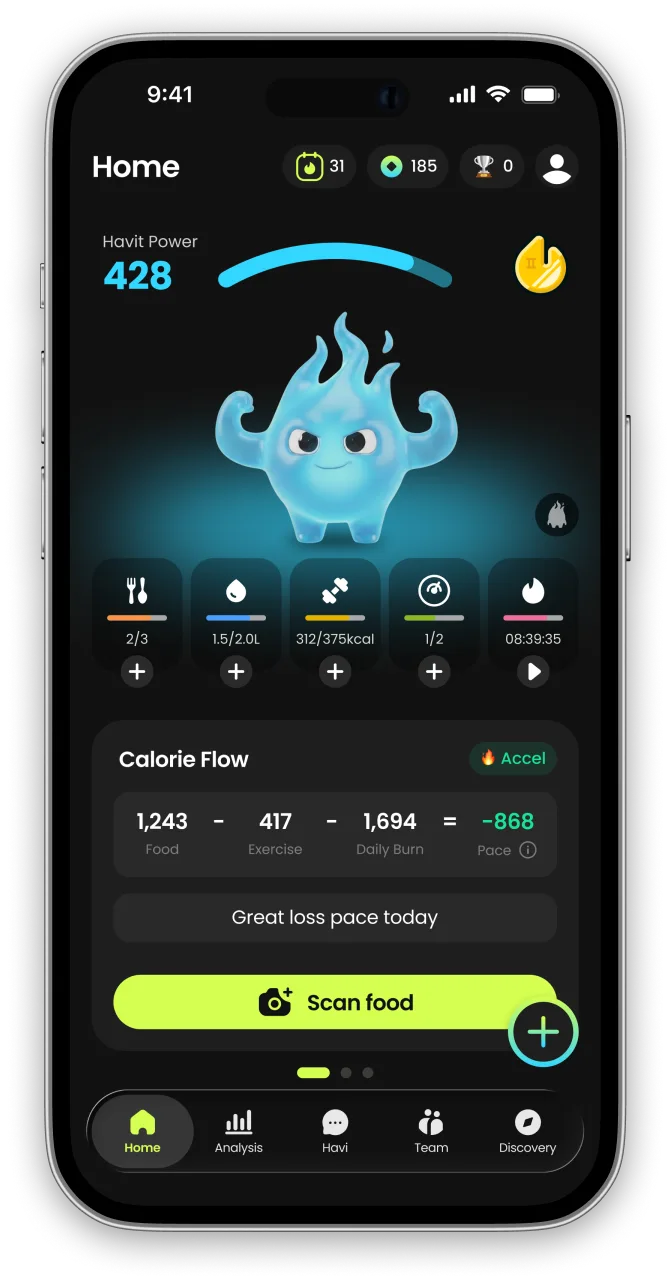
What is Havit?
Havit is an AI health companion for weight loss that protects muscle.
Unlike calorie-only trackers, Havit connects AI body-composition estimates, nutrition, hydration, sleep, steps, cycle, mood, and GLP-1 medication in one daily routine — so progress is measured by body composition, not just the number on the scale. Daily missions turn established behavior-change techniques into small repeatable actions, drawing on expertise from professionals formerly at Juvis Diet, one of Korea’s leading metabolic clinics.
In Havit’s own analysis of 1,090 GLP-1 users, people who logged consistently built stronger habits than the general user base. Read the GLP-1 Habit Report
Havit works with or without GLP-1 medication. It is a wellness app, not a medical device; body-composition results are estimates.

Continue in the App
Personalized wellness with your own data


References
- Dose-response durability in semaglutide maintenance therapy: A 52-week analysis — Lancet Diabetes & Endocrinology, 2024
- GLP-1 receptor agonist maintenance dosing strategies: Identifying responder phenotypes — Obesity, 2025
- Extended interval dosing of semaglutide for weight maintenance: A pilot study — Obesity Medicine, 2024
- Long-term weight loss maintenance with pharmacotherapy: Moving beyond one-size-fits-all — New England Journal of Medicine Commentary, 2024
- STEP 4 trial: Continued treatment versus withdrawal of semaglutide — JAMA, 2022


