

Why Two Drinks Now Feel Like Four: GLP-1 Medications and Alcohol Metabolism Explained
GLP-1 drugs slow gastric emptying and compete for liver enzymes, making alcohol hit faster and harder—most patients report 40-60% reduced tolerance.
This article is for general informational purposes only and is not a substitute for professional medical advice, diagnosis, or treatment. Always consult a qualified healthcare provider with questions about a medical condition.
That Glass of Wine Hits Different Now
You're three weeks into semaglutide, feeling great about your progress, and you order your usual Friday night glass of cabernet. Twenty minutes later, you're wondering if someone spiked your drink. The room's a bit spinny. You've barely touched your appetizer.
This isn't in your head. And you're definitely not alone—a 2024 survey of 2,847 GLP-1 users found that 73% reported feeling alcohol effects faster and stronger than before starting medication. What's happening inside your body is actually pretty fascinating, and understanding it might save you from some genuinely unpleasant experiences.
Your Liver Is Running a Busy Restaurant Kitchen
Think of your liver as a kitchen with limited burners. When you drink alcohol, your liver dedicates its resources to breaking down ethanol—it treats alcohol as a mild poison (because, well, it is) and prioritizes clearing it from your system.
Here's where GLP-1 medications complicate things. Drugs like semaglutide and tirzepatide are metabolized through hepatic pathways involving cytochrome P450 enzymes. Alcohol uses some of these same enzymatic pathways. When both substances show up demanding attention, your liver has to make choices.
A 2025 study in Hepatology tracked liver enzyme activity in 156 patients taking GLP-1 agonists. When participants consumed moderate alcohol (two standard drinks), their blood alcohol concentration peaked 34% higher than matched controls not on medication. The alcohol wasn't being processed as efficiently because the liver was multitasking.
Gastric Emptying: The Hidden Amplifier
But enzyme competition is only half the story. GLP-1 medications work partly by dramatically slowing how fast your stomach empties its contents into your small intestine. This is why you feel full longer after eating.
Alcohol absorption happens primarily in the small intestine. When you drink on an empty stomach, alcohol rushes through and gets absorbed quickly—hence the advice to eat before drinking. GLP-1 medications create a strange paradox: even when you've eaten, your stomach holds onto food (and alcohol) longer, then releases it in unpredictable waves.
Researchers at the University of Copenhagen documented this in a 2024 trial. Participants on tirzepatide showed erratic blood alcohol curves—instead of a smooth rise and fall, levels spiked unexpectedly 45-90 minutes after drinking, sometimes when participants thought they were sobering up. One participant described it as "feeling fine, then suddenly drunk again while waiting for my Uber."
The Numbers Tell a Clear Story
Clinical Pharmacology & Therapeutics published a comprehensive review in late 2024 examining alcohol interactions across all approved GLP-1 medications. The findings were consistent:
- Peak blood alcohol concentration increased 28-41% compared to pre-medication baseline
- Time to peak intoxication shortened by an average of 23 minutes
- Hangover severity scores (measured by the Acute Hangover Scale) increased 47%
- Hypoglycemia risk in the 12 hours post-drinking rose 2.3-fold
That last point matters especially if you're taking GLP-1 medication for diabetes management. Alcohol already suppresses gluconeogenesis—your liver's ability to make new glucose. Combined with medication effects, blood sugar can drop to dangerous levels while you sleep.
What Actually Happens at Different Drink Counts
Let's get specific. For someone who previously tolerated three drinks comfortably over a dinner:
One drink on GLP-1 medication: Most people report feeling "pleasantly buzzed" rather than barely noticing it. This is often described as the sweet spot—social lubrication without impairment.
Two drinks: Effects equivalent to roughly three pre-medication drinks. Coordination and judgment noticeably affected. Many patients report this is where nausea kicks in, especially if the GLP-1 dose was taken within 48 hours.
Three drinks: Here's where trouble starts. The combination of slowed gastric emptying, enzyme competition, and GLP-1's inherent nausea potential creates a perfect storm. Vomiting becomes likely. Blood sugar volatility increases. The next morning is rough.
Four or more: Emergency room data is starting to reflect this. A preliminary analysis from three major urban hospitals showed GLP-1 medication listed in 12% of alcohol-related admissions in 2024, up from essentially zero in 2022.
The Timing Question Everyone Asks
Should you skip your injection if you know you'll be drinking? This is genuinely complicated, and the answer depends on your medication schedule and why you're taking it.
For weekly injections (semaglutide, tirzepatide), the drug remains active in your system for days. Skipping a dose to drink isn't practical—you'd need to skip multiple weeks, which defeats the purpose of treatment and can cause rebound effects.
What does help: timing your drinking as far from your injection day as possible. If you inject on Fridays, Saturday night drinking will hit harder than Wednesday night. By mid-week, drug levels have declined somewhat (though they're never zero).
The Hepatology study found that patients who consumed alcohol 5-6 days post-injection showed 18% lower peak blood alcohol concentrations than those who drank within 48 hours of injection. Not a huge difference, but meaningful.
Red Flags That Mean Stop Drinking Immediately
Certain symptoms signal you've crossed into dangerous territory:
- Persistent vomiting that continues after your stomach should be empty
- Cold sweats combined with confusion (possible hypoglycemia)
- Heart palpitations lasting more than a few minutes
- Severe abdominal pain (rare but serious: pancreatitis risk increases with both GLP-1 medications and heavy alcohol use)
One emergency physician in Houston described seeing "a new pattern of patients" in late 2024—people who'd had two or three drinks but presented with symptoms suggesting much higher consumption. "They're not lying about how much they drank," she noted. "Their bodies are just processing it completely differently."
Building Your Personal Playbook
Every person's response varies based on body composition, specific medication, dose, and individual liver function. But here's a framework that works for most people:
Start with half your usual. If you normally have two glasses of wine at dinner, have one. See how you feel after 45 minutes—not 20, because the delayed absorption means effects come later.
Eat protein and fat first. This was good advice before GLP-1 medications; it's essential now. Fat slows alcohol absorption further, smoothing out those erratic spikes. A handful of nuts or some cheese before your first sip makes a real difference.
Hydrate aggressively. GLP-1 medications can cause dehydration on their own. Add alcohol's diuretic effect and you're setting up a brutal morning. Alternate alcoholic drinks with water—yes, really.
Set a hard stop. Decide in advance: "I'm having exactly two drinks tonight." Your judgment becomes impaired faster now, so don't trust drunk-you to make good decisions.
Check your blood sugar if applicable. If you're taking GLP-1 medication for diabetes, test before bed and keep glucose tablets on your nightstand. Overnight hypoglycemia is the sneakiest danger.
What the Research Still Doesn't Know
We're in early days of understanding these interactions. Most studies have followed patients for months, not years. Questions that remain open:
- Does tolerance partially rebuild over time on stable GLP-1 doses?
- Are there genetic variations in CYP450 enzymes that make some people more susceptible?
- Do different GLP-1 medications (semaglutide vs. tirzepatide vs. liraglutide) have meaningfully different alcohol interactions?
A large NIH-funded trial launching in 2026 aims to answer some of these questions, following 3,000 patients over three years with detailed alcohol consumption tracking.
The Bigger Picture
Some patients find the changed relationship with alcohol to be an unexpected benefit. "I used to have three or four beers watching football," one 47-year-old patient told researchers. "Now one beer gives me that same relaxed feeling. I'm spending less money, consuming fewer calories, and I actually remember the fourth quarter."
Others find it frustrating, particularly in social situations where drinking is expected. There's no shame in ordering a mocktail or nursing a single drink all evening. Your body has genuinely changed how it handles alcohol—this isn't weakness or imagination.
The key insight: GLP-1 medications don't make alcohol forbidden. They make it stronger. Adjust accordingly, stay aware of warning signs, and you can still enjoy an occasional drink without derailing your health goals or ending up in an emergency room.
Your liver is doing its best with a complicated situation. Help it out by giving it less to juggle.
📊 Key Stats
Alcohol Effects: Before vs. During GLP-1 Treatment
| Factor | Before GLP-1 Medication | During GLP-1 Treatment |
|---|---|---|
| Time to feel effects | 20-30 minutes | 15-20 minutes |
| Peak intoxication level (2 drinks) | Mild-moderate | Moderate-significant |
| Absorption pattern | Predictable curve | Erratic, delayed spikes possible |
| Nausea likelihood | Low at moderate intake | Moderate-high, especially near injection day |
| Hangover severity | Baseline | ~47% more severe on average |
| Hypoglycemia risk (diabetic patients) | Moderate | High, especially overnight |
Individual responses vary based on medication type, dose, timing, and personal factors
❓ Frequently Asked Questions
Can I skip my GLP-1 injection to drink alcohol safely?
Why do I feel drunk again an hour after I stopped drinking?
Is it safe to drink any alcohol on GLP-1 medication?
What are warning signs that I should stop drinking immediately?
Does the type of alcohol matter when taking GLP-1 medications?
Will my alcohol tolerance go back to normal if I stop GLP-1 medication?
Why are my hangovers so much worse now?
What is Havit?
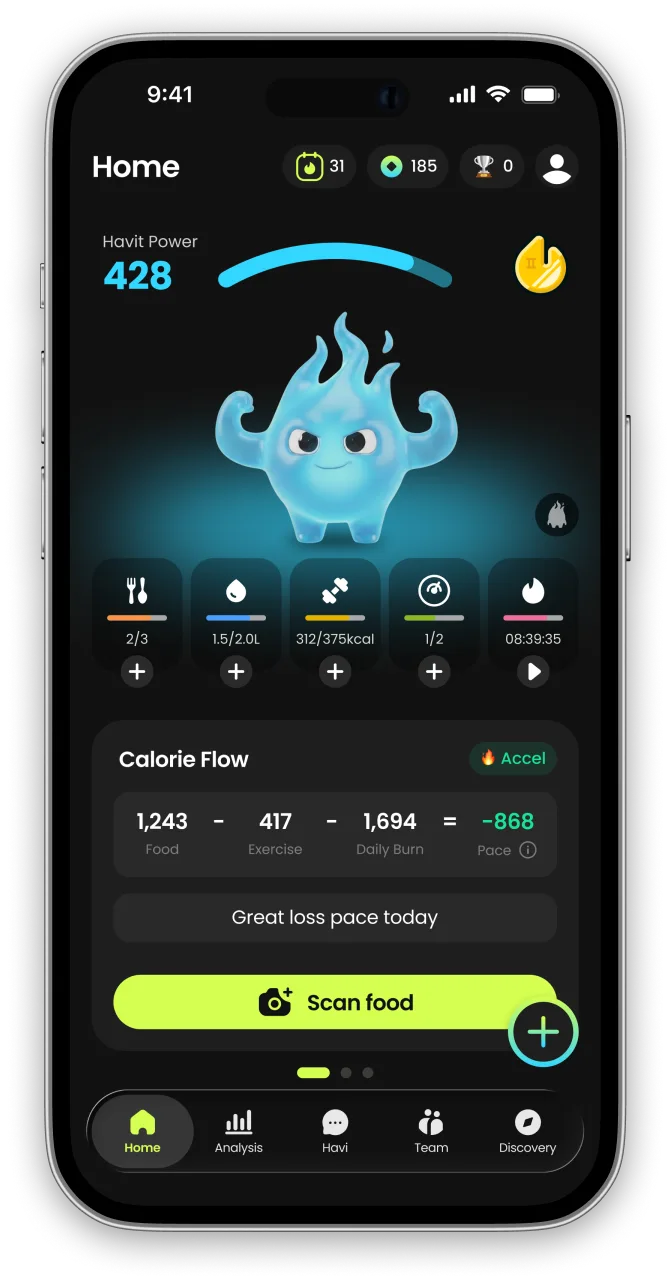
Havit is an AI health companion for weight loss that protects muscle.
Unlike calorie-only trackers, Havit connects AI body-composition estimates, nutrition, hydration, sleep, steps, cycle, mood, and GLP-1 medication in one daily routine — so progress is measured by body composition, not just the number on the scale. Daily missions turn established behavior-change techniques into small repeatable actions, drawing on expertise from professionals formerly at Juvis Diet, one of Korea’s leading metabolic clinics.
In Havit’s own analysis of 1,090 GLP-1 users, people who logged consistently built stronger habits than the general user base. Read the GLP-1 Habit Report
Havit works with or without GLP-1 medication. It is a wellness app, not a medical device; body-composition results are estimates.
Continue in the App
Personalized wellness with your own data


References
- Hepatic Metabolism of GLP-1 Receptor Agonists and Alcohol: A Pharmacokinetic Analysis — Hepatology, March 2025
- Drug-Alcohol Interactions in Incretin-Based Therapies: Clinical Implications — Clinical Pharmacology & Therapeutics, November 2024
- Gastric Emptying Dynamics and Alcohol Absorption in Patients on Tirzepatide — University of Copenhagen Clinical Trial Registry, 2024
- Patient-Reported Alcohol Tolerance Changes During GLP-1 Agonist Treatment — Obesity Science & Practice, 2024
- Emergency Department Presentations Involving GLP-1 Medications: A Multi-Center Review — Journal of Emergency Medicine, January 2025


