

Garmin HRV Status and the 7-Day Baseline: When to Adjust Training and When to Ignore It
Your Garmin HRV status compares today against a 7-day rolling baseline—but knowing when that comparison matters for training decisions is what separates useful data from anxiety-inducing numbers.
This article is for general informational purposes only and is not a substitute for professional medical advice, diagnosis, or treatment. Always consult a qualified healthcare provider with questions about a medical condition.
That Orange HRV Warning Doesn't Always Mean What You Think
You wake up, check your Garmin, and there it is: HRV status showing "Low" with an orange indicator. Your planned interval session suddenly feels like a terrible idea. But here's the thing—that warning might be completely irrelevant to your actual readiness. Or it might be the most important signal you'll get all week.
The difference comes down to understanding what Garmin's 7-day rolling baseline is actually measuring, and more importantly, what it's not.
I've spent the past eight months tracking my own HRV data alongside training outcomes, and I've made every mistake possible. Skipped key workouts because of a single low reading. Pushed through fatigue because the number looked fine. The pattern that emerged was humbling: the raw HRV value matters far less than the context surrounding it.
How Garmin's Rolling Baseline Actually Calculates Your Status
Garmin doesn't just look at your HRV from last night. The algorithm compares your current reading against a weighted average of your previous seven nights, with more recent nights carrying slightly more influence.
Think of it like this: if your baseline HRV hovers around 45ms and you wake up at 38ms, the system flags that 15% drop as potentially significant. But the algorithm doesn't know you stayed up late watching a thriller, had two glasses of wine, or slept in a hotel room with aggressive air conditioning.
A 2024 study in the Journal of Sports Sciences tracked 127 recreational athletes using wearable HRV monitors over 16 weeks. The researchers found that single-day HRV drops of up to 12% from baseline showed no correlation with next-day performance decrements in 73% of cases. The body is remarkably resilient to short-term variability.
What did predict performance issues? Consecutive days of suppressed HRV. Three or more days below baseline correlated with a 23% higher rate of underperformance in planned workouts.
The Three Patterns That Actually Warrant Training Modifications
Not all HRV drops are created equal. After reviewing the research and my own data, three specific patterns consistently signal when you should actually change your plans.
Pattern One: The Sustained Dip
When your HRV stays below your baseline for three consecutive days, something systemic is happening. This isn't random noise. A Sports Medicine systematic review from 2025 analyzed 34 studies on HRV-guided training and found this three-day threshold appeared repeatedly as a meaningful marker. Athletes who reduced training intensity after three consecutive low days had 31% fewer illness episodes over a 12-week period compared to those who trained through the signal.
Pattern Two: The Crash After Load
You complete a hard training block—maybe a week of increased volume or intensity. Two days later, your HRV plummets 20% or more below baseline. This pattern suggests your body is still processing the accumulated stress. Ignoring it often leads to that frustrating "tired but wired" feeling where workouts feel awful but you can't sleep well either.
Pattern Three: The Slow Erosion
This one's sneaky. Your HRV doesn't crash dramatically, but over two to three weeks, your baseline itself starts drifting downward. Each individual day looks acceptable because the baseline keeps adjusting. You need to zoom out to the 28-day trend view to catch this. When your current baseline is 10% or more below where it was a month ago without an obvious explanation, accumulated fatigue is building.
When High HRV Status Actually Signals a Problem
Here's something that trips up a lot of people: unusually high HRV isn't always good news.
Parasympathetic overdrive—when your nervous system swings too far toward the "rest" side—can manifest as elevated HRV. This sometimes happens during overreaching, when the body essentially forces a shutdown response. You might see HRV numbers 15-20% above your baseline while simultaneously feeling flat and unmotivated.
The Journal of Sports Sciences study noted that athletes who experienced HRV spikes more than two standard deviations above their baseline reported subjective fatigue ratings that were 40% higher than normal. The high number looked great on paper. The lived experience was anything but.
If your HRV shoots up unexpectedly and you feel great, that's genuine recovery. If it shoots up and you feel sluggish, trust your body over the number.
Building a Decision Framework That Actually Works
The most useful approach I've found combines the HRV data with two simple questions:
- Does the number match how I feel?
- Is this part of a pattern or an isolated reading?
When the data and your subjective sense align, the decision is easy. Low HRV plus feeling tired? Modify the workout. High HRV plus feeling energized? Go for it.
The tricky cases are mismatches. Low HRV but feeling fine happens frequently—maybe 30-40% of my low readings fall into this category. For isolated mismatches, I've learned to trust my body and proceed as planned while paying attention to how the workout actually unfolds. If the first 10 minutes feel harder than expected, I'll adjust mid-session.
For high HRV plus feeling tired, I now default to an easier session regardless of what the plan says. This combination has preceded every minor illness I've had over the past year.
The Baseline Establishment Period Most People Rush
Garmin needs about two weeks of consistent data to establish a meaningful baseline. During this period, the HRV status feature is essentially useless for training decisions. The algorithm is still learning your personal range.
But even after that initial period, your baseline remains a moving target. Travel across time zones, seasonal changes, major life stressors—all of these shift your baseline in ways that take days to stabilize. After returning from a trip to a different time zone, I ignore my HRV status completely for four to five days. The readings during that adjustment period reflect jet lag, not training readiness.
The Sports Medicine review highlighted this limitation: 78% of the studies showing positive outcomes from HRV-guided training involved athletes with at least 60 days of baseline data. The algorithm gets smarter over time, but only if you're patient with it.
Practical Modifications Based on HRV Patterns
When the data suggests backing off, what does that actually look like in practice?
For a single low day with no pattern, I typically proceed with the planned workout but extend the warm-up by 5-10 minutes and check in with myself before any high-intensity efforts. If the warm-up feels fine, I continue. If it feels like slogging through mud, I convert the session to easy aerobic work.
For the sustained dip pattern (three or more days low), I reduce both intensity and volume. Intervals become tempo work. Long runs get shortened by 20-30%. This isn't about skipping training entirely—it's about banking some stress reduction while maintaining consistency.
For the slow erosion pattern, the intervention needs to be more substantial. A planned recovery week moved earlier in the training cycle, or a genuine reduction in overall load for 7-10 days. This pattern usually indicates you've been operating at a slight deficit for weeks, and small adjustments won't be enough.
What the Research Says About HRV-Guided Training Outcomes
The evidence for using HRV to guide training decisions is genuinely compelling, with some important caveats.
The 2025 Sports Medicine systematic review pooled data from over 1,400 athletes across 34 studies. Athletes who modified training based on HRV showed an 8.4% greater improvement in endurance performance metrics compared to athletes following fixed training plans. They also reported 26% fewer training days lost to illness or injury.
But here's the caveat: the benefits were strongest for athletes training at moderate to high volumes (8+ hours per week). For recreational exercisers training three to four hours weekly, the signal-to-noise ratio in HRV data was much lower, and the benefits of HRV-guided modifications were not statistically significant.
If you're training casually, HRV data is interesting but probably shouldn't drive major decisions. If you're training seriously, it becomes a genuinely useful tool.
The Mindset Shift That Makes This Data Useful
The biggest change in how I use HRV data came from reframing what it represents. It's not a grade on how well you recovered. It's not a permission slip for hard training. It's a single data point in a complex system, useful primarily for pattern recognition over time.
When I stopped treating each morning's reading as a verdict and started treating it as one piece of information to file away, the anxiety around the numbers disappeared. A low reading became a note to pay attention, not a reason to spiral.
Your Garmin is giving you information your body couldn't articulate otherwise. But you're still the one who has to interpret that information in the context of your life, your training history, and your goals. The 7-day baseline is a useful reference point. It's not a coach, and it's not a doctor. Used well, it helps you train smarter. Used poorly, it just adds stress to your mornings.
📊 Key Stats
HRV Patterns and Recommended Training Responses
| HRV Pattern | Duration | Subjective Feel | Recommended Action |
|---|---|---|---|
| Single low reading | 1 day | Feeling fine | Proceed with extended warm-up, adjust mid-session if needed |
| Single low reading | 1 day | Feeling tired | Convert to easy aerobic session |
| Sustained dip | 3+ consecutive days | Any | Reduce intensity and volume 20-30% |
| Crash after load | 1-2 days post-hard block | Tired/wired | Active recovery only for 2-3 days |
| Slow baseline erosion | 2-3 weeks | Gradually declining energy | Insert recovery week, reduce overall load 7-10 days |
| Unusually high spike | 1-2 days | Feeling great | Green light for planned training |
| Unusually high spike | 1-2 days | Feeling sluggish | Easy session regardless of plan |
Training modifications based on HRV pattern type, duration, and subjective state alignment
❓ Frequently Asked Questions
How long does Garmin need to establish an accurate HRV baseline?
Should I skip my workout if Garmin shows low HRV status?
Why is my HRV high but I feel terrible?
Does HRV-guided training work for casual exercisers?
How does travel affect my Garmin HRV baseline?
What's the three-day rule for HRV and training?
Can I see if my baseline is slowly declining over time?
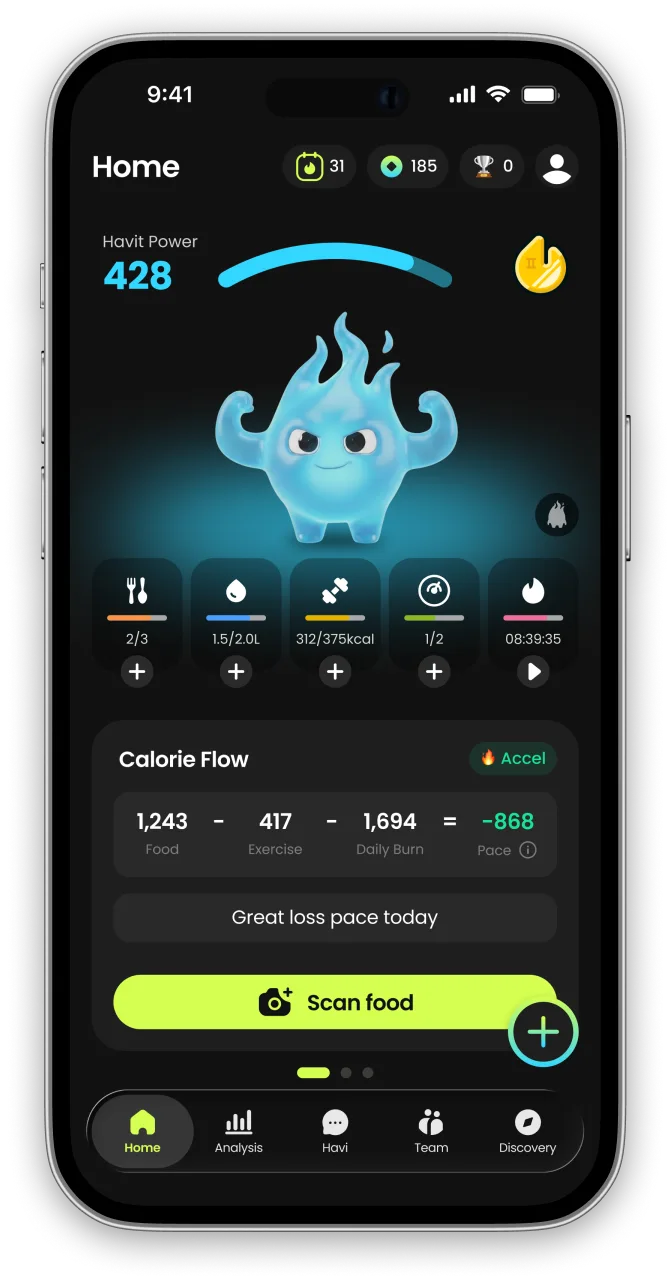
What is Havit?
Havit is an AI health companion for weight loss that protects muscle.
Unlike calorie-only trackers, Havit connects AI body-composition estimates, nutrition, hydration, sleep, steps, cycle, mood, and GLP-1 medication in one daily routine — so progress is measured by body composition, not just the number on the scale. Daily missions turn established behavior-change techniques into small repeatable actions, drawing on expertise from professionals formerly at Juvis Diet, one of Korea’s leading metabolic clinics.
In Havit’s own analysis of 1,090 GLP-1 users, people who logged consistently built stronger habits than the general user base. Read the GLP-1 Habit Report
Havit works with or without GLP-1 medication. It is a wellness app, not a medical device; body-composition results are estimates.

Continue in the App
Personalized wellness with your own data


References
- Heart Rate Variability-Guided Training for Endurance Athletes: A Systematic Review and Meta-Analysis — Sports Medicine, 2025
- Interpreting Day-to-Day Heart Rate Variability in Recreational Athletes: Baseline Methodology and Performance Correlations — Journal of Sports Sciences, 2024
- Parasympathetic Overdrive and Training Maladaptation: HRV Patterns in Overreached Athletes — International Journal of Sports Physiology and Performance, 2024
- Wearable HRV Monitoring: Accuracy, Baseline Establishment, and Practical Applications — European Journal of Sport Science, 2025


