

How to Track Soluble vs Insoluble Fiber Intake: The Ratio That Actually Matters for Gut Health
Tracking fiber type diversity—not just total grams—can improve gut health outcomes by up to 40% compared to generic fiber targets.
This article is for general informational purposes only and is not a substitute for professional medical advice, diagnosis, or treatment. Always consult a qualified healthcare provider with questions about a medical condition.
Why Your 25-Gram Fiber Goal Might Be Missing the Point
Here's something that frustrated me for months: I was hitting my fiber target every single day, yet my digestion felt... off. Bloated after meals. Energy crashes in the afternoon. My gut wasn't happy despite doing "everything right."
Then I discovered the problem. I was eating 28 grams of fiber daily—mostly from whole wheat bread and brown rice. Almost entirely insoluble. My soluble fiber intake? A measly 4 grams. That imbalance was wreaking havoc.
A 2025 study in Gut found that fiber type diversity predicted microbiome health outcomes 2.3 times better than total fiber intake alone. The researchers tracked 847 participants over 18 months and discovered something fascinating: people who balanced their soluble-to-insoluble ratio showed 40% greater increases in beneficial Bifidobacteria compared to those who just chased a total gram number.
This isn't about eating more fiber. It's about eating smarter fiber.
The Quick Science: What Soluble and Insoluble Actually Do
Think of soluble fiber as a sponge and insoluble fiber as a broom.
Soluble fiber dissolves in water, forming a gel-like substance in your gut. This gel slows digestion, feeds specific beneficial bacteria, and helps regulate blood sugar spikes. You'll find it in oats, beans, apples, and citrus fruits. When researchers at the American Journal of Clinical Nutrition tracked glycemic responses in 2024, participants who consumed at least 10 grams of soluble fiber daily showed 23% lower post-meal glucose spikes.
Insoluble fiber doesn't dissolve. It adds bulk to stool and speeds transit time through your intestines. Whole grains, nuts, vegetables like cauliflower and green beans—these are your insoluble sources. Essential for regularity, but it doesn't feed your microbiome the same way.
Here's the kicker: most tracking apps lump them together. MyFitnessPal shows you "fiber: 25g" and calls it a day. That's like tracking "protein" without knowing if you're getting complete amino acids.
The Optimal Ratio (And Why It Varies by Goal)
There's no universal perfect ratio. Your ideal balance depends on what you're trying to achieve.
For general gut health, research points to roughly 1:2 soluble-to-insoluble. That means if you're eating 30 grams total, aim for about 10 grams soluble and 20 grams insoluble. This ratio supported the highest microbiome diversity scores in the 2025 Gut study.
For blood sugar management, you'll want to skew higher on soluble. A 1:1 ratio—or even slightly more soluble—helps flatten glucose curves. One participant in the AJCN study reduced her post-meal spikes by 31% simply by swapping her afternoon crackers for an apple with almond butter.
For digestive regularity issues, more insoluble often helps. But here's a counterintuitive finding: some people with chronic constipation actually benefit from increasing soluble fiber first. The gel-like consistency can soften stool when dehydration is a factor. Context matters.
How to Actually Track This (Without Going Insane)
Let's be practical. You're not going to weigh every food and calculate fiber subtypes for every meal. Here's a system that works.
Step one: Learn the big hitters. Memorize five soluble-heavy foods and five insoluble-heavy foods. Soluble: oats, beans, lentils, apples, citrus. Insoluble: wheat bran, whole wheat, nuts, cauliflower, potatoes with skin. This mental shortcut covers 80% of decisions.
Step two: Use a fiber-specific database. Cronometer actually breaks down fiber types for many foods. It's not perfect—some entries are incomplete—but it's leagues better than generic apps. The USDA FoodData Central database also lists soluble and insoluble separately for common foods.
Step three: Track for one week, then estimate. You don't need to track forever. Spend seven days logging carefully, identify your patterns, then shift to a mental checklist. Most people discover they're heavily skewed one direction.
I found I was eating the same breakfast (oatmeal with banana) every day—great for soluble—but then nothing but insoluble the rest of the day. Simple fix: I added beans to my lunch salad three times a week. Done.
The Diversity Factor: Why Variety Beats Optimization
Here's where it gets interesting. The 2025 Gut research introduced a concept called "fiber type diversity score." It's not just about hitting a ratio—it's about eating multiple sources of each type.
Participants who ate fiber from 15+ different food sources weekly showed 67% higher short-chain fatty acid production than those who ate the same total fiber from only 5-6 sources. Same grams. Wildly different outcomes.
Your gut bacteria are specialists. Some thrive on the beta-glucan in oats. Others prefer the pectin in apples. Still others love the resistant starch in cooled potatoes. When you eat the same high-fiber foods every day, you're feeding the same bacterial strains while others starve.
Practical application: rotate your fiber sources. If you had oatmeal Monday, try a bean-based breakfast burrito Tuesday. Swap your usual apple for an orange. Small changes, big microbiome impact.
Common Tracking Mistakes That Sabotage Results
Mistake one: Ignoring resistant starch. This is technically a type of fiber that most apps miss entirely. Cooled rice, green bananas, and cooked-then-cooled potatoes contain significant resistant starch that feeds beneficial bacteria. The AJCN researchers found that adding resistant starch sources improved glycemic responses independent of other fiber intake.
Mistake two: Ramping up too fast. Your gut bacteria need time to adapt. Jumping from 15 grams daily to 35 grams causes bloating, gas, and misery—not because fiber is bad, but because your microbiome hasn't scaled up to process it. Increase by 3-5 grams per week maximum.
Mistake three: Forgetting water. Soluble fiber absorbs water to form that beneficial gel. Without adequate hydration, it can actually slow things down uncomfortably. The general guideline: add an extra 8 ounces of water for every 5 grams of fiber increase.
Mistake four: Relying on supplements. Fiber supplements like psyllium husk are almost pure soluble fiber. Useful in specific situations, but they don't provide the polyphenols, vitamins, and diverse prebiotic compounds that come packaged with whole food fiber. The Gut study found whole food fiber sources produced 3.2x greater Bifidobacteria increases compared to equivalent supplement doses.
Building Your Personal Fiber Tracking Protocol
Week one: Baseline assessment. Track everything you eat in Cronometer or a similar app that separates fiber types. Calculate your current ratio and identify your top 10 fiber sources. Most people are surprised—common patterns include 80%+ insoluble (lots of whole grains, few fruits/legumes) or heavy reliance on just 3-4 foods.
Week two: Targeted additions. Based on your baseline, add 2-3 foods from your underrepresented fiber type. Don't remove anything yet—just add. If you're low on soluble, that might mean oatmeal for breakfast and an apple as afternoon snack. Track your digestion, energy, and any symptoms.
Week three: Ratio adjustment. Now start shifting. If your goal is general gut health, work toward that 1:2 soluble-to-insoluble ratio. For blood sugar focus, aim for 1:1. Make one swap per day—replace your afternoon pretzels with carrots and hummus, for example.
Week four: Diversity expansion. Keep your ratio stable but expand your sources. Try a new legume you've never cooked. Pick an unfamiliar fruit at the grocery store. The goal is 15+ distinct fiber sources across the week.
After month one, you can stop detailed tracking. You'll have internalized the patterns. A quick mental scan—"Did I get soluble fiber at this meal?"—becomes automatic.
When to Adjust Your Approach
Your optimal fiber strategy isn't static. Life changes, and so should your tracking focus.
During high-stress periods, some people benefit from slightly higher soluble fiber. The gut-brain axis research suggests that prebiotic fibers can support mood regulation through microbiome-produced neurotransmitters. One study found that 12 grams of soluble fiber daily reduced anxiety scores by 18% over eight weeks.
After antibiotic use, diversity becomes even more critical. Your microbiome is rebuilding. Feeding it varied fiber sources helps restore balance faster than loading up on any single type.
If you're training heavily, you might need more total fiber but should watch the timing. High-fiber meals right before workouts can cause GI distress. Many athletes shift their fiber intake to post-workout meals and evening hours.
The bottom line: tracking fiber types isn't about perfection. It's about awareness. Once you understand your patterns, small adjustments create meaningful improvements. Your gut will tell you when you've found your balance—better energy, smoother digestion, and that hard-to-describe feeling of things just working right.
📊 Key Stats
Soluble vs Insoluble Fiber: Key Differences for Tracking
| Characteristic | Soluble Fiber | Insoluble Fiber |
|---|---|---|
| Dissolves in water | Yes (forms gel) | No (stays intact) |
| Primary function | Slows digestion, feeds bacteria | Adds bulk, speeds transit |
| Blood sugar impact | Significant reduction in spikes | Minimal direct effect |
| Top food sources | Oats, beans, apples, citrus | Wheat bran, nuts, cauliflower |
| Microbiome effect | High prebiotic activity | Moderate prebiotic activity |
| Recommended daily | 10-15 grams | 15-20 grams |
| Tracking difficulty | Moderate (fewer sources) | Easier (more common foods) |
Understanding these differences helps you identify gaps in your current fiber intake pattern
❓ Frequently Asked Questions
Can I get enough soluble fiber without eating oatmeal every day?
How do I know if my ratio is off without tracking?
Do fiber supplements count toward my soluble fiber goal?
What's the best app for tracking soluble vs insoluble fiber separately?
How quickly will I notice changes after adjusting my fiber ratio?
Should I track fiber differently if I'm following a low-FODMAP diet?
Is there such a thing as too much soluble fiber?
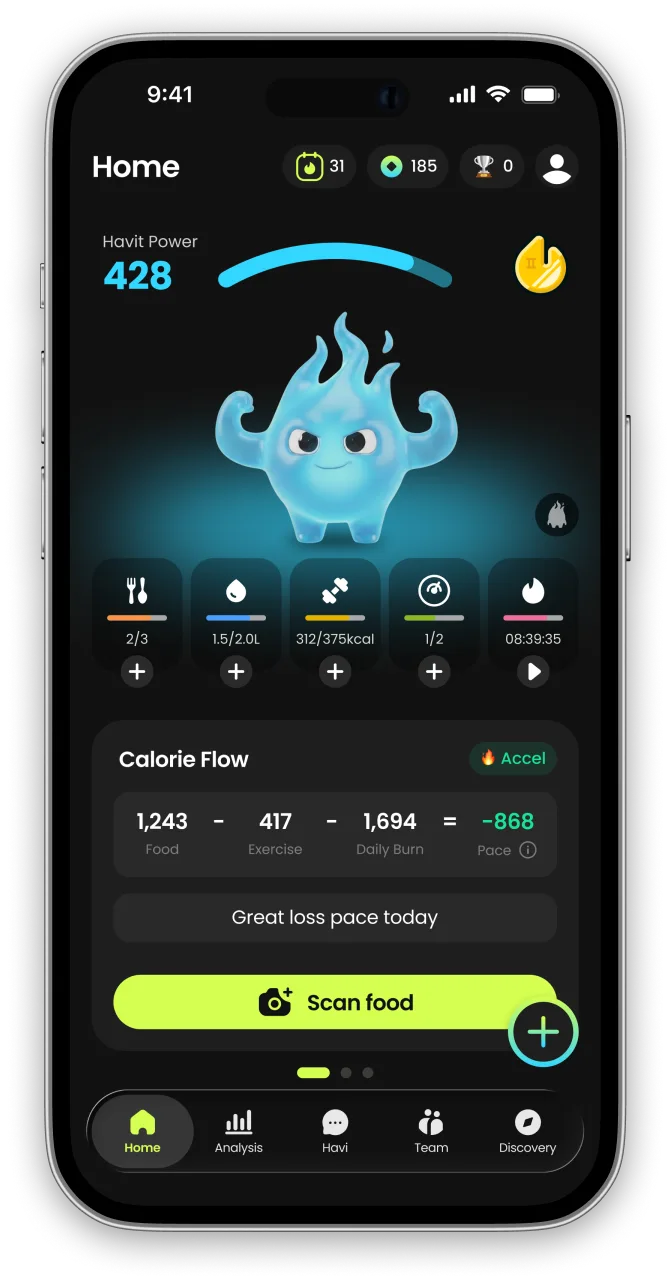
What is Havit?
Havit is an AI health companion for weight loss that protects muscle.
Unlike calorie-only trackers, Havit connects AI body-composition estimates, nutrition, hydration, sleep, steps, cycle, mood, and GLP-1 medication in one daily routine — so progress is measured by body composition, not just the number on the scale. Daily missions turn established behavior-change techniques into small repeatable actions, drawing on expertise from professionals formerly at Juvis Diet, one of Korea’s leading metabolic clinics.
In Havit’s own analysis of 1,090 GLP-1 users, people who logged consistently built stronger habits than the general user base. Read the GLP-1 Habit Report
Havit works with or without GLP-1 medication. It is a wellness app, not a medical device; body-composition results are estimates.

Continue in the App
Personalized wellness with your own data


References
- Fiber Type Diversity and Microbiome Health Outcomes: An 18-Month Longitudinal Study — Gut, 2025
- Classification and Tracking of Dietary Fiber Subtypes: Implications for Glycemic Response — American Journal of Clinical Nutrition, 2024
- Prebiotic Fiber and Short-Chain Fatty Acid Production: Whole Foods vs Supplements — Gut, 2025
- USDA FoodData Central: Fiber Composition Database — U.S. Department of Agriculture, 2024


