

Is 220 Minus Your Age Actually Accurate? What Field Tests Reveal About Heart Rate Zones
The 220-age formula has a standard error of ±10-12 bpm; field-tested protocols like the 3-minute all-out test provide far more accurate personal heart rate zones.
This article is for general informational purposes only and is not a substitute for professional medical advice, diagnosis, or treatment. Always consult a qualified healthcare provider with questions about a medical condition.
That Formula on Every Gym Poster? It's Probably Wrong for You
I watched a 45-year-old triathlete nearly pass out during a training session last month. Her coach had set her zones using 220 minus 45, which gave her a max heart rate of 175. Problem was, her actual max—discovered during a hill sprint that left her seeing stars—was 189. She'd been training in the wrong zones for two years.
This isn't unusual. The 220-age formula, scribbled on posters in every gym and baked into most fitness apps, wasn't even derived from original research. It emerged from a 1971 paper that roughly estimated a trend line from various studies. No controlled experiment. No validation protocol. Just a convenient number that stuck.
Where 220-Age Came From (And Why Scientists Cringe)
Dr. William Haskell and Dr. Samuel Fox published that now-famous formula in 1971, but here's what most people don't realize: they never intended it to be used for individual exercise prescription. Fox himself later admitted the formula was based on "loose observations" rather than rigorous data.
A 2024 analysis in Medicine & Science in Sports & Exercise examined 47 studies involving over 25,000 participants and found the standard error of the 220-age formula sits between 10-12 beats per minute. That means if you're 40, your predicted max of 180 could actually be anywhere from 168 to 192. For zone training, that's the difference between cruising and suffering.
The formula also assumes everyone ages the same way cardiovascularly. They don't. A sedentary 50-year-old and a lifelong runner of the same age can have max heart rates that differ by 15-20 beats.
The Alternatives: Better Formulas, Still Imperfect
Researchers have proposed dozens of alternatives over the decades. Three have gained the most traction.
The Tanaka formula (208 - 0.7 × age) emerged from a 2001 meta-analysis and performs better for adults over 40. For a 50-year-old, it predicts 173 bpm versus 170 from the classic formula—not a huge difference, but the standard error drops to about 7-10 bpm.
The Gulati formula (206 - 0.88 × age) was developed specifically for women after researchers noticed the original formula consistently overestimated female max heart rates. A 35-year-old woman would get 175 from this formula versus 185 from 220-age.
The HUNT formula (211 - 0.64 × age) came from Norwegian research on over 3,000 healthy adults and tends to predict higher max rates for older individuals. That same 50-year-old would get 179 bpm—nine beats higher than the gym poster says.
Why Even Good Formulas Miss the Mark
Here's what no formula can account for: you.
Genetics play a massive role. Some people simply have hearts that beat faster at maximum effort. A 2025 study in the Journal of Sports Sciences tracked 412 recreational athletes and found that training history, body composition, and even psychological factors influenced max heart rate independent of age.
Medications matter too. Beta-blockers can suppress max heart rate by 20-30 beats. Stimulants push it higher. The formula on your treadmill doesn't know you take propranolol for anxiety.
Then there's the altitude factor. Max heart rate drops about 1 beat per 1,000 feet of elevation gain. Train in Denver, and your sea-level zones become meaningless.
Field Tests That Actually Work
The gold standard for finding your true max heart rate is a graded exercise test in a lab, complete with oxygen masks and a cardiologist standing by. Most of us aren't doing that.
But field tests can get remarkably close. The 3-minute all-out test has gained popularity in cycling and running communities. You warm up thoroughly, then go absolutely maximum effort for three minutes. Not "hard." Maximum. Your peak heart rate in the final 30 seconds typically lands within 2-3 beats of your true max.
The 20-minute time trial approach works differently. You sustain the hardest effort you can hold for 20 minutes, then take 95% of your average heart rate as your threshold. This doesn't find your max, but it identifies your lactate threshold—arguably more useful for training zones anyway.
Hill repeats offer another option. Find a steep hill that takes 2-3 minutes to climb. Do four repeats at maximum effort with full recovery between. Your highest recorded heart rate across all repeats usually comes within 5 beats of your actual max.
Building Zones That Match Your Physiology
Once you have a tested max heart rate, zone calculation becomes straightforward. But which zone system should you use?
The 5-zone model dominates endurance sports. Zone 1 sits at 50-60% of max (easy recovery), Zone 2 at 60-70% (aerobic base), Zone 3 at 70-80% (tempo), Zone 4 at 80-90% (threshold), and Zone 5 at 90-100% (max effort). Simple and widely applicable.
The problem? These percentages assume your threshold occurs at roughly 80% of max. For some athletes, threshold hits at 75%. For others, 88%. Using generic percentages means your "tempo" zone might actually be your "threshold" zone.
Heart rate reserve calculations (the Karvonen method) partially address this by factoring in resting heart rate. The formula: Target HR = ((Max HR - Resting HR) × %Intensity) + Resting HR. This personalizes zones somewhat but still doesn't account for where your actual physiological thresholds fall.
The most accurate approach combines a field-tested max with a separate threshold test. Know both numbers, and you can anchor your zones to actual metabolic breakpoints rather than estimated percentages.
When Heart Rate Zones Lie to You
Even perfect zones fail under certain conditions.
Cardiac drift happens during prolonged exercise in heat. Your heart rate climbs 10-15 beats over two hours even at constant effort. Trusting your zones means slowing down when your actual work capacity hasn't changed.
Dehydration produces similar effects. Lose 2% of body weight through sweat, and your heart rate at the same power output jumps 5-8 beats. Your watch says you're in Zone 4. Your muscles say Zone 3.
Fatigue accumulated over days or weeks suppresses heart rate. Overtrained athletes often can't elevate their heart rate to expected zones even at maximum effort. A "failed" Zone 5 interval might indicate you need rest, not that you're not trying hard enough.
Caffeine, sleep deprivation, stress, and illness all shift the heart rate-effort relationship. Zones provide a framework, not a commandment.
The Practical Takeaway for Your Training
Should you abandon heart rate training entirely? No. Should you blindly trust 220 minus your age? Also no.
Start by testing. A single hard effort up a long hill with a heart rate monitor can give you data worth more than any formula. Compare that number to what the equations predict. If they're close, great. If they differ by 10+ beats, trust the test.
Retest annually, or whenever your fitness changes dramatically. Max heart rate does decline with age, but not as predictably as the formulas suggest. Some people lose 1 beat per year. Others maintain their max into their 50s.
Combine heart rate with perceived effort. If your watch says Zone 2 but you're breathing hard and can't hold a conversation, something's off. Your body knows things your wrist doesn't.
For serious training, consider a lactate threshold test or a VO2max assessment. These cost $100-300 at most sports medicine facilities and provide data that transforms generic zones into personalized training prescriptions.
The 220-age formula served its purpose as a rough population estimate. For your individual training, you deserve better than rough.
📊 Key Stats
Max Heart Rate Formulas Compared
| Formula | Equation | Age 30 Prediction | Age 50 Prediction | Best For |
|---|---|---|---|---|
| Classic (Fox-Haskell) | 220 - age | 190 bpm | 170 bpm | Quick estimate only |
| Tanaka | 208 - (0.7 × age) | 187 bpm | 173 bpm | Adults over 40 |
| Gulati | 206 - (0.88 × age) | 180 bpm | 162 bpm | Women specifically |
| HUNT | 211 - (0.64 × age) | 192 bpm | 179 bpm | Active older adults |
| Field Test | Actual measured max | Individual result | Individual result | Anyone serious about training |
All formulas have standard errors of 7-12 bpm; field testing remains most accurate for individuals
❓ Frequently Asked Questions
Why does my fitness watch use 220 minus age if it's inaccurate?
Can I manually set my max heart rate in most fitness apps?
How often should I retest my max heart rate?
Is it dangerous to do a max heart rate field test?
Why is my max heart rate higher than the formula predicts?
Does max heart rate indicate fitness level?
Should I use heart rate or power/pace for training zones?
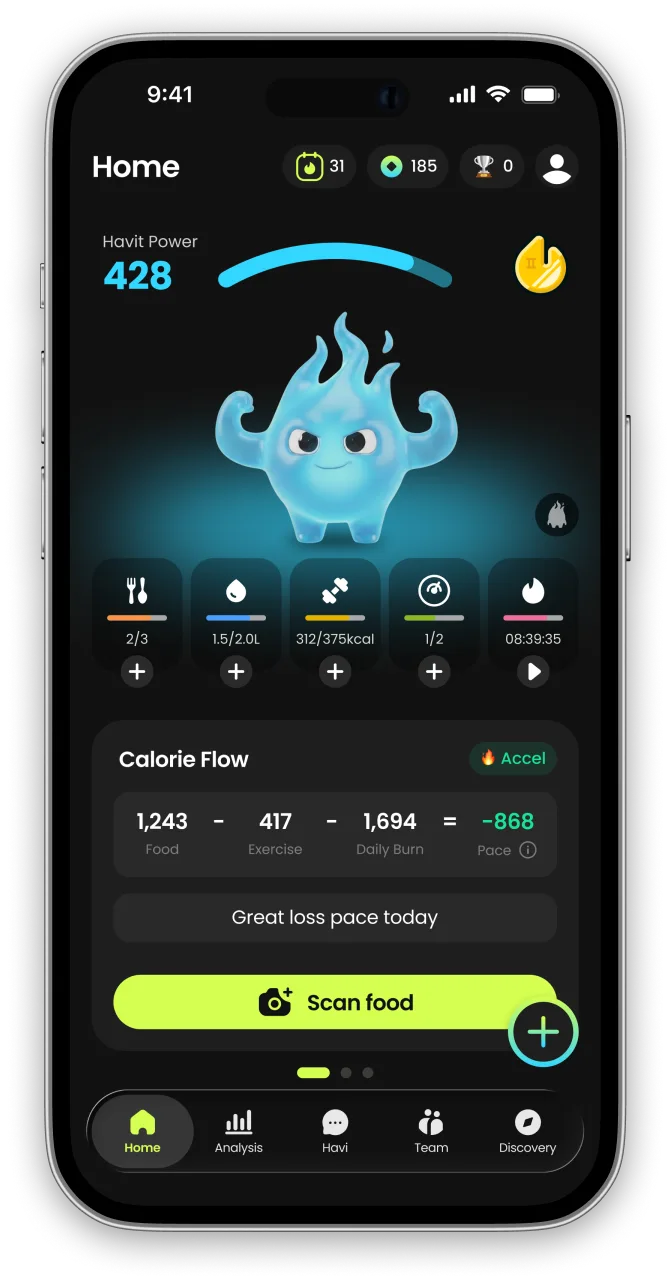
What is Havit?
Havit is an AI health companion for weight loss that protects muscle.
Unlike calorie-only trackers, Havit connects AI body-composition estimates, nutrition, hydration, sleep, steps, cycle, mood, and GLP-1 medication in one daily routine — so progress is measured by body composition, not just the number on the scale. Daily missions turn established behavior-change techniques into small repeatable actions, drawing on expertise from professionals formerly at Juvis Diet, one of Korea’s leading metabolic clinics.
In Havit’s own analysis of 1,090 GLP-1 users, people who logged consistently built stronger habits than the general user base. Read the GLP-1 Habit Report
Havit works with or without GLP-1 medication. It is a wellness app, not a medical device; body-composition results are estimates.

Continue in the App
Personalized wellness with your own data


References
- Validity of Age-Predicted Maximum Heart Rate Equations: A Systematic Review and Meta-Analysis — Medicine & Science in Sports & Exercise, 2024
- Individualizing Heart Rate Training Zones in Recreational Athletes: A Field-Based Approach — Journal of Sports Sciences, 2025
- Age-predicted maximal heart rate revisited — Tanaka et al., Journal of the American College of Cardiology, 2001
- The 3-Minute All-Out Test for Determining Critical Power and Anaerobic Work Capacity — International Journal of Sports Physiology and Performance, 2024


