

Heart Rate Recovery After Exercise: The 60-Second Test That Reveals Your True Fitness Level
A heart rate drop of 12+ beats in the first minute after exercise signals strong cardiovascular fitness—and improving this number may be more meaningful than your resting heart rate.
This article is for general informational purposes only and is not a substitute for professional medical advice, diagnosis, or treatment. Always consult a qualified healthcare provider with questions about a medical condition.
The Number Your Fitness Tracker Should Be Showing You
You just crushed a workout. Heart pounding, sweat dripping, lungs working overtime. But here's what most people miss: the real test starts the moment you stop moving.
How fast your heart rate drops in that first minute tells a story your step count never could. A 42-year-old marathon runner and a 42-year-old who hasn't exercised in years might both hit 165 bpm during a hard effort. The difference? One's heart rate plummets 25 beats in 60 seconds. The other barely budges 8 beats. That gap reveals everything about what's happening inside.
Why Your Heart's Cooldown Speed Matters More Than You Think
Heart rate recovery (HRR) measures how quickly your cardiovascular system shifts from "go" mode to "rest" mode. Think of it as your body's ability to pump the brakes after flooring the accelerator.
When you exercise, your sympathetic nervous system takes over—the fight-or-flight response that speeds everything up. The instant you stop, your parasympathetic system should kick in, telling your heart to chill out. In people with strong cardiovascular fitness, this handoff happens almost immediately. In others, the sympathetic system keeps revving like an engine that won't idle down.
A 2024 analysis in the Journal of the American College of Cardiology tracked 15,847 adults over eight years. Those with HRR below 12 beats per minute at one minute had a 2.3 times higher risk of cardiovascular events compared to those recovering 18+ beats. The researchers called it "one of the most accessible predictors of cardiac autonomic function."
The One-Minute Benchmark: Where Do You Stand?
Let's get specific. After moderate-to-vigorous exercise, stop completely (or slow to a very easy walk). Check your heart rate at peak effort, then again exactly 60 seconds later. Subtract.
Here's how the numbers break down:
Below 12 beats: This warrants attention. It suggests your autonomic nervous system isn't switching gears efficiently. Don't panic—this improves with consistent training. But it's worth discussing with a healthcare provider if you're also experiencing fatigue or shortness of breath during normal activities.
12-20 beats: You're in the normal range. Your body handles the transition reasonably well. Room for improvement exists, but your cardiovascular system is functioning appropriately.
21-30 beats: Solid. This typically shows up in people who exercise regularly—three to four sessions per week of moderate intensity.
Above 30 beats: Excellent recovery. Common in well-trained endurance athletes. Your vagal tone (the parasympathetic "brake" system) is strong.
I remember a colleague who started tracking this after reading about it. First measurement: 14 beats. Three months of consistent zone 2 cardio later? 23 beats. Same person, same genetics, dramatically different recovery.
The Two-Minute Mark: A Deeper Look
One minute gives you the quick snapshot. Two minutes reveals more nuance.
The Circulation 2025 study on heart rate recovery prognostic value found that two-minute HRR added independent predictive information beyond the one-minute reading. Specifically, participants whose heart rates hadn't dropped at least 22 beats by the two-minute mark showed elevated markers of cardiovascular strain, even when their one-minute recovery looked acceptable.
Why the difference? The first minute reflects the initial parasympathetic surge—that quick brake tap. The second minute shows whether your system can sustain the cooldown or if it's struggling to maintain calm.
Think about it like this: some people can briefly relax but can't stay relaxed. Their nervous system keeps wanting to ramp back up. Two-minute HRR catches this pattern.
What Actually Improves Heart Rate Recovery
Good news: HRR responds to training faster than many fitness metrics. Some people see meaningful improvements in 6-8 weeks.
Consistent aerobic exercise tops the list. Not crushing yourself daily—moderate, sustainable effort. A 2024 meta-analysis found that three weekly sessions of 30-45 minutes at conversational pace improved one-minute HRR by an average of 6 beats over 12 weeks.
High-intensity interval training creates rapid adaptations. The autonomic stress of repeated hard efforts followed by recovery periods essentially trains your nervous system to switch modes quickly. One study showed HIIT improved two-minute HRR by 19% in previously sedentary adults after just eight weeks.
Sleep quality matters more than sleep quantity here. Deep sleep is when your parasympathetic system does its maintenance work. Participants in a Stanford study who improved their sleep efficiency (time asleep vs. time in bed) from 78% to 88% saw their HRR improve by 4 beats—without changing their exercise habits.
Chronic stress tanks recovery. Cortisol keeps your sympathetic system activated. One fascinating finding: people who practiced 10 minutes of daily breathing exercises (slow exhales, specifically) improved HRR by 3-4 beats over six weeks. The exhale activates the vagus nerve, which controls that parasympathetic brake.
Reading the Trends, Not Just the Numbers
A single HRR measurement tells you something. A trend tells you everything.
Day-to-day variation is normal. Your recovery might be 22 beats on Monday and 17 beats on Wednesday—that's just life. Hydration, sleep, stress, caffeine, even the temperature affects individual readings.
What you're looking for: the 4-week moving average. Is it climbing, stable, or dropping?
A climbing trend while training consistently? Your cardiovascular system is adapting beautifully. A dropping trend despite regular exercise? Something's off. Could be overtraining, accumulated stress, poor sleep, or an underlying issue worth exploring.
One trainer I know uses HRR as her primary readiness indicator. If an athlete's two-week average drops more than 4 beats, she reduces training intensity until it rebounds. She's found this prevents more overtraining injuries than any other metric she tracks.
The Workout Types That Move the Needle Fastest
Not all exercise improves HRR equally.
Zone 2 cardio (where you can hold a conversation, roughly 60-70% of max heart rate) builds the aerobic base that supports strong recovery. It's not sexy, but it works. Four hours per week of zone 2 training improved HRR more than two hours of high-intensity work in a 2024 comparison study.
Swimming shows particularly strong effects. The combination of horizontal position, water pressure, and breath control creates unique parasympathetic stimulation. Swimmers consistently show higher HRR than runners at similar fitness levels.
Strength training helps, but less directly. It improves HRR primarily by reducing resting heart rate and improving stroke volume (how much blood your heart pumps per beat). The effect takes longer—typically 4-6 months of consistent resistance training.
Yoga and tai chi improve HRR through nervous system regulation rather than cardiovascular stress. A 16-week yoga intervention improved one-minute HRR by 5 beats in adults over 50, comparable to moderate aerobic training.
When Poor Recovery Signals Something Bigger
Let's be direct: persistently low HRR (below 12 beats at one minute) that doesn't improve with 8-12 weeks of consistent training deserves medical attention.
It doesn't mean something is wrong. But it means the question is worth asking.
Poor HRR can indicate autonomic dysfunction, which sometimes appears before other symptoms in conditions affecting the heart, thyroid, or nervous system. It can also simply mean someone needs more time to build fitness—context matters enormously.
The Circulation 2025 research emphasized that HRR should be interpreted alongside other factors: age, baseline fitness, medications (beta blockers dramatically affect HRR), and overall health status.
Tracking This Yourself: Practical Tips
Most modern fitness trackers and smartwatches calculate HRR automatically. But the methodology varies. Some measure at 60 seconds post-exercise, others at 120 seconds, and some use proprietary algorithms that aren't transparent.
For consistency, pick one method and stick with it:
- Complete your workout at moderate-to-hard effort
- Stop moving (or walk very slowly)
- Note your peak heart rate
- Start a 60-second timer
- Check heart rate at exactly 60 seconds
- Subtract the second number from the first
Do this after similar workouts for the most meaningful comparisons. Your HRR after a casual bike ride will differ from your HRR after hill sprints.
Record the numbers somewhere you'll actually look at them. A simple spreadsheet works. So does a notes app. The format matters less than the consistency.
The Bigger Picture of Recovery Fitness
Heart rate recovery isn't just about cardiovascular health. It reflects your entire stress-recovery balance.
People with strong HRR tend to handle mental stress better, sleep more efficiently, and recover faster from illness. The parasympathetic system that drops your heart rate quickly is the same system that promotes digestion, immune function, and cellular repair.
Improving your HRR through exercise and lifestyle changes doesn't just make your heart healthier. It upgrades your body's entire recovery infrastructure.
That 60-second window after your workout? It's telling you how well your whole system handles the transition from stress to rest. And in a world that keeps most of us stuck in stress mode, that might be the most valuable fitness metric of all.
📊 Key Stats
Heart Rate Recovery Benchmarks by Fitness Level
| HRR Category | One-Minute Drop | Two-Minute Drop | What It Indicates |
|---|---|---|---|
| Needs Attention | Below 12 beats | Below 22 beats | Autonomic function may need support; consult healthcare provider if persistent |
| Normal Range | 12-20 beats | 22-35 beats | Adequate cardiovascular transition; room for improvement with training |
| Good | 21-30 beats | 36-50 beats | Regular exerciser; strong parasympathetic response |
| Excellent | Above 30 beats | Above 50 beats | Well-trained endurance athlete; exceptional vagal tone |
Benchmarks based on active recovery (standing or slow walking) after moderate-to-vigorous exercise. Individual factors including age, medications, and baseline fitness affect interpretation.
❓ Frequently Asked Questions
Should I measure heart rate recovery standing still or walking slowly?
Why does my heart rate recovery vary so much day to day?
Can medications affect heart rate recovery measurements?
How long does it take to improve heart rate recovery with exercise?
Is heart rate recovery different for different types of exercise?
Does age affect what's considered a healthy heart rate recovery?
Can stress and anxiety affect heart rate recovery even if I'm physically fit?
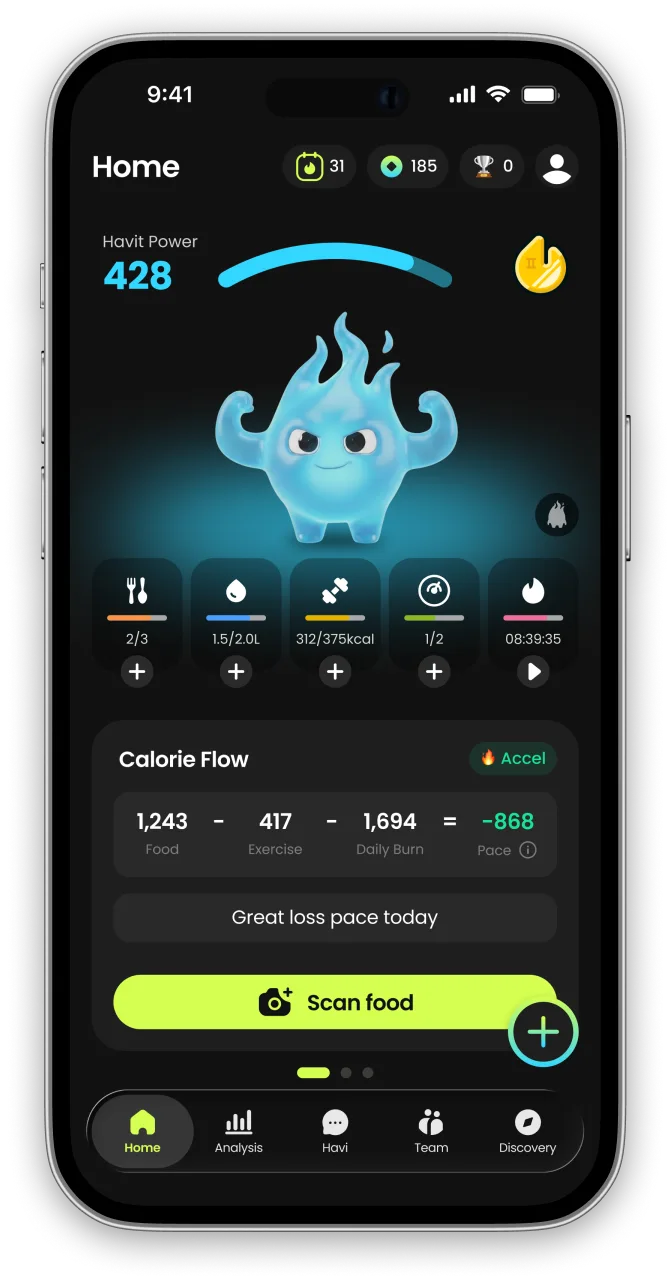
What is Havit?
Havit is an AI health companion for weight loss that protects muscle.
Unlike calorie-only trackers, Havit connects AI body-composition estimates, nutrition, hydration, sleep, steps, cycle, mood, and GLP-1 medication in one daily routine — so progress is measured by body composition, not just the number on the scale. Daily missions turn established behavior-change techniques into small repeatable actions, drawing on expertise from professionals formerly at Juvis Diet, one of Korea’s leading metabolic clinics.
In Havit’s own analysis of 1,090 GLP-1 users, people who logged consistently built stronger habits than the general user base. Read the GLP-1 Habit Report
Havit works with or without GLP-1 medication. It is a wellness app, not a medical device; body-composition results are estimates.

Continue in the App
Personalized wellness with your own data


References
- Heart Rate Recovery Prognostic Value: Updated Analysis and Clinical Applications — Circulation, 2025
- Autonomic Function Assessment Through Heart Rate Recovery in Cardiovascular Risk Stratification — Journal of the American College of Cardiology, 2024
- Exercise Training Effects on Heart Rate Recovery: A Systematic Review and Meta-Analysis — Sports Medicine, 2024
- Sleep Quality and Cardiac Autonomic Function in Adults — Stanford University Sleep Research Center, 2024


