

The 90-Minute Evening Wind Down Routine That Actually Speeds Up Sleep Onset
A structured 90-minute pre-sleep protocol using dim light, cooling, and calm activities can reduce sleep onset time by up to 23 minutes.
This article is for general informational purposes only and is not a substitute for professional medical advice, diagnosis, or treatment. Always consult a qualified healthcare provider with questions about a medical condition.
Why You're Still Staring at the Ceiling at 11:47 PM
Here's something that changed how I think about sleep: your body doesn't have an on/off switch. It has a dimmer. And most of us are trying to flip that switch at 11 PM after spending the entire evening with every light in the house blazing, our phones six inches from our faces, and maybe a late workout thrown in for good measure.
Then we wonder why sleep won't come.
The science here is surprisingly precise. Your brain needs roughly 90 minutes to properly transition from "alert daytime mode" to "ready for sleep." Not 20 minutes. Not the length of one Netflix episode. Ninety minutes of deliberate winding down, following a specific sequence that works with your biology instead of against it.
A 2025 meta-analysis in Sleep Medicine Reviews examined 47 studies on evening routines and found that participants who followed structured wind-down protocols fell asleep 23 minutes faster on average than those who didn't. That's not nothing. Over a year, that's 140 extra hours of sleep.
The Chronobiology Behind Your Evening Transition
Your body runs on a 24-hour internal clock called the circadian rhythm. But here's the part most people miss: this clock doesn't just track time. It tracks environmental signals—especially light and temperature.
Melatonin, your sleep hormone, starts rising about 2-3 hours before your natural bedtime. But it's incredibly sensitive to interference. Bright light suppresses it. Heat delays it. Stimulating activities confuse the signals entirely.
Research published in the Journal of Pineal Research in 2024 showed that exposure to typical indoor lighting (around 200 lux) in the final 90 minutes before bed suppressed melatonin onset by 50 minutes compared to dim lighting conditions. Fifty minutes. Just from regular room lights.
The same study found that the timing of light exposure mattered more than the total duration. Light in the final hour before bed had three times the melatonin-suppressing effect of light two hours before bed.
This is why "just putting your phone away" often doesn't work. You put the phone down at 10:45, but you've been marinating in bright light all evening. The damage is already done.
The 90-Minute Protocol: Phase by Phase
Think of the 90 minutes before bed as three distinct 30-minute phases. Each one builds on the last, gradually shifting your body toward sleep readiness.
Phase 1 (T-minus 90 to 60 minutes): The Light Shift
This is when you start dimming your environment. Not dramatically—you don't need to sit in the dark. But you do need to drop from typical indoor lighting (150-300 lux) down to about 30-50 lux. That's roughly the brightness of a few candles or a single dim lamp.
Switch off overhead lights. Use table lamps with warm bulbs (2700K or lower). If you're still using screens, enable night mode and reduce brightness to minimum comfortable levels.
One practical trick: set a recurring alarm on your phone for 90 minutes before your target bedtime. When it goes off, that's your cue to start the light shift. Make it automatic.
Phase 2 (T-minus 60 to 30 minutes): The Temperature Drop
Your core body temperature naturally decreases by about 1-2°F as you approach sleep. You can accelerate this process.
A warm shower or bath works counterintuitively well here. The warm water brings blood to your skin's surface. When you step out, that blood rapidly cools, dropping your core temperature faster than it would naturally. Studies show this can speed sleep onset by 10-15 minutes on its own.
Water temperature matters: aim for about 104-109°F (40-43°C). Duration: 10-15 minutes. Timing: finishing about 30-60 minutes before bed gives your body time to complete the cooling process.
If baths aren't your thing, a warm foot soak produces similar (though smaller) effects. Or simply lower your thermostat to 65-68°F and let passive cooling do the work.
Phase 3 (T-minus 30 to 0 minutes): The Mental Downshift
The final 30 minutes should involve activities that are engaging enough to prevent anxious rumination but not stimulating enough to activate your stress response.
Reading works well for most people—physical books or e-readers with warm light settings. Light stretching. Journaling. Listening to calm music or podcasts (nothing too gripping). Meditation or breathing exercises.
What doesn't work: checking email, scrolling social media, watching intense TV, having difficult conversations, planning tomorrow's tasks. Anything that activates problem-solving mode or emotional reactivity.
The 2025 meta-analysis found that participants who engaged in "cognitive deactivation" activities in the final 30 minutes showed 31% faster sleep onset than those who continued normal evening activities.
Light: The Most Underestimated Sleep Saboteur
Let's go deeper on light, because this is where most people unknowingly sabotage themselves.
The cells in your eyes that regulate circadian rhythm (called intrinsically photosensitive retinal ganglion cells, or ipRGCs) are most sensitive to blue light in the 460-480 nanometer range. This is exactly the wavelength emitted by LED screens, energy-efficient bulbs, and most modern lighting.
But here's what surprised me: these cells respond to total light exposure, not just blue light. Wearing blue-light blocking glasses while sitting in a brightly lit room still suppresses melatonin significantly. The glasses help, but they're not a complete solution.
The Journal of Pineal Research study measured melatonin levels under different evening light conditions:
- Bright room light (200 lux): 50-minute delay in melatonin onset
- Dim room light (30 lux): 12-minute delay
- Candlelight equivalent (10 lux): No significant delay
You don't need to live by candlelight. But dropping to 30-50 lux in that final 90 minutes makes a measurable difference.
Practical translation: one or two dim table lamps instead of overhead lights. Warm-toned bulbs (look for 2700K color temperature). Screens at minimum brightness with night mode enabled, held at arm's length rather than close to your face.
Temperature: Your Body's Sleep Switch
Core body temperature and sleep are intimately connected. Your temperature peaks in the late afternoon and naturally drops through the evening, reaching its lowest point around 4 AM.
When this temperature drop is delayed or insufficient, sleep onset suffers.
A 2024 study tracked 1,200 participants using wearable temperature sensors and found that those whose core temperature dropped by at least 0.9°F in the 90 minutes before bed fell asleep 18 minutes faster than those with smaller temperature decreases.
The warm bath trick works because of something called the "warm bath effect" or "thermal dump." Warm water dilates blood vessels near your skin's surface. When you exit the warm environment, heat radiates away from your body rapidly, accelerating the natural cooling process.
Bedroom temperature matters too. The Sleep Foundation recommends 60-67°F (15-19°C) for optimal sleep. Cooler is generally better than warmer. If you tend to run cold, use blankets rather than heating the room—your body can regulate more easily by adding or removing covers.
Building Your Personal Wind-Down Sequence
The exact activities don't matter as much as the structure. What matters is:
- Starting 90 minutes before your target sleep time
- Progressively reducing light exposure
- Initiating body cooling
- Shifting to low-stimulation activities
Here's a sample sequence for someone targeting an 11 PM bedtime:
9:30 PM - Dim overhead lights, switch to table lamps. If watching TV, reduce screen brightness and sit further back.
10:00 PM - Stop screen use. Start warm shower or bath. Set thermostat to 66°F if not already.
10:15 PM - Exit shower. Light stretching or gentle movement for 5-10 minutes as body cools.
10:30 PM - Final 30 minutes: reading, journaling, light conversation, or relaxation exercises. Only dim lamp lighting.
10:55 PM - Get into bed. Lights fully off.
You'll need to adjust based on your schedule and preferences. The key is consistency. Your circadian system responds to regularity. Doing this sequence at the same time each night trains your body to anticipate sleep.
What the Research Says About Consistency
The Sleep Medicine Reviews meta-analysis found an interesting pattern: the sleep benefits of evening routines increased over time. Participants who maintained consistent wind-down protocols for 4+ weeks showed 40% greater improvements in sleep onset than those who followed protocols inconsistently or for shorter periods.
Your circadian system is adaptive. It learns patterns. When you consistently dim lights at 9:30 PM, your body starts anticipating the melatonin release that follows. The routine becomes a sleep cue in itself.
This is why "sleep hygiene" advice often fails. People try it for three nights, don't see dramatic results, and abandon it. The real benefits accumulate over weeks as your internal clock synchronizes with your external routine.
Common Mistakes That Undermine Evening Routines
Exercising too late. Intense exercise raises core temperature and activates stress hormones. Both take 2-3 hours to return to baseline. If you're working out at 9 PM and trying to sleep at 11 PM, you're fighting your own biology. Move workouts earlier, or stick to gentle stretching and yoga in the evening.
Eating large meals close to bedtime. Digestion raises body temperature and can cause discomfort that delays sleep. Finish eating at least 2-3 hours before bed. If you need a snack, keep it small and avoid heavy proteins or spicy foods.
Inconsistent timing. Sleeping at 10 PM on weeknights and 1 AM on weekends creates "social jet lag" that disrupts your circadian rhythm. Try to keep sleep and wake times within a 1-hour window, even on weekends.
Relying on alcohol. Alcohol might help you fall asleep faster, but it fragments sleep architecture and suppresses REM sleep. The net effect is worse sleep quality despite faster onset.
Clock-watching. Checking the time when you can't sleep increases anxiety and makes sleep less likely. Turn clocks away from view. If you use your phone as an alarm, put it face-down across the room.
When 90 Minutes Isn't Realistic
Look, I get it. Not everyone can dedicate 90 minutes to a wind-down routine every night. Life happens.
If you're short on time, prioritize in this order:
- Light reduction (most impactful) - Even 30 minutes of dim lighting helps
- Screen cessation - Stop screens at least 30 minutes before bed
- Temperature - A quick warm shower still produces some cooling effect
- Mental downshift - Even 10 minutes of reading or breathing exercises helps
Something is better than nothing. A compressed 45-minute routine still outperforms no routine at all. The 2025 meta-analysis found that even partial adherence to wind-down protocols produced measurable benefits, though smaller than full adherence.
The Compound Effect of Better Sleep Onset
Falling asleep 20 minutes faster might not sound life-changing. But consider the compound effects:
- Less time lying awake with anxious thoughts
- More total sleep time without extending time in bed
- Reduced sleep anxiety (knowing you can fall asleep builds confidence)
- Better alignment between your sleep schedule and circadian rhythm
- Improved sleep quality, not just quantity
The participants in the meta-analysis who followed consistent wind-down protocols also reported 27% fewer nighttime awakenings and 22% better subjective sleep quality scores. Falling asleep faster was just the beginning.
Your evening routine is really a daily investment in your next day. The 90 minutes you spend winding down properly pay dividends in energy, mood, and cognitive function for the 16 hours that follow.
Start tonight. Dim the lights at T-minus 90. See what happens after two weeks of consistency. Your ceiling will become a lot less familiar.
📊 Key Stats
Evening Light Exposure and Melatonin Onset Delay
| Light Condition | Lux Level | Melatonin Delay | Practical Example |
|---|---|---|---|
| Bright room light | 200 lux | 50 minutes | Overhead LED lights, typical living room |
| Moderate dim light | 50 lux | 25 minutes | Two table lamps with warm bulbs |
| Low dim light | 30 lux | 12 minutes | Single dim lamp, night mode screens |
| Candlelight equivalent | 10 lux | No significant delay | Candles only, no electric light |
Data adapted from Journal of Pineal Research 2024 light exposure timing study
❓ Frequently Asked Questions
Can I watch TV during my wind-down routine?
Does the warm bath trick work with showers?
What if I work night shifts or have an irregular schedule?
Are blue-light blocking glasses enough to protect melatonin?
How long until I see results from a wind-down routine?
What activities count as 'cognitive deactivation' for the final 30 minutes?
Is it okay to use a sleep supplement alongside this routine?
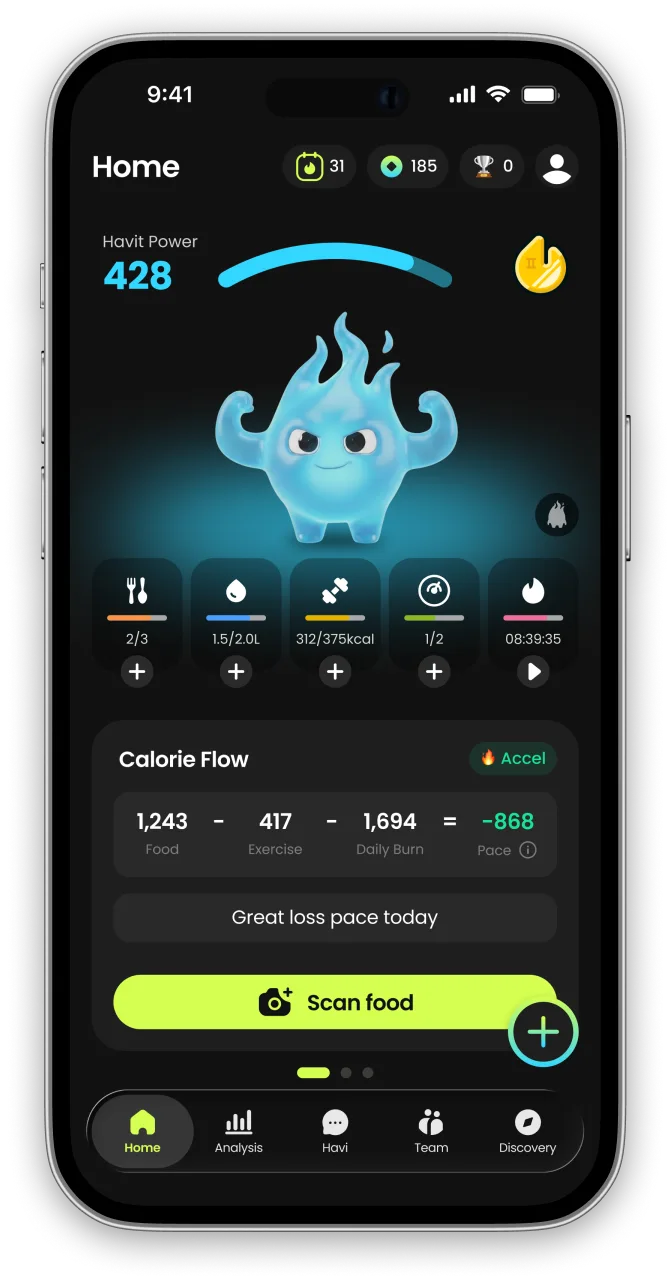
What is Havit?
Havit is an AI health companion for weight loss that protects muscle.
Unlike calorie-only trackers, Havit connects AI body-composition estimates, nutrition, hydration, sleep, steps, cycle, mood, and GLP-1 medication in one daily routine — so progress is measured by body composition, not just the number on the scale. Daily missions turn established behavior-change techniques into small repeatable actions, drawing on expertise from professionals formerly at Juvis Diet, one of Korea’s leading metabolic clinics.
In Havit’s own analysis of 1,090 GLP-1 users, people who logged consistently built stronger habits than the general user base. Read the GLP-1 Habit Report
Havit works with or without GLP-1 medication. It is a wellness app, not a medical device; body-composition results are estimates.

Continue in the App
Personalized wellness with your own data


References
- Evening Routine Interventions and Sleep Onset Latency: A Systematic Review and Meta-Analysis — Sleep Medicine Reviews, 2025
- Timing of Evening Light Exposure and Melatonin Suppression in Healthy Adults — Journal of Pineal Research, 2024
- Effects of Warm Bathing on Sleep Onset: A Meta-Analytic Review — Sleep Medicine Reviews, 2019
- Circadian Rhythm and Core Body Temperature: Implications for Sleep Optimization — Chronobiology International, 2023


