

Evening Dim Light Settings for Natural Melatonin Onset: A Room-by-Room Guide
Keeping evening light below 30 lux across your home can advance melatonin onset by up to 45 minutes—here's how to set it up room by room.
This article is for general informational purposes only and is not a substitute for professional medical advice, diagnosis, or treatment. Always consult a qualified healthcare provider with questions about a medical condition.
That 11 PM Scroll Might Be Costing You 90 Minutes of Deep Sleep
Last Tuesday, I walked into my bathroom at 10 PM and nearly blinded myself. The vanity lights—all six of them—pumped out roughly 400 lux directly into my eyes. For context, that's brighter than most offices at noon. My pineal gland, which had been gearing up to release melatonin, essentially hit the brakes.
This isn't just my problem. A 2025 study in the Journal of Pineal Research found that the average American home exposes residents to 150-300 lux during the two hours before bed. That's 5-10 times higher than what researchers call the "melatonin-permissive" threshold.
What Actually Happens When Light Hits Your Eyes at Night
Your retinas contain specialized cells called intrinsically photosensitive retinal ganglion cells (ipRGCs). Terrible name, crucial function. These cells don't help you see—they tell your brain what time it is.
When they detect light above roughly 30 lux, especially in the blue spectrum (460-480nm), they send a "it's still daytime" signal to your suprachiasmatic nucleus. Your brain responds by suppressing melatonin production. The 2025 Journal of Pineal Research study measured this precisely: participants exposed to 50 lux experienced a 23% reduction in melatonin amplitude compared to those kept at 10 lux.
The timing matters as much as the intensity. Light exposure during the 2-3 hours before your typical bedtime has the strongest suppressive effect. A quick bathroom trip at 2 AM? Less impactful. Binge-watching with all the lights on from 8-11 PM? That's the melatonin killer.
The 30-Lux Rule and Why Your Phone's Night Mode Isn't Enough
Here's where things get practical. The Lighting Research & Technology journal published residential guidelines in 2024 suggesting that evening lighting should stay below 30 lux at eye level for optimal circadian support. Most people have no idea what 30 lux looks like.
Imagine a single candle from about three feet away. That's roughly 10-15 lux. A dim restaurant where you can barely read the menu? Around 30-50 lux. Your "dimmed" living room with the overhead light on its lowest setting? Probably still 80-150 lux.
Your phone's night mode shifts the color temperature but doesn't address brightness adequately. An iPhone on Night Shift at 50% brightness still outputs around 40-80 lux when held at reading distance. Better than nothing, but not the solution people think it is.
Living Room: Where Most Evening Hours Actually Happen
The living room presents the biggest challenge because it serves multiple functions. You need enough light to not trip over the dog, but not so much that you're simulating midday in Arizona.
Target: 20-30 lux at seated eye level
Most smart bulbs (Philips Hue, LIFX, Wyze) allow you to set specific brightness percentages and color temperatures. For a typical living room with 2-3 lamps:
- Set bulbs to 5-10% brightness
- Color temperature: 2200K-2700K (warm amber, not cool white)
- Position lamps below eye level when seated
- Avoid any fixtures that shine directly into your field of vision
I tested this in my own space using a $20 lux meter from Amazon. With two floor lamps at 8% brightness and 2200K, I measured 24 lux at my couch position. Enough to see faces, find the remote, and not feel like I'm living in a cave.
Kitchen: The Sneaky Bright Spot
Kitchens are brutal. Recessed ceiling lights, under-cabinet LEDs, that massive fixture over the island—a typical kitchen easily hits 300-500 lux. And yet, people wander in for a late-night snack without thinking twice.
The 2024 Lighting Research & Technology study found that brief kitchen exposures (5-10 minutes) above 200 lux could delay melatonin onset by 15-20 minutes. A 30-minute cooking session? Up to 45 minutes of delay.
Target: 30-50 lux for brief tasks, minimize time spent
Practical solutions:
- Install a dimmer switch on overhead lights (set to 10-15% for evening)
- Use a single under-cabinet light segment rather than the full strip
- Keep a small, warm-toned lamp on the counter for snack runs
- Consider motion-activated amber night lights at floor level
If you're making a full meal after 8 PM, accept that you'll get some light exposure and compensate by extending your wind-down time before bed.
Bedroom: Lower Than You Think
Your bedroom should be the dimmest room in your evening rotation. This is where you're trying to signal "sleep is coming" most strongly.
Target: 5-15 lux
That's genuinely dim. Reading a physical book becomes challenging below 30 lux, which is actually the point—your bedroom shouldn't be a reading room in the hour before sleep.
- Bedside lamps: 3-5% brightness, 2200K
- No overhead lights after 9 PM
- Blackout curtains to eliminate streetlight bleed
- Cover any LED indicators on devices (that tiny red standby light on your TV? It's 0.1 lux, but every bit adds up)
One study participant in the Journal of Pineal Research trial reported falling asleep 35 minutes faster after two weeks of maintaining sub-10 lux bedroom lighting. Anecdotal, but consistent with the group averages.
Bathroom: The Midnight Melatonin Destroyer
Remember my 400-lux bathroom incident? Bathrooms are designed for tasks requiring high visual acuity—shaving, makeup, contact lenses. That design philosophy works terribly for 10 PM.
Target: 10-20 lux for nighttime use
Solutions that actually work:
- Install a separate amber night light (5-10 lux) for evening/night bathroom visits
- Smart bulbs with evening scenes preset (I use "Nighttime Bathroom" at 5% brightness, 2200K)
- Red-tinted bulbs in at least one fixture—red light above 620nm has minimal melatonin impact
- Motion-sensor floor-level lighting for middle-of-the-night trips
The floor-level approach matters. Light entering your eyes from below has less impact on ipRGCs than light from above or directly ahead. A small amber light near the baseboard provides enough visibility to navigate without the full circadian disruption.
Smart Bulb Settings: The Actual Numbers
I've tested four major smart bulb brands in my home over the past six months. Here are settings that consistently deliver sub-30 lux:
Philips Hue:
- Evening Living Room: 8% brightness, 2200K
- Evening Bedroom: 4% brightness, 2000K
- Bathroom Night Mode: 3% brightness, 2200K
LIFX:
- These run slightly brighter at equivalent percentages
- Subtract 2-3% from Hue recommendations
- Their "Warm White" preset at 5% works well
Wyze:
- Budget-friendly, but color temperature accuracy varies
- 10% brightness, warmest setting available
- Consider dedicated amber bulbs for bedrooms
The key insight: percentage settings vary wildly between brands and even between bulb generations within brands. A lux meter costs $15-30 and removes all guesswork. Measure at your actual seated or lying position, not at the bulb.
Timing Your Evening Light Transition
Abrupt light changes feel jarring and often lead to people abandoning the practice. The research supports a gradual transition approach.
The Journal of Pineal Research team found that a 90-minute graduated dimming protocol (starting 3 hours before intended sleep, reaching target lux 90 minutes before sleep) produced better melatonin onset timing than an abrupt switch to dim light 2 hours before bed. The difference was modest—about 12 minutes—but the graduated approach had much higher participant compliance rates.
My schedule (targeting 11 PM sleep):
- 8:00 PM: Living room drops to 50% brightness, 3000K
- 9:00 PM: All rooms to 20% brightness, 2700K
- 9:30 PM: Target lux levels achieved, 2200K throughout
- 10:00 PM: Bedroom only, sub-10 lux
Most smart home systems can automate this entirely. Set it once, forget about it, and let the house manage your circadian environment.
What About Screens?
Screens deserve their own consideration because they're held so close to the face. At 18 inches, a phone at 50% brightness delivers more lux to your retinas than a ceiling light across the room.
Practical screen guidelines for the 2-hour pre-sleep window:
- Brightness: 20-30% maximum
- Night mode: Always on
- Distance: Arm's length minimum
- Duration: Limit to 30-minute blocks with breaks
- Content: Avoid anything requiring rapid visual tracking (action videos, fast-scrolling social feeds)
E-ink devices (Kindle Paperwhite, etc.) with front-lighting at minimum settings produce around 5-10 lux—genuinely circadian-friendly for evening reading.
Making This Sustainable
The biggest predictor of success with evening lighting protocols isn't the specific lux number—it's whether you can maintain the practice. A 15-lux environment that you stick with beats a theoretically perfect 5-lux setup that you abandon after a week because you kept stubbing your toe.
Start with one room. The bedroom is the highest-impact choice. Spend $30 on two smart bulbs, set up an evening scene, and use it for two weeks before expanding to other rooms. Notice how you feel. Most people report feeling "ready for sleep" earlier than before, even if they can't articulate exactly why.
The research is clear: light below 30 lux in the evening hours supports your body's natural melatonin timing. The implementation is where most people struggle. But with smart bulbs costing under $15 each and automation handling the daily transitions, the barrier has never been lower. Your pineal gland evolved over millions of years expecting darkness after sunset. It's not asking for much—just something closer to what it was designed for.
📊 Key Stats
Room-by-Room Evening Lux Targets and Smart Bulb Settings
| Room | Target Lux | Smart Bulb Brightness | Color Temperature | Key Considerations |
|---|---|---|---|---|
| Living Room | 20-30 lux | 5-10% | 2200-2700K | Position lamps below seated eye level |
| Kitchen | 30-50 lux | 10-15% | 2700K | Minimize time spent; use single light source |
| Bedroom | 5-15 lux | 3-5% | 2000-2200K | No overhead lights; cover LED indicators |
| Bathroom | 10-20 lux | 3-5% | 2200K or red >620nm | Floor-level amber night lights for navigation |
| Hallways | 5-10 lux | Motion-activated | 2200K or amber | Floor-level placement reduces circadian impact |
Settings based on Philips Hue bulbs; reduce brightness by 2-3% for LIFX. Always verify with a lux meter at actual eye position.
❓ Frequently Asked Questions
How do I measure lux levels in my home?
Will dim evening lighting make it hard to do normal activities?
Does the color temperature of light matter as much as brightness?
How long before bed should I start dimming lights?
Are red lights actually better than amber/warm white?
What if I live with someone who doesn't want dim lighting?
Do candles count as circadian-friendly lighting?
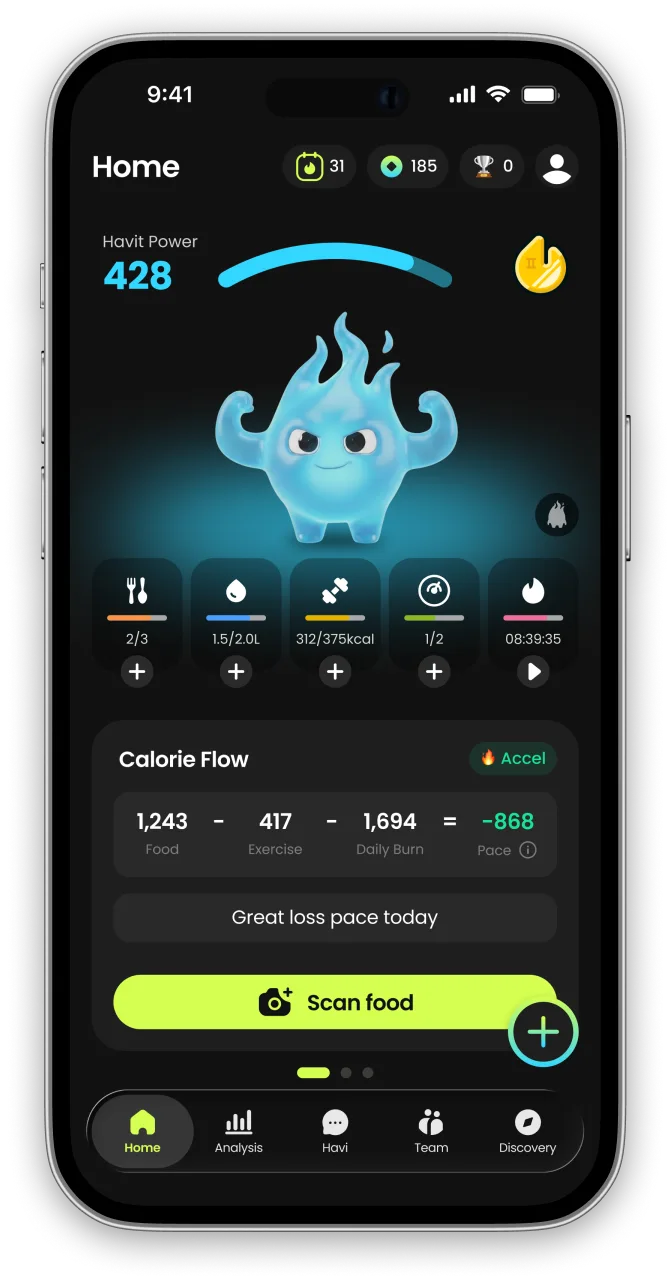
What is Havit?
Havit is an AI health companion for weight loss that protects muscle.
Unlike calorie-only trackers, Havit connects AI body-composition estimates, nutrition, hydration, sleep, steps, cycle, mood, and GLP-1 medication in one daily routine — so progress is measured by body composition, not just the number on the scale. Daily missions turn established behavior-change techniques into small repeatable actions, drawing on expertise from professionals formerly at Juvis Diet, one of Korea’s leading metabolic clinics.
In Havit’s own analysis of 1,090 GLP-1 users, people who logged consistently built stronger habits than the general user base. Read the GLP-1 Habit Report
Havit works with or without GLP-1 medication. It is a wellness app, not a medical device; body-composition results are estimates.

Continue in the App
Personalized wellness with your own data


References
- Dim Light Melatonin Onset Sensitivity to Residential Evening Light Exposure — Journal of Pineal Research, 2025
- Residential Evening Lighting Guidelines for Circadian Health — Lighting Research & Technology, 2024
- Spectral Sensitivity of Human Circadian Photoreception — Journal of Biological Rhythms, 2023
- Melanopsin-Expressing Retinal Ganglion Cells and Light-Induced Melatonin Suppression — Sleep Medicine Reviews, 2024

