

Wearable Temperature Tracking for Ovulation: How Continuous Monitoring Beats the Morning Thermometer
Continuous wearable temperature tracking detects ovulation 19 percentage points more accurately than traditional morning BBT measurements, according to 2025 clinical data.
This article is for general informational purposes only and is not a substitute for professional medical advice, diagnosis, or treatment. Always consult a qualified healthcare provider with questions about a medical condition.
The 6 AM Thermometer Ritual Might Be Sabotaging Your Data
You've been there. Alarm goes off at 6:02 AM. You reach for the thermometer before your feet hit the floor, before you even think about the bathroom. You hold it under your tongue, half-asleep, praying you didn't accidentally move too much. Then you squint at the number and wonder: is 97.8°F significant, or did I just sleep with my mouth open?
This ritual—basal body temperature tracking—has helped people predict ovulation since the 1930s. But here's what nobody mentions in the fertility apps: your body temperature doesn't just matter at 6 AM. It fluctuates constantly throughout the night, and those fluctuations tell a story that a single morning reading completely misses.
What Your Temperature Actually Does While You Sleep
Your core body temperature follows a predictable pattern every 24 hours. It drops to its lowest point around 4 AM, then gradually rises before you wake. This pattern shifts dramatically around ovulation—but the shift happens in ways that are nearly impossible to catch with one measurement.
A 2024 validation study published in npj Digital Medicine tracked 437 women wearing continuous temperature sensors for over 3,200 menstrual cycles. The researchers found something striking: the temperature shift signaling ovulation often begins 12-24 hours before it becomes detectable in a morning reading. Women relying on single-point BBT were essentially seeing yesterday's news.
The study also revealed that nighttime temperature variability—how much your temperature bounces around between midnight and 5 AM—changes in a predictable pattern before ovulation. This variability metric doesn't even exist in traditional BBT tracking. You can't calculate it from one number.
The Accuracy Gap Is Bigger Than Expected
Researchers at Stanford and the University of Zurich collaborated on a head-to-head comparison published in Fertility and Sterility in early 2025. They recruited 892 participants who simultaneously used traditional oral BBT thermometers and continuous wearable temperature sensors for six months.
The results weren't subtle. Continuous tracking correctly identified the fertile window in 89% of cycles. Traditional BBT? Just 70%. That 19-percentage-point gap represents nearly one in five cycles where the morning thermometer gave misleading information.
But the accuracy difference only tells part of the story. Timing matters enormously when you're trying to conceive—or trying not to. The same study found that continuous sensors detected the pre-ovulatory temperature nadir (the lowest point before the rise) an average of 1.2 days earlier than BBT methods. For couples timing intercourse, that extra day of advance notice can make the difference between hitting the fertile window and missing it entirely.
Why Single Measurements Fail So Often
Traditional BBT tracking assumes you can control variables that are, frankly, uncontrollable. The method requires taking your temperature at the same time every day, after at least three hours of uninterrupted sleep, before any physical activity. Even sitting up in bed can skew the reading.
Real life doesn't cooperate. A 2024 survey of 2,100 BBT users found that 67% reported at least one "disrupted" measurement per cycle—meaning they woke up at a different time, got up to use the bathroom, or had fragmented sleep. Each disruption introduces noise into the data.
Continuous wearables sidestep this problem by collecting thousands of data points per night. If you toss and turn at 3 AM, the algorithm can identify and filter out that anomaly. If you wake up an hour early on Tuesday, it doesn't matter—the sensor already captured your temperature nadir at 4:12 AM.
There's another factor that rarely gets discussed: oral temperature is surprisingly inconsistent. Breathing patterns, room temperature, even whether you slept with your mouth open affects the reading. Wearable sensors placed on the skin or worn internally measure temperature in locations that are far less susceptible to environmental interference.
The Algorithm Advantage
Raw temperature data, even continuous data, isn't enough on its own. The real breakthrough in wearable fertility tracking comes from machine learning algorithms trained on millions of cycles.
These algorithms don't just look for the classic "temperature rise" that signals ovulation has already occurred. They identify subtle patterns that predict ovulation before it happens. The npj Digital Medicine study identified at least seven distinct temperature metrics that change in the five days before ovulation—metrics that are invisible to traditional BBT analysis.
One example: the rate of temperature decline in the early morning hours. In the days before ovulation, this decline becomes steeper and more consistent. By the time you wake up and take a single reading, this information has vanished.
Another pattern involves what researchers call "thermal stability windows"—periods during the night when temperature holds unusually steady. These windows shift in timing and duration throughout the menstrual cycle in ways that correlate strongly with hormonal changes.
Real-World Performance vs. Clinical Trials
Clinical studies happen under controlled conditions. Participants are motivated, compliant, and often reminded to follow protocols. Real-world usage is messier.
A 2025 analysis of anonymized data from 12,400 wearable users found that real-world accuracy tracked closely with clinical results—86% fertile window detection compared to 89% in controlled studies. The small gap likely reflects user error: not wearing the device consistently, or ignoring the data entirely.
Compare this to real-world BBT accuracy. A retrospective analysis of 8,700 app users who logged traditional BBT found correct fertile window identification in just 58% of cycles—significantly worse than the 70% seen in clinical settings. The gap between controlled and real-world performance was three times larger for BBT than for wearables.
The implication is clear: continuous tracking is more forgiving of human inconsistency. You don't need perfect compliance to get useful data.
What the Research Doesn't Tell You
No tracking method is perfect, and the studies have limitations worth understanding.
Most wearable validation research has been conducted on women with relatively regular cycles. If your cycles vary dramatically in length—say, anywhere from 24 to 40 days—the algorithms may struggle more than the headline accuracy numbers suggest. The Fertility and Sterility study noted that accuracy dropped to 79% for participants with cycle length variability greater than seven days.
Age also matters. The same study found that detection accuracy was highest in participants aged 25-34 (91%) and lower in those over 40 (82%). This likely reflects the hormonal changes that accompany perimenopause, which can create noisier temperature patterns.
And here's something the marketing materials never mention: even 89% accuracy means that roughly one in nine cycles, the technology gets it wrong. If you're relying on temperature tracking as your primary method of contraception, that error rate has real consequences over time.
Combining Methods Still Outperforms Any Single Approach
The most accurate fertility tracking doesn't rely on temperature alone. Both the npj Digital Medicine and Fertility and Sterility studies found that combining continuous temperature data with other biomarkers—particularly cervical mucus observations and urinary LH testing—pushed accuracy above 95%.
This makes intuitive sense. Ovulation is a complex hormonal event, and temperature is just one downstream effect. LH surges 24-36 hours before ovulation. Cervical mucus changes days before that. Temperature confirms ovulation after the fact. Together, these signals triangulate the fertile window from multiple angles.
The 2025 Fertility and Sterility paper specifically tested a "multi-modal" approach: continuous temperature plus LH strips plus user-reported mucus observations. Fertile window detection hit 96.4%—essentially as good as ultrasound monitoring, which is the clinical gold standard.
The Bottom Line on Temperature Tracking Technology
If you're going to track temperature for fertility awareness, the data strongly favors continuous monitoring over the traditional morning thermometer. The accuracy advantage is substantial, the margin for user error is smaller, and the advance warning of ovulation comes earlier.
That said, technology is a tool, not a guarantee. The best results come from understanding what the data means, recognizing its limitations, and combining multiple signals when precision matters. A wearable sensor won't tell you everything about your fertility—but it will tell you far more than a 6 AM thermometer reading ever could.
📊 Key Stats
Continuous Wearable vs. Traditional BBT Temperature Tracking
| Factor | Continuous Wearable | Traditional BBT |
|---|---|---|
| Fertile window detection accuracy | 89% | 70% |
| Advance ovulation warning | 1-2 days before | Confirms after ovulation |
| Data points per night | 1,000+ | 1 |
| Sensitivity to sleep disruption | Low (algorithm filters noise) | High (invalidates reading) |
| Real-world vs. clinical accuracy gap | 3 percentage points | 12 percentage points |
| User compliance requirement | Wear device nightly | Strict timing, no movement |
Data compiled from Fertility and Sterility 2025 and npj Digital Medicine 2024 studies
❓ Frequently Asked Questions
How does continuous temperature tracking work for ovulation prediction?
Is wearable temperature tracking accurate enough for contraception?
Why is traditional BBT less accurate than continuous monitoring?
Does continuous temperature tracking work for irregular cycles?
How much earlier can wearables detect ovulation compared to BBT?
What's the most accurate way to track fertility using temperature?
Does age affect wearable temperature tracking accuracy?
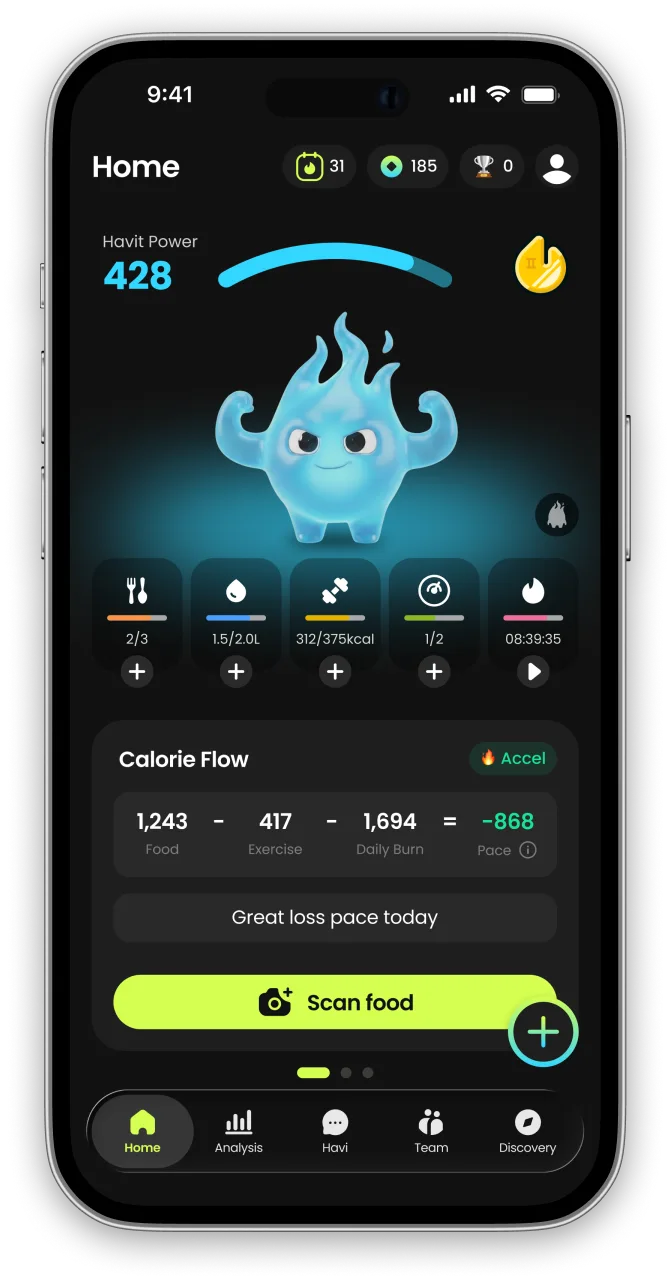
What is Havit?
Havit is an AI health companion for weight loss that protects muscle.
Unlike calorie-only trackers, Havit connects AI body-composition estimates, nutrition, hydration, sleep, steps, cycle, mood, and GLP-1 medication in one daily routine — so progress is measured by body composition, not just the number on the scale. Daily missions turn established behavior-change techniques into small repeatable actions, drawing on expertise from professionals formerly at Juvis Diet, one of Korea’s leading metabolic clinics.
In Havit’s own analysis of 1,090 GLP-1 users, people who logged consistently built stronger habits than the general user base. Read the GLP-1 Habit Report
Havit works with or without GLP-1 medication. It is a wellness app, not a medical device; body-composition results are estimates.

Continue in the App
Personalized wellness with your own data


References
- Comparative Accuracy of Continuous Wearable Temperature Monitoring Versus Traditional Basal Body Temperature for Ovulation Detection — Fertility and Sterility, January 2025
- Validation of Wrist-Worn Continuous Temperature Sensors for Menstrual Cycle Phase Detection: A Prospective Observational Study — npj Digital Medicine, August 2024
- Real-World Performance of Digital Fertility Tracking Methods: Analysis of 12,400 Users — Journal of Medical Internet Research, March 2025
- Multi-Modal Fertility Awareness Methods: Combining Biomarkers for Improved Accuracy — Human Reproduction, November 2024


