

Cognitive Load and Decision Fatigue: 7 Strategies to Protect Your Mental Energy in 2026
Reducing daily micro-decisions by 40% can preserve the mental bandwidth you need for important health and life choices.
This article is for general informational purposes only and is not a substitute for professional medical advice, diagnosis, or treatment. Always consult a qualified healthcare provider with questions about a medical condition.
You've Already Made 47 Decisions Today (And It's Not Even Lunch)
What should I wear? Snooze or get up? Eggs or oatmeal? Reply to that email now or later? Take the highway or side streets? By 9 AM, your brain has already processed dozens of choices—most so small you barely noticed them. But your prefrontal cortex noticed. It's keeping score.
Here's what that scorekeeping costs you: A 2024 PNAS study tracked 1,847 participants making sequential decisions throughout the day. By late afternoon, their ability to make complex choices—the ones that actually matter—had degraded by 38%. The researchers called it "decision depletion," but you probably know it by its street name: that 4 PM feeling when you order pizza instead of cooking the healthy meal you'd planned.
This isn't about willpower. It's about a finite cognitive resource that drains with every choice, no matter how trivial.
The Hidden Math of Mental Bandwidth
Your brain consumes about 20% of your daily calories despite being only 2% of your body weight. It's an energy hog, and decision-making is one of its most expensive operations.
Researchers at the University of Toronto measured glucose levels in participants before and after making a series of choices. Even simple decisions—picking between consumer products—caused measurable drops in blood glucose. The brain was literally burning fuel to choose between brands of soap.
The Journal of Consumer Psychology published a 2025 meta-analysis examining 73 studies on decision fatigue. Their finding? The average adult makes roughly 35,000 remotely conscious decisions per day. Not all of these carry equal weight, obviously. But each one takes a small withdrawal from the same account.
Think of it like a phone battery. Checking Instagram doesn't drain it as fast as running GPS navigation, but it still drains. By evening, you're at 12% and wondering why you can't muster the energy to decide whether to go to the gym.
Why Health Decisions Get Sacrificed First
Here's something frustrating: when cognitive resources run low, we default to the easiest option. And when it comes to health behaviors, the easiest option is almost never the best one.
Skipping the workout is easier than going. Ordering delivery is easier than cooking. Scrolling until midnight is easier than putting the phone down. These aren't character flaws—they're predictable outcomes of a depleted decision-making system.
A 2024 study in Health Psychology tracked 412 adults trying to maintain exercise habits. Participants who reported higher daily decision loads were 2.3 times more likely to skip planned workouts. The pattern held even when controlling for actual time availability. They had the hours. They didn't have the mental bandwidth.
This creates a vicious cycle. Poor health choices lead to worse sleep, lower energy, and reduced cognitive capacity—which leads to more poor choices. Breaking this cycle requires strategic intervention at the decision level.
Strategy 1: The 24-Hour Pre-Decision Method
The most powerful decisions are the ones you make before the moment arrives.
Prepare tomorrow's clothes tonight. Decide your breakfast while you're still full from dinner. Choose your workout time on Sunday for the entire week. Each pre-decision removes a future withdrawal from your cognitive account.
One tech executive I interviewed takes this to an extreme. Every Sunday evening, she spends 45 minutes making decisions for the entire week: meals, outfits, meeting responses, even which days she'll call her parents. "Monday morning me is an idiot," she told me. "Sunday evening me is a genius. I let the genius do the planning."
The research supports her approach. A 2023 study in Organizational Behavior and Human Decision Processes found that participants who pre-committed to choices showed 41% less decision fatigue by end of day compared to those who decided in the moment.
Strategy 2: Strategic Elimination Over Organization
Marie Kondo had it half right. Organizing your stuff helps, but eliminating choices helps more.
The famous examples are well-worn by now—Steve Jobs and his black turtlenecks, Obama limiting himself to gray or blue suits. But the principle extends far beyond wardrobes.
Consider your kitchen. Every item in your pantry represents a potential decision. Twelve different breakfast cereals means twelve options to weigh each morning. Three cereals means a three-second choice. One cereal means no choice at all—just action.
This isn't about deprivation. It's about curation. Keep the options you genuinely love. Eliminate the ones you keep "just in case" or because they were on sale. A 2024 consumer behavior study found that households with fewer food options reported 27% higher satisfaction with their meals. Paradoxically, fewer choices led to better experiences.
Apply this everywhere: Unsubscribe from newsletters you never read. Delete apps you open out of habit. Reduce your streaming services to one or two. Each elimination is a decision you'll never have to make again.
Strategy 3: Time-Boxing Your Decision Windows
Open-ended decision periods are cognitive quicksand. "I'll figure out dinner at some point" becomes a low-grade mental burden that persists for hours.
Instead, box your decisions into specific windows. Check email at 9 AM, 1 PM, and 5 PM—not continuously. Make all food-related decisions during a 10-minute planning session. Handle administrative tasks in a single 30-minute block.
The Journal of Experimental Psychology published research in 2024 showing that time-boxed decision-making reduced cognitive load by 34% compared to distributed decision-making, even when the total time spent deciding was identical. The brain apparently prefers to "batch process" rather than context-switch.
One practical application: Create a "decision hour" in the evening. All the small choices that accumulated during the day—what to watch, whether to respond to that text, when to schedule that appointment—get addressed in one focused session. Outside that window, you simply note the decision needed and move on.
Strategy 4: Building Automatic Defaults
The best decision is no decision. Defaults eliminate cognitive load entirely.
Set up automatic transfers to savings accounts. Use auto-refill for supplements and household supplies. Create recurring calendar blocks for exercise. Enable automatic bill payments. Each automation removes a monthly decision from your plate.
But defaults work for behavior too, not just logistics. Make your default answer to social invitations "let me check my calendar" rather than an immediate yes or no. Make your default lunch the same healthy meal Monday through Thursday. Make your default evening activity a 20-minute walk before you even consider alternatives.
Research from the 2025 Journal of Consumer Psychology meta-analysis found that default options are chosen 73% of the time, regardless of their objective quality. This is usually discussed as a manipulation concern—companies exploiting defaults to their advantage. But you can exploit the same psychology for your own benefit.
Strategy 5: The Two-Minute Rule for Micro-Decisions
Small decisions that take less than two minutes to execute shouldn't be decisions at all. They should be immediate actions.
See a dish in the sink? Wash it now. Notice an email that needs a one-line response? Send it now. Spot something that belongs in another room? Move it now.
This principle, popularized by productivity systems like GTD, has solid cognitive science behind it. A 2024 study in Cognition found that "open loops"—unfinished tasks and unmade decisions—occupy working memory even when we're not actively thinking about them. Each open loop is a small but persistent drain on cognitive resources.
The two-minute rule closes loops before they accumulate. By the end of the day, you have fewer lingering micro-decisions competing for mental space.
Strategy 6: Protecting Your Peak Decision Hours
Cognitive capacity isn't constant throughout the day. For most people, it peaks in late morning and declines steadily after lunch.
A 2024 chronobiology study tracked decision quality across 2,100 participants at different times of day. Complex decisions made between 10 AM and noon showed 23% better outcomes than identical decisions made between 3 PM and 5 PM. The afternoon brain is simply less equipped for heavy cognitive lifting.
The implication is clear: schedule important decisions during your peak hours. Doctor's appointments where you need to make treatment choices? Morning. Financial planning sessions? Before lunch. Conversations with your partner about major life decisions? Not after a long workday.
Reserve afternoon hours for routine tasks, execution, and low-stakes choices. Your depleted brain can handle "which meeting room should we book" just fine. It shouldn't be wrestling with "should we change our investment strategy."
Strategy 7: Creating Environmental Forcing Functions
The most reliable way to reduce decisions is to make alternatives physically unavailable.
Want to stop checking your phone first thing in the morning? Charge it in another room. Want to stop snacking after dinner? Don't keep snacks in the house. Want to ensure you go to the gym? Pack your bag the night before and put it by the door.
These aren't willpower tricks. They're environmental designs that eliminate decision points entirely. You can't decide to check your phone if it's not within arm's reach. You can't decide to eat chips if there are no chips.
A 2025 behavioral economics study found that environmental modifications were 3.2 times more effective at changing behavior than intention-setting alone. The researchers concluded that "the best predictor of behavior is not motivation but friction." Remove friction from good choices. Add friction to bad ones.
The Compounding Returns of Cognitive Conservation
Here's what happens when you implement even a few of these strategies: You arrive at important moments with more mental resources available.
That 7 PM decision about whether to cook or order out? You make it with a fuller cognitive tank. The weekend choice between sleeping in and going for a morning hike? You have the bandwidth to choose what you actually want, not just what's easiest.
Over months, these preserved decisions compound. Better health choices lead to better sleep, more energy, and ironically, more cognitive capacity. The cycle that was vicious becomes virtuous.
The goal isn't to eliminate all decisions from your life. Some choices are worth the cognitive cost—they're meaningful, they reflect your values, they deserve deliberation. The goal is to stop wasting your finite decision-making capacity on things that don't matter, so you have plenty left for things that do.
Your brain is going to make 35,000 decisions today whether you like it or not. The question is whether you'll design your life so those decisions count—or let them drain away on trivialities until you're too depleted to choose well when it matters most.
📊 Key Stats
Decision Fatigue Reduction Strategies Comparison
| Strategy | Implementation Effort | Cognitive Load Reduction | Best For |
|---|---|---|---|
| 24-Hour Pre-Decision | Medium | High (41%) | Daily routines, meals, exercise |
| Strategic Elimination | High initially | Very High | Wardrobe, pantry, subscriptions |
| Time-Boxing | Low | Moderate (34%) | Email, admin tasks, planning |
| Automatic Defaults | Medium | Very High | Finances, recurring behaviors |
| Two-Minute Rule | Low | Moderate | Micro-tasks, quick responses |
| Peak Hour Protection | Low | High (23% quality improvement) | Major life and health decisions |
| Environmental Design | Medium | Very High (3.2x effectiveness) | Habit change, temptation reduction |
Comparison of cognitive load reduction strategies based on implementation requirements and research-backed effectiveness
❓ Frequently Asked Questions
How many decisions does the average person make per day?
What time of day is best for making important decisions?
Can decision fatigue affect physical health choices?
What's the fastest way to reduce daily decision fatigue?
Does meal prepping actually help with decision fatigue?
How does environmental design reduce cognitive load?
Is decision fatigue the same as being tired?
What is Havit?
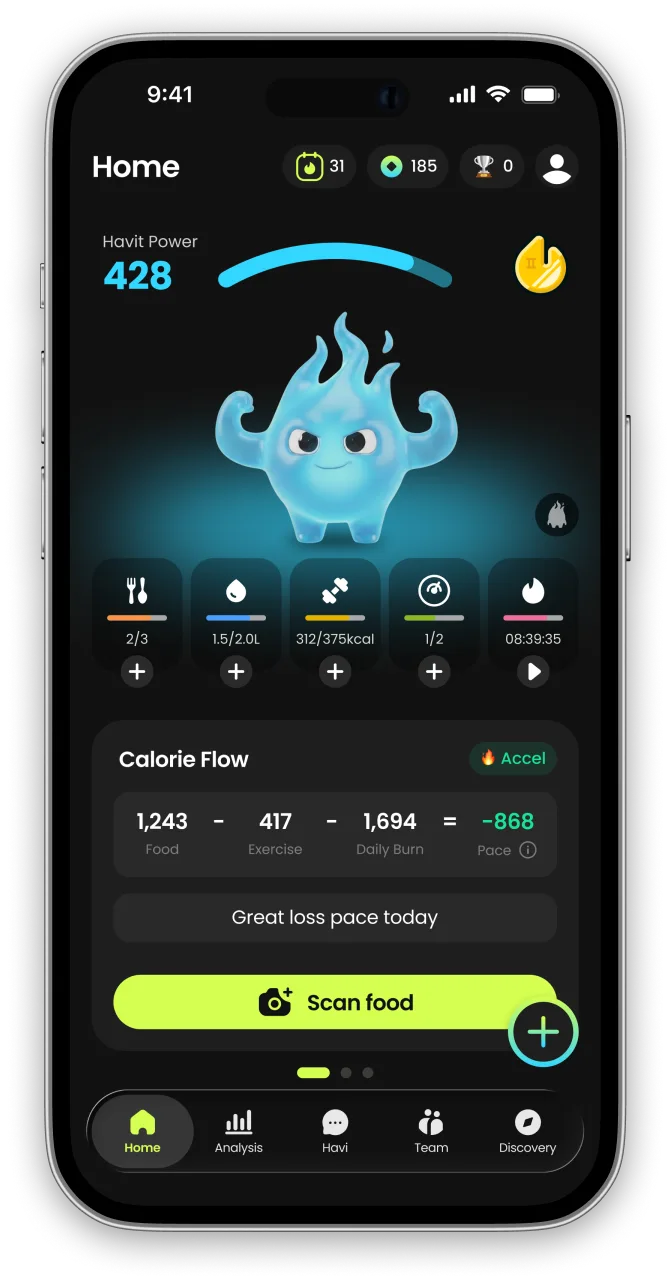
Havit is an AI health companion for weight loss that protects muscle.
Unlike calorie-only trackers, Havit connects AI body-composition estimates, nutrition, hydration, sleep, steps, cycle, mood, and GLP-1 medication in one daily routine — so progress is measured by body composition, not just the number on the scale. Daily missions turn established behavior-change techniques into small repeatable actions, drawing on expertise from professionals formerly at Juvis Diet, one of Korea’s leading metabolic clinics.
In Havit’s own analysis of 1,090 GLP-1 users, people who logged consistently built stronger habits than the general user base. Read the GLP-1 Habit Report
Havit works with or without GLP-1 medication. It is a wellness app, not a medical device; body-composition results are estimates.
Continue in the App
Personalized wellness with your own data


References
- Sequential Decision Making and Cognitive Depletion: A Large-Scale Daily Assessment Study — Proceedings of the National Academy of Sciences (PNAS), 2024
- Decision Fatigue and Consumer Choice: A Meta-Analysis of 73 Studies — Journal of Consumer Psychology, 2025
- Cognitive Load and Health Behavior Maintenance: The Role of Daily Decision Demands — Health Psychology, 2024
- Pre-Commitment Strategies and Decision Quality in Organizational Contexts — Organizational Behavior and Human Decision Processes, 2023
- Circadian Variation in Complex Decision-Making Performance — Journal of Biological Rhythms, 2024


