

Shift Work Sleep Schedule Adaptation Protocol: A Phased Light and Meal Timing Guide for 2026
Strategic light exposure windows and meal timing can cut shift work adaptation time from 8-12 days down to 3-5 days when matched to your chronotype.
This article is for general informational purposes only and is not a substitute for professional medical advice, diagnosis, or treatment. Always consult a qualified healthcare provider with questions about a medical condition.
Your Body Doesn't Know It's Tuesday Night
Sarah, a 34-year-old ICU nurse in Chicago, rotates through day, evening, and night shifts every two weeks. For years, she accepted the brain fog, the 3 AM hunger that nothing satisfies, the weird Sunday afternoons where she couldn't tell if she should be sleeping or awake. Then she discovered something that changed everything: her body wasn't broken. It was just receiving the wrong signals at the wrong times.
Here's what most shift workers don't realize. Your circadian rhythm isn't controlled by willpower or caffeine. It's controlled by three master signals: light hitting your eyes, food entering your stomach, and physical activity patterns. Get these signals aligned with your work schedule, and adaptation happens surprisingly fast. Get them wrong, and you're fighting your own biology every single shift.
This guide breaks down exactly how to send the right signals at the right times, based on emerging research from 2024-2025 that finally accounts for individual differences in chronotype. Because the protocol that works for your early-bird colleague might be the exact wrong approach for you.
Why Traditional Shift Work Advice Fails Most People
The standard recommendation you'll find everywhere goes something like this: blackout curtains, melatonin before day sleep, avoid caffeine after midnight. Reasonable enough. But a 2025 analysis published in Lancet Public Health tracked 12,400 rotating shift workers across Europe and found something striking. Workers following generic adaptation advice showed no significant improvement in sleep quality scores compared to those receiving no guidance at all.
The problem? Timing.
Generic advice ignores the 4-6 hour variation in natural circadian phase between early chronotypes and late chronotypes. Telling a night owl to take melatonin at 7 AM after a night shift might be perfect timing. Telling the same thing to an extreme morning person could actually delay their adaptation by pushing their rhythm in the wrong direction.
The same study identified three factors that predicted successful adaptation: personalized light exposure windows, consistent meal timing relative to sleep (not clock time), and a phased transition protocol rather than abrupt schedule changes. Workers who implemented all three adapted in 3.4 days on average. Those using none took 11.2 days.
That's a week of cognitive impairment, accident risk, and misery that's completely preventable.
Finding Your Chronotype Starting Point
Before diving into protocols, you need to know your baseline. Your chronotype isn't just whether you prefer mornings or evenings. It's your biological tendency toward a specific sleep-wake phase, encoded in genes like PER3 and CLOCK.
The simplest assessment: On days with zero obligations, when do you naturally fall asleep and wake up? Not when you force yourself to sleep, but when sleep comes easily.
- Early chronotype: Natural sleep 9 PM - 5 AM range
- Intermediate chronotype: Natural sleep 11 PM - 7 AM range
- Late chronotype: Natural sleep 1 AM - 9 AM or later
About 25% of people fall into each extreme category, with 50% somewhere in the middle. Here's the crucial insight: early chronotypes actually adapt faster to morning shifts but struggle significantly more with night shifts. Late chronotypes show the opposite pattern. A 2024 meta-analysis in Sleep examined 31 light therapy studies and found that chronotype-matched protocols produced 2.3 times greater circadian phase shifts than generic timing.
Your chronotype doesn't change much over your lifetime after age 25, though it does shift slightly earlier with age. Work with your biology, not against it.
The Phased Light Exposure Protocol
Light is the most powerful circadian signal, but timing is everything. Bright light at the wrong time doesn't just fail to help. It actively pushes your rhythm in the wrong direction.
The core principle: Light in the hours after your biological minimum temperature (usually 2-3 hours before natural wake time) advances your rhythm, making you sleepy earlier. Light in the hours before that minimum delays your rhythm, making you sleepy later.
For transitioning to night shifts (needing to delay your rhythm):
Early chronotypes should seek bright light (10,000 lux or outdoor daylight) from 6 PM to 10 PM on transition days, then shift that window 2-3 hours later each day. Wear blue-blocking glasses from 6 AM until sleep.
Late chronotypes have an easier path. Bright light from 9 PM to 1 AM on transition days, shifting later as needed. The delay direction aligns with their natural tendency.
For transitioning to day shifts (needing to advance your rhythm):
Late chronotypes face the harder adjustment. Bright light immediately upon waking, ideally 30 minutes at 10,000 lux. Strict light avoidance after 7 PM. This is where light therapy boxes earn their cost.
Early chronotypes often need minimal intervention. Their systems naturally want this schedule.
The phased approach matters enormously. Attempting to shift more than 2 hours per day creates a phenomenon called "circadian splitting" where different body systems adapt at different rates. Your sleep-wake cycle might adjust while your cortisol rhythm lags behind by days. That's the source of the persistent fatigue many shift workers experience even after they're sleeping adequately.
Meal Timing: The Underrated Second Signal
Your digestive system has its own circadian clock, somewhat independent of your brain's master clock. When these two clocks disagree, metabolic chaos follows. This explains why shift workers have 29% higher rates of metabolic syndrome even when controlling for sleep duration.
The emerging research points to a simple rule: eat during your biological day, minimize eating during your biological night, regardless of when you're actually working.
In practice, this means:
Night shift workers should front-load calories before the shift. A substantial meal 1-2 hours before starting work, a moderate snack at the shift midpoint, then minimal or no food in the final 4 hours. Yes, this means being hungry at 5 AM. Your body will adapt within a week.
Rotating shift workers should maintain consistent meal-to-sleep timing rather than consistent clock timing. If you eat dinner 5 hours before sleep on day shifts, maintain that 5-hour window when switching to nights. The absolute clock time changes, but the relationship to sleep stays constant.
A 2024 study from the University of Surrey tracked glucose responses in shift workers and found that eating identical meals at 3 AM versus 3 PM produced 41% higher glucose spikes at night. The food doesn't change. Your body's ability to process it does. Working with this reality rather than ignoring it makes a measurable difference.
Building Your Personal Adaptation Schedule
Let's construct a concrete example. Marcus works a rotating schedule: two weeks of day shifts (7 AM - 3 PM), two weeks of night shifts (11 PM - 7 AM). He's an intermediate chronotype, naturally sleeping around midnight to 8 AM when unrestricted.
Transition from days to nights (needs to delay rhythm by about 7 hours):
Day 1 (last day shift): Normal schedule. Begin light exposure 8-11 PM using a 10,000 lux light box while reading or watching TV. Delay bedtime to 1 AM.
Day 2 (off day): Sleep 1 AM - 9 AM. Light exposure 10 PM - 1 AM. Main meal at 6 PM, light snack at midnight. Bedtime 3 AM.
Day 3 (off day): Sleep 3 AM - 11 AM. Light exposure midnight - 3 AM. Main meal at 8 PM, snack at 2 AM. Bedtime 5 AM.
Day 4 (first night shift): Sleep 5 AM - 1 PM. Now aligned for 11 PM shift start. Main meal at 9 PM before work, snack at 3 AM, minimal food after.
Total transition: 3 days with gradual 2-hour shifts. Compare this to the common approach of staying up all night before the first night shift, which produces 4-5 days of impaired performance even after sleep normalizes.
The reverse transition (nights to days) follows similar logic but in the advance direction, with morning light exposure and earlier meal timing.
Equipment and Environment Setup
You don't need expensive gear, but a few targeted investments pay for themselves in reduced adaptation time.
Light therapy box (10,000 lux, UV-filtered): $40-150. Position at arm's length, 15-30 degrees above eye level. You don't need to stare at it. Having it in your peripheral vision while doing other activities works fine.
Blue-blocking glasses (amber or red lens): $15-40. The cheap ones work as well as expensive versions for circadian purposes. Wear during the 4-6 hours before intended sleep when light avoidance matters most.
Blackout solutions: Heavy curtains ($30-80) or blackout film for windows ($20-40). Your sleep environment should be dark enough that you can't see your hand at arm's length. Even small amounts of light during day sleep reduce melatonin production by 50% or more.
Smart lighting (optional but helpful): Programmable bulbs that shift color temperature throughout your personal "day" reinforce circadian signals automatically. Set warm, dim light (2700K or lower) for the hours before sleep, bright cool light (5000K+) for wake time.
The bedroom temperature also matters more for day sleep than night sleep. Aim for 65-68°F. Your body naturally drops temperature for sleep, but daytime ambient temperatures work against this. A cooling mattress pad or fan can make a noticeable difference.
Managing the Social and Practical Complications
The biology is straightforward. The life logistics are harder.
Family schedules don't rotate with yours. Social events happen during your sleep windows. Doctors' offices aren't open at 2 AM when you're awake and functional.
Some practical approaches that shift workers report success with:
Protect one transition day fiercely. If you have 2-3 days between shift changes, designate the first day as non-negotiable adaptation time. Explain to family that this day is as important as a work day. The investment pays off in better presence and mood during the remaining off days.
Anchor sleep when possible. If your schedule allows, maintain a consistent 4-hour sleep block that doesn't change between rotations. For example, always sleeping from 3 AM - 7 AM regardless of shift. This keeps one portion of your rhythm stable. The research on anchor sleep shows it reduces total adaptation time by about 30%.
Batch social obligations. Rather than scattering social events across your schedule, cluster them during the transition days when you're awake during normal hours anyway. This minimizes the circadian disruption from irregular scheduling.
Communicate with specifics. "I work nights" is vague. "I'll be awake and available between 8 PM and midnight this week" gives people actionable information. Most social relationships can flex around your schedule if you make the windows clear.
When to Seek Additional Support
Some people adapt to shift work reasonably well with lifestyle modifications alone. Others have underlying factors that make adaptation genuinely difficult.
Consider consulting a sleep specialist if:
- You've implemented light and meal timing protocols consistently for 4+ weeks without improvement
- You're sleeping fewer than 5 hours per 24-hour period regularly
- You experience symptoms beyond fatigue: significant mood changes, frequent illness, difficulty with tasks you previously handled easily
- You have a diagnosed sleep disorder that may interact with shift work demands
Shift work disorder is a recognized condition affecting an estimated 10-38% of shift workers (the wide range reflects different diagnostic criteria). It's characterized by insomnia and excessive sleepiness specifically related to work schedule, persisting for at least 3 months. Treatments exist beyond lifestyle modification, including carefully timed melatonin, modafinil for alertness during shifts, and in some cases, strategic use of short-acting sleep aids.
The goal isn't to medicalize normal shift work adjustment. It's to recognize when you've hit the limits of what behavioral changes can accomplish for your particular biology.
Tracking Progress and Adjusting
How do you know if your protocol is working?
The most practical metric: sleep efficiency. If you're in bed for 7 hours but only sleeping 5, your adaptation is incomplete. Track this for a week during each rotation. Improving efficiency (time asleep divided by time in bed) indicates your circadian rhythm is aligning with your schedule.
Other useful markers:
- Time to fall asleep (should be under 20 minutes when well-adapted)
- Number of awakenings during sleep
- Subjective alertness 4 hours into your shift (the typical low point)
- Appetite timing (hunger should align with your planned meal windows)
Adjust your protocol based on what you observe. If you're falling asleep easily but waking after 4 hours, your light exposure timing may need to shift earlier. If you can't fall asleep at your target time, you may need more evening light (for delaying) or less evening light (for advancing).
The first rotation using a new protocol is always roughest. Give any approach at least two full rotations before concluding it doesn't work for you. Circadian adaptation has momentum. Consistency compounds.
Sarah, the ICU nurse from the opening, now transitions between rotations in 3 days instead of 10. She's not fighting her biology anymore. She's working with it. The brain fog lifted. The weird hunger patterns resolved. She still works the same demanding schedule. But her body finally knows what time it is.
📊 Key Stats
Light Exposure Protocol by Chronotype and Shift Direction
| Chronotype | Transition to Night Shifts | Transition to Day Shifts | Adaptation Difficulty |
|---|---|---|---|
| Early (sleep 9 PM-5 AM) | Light 6-10 PM, shift 2-3 hrs later daily; blue blockers from 6 AM | Minimal intervention needed; natural alignment | Night shifts: Hard / Day shifts: Easy |
| Intermediate (sleep 11 PM-7 AM) | Light 8-11 PM, shift 2 hrs later daily; blue blockers from 7 AM | Morning light 30 min at wake; avoid light after 8 PM | Night shifts: Moderate / Day shifts: Moderate |
| Late (sleep 1 AM-9 AM+) | Light 9 PM-1 AM, shift later as needed; natural delay tendency helps | Bright light immediately at wake; strict light avoidance after 7 PM | Night shifts: Easy / Day shifts: Hard |
Protocol timing based on 2024 Sleep meta-analysis findings on chronotype-specific light therapy effectiveness
❓ Frequently Asked Questions
How long should I use a light therapy box each session?
Can I drink coffee during night shifts without disrupting my adaptation?
Should I take melatonin to help with shift work adaptation?
What if I only have one day off between rotating shifts?
How do I handle shift work adaptation if I have young children with fixed schedules?
Do blue-blocking glasses actually work, or is it marketing?
Is permanent night shift easier than rotating shifts?
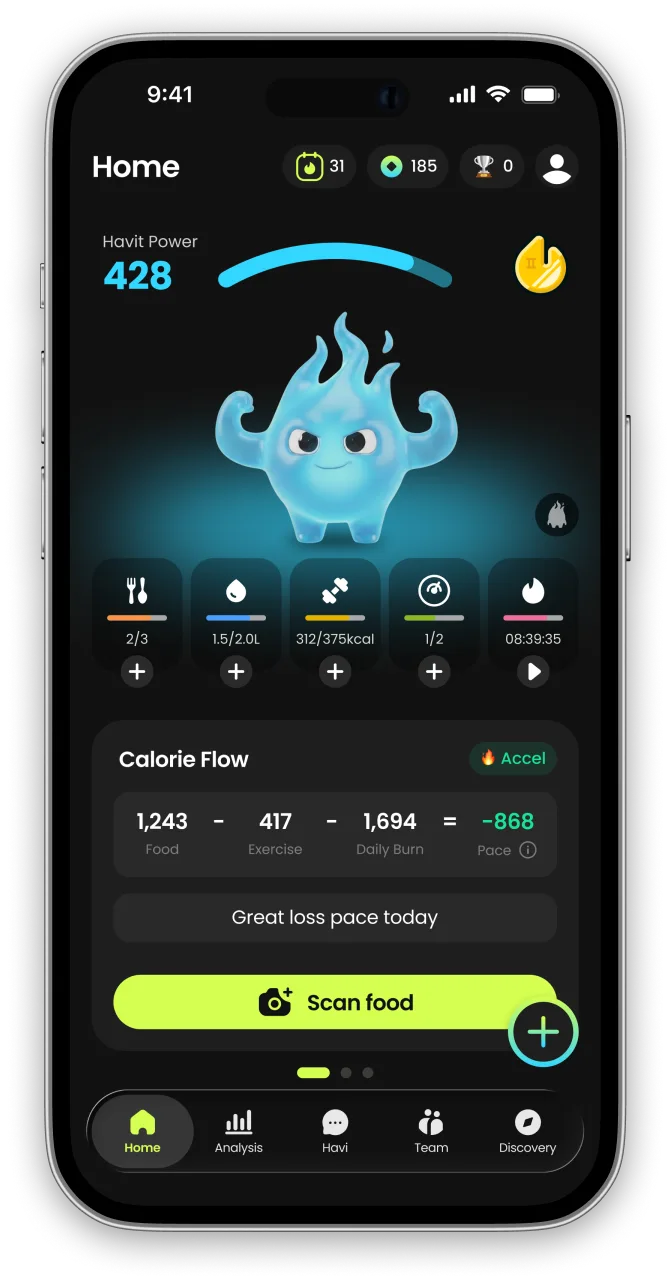
What is Havit?
Havit is an AI health companion for weight loss that protects muscle.
Unlike calorie-only trackers, Havit connects AI body-composition estimates, nutrition, hydration, sleep, steps, cycle, mood, and GLP-1 medication in one daily routine — so progress is measured by body composition, not just the number on the scale. Daily missions turn established behavior-change techniques into small repeatable actions, drawing on expertise from professionals formerly at Juvis Diet, one of Korea’s leading metabolic clinics.
In Havit’s own analysis of 1,090 GLP-1 users, people who logged consistently built stronger habits than the general user base. Read the GLP-1 Habit Report
Havit works with or without GLP-1 medication. It is a wellness app, not a medical device; body-composition results are estimates.

Continue in the App
Personalized wellness with your own data


References
- Circadian adaptation patterns in rotating shift workers: a 12-month prospective cohort study — Lancet Public Health, 2025
- Timing of light therapy for circadian phase shifting: a systematic review and meta-analysis — Sleep, 2024
- Chronotype-specific interventions for shift work disorder: randomized controlled trial — Journal of Biological Rhythms, 2024
- Meal timing and metabolic consequences in shift workers — University of Surrey / Proceedings of the Nutrition Society, 2024
- Anchor sleep strategies for irregular work schedules: practical applications — Sleep Medicine Reviews, 2025


