

How to Find Your Personal Caffeine Metabolism Rate Using Sleep and HRV Data
Your caffeine half-life is probably somewhere between 2 and 12 hours—track sleep latency and HRV patterns for 14 days to find your personal cutoff time without expensive genetic testing.
This article is for general informational purposes only and is not a substitute for professional medical advice, diagnosis, or treatment. Always consult a qualified healthcare provider with questions about a medical condition.
Why Your Coworker Sleeps Fine After 4 PM Espresso (And You Don't)
Sarah drinks cold brew at 3 PM and passes out by 10. You have half a cup at noon and stare at the ceiling until midnight. What's going on?
The answer isn't willpower or sleep hygiene. It's pharmacokinetics—specifically, how fast your liver breaks down caffeine. And the variation between people is staggering. One person might clear caffeine in 2 hours. Another takes 12. That's a 6x difference in how long the stimulant actively circulates in your bloodstream.
Most advice says "don't drink coffee after 2 PM." That's useless. For fast metabolizers, 2 PM is overly cautious. For slow metabolizers, it's dangerously late. You need your number, not a population average.
Here's how to find it without a genetic test.
The CYP1A2 Problem (And Why Generic Advice Fails)
Caffeine metabolism happens primarily through an enzyme called CYP1A2. Your genetic variants determine baseline activity, but that's only part of the story.
A 2025 study in Clinical Pharmacology & Therapeutics tracked 847 participants and found that CYP1A2 activity varied by 340% even among people with identical genetic variants. Why? Smoking status, vegetable intake, oral contraceptive use, and recent illness all shift enzyme activity week to week.
Genetic testing tells you your baseline tendency. But your actual caffeine clearance right now? That requires real-time data.
The practical half-life range spans from 1.5 hours in heavy smokers to 9.5 hours in women on birth control. Pregnancy can push it past 15 hours. Your number changes based on your life circumstances.
The Two Metrics That Reveal Your Caffeine Clearance
You don't need blood draws or lab equipment. Two trackable metrics correlate strongly with caffeine's presence in your system: sleep onset latency and heart rate variability during early sleep.
Sleep onset latency measures how long you lie in bed before actually falling asleep. Caffeine blocks adenosine receptors, directly fighting the neurochemical pressure that makes you drowsy. When caffeine is still active, falling asleep takes longer. Period.
HRV during the first sleep cycle drops when caffeine is present. A 2024 paper in Sleep demonstrated that even subclinical caffeine levels—amounts people don't consciously feel—suppress parasympathetic activity during NREM sleep. Your nervous system knows caffeine is there even when you think you're fine.
Most wearables track both metrics automatically. You already have the data. You just need to run the experiment.
The 14-Day Self-Tracking Protocol
This protocol creates controlled variation in caffeine timing to map your personal clearance curve. You'll need a sleep tracker (Oura, Whoop, Apple Watch, or similar) and a notes app.
Days 1-4: Baseline establishment
No caffeine after 10 AM. Record your typical sleep onset latency and first-cycle HRV. This is your clean baseline—what sleep looks like when caffeine isn't interfering.
Days 5-7: Early afternoon test
Consume your normal caffeine dose at exactly 1 PM. Nothing after. Track the same metrics.
Days 8-10: Mid-afternoon test
Same dose, same measurement approach, but consume at 3 PM.
Days 11-14: Late afternoon test
Push to 5 PM. Same dose. Same tracking.
Keep everything else constant. Same bedtime. Same caffeine amount. Same sleep environment. The only variable is timing.
Reading Your Results: The Latency Threshold Method
After 14 days, you'll have four data clusters. Here's what to look for.
Compare your average sleep onset latency across each phase. Most people see a clear inflection point—a timing threshold where latency jumps noticeably. For one person, the jump happens between 1 PM and 3 PM caffeine. For another, sleep stays fine until the 5 PM test.
The math is straightforward. If your sleep onset latency increases significantly with 3 PM caffeine but not 1 PM caffeine, and you typically sleep at 11 PM, caffeine is affecting you at 8 hours but not 10 hours. Your functional half-life is somewhere around 5-6 hours—after 8 hours, enough caffeine remains to delay sleep, but after 10 hours, levels drop below your sensitivity threshold.
HRV confirms this. Look for suppressed HRV during your first sleep cycle. If your 3 PM caffeine days show HRV 15-20% below baseline in early sleep, caffeine is still active in your system 8 hours later.
Sample Calculation: Finding Your Cutoff Time
Let's work through an example.
Maria runs the protocol. Her baseline sleep onset latency averages 12 minutes. Her baseline first-cycle HRV averages 45ms.
With 1 PM caffeine (10 hours before bed): latency 14 minutes, HRV 43ms. Essentially unchanged.
With 3 PM caffeine (8 hours before bed): latency 18 minutes, HRV 38ms. Noticeable shift.
With 5 PM caffeine (6 hours before bed): latency 31 minutes, HRV 29ms. Major disruption.
Maria's data suggests caffeine significantly impacts her sleep when consumed less than 10 hours before bed. Her personal cutoff for an 11 PM bedtime is around 1 PM. She's a slower metabolizer than average.
John runs the same protocol. His numbers barely shift until the 5 PM test. He can safely drink coffee at 3 PM for an 11 PM bedtime. He's a faster metabolizer.
Same protocol, different results, personalized recommendations.
Confounding Variables and How to Control Them
Several factors can muddy your data. Be aware of these.
Alcohol accelerates caffeine metabolism acutely but disrupts sleep independently. Avoid alcohol during the protocol entirely.
Exercise timing affects both caffeine clearance and sleep onset. Keep workout times consistent across all 14 days.
Stress and illness shift CYP1A2 activity. If you get sick or face unusual stress during the protocol, restart that phase.
Caffeine source matters less than you'd think. Coffee, tea, and energy drinks all deliver caffeine that follows the same metabolic pathway. The dose matters more than the vehicle. Standardize your dose in milligrams if possible—roughly 95mg per 8oz coffee, 47mg per 8oz black tea.
One factor you can't control: your results may change over time. Rerun this protocol every 6-12 months, or whenever major life changes occur (starting or stopping birth control, significant weight change, new medications).
Beyond Timing: What Your Metabolism Type Means
Once you know your clearance rate, you can make smarter decisions beyond just cutoff times.
Fast metabolizers (functional half-life under 4 hours) can use caffeine more strategically throughout the day. A second cup in the afternoon won't accumulate. But they may also need higher doses for the same effect, since levels drop quickly.
Slow metabolizers (functional half-life over 6 hours) should front-load caffeine consumption. Morning-only becomes the rule. The upside: they often need less caffeine total because it sticks around longer.
Moderate metabolizers (4-6 hours) have the most flexibility but also the most room for error. They can probably handle early afternoon caffeine but should track carefully during stressful periods when metabolism may slow.
Knowing your type also helps interpret energy crashes. Fast metabolizers often experience a distinct afternoon slump as caffeine levels plummet. Slow metabolizers may feel a more gradual fade. Understanding your pattern helps you distinguish caffeine withdrawal from genuine fatigue.
The Genetic Testing Question
Should you still get a genetic test for caffeine metabolism?
Maybe. The CYP1A2 gene test costs around $100-200 and tells you your baseline tendency. It's useful context. But it won't tell you your current functional metabolism, which depends on lifestyle factors that change.
Think of genetics as your hardware and lifestyle as your software. The self-tracking protocol measures how the whole system actually performs right now. Genetic testing tells you what the hardware is capable of under ideal conditions.
If you're curious about the underlying biology, get the test. If you just want to know when to stop drinking coffee, the 14-day protocol gives you actionable data faster and cheaper.
Building Your Personal Caffeine Schedule
With your clearance data in hand, work backward from your target bedtime.
Take your sleep time and subtract your buffer. If caffeine affects your sleep at 8 hours but not 10 hours, use 9 hours as your cutoff—adding a margin of safety.
For an 11 PM bedtime with a 9-hour buffer, your last caffeine should be at 2 PM.
But here's where it gets interesting. You can also work forward from your wake time to optimize alertness. Caffeine takes 20-45 minutes to reach peak blood levels. If you wake at 7 AM and want peak alertness for a 9 AM meeting, drink coffee at 8:15 AM.
Map your day around both constraints: peak alertness when you need it, clearance complete before you sleep.
The generic advice of "no coffee after 2 PM" happens to work for people with roughly 5-hour half-lives and 11 PM bedtimes. That's a lot of assumptions. Your schedule should reflect your biology.
📊 Key Stats
Caffeine Metabolism Types and Practical Implications
| Metabolism Type | Functional Half-Life | Recommended Cutoff (11 PM Sleep) | Strategic Considerations |
|---|---|---|---|
| Fast | Under 4 hours | 5-6 PM | May need higher doses; afternoon caffeine won't accumulate; expect distinct energy crashes |
| Moderate | 4-6 hours | 2-3 PM | Most flexibility but highest error risk; retest during high-stress periods |
| Slow | Over 6 hours | 11 AM-1 PM | Morning-only consumption; lower total doses effective; avoid compounding across days |
Cutoff times assume a 2-hour safety buffer beyond the point where sleep metrics show impact
❓ Frequently Asked Questions
Can I use this protocol with decaf coffee?
What if my sleep onset latency is already long at baseline?
Does caffeine tolerance affect the results?
How accurate is wearable sleep onset detection?
Should I track weekends differently than weekdays?
Can medications change my results?
What's the minimum equipment needed for this protocol?
What is Havit?
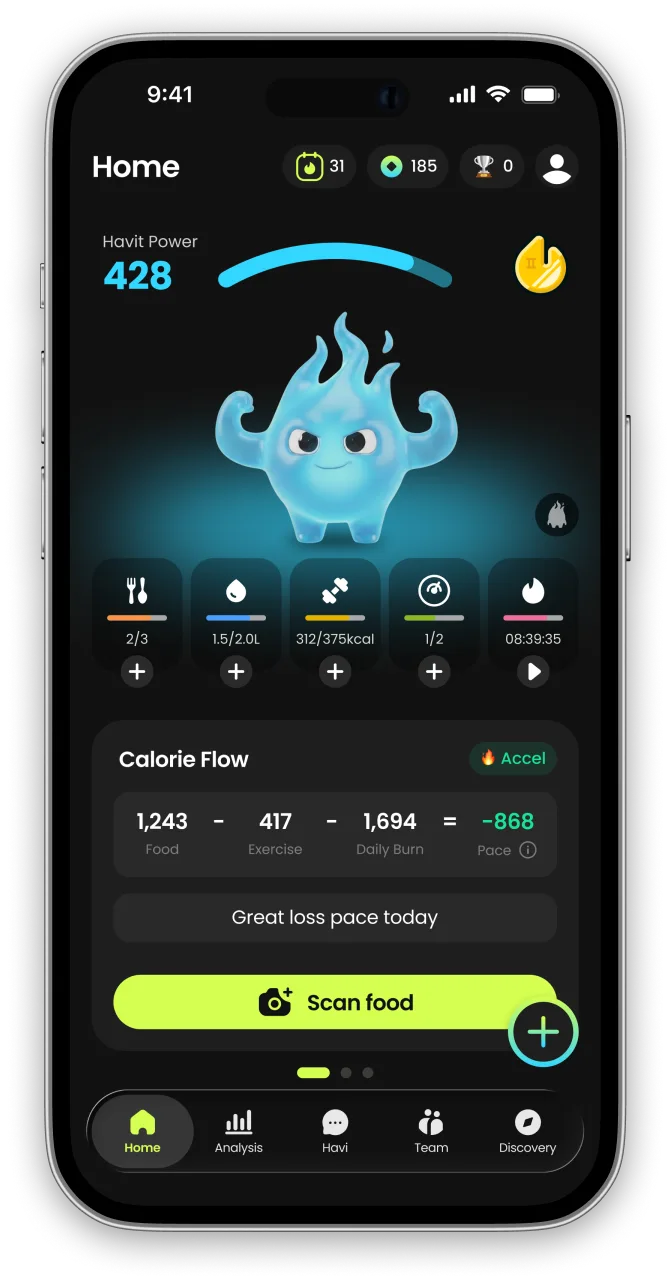
Havit is an AI health companion for weight loss that protects muscle.
Unlike calorie-only trackers, Havit connects AI body-composition estimates, nutrition, hydration, sleep, steps, cycle, mood, and GLP-1 medication in one daily routine — so progress is measured by body composition, not just the number on the scale. Daily missions turn established behavior-change techniques into small repeatable actions, drawing on expertise from professionals formerly at Juvis Diet, one of Korea’s leading metabolic clinics.
In Havit’s own analysis of 1,090 GLP-1 users, people who logged consistently built stronger habits than the general user base. Read the GLP-1 Habit Report
Havit works with or without GLP-1 medication. It is a wellness app, not a medical device; body-composition results are estimates.
Continue in the App
Personalized wellness with your own data


References
- Interindividual Variability in Caffeine Metabolism: Genetic and Environmental Determinants — Clinical Pharmacology & Therapeutics, 2025
- Caffeine Timing and Individual Differences in Sleep Architecture: A Wearable-Based Cohort Study — Sleep, 2024
- CYP1A2 Phenotyping in Clinical Practice: Methods and Applications — Drug Metabolism Reviews, 2024
- Heart Rate Variability as a Biomarker for Stimulant Effects During Sleep — Journal of Sleep Research, 2024


