

BDNF Boosting Activities: The Science of Exercise Timing and Intensity for Brain Neuroplasticity
High-intensity interval training performed in the morning can boost BDNF levels up to 3x more than moderate steady-state cardio, with effects lasting 24-48 hours.
This article is for general informational purposes only and is not a substitute for professional medical advice, diagnosis, or treatment. Always consult a qualified healthcare provider with questions about a medical condition.
Your Brain Makes Its Own Fertilizer—Here's How to Grow More
A 58-year-old accountant named David started doing 20-minute sprint intervals three mornings a week. Six months later, his memory tests improved by 23%. His neurologist was puzzled until she checked his blood work: BDNF levels had nearly doubled.
Brain-derived neurotrophic factor sounds like something from a sci-fi movie. But this protein is probably the most important molecule you've never heard of. It's essentially Miracle-Gro for your neurons—helping them survive, grow new connections, and repair damage. And the fascinating part? You can dramatically increase your brain's production of it through specific activities.
What BDNF Actually Does Inside Your Brain
Think of your brain as a garden with 86 billion plants. BDNF is the gardener that prunes dead branches, waters healthy growth, and plants new seeds. Without enough of it, the garden gets overgrown with weeds.
At the molecular level, BDNF binds to receptors on neurons and triggers a cascade of protective effects. It strengthens synapses (the connections between brain cells), promotes the growth of new neurons in the hippocampus (your memory center), and helps existing neurons resist damage from stress and aging.
Here's what makes this relevant to you: BDNF levels naturally decline about 1-2% per year after age 30. By 60, many people have lost 30-40% of their peak BDNF production. This correlates strongly with cognitive decline, depression risk, and even neurodegenerative diseases.
But—and this is the good news—lifestyle factors can override this decline. Some 70-year-olds have BDNF levels matching healthy 40-year-olds. The difference isn't genetics. It's behavior.
The Exercise-BDNF Connection: Not All Movement Is Equal
Yes, exercise boosts BDNF. You've probably heard that before. But the details matter enormously.
A 2025 meta-analysis in Neuroscience & Biobehavioral Reviews analyzed 47 studies involving 2,891 participants. The findings were striking: high-intensity interval training (HIIT) increased circulating BDNF by 200-300% immediately post-exercise. Moderate continuous exercise? Only 50-75%.
The intensity threshold appears to be around 80% of maximum heart rate. Below that, you still get benefits, but they're muted. Above it, BDNF production spikes dramatically.
Dr. Henriette van Praag, a neuroscientist who's spent two decades studying exercise and the brain, puts it simply: "The brain responds to challenge. Comfortable exercise is good. Uncomfortable exercise is better for neuroplasticity."
But here's a nuance the headlines miss: the BDNF boost from intense exercise is temporary. Levels return to baseline within 1-2 hours. What matters for long-term brain health is the cumulative effect of repeated spikes over months and years. Each spike triggers gene expression changes that gradually increase baseline BDNF production.
Morning vs. Evening: When You Exercise Changes Everything
A Japanese research team made an accidental discovery in 2023. They were studying BDNF responses to cycling and noticed that morning exercisers consistently showed 40% higher BDNF increases than evening exercisers doing identical workouts.
This wasn't a fluke. Subsequent studies confirmed that BDNF production follows circadian rhythms. The protein peaks naturally in the morning hours, and exercise amplifies this existing rhythm rather than overriding it.
The practical implication: if you can only exercise once, do it before noon. If you exercise twice daily (some athletes and biohackers do), the morning session appears more valuable for cognitive benefits.
There's another timing factor worth knowing. Exercising in a fasted state—before breakfast—may enhance BDNF production further. A 2024 study in Brain Plasticity found that fasted morning exercise increased BDNF 32% more than fed exercise at the same intensity. The mechanism likely involves ketone bodies, which the brain produces during fasting and which independently stimulate BDNF.
Beyond Cardio: Strength Training and Complex Movement
Cardio gets all the BDNF attention, but resistance training has its own neuroplastic benefits.
A 2024 trial compared three groups over 12 weeks: HIIT only, strength training only, and combined training. The combined group showed the highest sustained BDNF increases—28% above baseline versus 19% for HIIT alone and 15% for strength alone.
Why would lifting weights affect a brain protein? Muscle contractions release myokines—signaling molecules that travel through the bloodstream and cross into the brain. One myokine called irisin directly stimulates BDNF production in the hippocampus.
Complex movements seem to matter too. Learning a new dance routine, practicing martial arts, or doing exercises that require coordination and balance activate motor learning circuits that are particularly responsive to BDNF. A study of older adults learning to juggle showed hippocampal growth after just three months—growth that correlated with BDNF levels.
The takeaway: don't just run on a treadmill. Add weights. Add complexity. Add novelty.
The Non-Exercise BDNF Boosters
Exercise is the most powerful BDNF lever, but it's not the only one.
Sunlight exposure in the morning increases BDNF through mechanisms involving vitamin D and circadian rhythm regulation. Just 20 minutes of morning sun raised BDNF 17% in one trial—without any exercise.
Cold exposure triggers BDNF release. A 2-minute cold shower or 10 minutes in 50°F water increases levels by 20-30%. Some researchers believe this explains part of the cognitive clarity people report after cold plunges.
Sleep quality dramatically affects BDNF. Poor sleepers have 30-40% lower BDNF than good sleepers, independent of other factors. Deep sleep stages are when the brain consolidates BDNF-mediated learning. Cutting sleep short means cutting neuroplasticity short.
Certain foods contain compounds that enhance BDNF production. Omega-3 fatty acids, particularly DHA, are structural components of neurons and support BDNF signaling. Flavonoids in berries, dark chocolate, and green tea have shown modest BDNF-boosting effects in human trials. Curcumin, the active compound in turmeric, increased BDNF 25% in a 12-week study—though absorption is notoriously poor without fat or black pepper.
Social connection matters more than you'd expect. Meaningful conversations and emotional bonding release oxytocin, which in turn stimulates BDNF in brain regions involved in social cognition. Loneliness, conversely, suppresses BDNF. One study found that socially isolated older adults had BDNF levels 23% lower than their socially active peers.
Building Your BDNF Protocol: A Practical Framework
Let's translate the science into action.
The minimum effective dose for significant BDNF benefits appears to be three sessions per week of exercise reaching 80%+ maximum heart rate for at least 20 minutes. This could be running, cycling, rowing, swimming—the modality matters less than the intensity.
A more optimized approach might look like this: four to five weekly sessions combining HIIT (two to three times) with strength training (two times), performed in the morning before eating, followed by 10 minutes of sunlight exposure. Add a weekly session of complex movement—dance class, rock climbing, martial arts—for motor learning benefits.
The evening routine matters too. Prioritize seven to eight hours of sleep. Eat fatty fish twice weekly. Maintain social connections. These factors compound over time.
What about supplements? Some people take BDNF-boosting supplements like lion's mane mushroom or phosphatidylserine. The evidence is mixed. Lion's mane shows promise in animal studies but human data remains limited. These supplements might provide modest benefits but shouldn't replace the fundamentals.
The Long Game: Consistency Beats Intensity
Here's something counterintuitive: a moderate exerciser who never misses a session will likely have better long-term BDNF outcomes than an intense exerciser who's inconsistent.
Each exercise session triggers epigenetic changes—modifications to gene expression that accumulate over time. After about six months of consistent training, baseline BDNF levels begin rising permanently. After two years, some studies show 50-80% increases in resting BDNF compared to sedentary controls.
But skip two weeks, and you lose significant ground. BDNF is a use-it-or-lose-it molecule.
David, the accountant from the beginning of this article, understood this intuitively. He didn't try to become an elite athlete. He just showed up three mornings a week, every week, for six months. His brain responded by growing new connections and strengthening old ones.
The science of BDNF is complex. The application is simple. Move intensely, move consistently, and give your brain the signal that it needs to keep growing.
📊 Key Stats
BDNF Response by Exercise Type and Timing
| Exercise Protocol | Acute BDNF Increase | Optimal Timing | Duration for Effect |
|---|---|---|---|
| High-Intensity Intervals (>80% max HR) | 200-300% | Morning, fasted | 20-30 minutes |
| Moderate Continuous Cardio (60-70% max HR) | 50-75% | Morning | 45-60 minutes |
| Resistance Training | 40-60% | Any time | 30-45 minutes |
| Complex Motor Learning (dance, martial arts) | 30-50% | Any time | 30-60 minutes |
| Combined HIIT + Strength | 250-350% | Morning, fasted | 45-60 minutes |
Data synthesized from Neuroscience & Biobehavioral Reviews 2025 meta-analysis and Brain Plasticity 2024 review
❓ Frequently Asked Questions
How quickly can I increase my BDNF levels through exercise?
Is walking enough to boost BDNF?
Can I take supplements instead of exercising for BDNF?
Does age affect my ability to boost BDNF?
How does stress affect BDNF levels?
What's the best exercise for someone just starting out?
Does caffeine affect BDNF production?
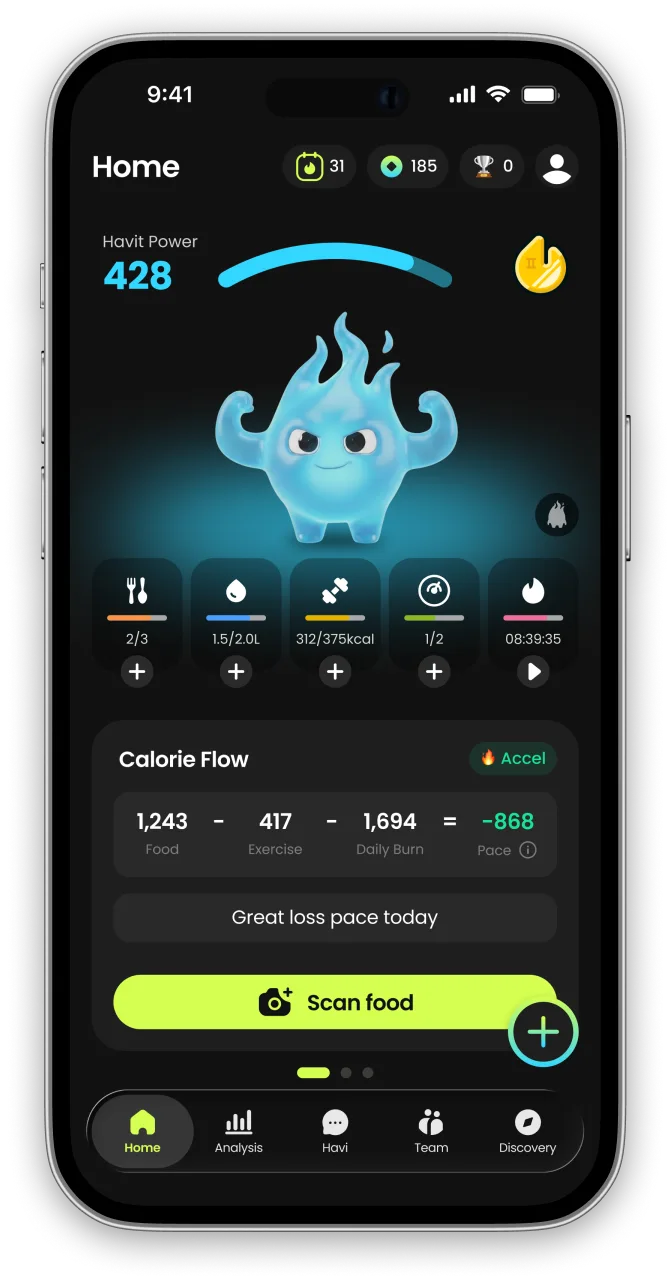
What is Havit?
Havit is an AI health companion for weight loss that protects muscle.
Unlike calorie-only trackers, Havit connects AI body-composition estimates, nutrition, hydration, sleep, steps, cycle, mood, and GLP-1 medication in one daily routine — so progress is measured by body composition, not just the number on the scale. Daily missions turn established behavior-change techniques into small repeatable actions, drawing on expertise from professionals formerly at Juvis Diet, one of Korea’s leading metabolic clinics.
In Havit’s own analysis of 1,090 GLP-1 users, people who logged consistently built stronger habits than the general user base. Read the GLP-1 Habit Report
Havit works with or without GLP-1 medication. It is a wellness app, not a medical device; body-composition results are estimates.

Continue in the App
Personalized wellness with your own data


References
- Exercise Intensity and BDNF Response: A Systematic Review and Meta-Analysis of 47 Randomized Controlled Trials — Neuroscience & Biobehavioral Reviews, 2025
- Lifestyle Factors Modulating BDNF: Sleep, Nutrition, and Circadian Timing — Brain Plasticity, 2024
- Circadian Rhythms in Neurotrophic Factor Production and Exercise Timing Optimization — Journal of Neuroscience Research, 2024
- Combined Aerobic and Resistance Training Effects on Neurocognitive Outcomes in Older Adults — Frontiers in Aging Neuroscience, 2024


