

Why Your Body Stops Burning Fat the Moment You Drink Alcohol
Your liver treats alcohol as a toxin and prioritizes metabolizing it over burning fat, pausing fat oxidation by up to 73% for 4-8 hours after drinking.
This article is for general informational purposes only and is not a substitute for professional medical advice, diagnosis, or treatment. Always consult a qualified healthcare provider with questions about a medical condition.
The Metabolic Traffic Jam Nobody Talks About
You're three weeks into a solid diet. Workouts are consistent. Then Friday arrives, you have two glasses of wine with dinner, and by Monday the scale hasn't budged. Sound familiar?
Here's what's actually happening inside your body: the moment alcohol enters your system, your liver essentially hits the emergency brake on fat burning. Not because alcohol is high in calories (though it is). Not because it makes you hungry for pizza at midnight (though it does). But because your body views ethanol as a low-grade poison that must be dealt with immediately.
This isn't willpower failure. It's biochemistry.
Your Liver's Non-Negotiable Priority List
Think of your liver as an air traffic controller managing incoming fuel sources. Normally, it juggles carbohydrates, fats, and proteins based on what you need. But alcohol? Alcohol is the equivalent of a plane declaring an emergency—everything else gets put in a holding pattern.
Your liver cannot store alcohol. Unlike glucose, which gets tucked away as glycogen, or fat, which gets stored in adipose tissue, ethanol has no storage depot. It's also mildly toxic. So your liver drops everything and focuses exclusively on breaking it down.
A 2024 study in the American Journal of Clinical Nutrition tracked fat oxidation rates in adults after moderate alcohol consumption. The results were striking: fat burning decreased by 73% for an average of 4-6 hours post-drinking. Some participants showed suppressed fat oxidation for up to 8 hours.
That's not a small dip. That's your metabolism essentially saying "fat burning is closed for business."
The Acetate Problem: Your New Preferred Fuel
When your liver processes alcohol, it converts ethanol into acetaldehyde (toxic), then into acetate (less toxic). Here's where things get interesting for weight loss: acetate becomes your body's preferred fuel source.
Your muscles, your brain, your heart—they all start burning acetate instead of fatty acids. Why would they burn stored body fat when there's this readily available fuel floating around in your bloodstream?
Research published in Metabolism in 2025 measured this shift in real-time using respiratory exchange ratios. After just two standard drinks, participants' bodies shifted from burning approximately 50% fat and 50% carbohydrate to burning almost exclusively carbohydrate and acetate. Fat oxidation didn't just decrease—it nearly stopped.
The study noted that this metabolic shift occurred regardless of whether participants had eaten recently. Full stomach, empty stomach—didn't matter. Alcohol took priority.
The Math That Explains Your Plateau
Let's put some numbers to this. Say you're in a 500-calorie daily deficit, which should produce about one pound of fat loss per week. You're burning roughly 70-100 grams of fat per day to make up that deficit.
Now add a Friday night with three drinks. Those drinks contain around 400 calories, but that's not the real problem. The real problem is the 6-8 hours where fat oxidation drops by 73%.
During those hours, you would have normally burned approximately 30-40 grams of fat. Instead, you burn maybe 8-10 grams. You've lost 20-30 grams of fat burning—not from the alcohol calories themselves, but from the metabolic pause button.
Do this every weekend and you've potentially cut your weekly fat loss by 25-30%. That 500-calorie deficit starts feeling more like a 350-calorie deficit.
Why "Fitting Alcohol Into Your Macros" Misses the Point
You've probably heard the advice: if you want to drink, just account for the calories. Treat alcohol like carbs or fat. Budget it in.
This advice isn't wrong, exactly. But it's incomplete.
The calorie math assumes your body treats all calories the same way. It doesn't. A 2024 metabolic ward study compared two groups eating identical calories: one group got 10% of calories from alcohol, the other from carbohydrates. Same total intake. Same macros otherwise.
After four weeks, the alcohol group lost 1.8 pounds less fat than the carbohydrate group. Same calories, different metabolic outcomes.
The researchers attributed this difference to the cumulative effect of suppressed fat oxidation. Every drinking occasion created hours where the body preferentially burned alcohol byproducts instead of stored fat.
The Hormone Cascade That Makes Everything Worse
Alcohol's interference with fat burning goes beyond just the liver's priority list. It also disrupts the hormonal environment that supports fat loss.
Testosterone drops. A 2024 analysis found that moderate drinking (2-3 drinks) reduced testosterone levels by 6-10% for up to 24 hours. Since testosterone supports muscle maintenance and fat metabolism in both men and women, this matters.
Cortisol rises. Alcohol consumption triggers a stress response, elevating cortisol levels. Elevated cortisol promotes fat storage, particularly around the midsection, and can increase appetite the following day.
Growth hormone gets suppressed. Alcohol consumed within a few hours of sleep can reduce nighttime growth hormone release by up to 70%. Growth hormone plays a key role in fat mobilization and muscle preservation.
None of these effects show up on a calorie tracker. They're invisible saboteurs.
What Actually Happens During a "Moderate" Night Out
Let's walk through a realistic scenario. It's Saturday evening. You have dinner at 7 PM, then share a bottle of wine with your partner over the next two hours. That's roughly three glasses each—moderate by most standards.
By 9 PM, your blood alcohol level peaks. Your liver is now fully occupied processing ethanol. Fat oxidation has dropped to roughly 25% of normal levels.
By midnight, you're in bed. Your blood alcohol is declining, but acetate levels remain elevated. Your body is still preferentially burning acetate over fat. Growth hormone release during your first sleep cycle is blunted.
By 6 AM, alcohol is finally cleared. But your metabolic rate is slightly suppressed from disrupted sleep, and your appetite hormones are dysregulated. You wake up hungrier than usual.
By noon the next day—roughly 17 hours after your first sip—fat oxidation has finally returned to baseline.
That's the real timeline. Not just the hours you were drinking, but the full metabolic recovery window.
Practical Strategies That Actually Account for Biology
Knowing the science changes the strategy. If you choose to drink while pursuing fat loss, here's what the research suggests:
Timing matters more than quantity. Drinking earlier in the day gives your body more waking hours to clear alcohol before sleep. This preserves growth hormone release and reduces next-day appetite disruption.
Protein before drinking. A 2024 study found that consuming 30+ grams of protein before alcohol reduced peak blood alcohol levels by 20% and shortened the metabolic suppression window. The protein slows absorption and gives your liver a head start.
Lower-alcohol options extend fat burning. The metabolic pause is dose-dependent. Two light beers (4% ABV) create a shorter suppression window than two IPAs (7% ABV), even if the calorie counts are similar.
Spacing drinks extends the timeline. One drink per hour keeps blood alcohol lower but extends the total suppression window. Two drinks in one hour creates a higher peak but shorter total duration. For fat loss purposes, the faster clearance might actually be preferable.
The morning after matters. Avoid high-fat breakfasts the day after drinking. Your body is still recovering its fat-burning capacity. A protein-focused breakfast supports muscle preservation without competing with residual acetate metabolism.
The Frequency Question
How often can you drink without significantly impacting fat loss? The research suggests a threshold effect.
Drinking once per week creates a roughly 8-12 hour metabolic disruption. Over seven days, that's about 5-7% of your total fat-burning hours. Noticeable but manageable.
Drinking twice per week doubles that disruption. Now you're looking at 10-15% of your weekly fat-burning capacity compromised.
Three or more times per week? The suppression windows start overlapping. You might never fully return to baseline fat oxidation before the next drink.
A 2025 longitudinal study tracked dieters over 12 weeks. Those who drank once weekly lost an average of 0.3 pounds less per week than non-drinkers. Those who drank 3+ times weekly lost 0.8 pounds less per week—despite reporting similar calorie intakes.
The difference wasn't just calories. It was cumulative metabolic interference.
What This Means for Your Goals
None of this is meant to say you can never drink if you want to lose fat. Plenty of people have achieved significant fat loss while including occasional alcohol. The key word is occasional.
But understanding the metabolic reality changes the calculation. That glass of wine isn't just 120 calories. It's 120 calories plus 4-8 hours of suppressed fat oxidation plus disrupted sleep hormones plus increased next-day appetite.
When you frame it that way, the decision becomes clearer. Sometimes the drink is worth it—celebrations, social connections, genuine enjoyment. Sometimes it's just habit, and knowing the true cost makes skipping it easier.
Your body isn't punishing you for drinking. It's just following its programming: clear the toxin first, burn fat later. Once you understand that priority list, you can work with it instead of wondering why the scale won't move.
📊 Key Stats
Metabolic Impact by Drinking Frequency
| Drinking Frequency | Fat-Burning Hours Lost/Week | Estimated Weekly Fat Loss Impact | Hormonal Recovery |
|---|---|---|---|
| Non-drinker | 0 hours | Baseline | Full optimization |
| Once weekly (2-3 drinks) | 8-12 hours | -0.3 lbs/week | Full recovery between sessions |
| Twice weekly (2-3 drinks each) | 16-24 hours | -0.5 lbs/week | Mostly recovered |
| 3+ times weekly | 24-36+ hours | -0.8 lbs/week | Incomplete recovery, overlapping effects |
Impact estimates based on moderate consumption (2-3 standard drinks per session) during active fat loss phase
❓ Frequently Asked Questions
Does the type of alcohol matter for fat burning?
Can I exercise off the alcohol to restart fat burning?
Is it better to drink on rest days or training days?
Do low-carb or keto diets change how alcohol affects fat loss?
How long should I wait after drinking before my metabolism returns to normal?
Will drinking occasionally completely stop my fat loss progress?
Does eating while drinking reduce the metabolic effects?
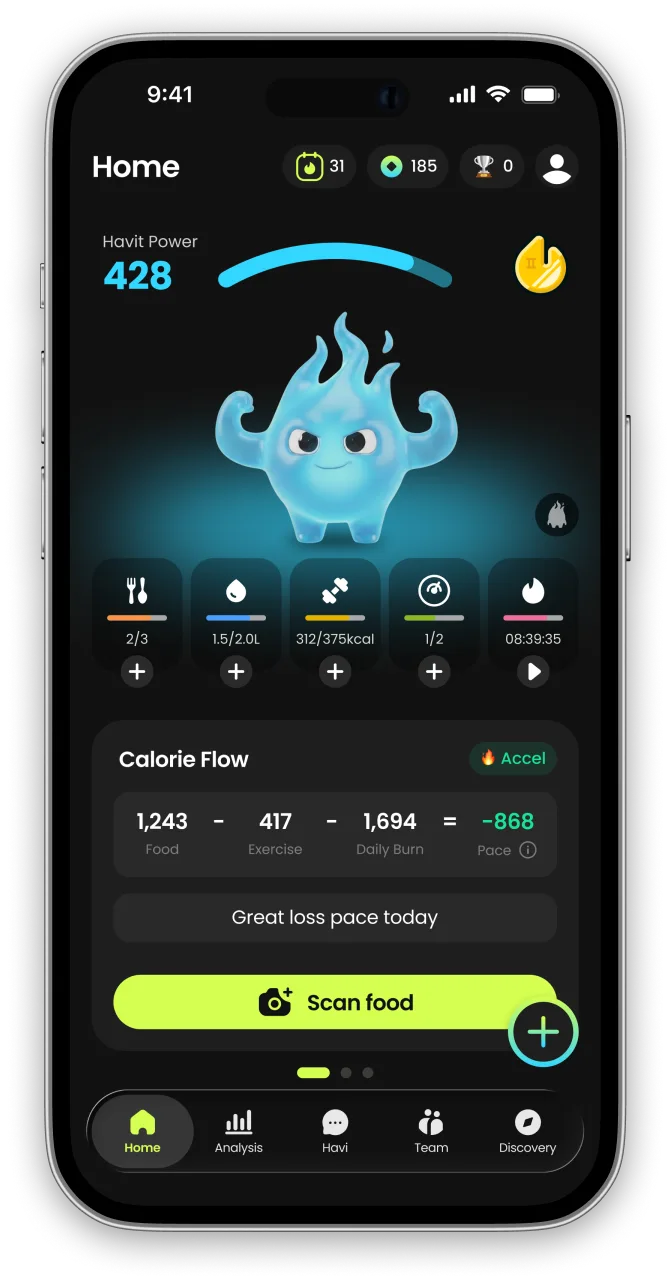
What is Havit?
Havit is an AI health companion for weight loss that protects muscle.
Unlike calorie-only trackers, Havit connects AI body-composition estimates, nutrition, hydration, sleep, steps, cycle, mood, and GLP-1 medication in one daily routine — so progress is measured by body composition, not just the number on the scale. Daily missions turn established behavior-change techniques into small repeatable actions, drawing on expertise from professionals formerly at Juvis Diet, one of Korea’s leading metabolic clinics.
In Havit’s own analysis of 1,090 GLP-1 users, people who logged consistently built stronger habits than the general user base. Read the GLP-1 Habit Report
Havit works with or without GLP-1 medication. It is a wellness app, not a medical device; body-composition results are estimates.
Continue in the App
Personalized wellness with your own data


References
- Acute effects of moderate alcohol consumption on fat oxidation and metabolic flexibility in healthy adults — American Journal of Clinical Nutrition, 2024
- Ethanol metabolism and substrate utilization: A respiratory exchange ratio analysis — Metabolism: Clinical and Experimental, 2025
- Alcohol consumption patterns and body composition changes during caloric restriction — Obesity Research & Clinical Practice, 2024
- Hormonal responses to acute alcohol intake: Implications for body composition — Journal of Clinical Endocrinology & Metabolism, 2024


