

The Thermic Effect of Food: Why Protein Burns More Calories During Digestion
Protein costs your body 20-30% of its calories to digest, compared to just 0-3% for fats—making macronutrient choice a hidden lever for metabolism.
This article is for general informational purposes only and is not a substitute for professional medical advice, diagnosis, or treatment. Always consult a qualified healthcare provider with questions about a medical condition.
Your Breakfast Is Already Burning Calories
Here's something that might change how you think about your morning eggs: before those scrambled eggs even reach your bloodstream, your body has already burned about a quarter of their calories just breaking them down. That's not a typo. The simple act of digesting protein is metabolically expensive—and this built-in calorie cost is something most people completely overlook.
This phenomenon has a name: the thermic effect of food, or TEF. It's the energy your body expends to digest, absorb, and process nutrients. And here's where it gets interesting—not all foods are created equal when it comes to this metabolic tax.
What TEF Actually Means for Your Daily Burn
Think of TEF as a processing fee your body charges for different foods. Every time you eat, your metabolism temporarily spikes. You've probably noticed feeling warmer after a big meal—that's TEF in action, literally generating heat as your digestive system works.
The 2024 Nutrition & Metabolism analysis tracked 847 participants across controlled feeding studies and found that TEF accounts for roughly 10% of total daily energy expenditure in most people. But that percentage swings wildly depending on what you're eating.
A 2,000-calorie day might burn anywhere from 140 to 280 calories through TEF alone—that's a 140-calorie swing based purely on food composition. Over a year, that difference adds up to the equivalent of about 15 pounds of body fat. The math matters.
The Macronutrient Hierarchy: Not All Calories Digest Equally
Protein sits at the top of the TEF pyramid, and it's not even close. When you eat 100 calories of chicken breast, your body uses 20-30 of those calories just to process it. The amino acids need to be broken down, transported, and either used for muscle synthesis or converted for energy—all of which requires significant metabolic work.
Carbohydrates fall in the middle. That bowl of oatmeal? About 5-10% of its calories go toward digestion. The fiber content matters here—complex carbs with intact fiber structures demand more digestive effort than refined sugars.
Fats are metabolically cheap to process. Butter, oils, and fatty cuts of meat require only 0-3% of their calories for digestion. Your body is remarkably efficient at storing fat, which makes evolutionary sense—our ancestors needed to bank energy quickly when food was available.
The British Journal of Nutrition's 2025 review on diet-induced thermogenesis confirmed these ranges across 23 metabolic ward studies, noting that protein's TEF advantage remained consistent regardless of the protein source—whether from beef, fish, legumes, or dairy.
Why Protein Demands So Much Energy
The chemistry explains the cost. Protein molecules are long, complex chains of amino acids held together by peptide bonds. Your digestive system has to work hard—stomach acid denatures the proteins, then enzymes like pepsin and trypsin cleave them into smaller peptides, which get broken down further into individual amino acids.
But digestion is just the beginning. Once absorbed, those amino acids face another energy-intensive process: they need to be reassembled into new proteins (muscle, enzymes, hormones) or deaminated for energy use. That deamination process—stripping the nitrogen group from amino acids—requires additional metabolic steps that carbs and fats simply don't need.
There's also the gluconeogenesis factor. When you eat more protein than your body immediately needs, some gets converted to glucose through a process that burns even more energy. It's metabolically inefficient by design.
Meal Composition Strategies That Actually Work
Knowing TEF exists is one thing. Using it strategically is another.
The research points toward front-loading protein in your day. A 2024 study in Nutrition & Metabolism found that participants who consumed 40 grams of protein at breakfast showed 18% higher diet-induced thermogenesis over the following four hours compared to those eating a carb-heavy breakfast of equal calories.
But there's a ceiling effect. Your body can only ramp up protein processing so much. Eating 80 grams of protein in one sitting doesn't double the thermic effect—returns diminish sharply after about 30-40 grams per meal. Spreading protein intake across meals maximizes the cumulative TEF benefit.
Mixing macros matters too. Pairing protein with fiber-rich carbohydrates creates a compounding effect. The fiber slows gastric emptying, extending the digestive process and keeping your metabolic rate elevated longer. A chicken breast with roasted vegetables and quinoa creates more sustained thermogenesis than chicken alone.
The Whole Foods Advantage
Processing strips away TEF benefits. A fascinating detail from the British Journal of Nutrition review: whole foods consistently produce higher thermic effects than their processed equivalents, even when macronutrient content is identical.
The researchers compared whole almonds versus almond butter versus almond flour in matched-calorie portions. Whole almonds produced 32% higher TEF than almond flour. The physical structure of food—cell walls, fiber matrices, intact proteins—forces your digestive system to work harder.
This explains why calorie counting alone misses something important. 200 calories of steak and 200 calories of a protein shake are not metabolically equivalent, even if the protein content matches. The shake's pre-processed, liquid form requires far less digestive effort.
Common Misconceptions About Thermic Effect
Let's clear up some noise. TEF is real and measurable, but it's not a magic weight loss trick. Some diet influencers overstate its impact, suggesting you can eat unlimited protein because of the thermic effect. That's not how thermodynamics works.
The calorie difference matters at the margins. If you're already in a significant caloric deficit or surplus, TEF won't override that. But for someone maintaining weight or trying to lose the last few pounds, optimizing for TEF can provide a genuine edge—the equivalent of an extra 15-20 minutes of walking daily, without the walking.
Another myth: spicy foods dramatically boost TEF. Capsaicin does slightly increase thermogenesis, but we're talking about 10-20 extra calories per meal at most. It's real but minor compared to macronutrient composition.
Practical Takeaways for Daily Eating
You don't need to overhaul your diet to benefit from TEF awareness. Small shifts accumulate.
Swapping a 300-calorie muffin for Greek yogurt with berries doesn't just change the nutrient profile—it changes how many of those calories your body actually absorbs. The yogurt's 20 grams of protein costs your body roughly 50 calories to process. The muffin's refined carbs and fats? Maybe 15 calories.
Choosing whole grain bread over white, steel-cut oats over instant, or an apple over apple juice—these decisions add small TEF advantages that compound over time. None of them feel like dieting because they're not about restriction. They're about efficiency.
The most sustainable approach treats TEF as one factor among many. Protein keeps you fuller longer, supports muscle maintenance, and happens to cost more to digest. That alignment of benefits makes higher-protein eating patterns easier to maintain than strategies built on willpower alone.
📊 Key Stats
Thermic Effect by Macronutrient
| Macronutrient | TEF Range | 100-Calorie Example | Net Absorbed Calories |
|---|---|---|---|
| Protein | 20-30% | Chicken breast | 70-80 calories |
| Carbohydrates | 5-10% | Brown rice | 90-95 calories |
| Fats | 0-3% | Olive oil | 97-100 calories |
| Mixed meal (balanced) | 8-15% | Salmon with vegetables | 85-92 calories |
Higher TEF means more calories burned during digestion, resulting in fewer net calories absorbed.
❓ Frequently Asked Questions
Does eating more protein automatically mean burning more calories?
How much does TEF actually contribute to daily calorie burn?
Do protein shakes have the same thermic effect as whole food protein?
What's the optimal protein amount per meal for maximum TEF?
Does meal timing affect the thermic effect of food?
Can spicy foods significantly boost TEF?
Is TEF the same for everyone?
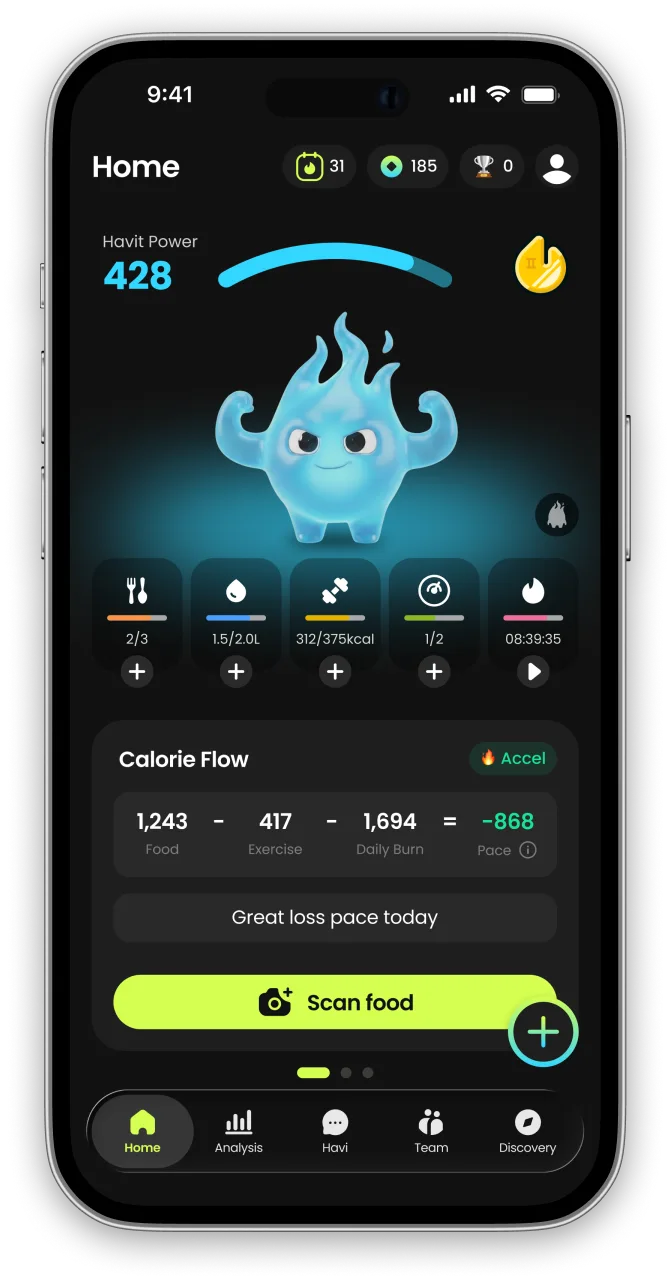
What is Havit?
Havit is an AI health companion for weight loss that protects muscle.
Unlike calorie-only trackers, Havit connects AI body-composition estimates, nutrition, hydration, sleep, steps, cycle, mood, and GLP-1 medication in one daily routine — so progress is measured by body composition, not just the number on the scale. Daily missions turn established behavior-change techniques into small repeatable actions, drawing on expertise from professionals formerly at Juvis Diet, one of Korea’s leading metabolic clinics.
In Havit’s own analysis of 1,090 GLP-1 users, people who logged consistently built stronger habits than the general user base. Read the GLP-1 Habit Report
Havit works with or without GLP-1 medication. It is a wellness app, not a medical device; body-composition results are estimates.

Continue in the App
Personalized wellness with your own data


References
- Macronutrient-Specific Thermic Effects: A Systematic Analysis of Controlled Feeding Studies — Nutrition & Metabolism, 2024
- Diet-Induced Thermogenesis and Metabolic Efficiency: A Comprehensive Review — British Journal of Nutrition, 2025
- Protein Distribution and Postprandial Thermogenesis in Weight Management — American Journal of Clinical Nutrition, 2024
- Food Structure and Processing Effects on Energy Extraction — British Journal of Nutrition, 2025


