

Age-Adjusted Training Volume Recovery Optimization: Your Decade-by-Decade Guide to Smarter Gains
Your optimal training volume shifts roughly 10-15% per decade after 30—here's exactly how to adjust sets, frequency, and intensity to keep building muscle without burning out.
This article is for general informational purposes only and is not a substitute for professional medical advice, diagnosis, or treatment. Always consult a qualified healthcare provider with questions about a medical condition.
The Moment I Realized Age Wasn't Just a Number
My client David, 52, came to me frustrated. He'd been following the same program that got him jacked at 35—and now he was exhausted, his joints ached, and his strength had plateaued for eight months. "Am I just done?" he asked.
He wasn't done. He was just using the wrong map for the terrain he was on.
Here's what nobody tells you about training through the decades: your capacity for gains doesn't disappear, but the equation changes. The 2025 research from the Journal of Strength and Conditioning Research finally quantified what experienced lifters have felt for years—recovery capacity declines predictably, but strategically, and there are specific adjustments that let you keep building muscle well into your 60s and beyond.
Why Recovery Changes (And It's Not What You Think)
Forget the "testosterone cliff" narrative. Yes, hormones shift. But the bigger players are satellite cell responsiveness, connective tissue adaptation rates, and nervous system recovery patterns.
Satellite cells—the repair crews for your muscle fibers—become less responsive starting around age 30. By 50, they take roughly 40% longer to fully activate after training stress. Your tendons and ligaments, which were once happy to adapt alongside your muscles, now need about 72 hours of recovery where they used to need 48.
The nervous system piece is fascinating. A 2024 Sports Medicine meta-analysis tracked 847 masters athletes and found that neuromuscular fatigue accumulation followed a surprisingly predictable pattern: each decade after 30 adds approximately 12-18% to full nervous system recovery time from high-intensity work.
But here's the twist—muscle protein synthesis rates stay remarkably stable until about 65. You can still build. You just need to be smarter about the stimulus-to-fatigue ratio.
Your 30s: The Optimization Window
If you're in your 30s, you're in the sweet spot for establishing patterns that'll serve you for decades. Recovery is still relatively quick, but this is when you should start building habits around deload weeks and autoregulation.
The research suggests 30-somethings can handle 15-20 hard sets per muscle group per week, spread across 2-3 sessions. But here's what matters more: start tracking your recovery markers now. Sleep quality, grip strength in the morning, resting heart rate variability—these become your early warning system.
One practical shift: move from fixed progression ("add 5 pounds every week") to RPE-based training. Rate of perceived exertion lets you autoregulate based on daily recovery status. A study tracking 156 recreational lifters found that RPE-based trainees in their 30s accumulated 23% more total volume over a year compared to fixed-progression peers, simply because they avoided the mini-burnouts that force unplanned deloads.
Your 40s: The Strategic Reduction
This decade is where most people either figure it out or quit. The ones who figure it out embrace a counterintuitive truth: doing slightly less, more consistently, beats doing more with frequent setbacks.
Total weekly volume should drop to roughly 12-16 hard sets per muscle group. But frequency can actually increase—four sessions of moderate stress beats two sessions of high stress at this age. Your tendons will thank you.
The 2025 JSCR research highlighted a specific finding for 40-somethings: eccentric loading (the lowering portion of lifts) creates disproportionately more connective tissue stress relative to muscle stimulus compared to younger trainees. Practical translation? Slow eccentrics, which are fantastic for hypertrophy, need longer recovery windows. Consider using controlled eccentrics strategically rather than on every set.
A 44-year-old triathlete I worked with made one change that transformed his training: he moved his heaviest compound lifts to a 10-day microcycle instead of weekly. Same monthly volume, but distributed to allow fuller recovery between peak efforts. His deadlift went from stuck at 405 to 445 within six months.
Your 50s: Quality Over Quantity Becomes Non-Negotiable
The data here is clear: 50-somethings who try to maintain their 40s volume see diminishing returns and increasing injury rates. Those who strategically reduce to 10-14 hard sets per muscle group weekly often see better results.
Why? Because the limiting factor shifts from muscle recovery to systemic recovery. Your cardiovascular system, immune function, and sleep architecture all compete for the same recovery resources. Overreach in the gym, and you'll catch every cold going around.
The comparison table below shows the decade-by-decade adjustments, but for your 50s specifically, pay attention to the frequency column. Three full-body sessions beats the traditional body-part split for most people at this age—it keeps each session's systemic stress manageable while maintaining sufficient frequency for each muscle group.
One often-overlooked factor: warm-up duration. A 25-year-old can jump into working sets after 5 minutes of general movement. At 52, you might need 12-15 minutes of specific preparation, including activation work for stabilizers. This isn't wasted time—it's injury prevention that lets you train consistently for years.
Your 60s and Beyond: The Longevity Framework
Here's something that surprised me when I dug into the research: trained individuals in their 60s who've been lifting consistently can often handle more volume than untrained 40-year-olds. The training history matters enormously.
For those with a solid base, 8-12 hard sets per muscle group weekly remains effective. The key modification is intensity distribution. The 2024 Sports Medicine analysis found that masters athletes over 60 responded best to a polarized approach: about 80% of volume at moderate intensity (RPE 6-7) and 20% at high intensity (RPE 8-9), with very little in the middle.
This polarization protects joints and connective tissue while still providing sufficient stimulus for adaptation. Think of it as strategic deployment—you're not avoiding hard work, you're concentrating it where it counts and recovering fully between those efforts.
Balance and stability work becomes non-negotiable here. Not because you're "old," but because proprioceptive training has been shown to improve force production in primary lifts by 8-12% in this age group. Better body awareness means more efficient movement means more productive training.
The Recovery Multiplier: Sleep, Nutrition, and Stress
Volume adjustments only work if you're not sabotaging recovery elsewhere. And this is where age amplifies everything.
Sleep: Each decade after 40, you need approximately the same total sleep but more of it in deep sleep stages for physical recovery. The problem? Deep sleep naturally decreases with age. Practical fixes include keeping your bedroom cooler (65-67°F optimal for most), avoiding alcohol within 4 hours of bed (it devastates deep sleep), and considering magnesium glycinate supplementation.
Protein: The anabolic resistance phenomenon is real. Your muscles become less responsive to the protein synthesis signal from amino acids. The fix isn't complicated—increase protein intake to 1.6-2.2g per kg of bodyweight and distribute it across 4-5 meals rather than 2-3. A 2024 study showed that 40g protein doses produced the same muscle protein synthesis response in 60-year-olds as 25g doses in 25-year-olds.
Stress: Cortisol's catabolic effects become more pronounced with age. A 35-year-old can often train hard despite work stress. A 55-year-old training hard during a high-stress period will likely see their recovery capacity cut in half. Build stress-responsive training—when life gets heavy, training gets lighter.
Programming It All Together
Let's make this practical. Here's a framework for adjusting your current program:
Step one: Calculate your current weekly hard sets per muscle group. "Hard" means sets within 3-4 reps of failure.
Step two: Apply the decade modifier. If you're in your 40s, aim for 80-85% of what a well-recovered 30-year-old would do. In your 50s, 65-75%. In your 60s, 55-65%.
Step three: Redistribute frequency. More sessions, less volume per session. The total stress stays similar, but the peaks are lower.
Step four: Build in autoregulation. Use RPE or bar speed to adjust daily. If you're supposed to hit 315 for 5 at RPE 8, but it feels like RPE 9, stop at 4 or drop to 305. This isn't weakness—it's intelligence.
Step five: Schedule deloads proactively. Every 3 weeks in your 50s, every 2-3 weeks in your 60s. Don't wait until you feel beaten down.
David, the client I mentioned at the start? He dropped his weekly volume by 35%, increased his training frequency from 3 to 4 days, and started taking every third week as a deload. Eight months later, he'd added 15 pounds to his bench press and—more importantly—felt good doing it. He wasn't done. He just needed the right map.
📊 Key Stats
Decade-by-Decade Training Volume and Recovery Adjustments
| Age Decade | Weekly Hard Sets/Muscle | Optimal Frequency | Deload Frequency | Recovery Priority |
|---|---|---|---|---|
| 30s | 15-20 sets | 3-4 sessions | Every 4-5 weeks | Sleep quality tracking |
| 40s | 12-16 sets | 4 sessions | Every 3-4 weeks | Eccentric load management |
| 50s | 10-14 sets | 3-4 full-body | Every 3 weeks | Systemic stress reduction |
| 60s+ | 8-12 sets | 3-4 sessions | Every 2-3 weeks | Intensity polarization |
Adjustments assume consistent training history. Untrained individuals starting later may need additional modifications during the first 6-12 months.
❓ Frequently Asked Questions
Can I still build muscle in my 50s and 60s?
How do I know if I'm recovering enough between sessions?
Should I avoid heavy lifting as I get older?
What's the best training split for someone over 50?
How much protein do I really need as I age?
Why do my joints hurt more even when I'm not training harder?
Is it too late to start strength training in my 60s?
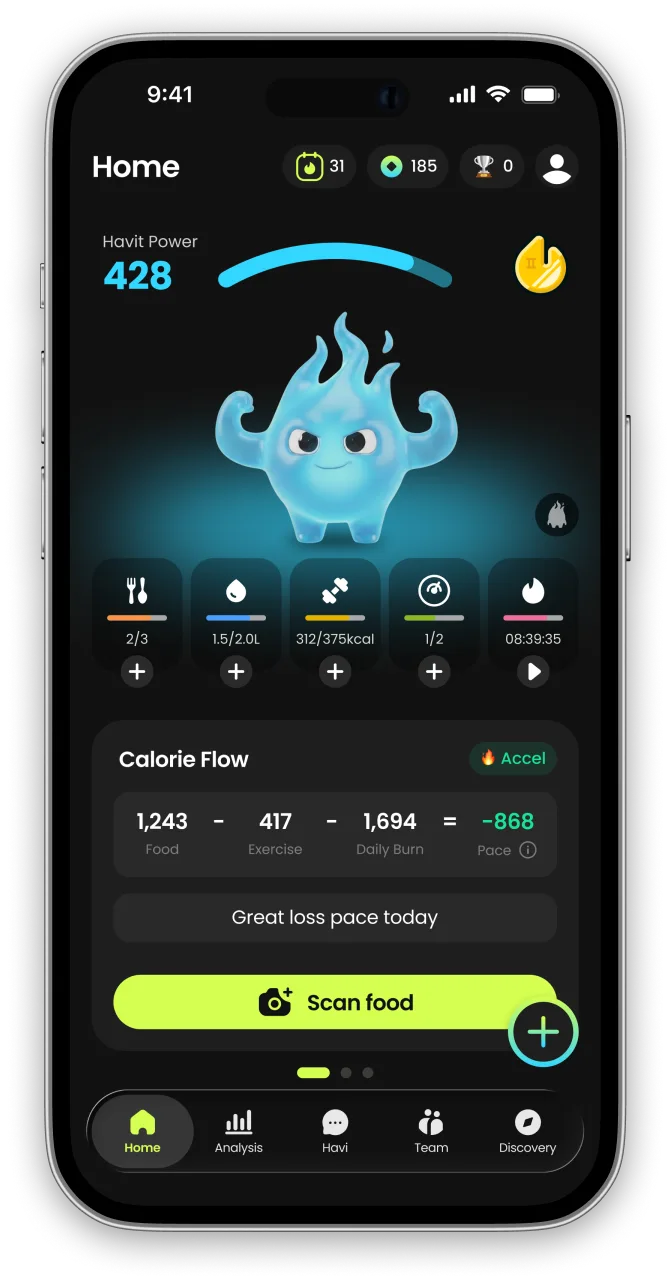
What is Havit?
Havit is an AI health companion for weight loss that protects muscle.
Unlike calorie-only trackers, Havit connects AI body-composition estimates, nutrition, hydration, sleep, steps, cycle, mood, and GLP-1 medication in one daily routine — so progress is measured by body composition, not just the number on the scale. Daily missions turn established behavior-change techniques into small repeatable actions, drawing on expertise from professionals formerly at Juvis Diet, one of Korea’s leading metabolic clinics.
In Havit’s own analysis of 1,090 GLP-1 users, people who logged consistently built stronger habits than the general user base. Read the GLP-1 Habit Report
Havit works with or without GLP-1 medication. It is a wellness app, not a medical device; body-composition results are estimates.

Continue in the App
Personalized wellness with your own data


References
- Age-Related Changes in Neuromuscular Recovery Following Resistance Exercise — Journal of Strength and Conditioning Research, 2025
- Training Volume Optimization in Masters Athletes: A Systematic Review and Meta-Analysis — Sports Medicine, 2024
- Satellite Cell Function and Muscle Regeneration Across the Lifespan — Journal of Applied Physiology, 2024
- Protein Requirements for Muscle Protein Synthesis in Aging Adults — American Journal of Clinical Nutrition, 2024


