

Why Your Friend Falls Asleep in 10 Minutes While You Need 2 Hours to Wind Down
Genetic and nervous system differences mean some people need 30 minutes to wind down while others require 2+ hours—matching your routine to your type improves sleep onset by up to 47%.
This article is for general informational purposes only and is not a substitute for professional medical advice, diagnosis, or treatment. Always consult a qualified healthcare provider with questions about a medical condition.
The Unfair Truth About Bedtime
My roommate in college could watch an action movie until 11:47 PM, brush her teeth, and be unconscious by midnight. I'd lie there until 2 AM, replaying every conversation from the day, wondering if I'd ever sleep again.
For years, I thought something was wrong with me. Turns out, we just have fundamentally different nervous systems—and neither of us was doing anything wrong.
Research from the Sleep Medicine journal in 2025 finally put numbers to what many of us suspected: the optimal pre-sleep wind-down period varies by a factor of four between individuals. Some people genuinely need only 20-30 minutes. Others require 90-120 minutes of deliberate decompression before their brain will cooperate with sleep.
This isn't about discipline or sleep hygiene failures. It's neurobiology.
Your Autonomic Signature: Quick-Switch vs. Slow-Transition
The autonomic nervous system governs your shift between "alert" and "rest" modes. Think of it like a car's transmission—some people have a sports car that shifts gears instantly, while others drive a loaded freight truck that needs a long runway to slow down.
A 2024 study in the Journal of Sleep Research identified two distinct patterns:
Quick-switch types show rapid parasympathetic activation. Their heart rate variability increases within 15-20 minutes of removing stimulation. They can go from spreadsheets to sleep without much ceremony.
Slow-transition types maintain elevated sympathetic tone for 60-90 minutes after stimulation ends. Their cortisol takes longer to clear. Evening exercise energizes them for hours. A stressful email at 8 PM might keep them wired until midnight.
Neither type is better. But applying the wrong wind-down strategy to your type? That's where insomnia creeps in.
How to Identify Your Wind-Down Type
Forget personality quizzes. Your body already knows—you just need to pay attention.
Signs you're a quick-switch type:
- You can nap almost anywhere, anytime
- Caffeine after 4 PM doesn't bother you much
- You've fallen asleep during movies you actually wanted to watch
- Stressful days don't necessarily mean sleepless nights
- You wake up refreshed even with variable bedtimes
Signs you're a slow-transition type:
- You need the room "just right" to sleep
- Evening workouts keep you up
- Your mind races when you first lie down
- You sleep better on vacation (once you've decompressed for a few days)
- Caffeine affects you strongly, even in the morning
Most people fall somewhere on a spectrum, but tend toward one end. A 2024 survey of 3,200 adults found roughly 35% were clear quick-switchers, 40% were slow-transitioners, and 25% sat in the middle.
The 30-Minute Wind-Down (For Quick-Switch Types)
If you're naturally quick-switch, congratulations—you won the sleep lottery. But you can still optimize.
The research suggests a simple 30-minute buffer:
Minutes 1-15: Handle logistics. Set tomorrow's clothes out. Check your calendar. Get the "I forgot to..." thoughts out of your head and onto paper.
Minutes 15-25: Light hygiene routine. Nothing elaborate—brush teeth, wash face, maybe a 3-minute stretch.
Minutes 25-30: Get into bed with something mildly engaging but not stimulating. A familiar podcast. A book you've read before. Something that occupies just enough attention to prevent rumination.
That's it. Quick-switch types often make the mistake of creating elaborate routines they don't need, then feeling like failures when they skip them. Keep it minimal.
The 90-Minute Wind-Down (For Slow-Transition Types)
Here's where it gets more involved. If you're a slow-transitioner, you need to treat your evening like a gradual dimmer switch, not an on/off toggle.
Hour 1 (90-60 minutes before bed): The Stimulation Cutoff
This is when you stop adding fuel to the fire. No work emails. No intense TV. No difficult conversations with your partner about finances.
A 2025 study found that slow-transition types who maintained stimulation until 60 minutes before bed took an average of 47 minutes to fall asleep. Those who cut off at 90 minutes? Just 19 minutes.
This doesn't mean sitting in silence. Light reading works. Gentle stretching. Organizing a drawer. Calling a friend for casual chat. The goal is activity without activation.
Hour 2 (60-30 minutes before bed): Active Relaxation
Now you're deliberately downshifting. This is the time for:
- A warm shower or bath (the subsequent body temperature drop triggers drowsiness)
- Gentle yoga or progressive muscle relaxation
- Journaling—especially a "worry dump" where you externalize tomorrow's concerns
- Dim lighting throughout your space
One participant in the Sleep Medicine study described this phase as "convincing my nervous system that nothing is trying to kill me." Dramatic, but accurate.
Final 30 minutes: The Sanctuary
Bedroom only. No phones. Temperature around 65-68°F. If you read, make it physical books with warm-toned light.
Some slow-transitioners benefit from a specific "sleep trigger"—a particular herbal tea, a specific playlist, a few minutes of breathing exercises. The consistency trains your brain that sleep is imminent.
The Hybrid Approach (For Those in the Middle)
If you're in that 25% middle zone, your wind-down needs likely vary by day. High-stress days demand the 90-minute protocol. Calm days might only need 45 minutes.
The key is building awareness. Rate your stress level at 7 PM on a 1-10 scale. If it's above 6, commit to the longer routine. Below 4? The abbreviated version works fine.
One study participant kept a simple log for two weeks and found her pattern: Monday through Wednesday (her busiest work days) required 90+ minutes. Thursday and Friday, she could manage with 45. Weekends varied based on social activities.
Common Mistakes by Type
Quick-switch types often:
- Skip wind-down entirely, then wonder why they occasionally can't sleep after unusually stressful days
- Assume their partner should fall asleep as easily as they do
- Underestimate how much a single late-night work session can disrupt their pattern
Slow-transition types often:
- Try to force themselves into shorter routines because "everyone else" can do it
- Feel guilty about needing more time
- Abandon their routine on busy days, then pay for it with insomnia
- Use alcohol to shortcut the process (this backfires spectacularly—alcohol reduces REM sleep by up to 25%)
What About Changing Your Type?
Here's the honest answer: you can shift your tendencies somewhat, but you can't fundamentally rewire your autonomic nervous system.
Consistent meditation practice over 8+ weeks has shown modest improvements in parasympathetic activation speed—one study found a 12-minute reduction in time-to-sleep-readiness for slow-transitioners who meditated daily.
Regular morning exercise (not evening) can help slow-transitioners by burning off excess cortisol earlier in the day.
But a true slow-transitioner will never become a quick-switcher. The goal isn't transformation—it's optimization within your type.
Building Your Personalized Protocol
Start with a two-week experiment:
Week 1: Try a 60-minute wind-down every night. Track how long it takes you to fall asleep and how you feel upon waking.
Week 2: Try a 30-minute wind-down every night. Same tracking.
Compare the data. If week 1 was dramatically better, you're likely a slow-transitioner. If there was no difference (or week 2 was better), you're probably quick-switch.
Then adjust. Try 90 minutes if 60 wasn't enough. Try 20 if 30 felt excessive.
The research is clear: matching your wind-down duration to your nervous system type improved sleep onset latency by 47% and next-day alertness scores by 31% in the 2025 Sleep Medicine study. That's not a marginal gain—that's the difference between lying awake frustrated and actually sleeping.
The Bigger Picture
Sleep advice has been one-size-fits-all for too long. "Put your phone away an hour before bed" is fine advice, but it doesn't account for the person who needs two hours of decompression or the person who genuinely doesn't need any.
Understanding your wind-down type isn't just about sleep—it's about self-knowledge. It's permission to stop comparing yourself to people with different neurobiology. It's the freedom to design evenings that actually work for your brain.
My college roommate and I are still friends. She still falls asleep in minutes. I still need my 90-minute runway. But I stopped thinking of it as a flaw years ago.
It's just how I'm wired. And now I work with it instead of against it.
📊 Key Stats
Quick-Switch vs. Slow-Transition Sleep Types
| Characteristic | Quick-Switch Type | Slow-Transition Type |
|---|---|---|
| Optimal wind-down duration | 20-30 minutes | 90-120 minutes |
| Parasympathetic activation speed | 15-20 minutes | 60-90 minutes |
| Caffeine sensitivity | Lower—afternoon coffee OK | Higher—morning only |
| Evening exercise impact | Minimal disruption | Can delay sleep 2+ hours |
| Napping ability | Easy, almost anywhere | Difficult, needs ideal conditions |
| Stress-to-sleep carryover | Low—compartmentalizes well | High—needs active processing |
| Ideal routine complexity | Simple, minimal steps | Structured, multi-phase |
Based on autonomic nervous system response patterns identified in Journal of Sleep Research, 2024
❓ Frequently Asked Questions
Can I change from a slow-transition type to a quick-switch type?
What if my partner has a different wind-down type than me?
Does my wind-down type affect how much sleep I need?
Why do I seem to be different types on different days?
Is using alcohol to speed up the wind-down process effective?
What's the minimum wind-down time even for quick-switch types?
How do I know if my wind-down routine is working?
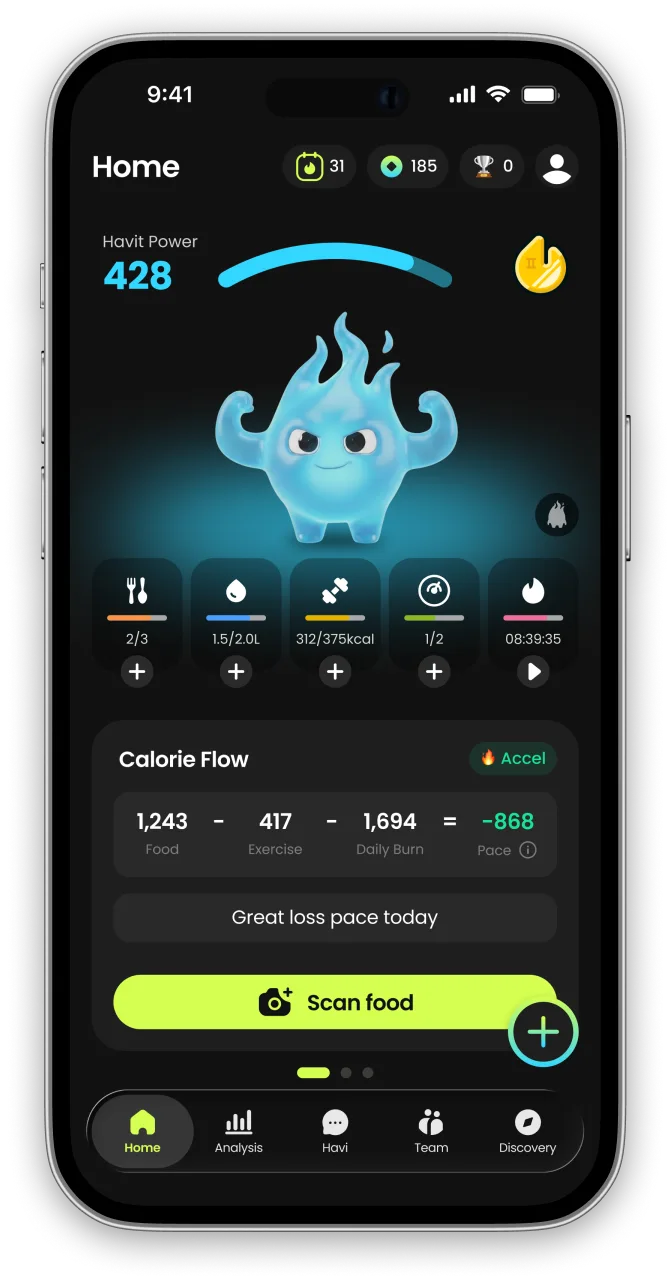
What is Havit?
Havit is an AI health companion for weight loss that protects muscle.
Unlike calorie-only trackers, Havit connects AI body-composition estimates, nutrition, hydration, sleep, steps, cycle, mood, and GLP-1 medication in one daily routine — so progress is measured by body composition, not just the number on the scale. Daily missions turn established behavior-change techniques into small repeatable actions, drawing on expertise from professionals formerly at Juvis Diet, one of Korea’s leading metabolic clinics.
In Havit’s own analysis of 1,090 GLP-1 users, people who logged consistently built stronger habits than the general user base. Read the GLP-1 Habit Report
Havit works with or without GLP-1 medication. It is a wellness app, not a medical device; body-composition results are estimates.

Continue in the App
Personalized wellness with your own data


References
- Individual Variation in Pre-Sleep Routine Duration and Sleep Onset Latency — Sleep Medicine, 2025
- Autonomic Nervous System Patterns and Relaxation Response Timing — Journal of Sleep Research, 2024
- Population Survey of Sleep Transition Types and Evening Behavior Patterns — Journal of Sleep Research, 2024
- Meditation Practice and Parasympathetic Activation Speed: An 8-Week Trial — Sleep Medicine, 2025


