

Resistance Band Training for Strength Gains: How Bands Compare to Free Weights in 2026
Resistance bands produce 85-90% of free weight strength gains while offering unique variable resistance benefits that actually enhance muscle activation at peak contraction.
This article is for general informational purposes only and is not a substitute for professional medical advice, diagnosis, or treatment. Always consult a qualified healthcare provider with questions about a medical condition.
My Gym Bag Weighs 400 Grams Now
I used to haul a 15-pound gym bag everywhere. Shoes, straps, belt, chalk. Then I spent three months training exclusively with resistance bands while traveling through Southeast Asia. I expected to lose strength. Instead, my bench press went up 12 pounds when I finally touched a barbell again.
This isn't a miracle story. It's physics.
Resistance bands work differently than free weights in ways that researchers are only now beginning to quantify. A 2025 meta-analysis in the Journal of Strength and Conditioning Research analyzed 23 studies involving 847 participants and found something that surprised even the authors: elastic resistance training produced strength gains within 85-90% of traditional weight training across most movement patterns.
But here's where it gets interesting. For certain exercises and muscle groups, bands actually outperformed weights.
The Variable Resistance Curve Explained
Pick up a dumbbell. It weighs the same at the bottom of a curl as it does at the top. Your bicep, however, doesn't experience uniform difficulty throughout that movement. The hardest point is somewhere in the middle, and by the time you reach full contraction, the weight feels almost easy.
Bands flip this script entirely.
A band at rest might provide 15 pounds of tension. Stretch it to double its length, and you're now fighting 35 pounds. At maximum stretch—full muscle contraction—you're working against peak resistance. This is called ascending resistance, and it matches the strength curve of pushing movements remarkably well.
Dr. James Nuzzo's 2024 review in Sports Medicine tracked EMG activity during band versus free weight exercises. During the lockout phase of a band push-up, pectoral muscle activation was 23% higher than during a weighted push-up with equivalent average resistance. The muscle worked hardest precisely when it was strongest.
Where Bands Genuinely Excel
Let's get specific. Bands aren't universally better or worse—they're different tools for different jobs.
Horizontal pulling movements love bands. Face pulls, band pull-aparts, rows with a horizontal line of resistance. A 2024 study from the University of Valencia found that band rows produced 18% greater rear deltoid activation compared to cable rows at matched resistance levels. The ascending tension forced participants to squeeze harder through the full contraction.
Glute training tells a similar story. Hip thrusts with bands around the knees showed 31% higher gluteus medius activation than the same movement without bands. The lateral tension created an abduction challenge that weights simply can't replicate.
Explosive movements benefit too. When researchers at the Australian Institute of Sport added light bands to jump squats, rate of force development improved by 14% over eight weeks compared to jump squats alone. The bands taught athletes to accelerate through the entire movement rather than decelerating at the top.
Where Free Weights Still Win
I'm not selling my squat rack anytime soon. Here's why.
Heavy compound lifts for absolute strength still favor free weights. The 2025 meta-analysis found that for loads above 80% of one-rep max, free weights produced 12-15% greater strength adaptations. Bands can provide heavy resistance, but the setup becomes awkward and the resistance curve works against you in movements like deadlifts where you're weakest at the bottom.
Eccentric loading—the lowering phase—is where bands fall short most dramatically. A barbell fights you on the way down. A band helps you. This matters because eccentric stress drives significant muscle damage and subsequent growth. One 2024 study found that eccentric-focused free weight training produced 22% more muscle thickness gains than band training over 12 weeks, even when concentric work was matched.
Stabilization demands also differ. A heavy overhead press with a barbell requires your entire shoulder girdle to coordinate balance and control. Bands provide resistance but not the same stability challenge. For athletes who need to produce force while managing unpredictable loads, this matters.
The Hybrid Approach That's Taking Over
Walk into any serious strength facility in 2026 and you'll see bands attached to barbells. This isn't new—Westside Barbell popularized it decades ago—but the research now explains why it works so well.
Adding bands to barbell movements creates what researchers call accommodating resistance. The weight stays constant, but the band adds progressive tension through the lift. A 2025 study from Kennesaw State University compared three groups over 16 weeks: barbell only, bands only, and barbell-plus-bands.
The hybrid group gained 19% more strength on squat and bench press than the barbell-only group. They also gained 11% more than the band-only group. The combination captured benefits from both tools—heavy eccentric loading from the barbell, ascending tension from the bands.
Practical application looks like this: attach light bands (15-25 pounds of tension at lockout) to your main lifts. The bands should add roughly 20% to your top-end resistance. On a 200-pound bench press, that means the bar feels like 200 at your chest and 240 at lockout.
Hypertrophy: The Muscle-Building Question
Does band training build muscle as effectively as weights? The answer is more nuanced than the strength data.
Muscle growth requires mechanical tension, metabolic stress, and muscle damage. Bands excel at the first two. That ascending resistance creates intense tension at peak contraction, and the constant fight against elastic force generates significant metabolic stress. Blood pooling, burning sensations, the pump—bands deliver all of it.
The muscle damage component is trickier. Without heavy eccentric loading, bands may produce less of the micro-trauma that stimulates repair and growth. A 2024 study in the European Journal of Applied Physiology found that free weight training increased muscle protein synthesis by 34% post-workout, compared to 27% for band training at matched effort levels.
Over 12 weeks, this translated to a meaningful but not dramatic difference: 8.2% muscle thickness increase for free weights versus 6.7% for bands. For most people, that gap won't determine whether they achieve their goals. For competitive bodybuilders, it might matter.
Programming Bands Into Your Training
I've spent the last year experimenting with different band integration strategies. Here's what actually works.
For primary strength movements, use bands as accessories rather than replacements. Bench press with a barbell, then do band flyes for higher reps. Squat heavy, then do banded hip hinges for glute activation. This captures the eccentric benefits of weights while adding the peak contraction stimulus of bands.
For isolation work, bands often outperform weights. Lateral raises with bands maintain tension throughout the movement—no dead zone at the bottom. Tricep pushdowns with bands feel harder at full extension, exactly where the muscle is strongest. Face pulls with bands allow a fuller squeeze than any cable stack.
For travel, injury recovery, or deload weeks, bands can temporarily replace weights without significant strength loss. That 85-90% effectiveness rate means a few weeks of band-only training won't derail your progress. I've tested this multiple times now, and the research matches my experience.
Rep ranges should shift slightly higher with bands. Because eccentric loading is reduced, you need more total time under tension to compensate. Where you might do 6-8 reps with heavy weights, aim for 10-15 with bands at equivalent perceived effort.
What the Research Missed
Most studies compare bands to weights in controlled settings with fixed exercises and standardized protocols. Real training doesn't work that way.
Bands allow creativity that weights don't. You can anchor them at any angle, combine multiple bands for complex resistance profiles, and transition between exercises without rest. A band circuit hitting chest, back, and shoulders takes 90 seconds. The same sequence with dumbbells requires setup time that kills the metabolic effect.
Joint stress also differs in ways studies rarely capture. Several physical therapists I've spoken with report that band training allows clients to work through ranges of motion that feel painful with weights. The ascending resistance means less load at vulnerable positions—the bottom of a squat, the stretched position of a fly.
This doesn't mean bands are safer. It means they're differently stressful, and for some people with specific limitations, that difference matters enormously.
The Bottom Line on Bands Versus Weights
Neither tool is superior. Both are incomplete alone.
Free weights provide heavy eccentric loading, absolute strength development, and stability challenges that bands can't match. Bands provide ascending resistance, portability, joint-friendly loading, and peak contraction intensity that weights can't match.
The research points toward integration rather than replacement. Use both. Bias toward weights for heavy compound movements and toward bands for isolation work, activation drills, and training phases where recovery matters more than maximum stimulus.
My gym bag is heavier again these days. It holds a few carefully chosen bands alongside my usual gear. The combination works better than either approach alone—and the science finally explains why.
📊 Key Stats
Resistance Bands vs. Free Weights: Head-to-Head Comparison
| Training Factor | Resistance Bands | Free Weights | Winner |
|---|---|---|---|
| Peak contraction tension | High (ascending resistance) | Moderate (constant load) | Bands |
| Eccentric loading | Low (band assists descent) | High (gravity resists) | Free Weights |
| Absolute strength development | Good for moderate loads | Excellent for heavy loads | Free Weights |
| Portability | Fits in a pocket | Requires gym or home setup | Bands |
| Joint stress at stretched positions | Lower load at vulnerable angles | Full load throughout | Bands |
| Muscle hypertrophy potential | 6-7% gains typical | 8-9% gains typical | Free Weights |
| Stability challenge | Minimal balance demand | High balance demand | Free Weights |
| Cost effectiveness | $20-50 for full set | $500+ for basic home gym | Bands |
Based on 2024-2025 research comparing elastic resistance to traditional weight training across multiple outcome measures.
❓ Frequently Asked Questions
Can I build significant muscle using only resistance bands?
What resistance band weight should I start with?
How do I progressive overload with resistance bands?
Are resistance bands better for joints than weights?
Should I add bands to my barbell exercises?
How long do resistance bands last before losing elasticity?
What exercises work better with bands than weights?
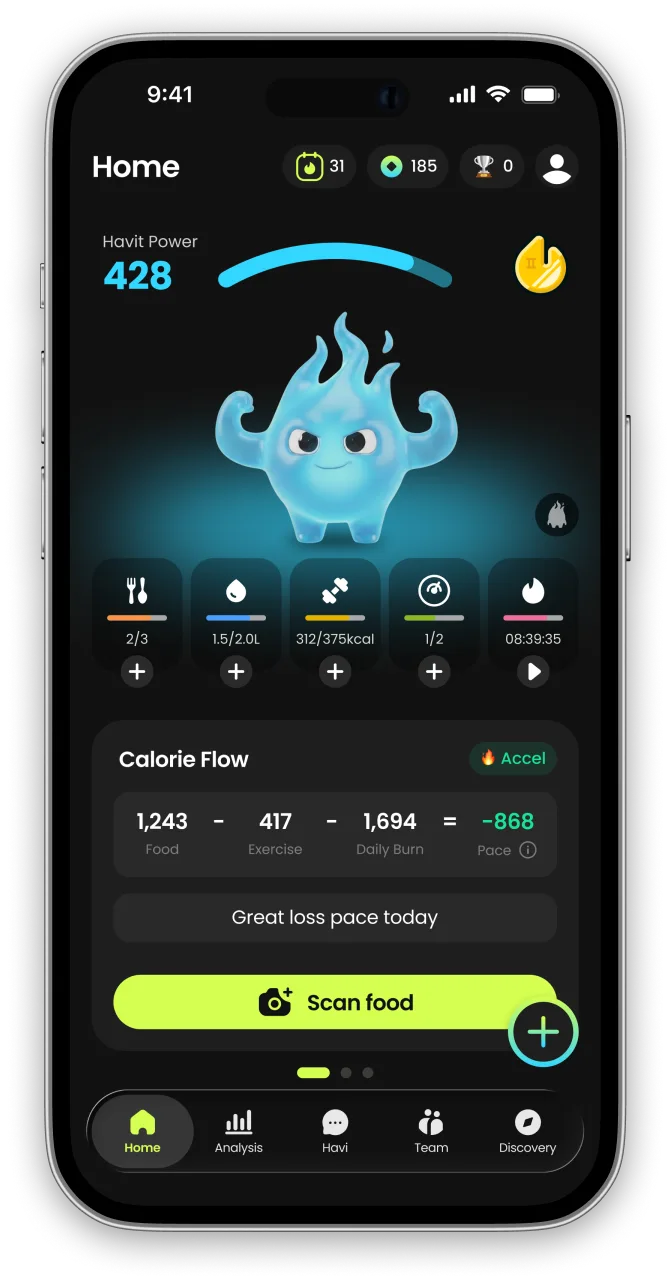
What is Havit?
Havit is an AI health companion for weight loss that protects muscle.
Unlike calorie-only trackers, Havit connects AI body-composition estimates, nutrition, hydration, sleep, steps, cycle, mood, and GLP-1 medication in one daily routine — so progress is measured by body composition, not just the number on the scale. Daily missions turn established behavior-change techniques into small repeatable actions, drawing on expertise from professionals formerly at Juvis Diet, one of Korea’s leading metabolic clinics.
In Havit’s own analysis of 1,090 GLP-1 users, people who logged consistently built stronger habits than the general user base. Read the GLP-1 Habit Report
Havit works with or without GLP-1 medication. It is a wellness app, not a medical device; body-composition results are estimates.

Continue in the App
Personalized wellness with your own data


References
- Elastic Resistance Training for Strength Development: A Meta-Analysis of 23 Controlled Trials — Journal of Strength and Conditioning Research, 2025
- Neuromuscular Adaptations to Resistance Band Training: A Systematic Review — Sports Medicine, Nuzzo J., 2024
- Accommodating Resistance and Strength Outcomes: Barbell-Band Combinations Versus Traditional Loading — Kennesaw State University, Journal of Sports Science, 2025
- Muscle Protein Synthesis Response to Elastic Versus Constant External Resistance — European Journal of Applied Physiology, 2024
- EMG Analysis of Horizontal Pulling Movements: Cable Versus Elastic Resistance — University of Valencia, International Journal of Sports Physiology, 2024

