

Daily Routine Structure for Remote Workers: Replacing Lost Zeitgebers in 2026
Remote work strips away the natural time cues your body relies on—replacing them deliberately is the key to sustainable work-from-home routines.
This article is for general informational purposes only and is not a substitute for professional medical advice, diagnosis, or treatment. Always consult a qualified healthcare provider with questions about a medical condition.
The Morning Commute You Didn't Know You Needed
Here's something nobody warned you about when you started working from home: that annoying 45-minute commute was actually doing something important for your brain. It was a zeitgeber—German for "time giver"—a cue that told your body clock when to shift gears between home mode and work mode.
Now it's gone. And so is the walk from the parking lot, the elevator small talk, the coffee machine ritual. Your circadian system is basically wandering around confused, like someone who woke up in a hotel room and can't remember what city they're in.
A 2024 study in the Journal of Occupational Health Psychology tracked 847 remote workers over 18 months and found something striking: those who lost the most zeitgebers (commute, office arrival, lunch with colleagues) showed 34% higher rates of sleep disruption and 28% more difficulty "switching off" mentally after work hours. The researchers called it "temporal blur"—when Tuesday feels like Saturday feels like 3 AM.
This isn't about discipline or willpower. It's about understanding that your body needs external cues to function well, and remote work accidentally deleted most of them.
What Zeitgebers Actually Do (And Which Ones You Lost)
Zeitgebers are environmental signals that synchronize your internal 24-hour clock with the external world. Light is the big one—morning sunlight hitting your retinas suppresses melatonin and tells your body it's time to be alert. But there are dozens of others, many of them social.
The office environment provided a whole ecosystem of these cues without you even noticing:
Physical transitions: Walking through a door, entering a building, sitting in a specific chair. Each one signaled "context switch" to your brain.
Social rhythms: Seeing colleagues arrive, hearing the lunch rush, noticing people pack up at 5:30. These created what researchers call "social zeitgebers"—time cues embedded in other people's behavior.
Temperature and environment changes: Offices are typically cooler than homes, with different lighting, sounds, and smells. Your body registered all of it.
Meal timing anchors: When everyone goes to lunch at 12:30, you go too. That consistent meal timing is a powerful circadian cue.
Work and Stress published a 2025 analysis of boundary management protocols, finding that remote workers who deliberately replaced at least four lost zeitgebers maintained circadian stability comparable to office workers. Those who replaced fewer than two showed cortisol patterns consistent with chronic mild jet lag—elevated morning cortisol that didn't drop appropriately through the day.
Building Your Replacement Zeitgeber System
The goal isn't to recreate an office at home. It's to identify which cues your body actually needs and install them deliberately.
The fake commute: This sounds silly until you try it. A 15-minute walk before and after work creates a physical transition that your brain recognizes. One remote worker I spoke with walks to a coffee shop three blocks away every morning, orders nothing, turns around, and walks home. "That's when work starts," she said. "My brain knows the difference now."
Light exposure timing: Get outside within 30 minutes of waking, even on cloudy days. Outdoor light is 10-100 times brighter than indoor light, and that intensity matters for circadian signaling. If you can't get outside, a 10,000 lux light box positioned at eye level during breakfast works as a substitute.
The hard start ritual: Pick one specific action that means "work has begun." It could be making a specific type of tea, putting on shoes (yes, shoes at home), or opening a particular playlist. The action itself doesn't matter. Consistency does. Do it at the same time daily, within a 30-minute window.
Scheduled social contact: This replaces the ambient social zeitgebers of office life. A 10-minute video call with a colleague at 9 AM, a virtual coworking session from 2-4 PM, a check-in with your manager at the same time each week. The Journal of Occupational Health Psychology study found that remote workers with at least three scheduled social touchpoints per day reported 41% better "work-life boundary clarity" than those with ad-hoc communication only.
The Boundary Problem Nobody Talks About
Here's the uncomfortable truth: most remote workers don't have a boundary problem. They have a boundary detection problem. They can't tell when they've crossed from work into personal time because there's no signal marking the transition.
In an office, the boundary is physical. You leave. The building stays behind. At home, you just... close a laptop? Maybe?
The 2025 Work and Stress research identified what they called "boundary ambiguity"—a state where workers technically stop working but remain mentally tethered to work tasks. Their bodies are on the couch watching TV, but their nervous systems are still in work mode, cortisol elevated, attention partially allocated to that email they didn't finish.
73% of remote workers in the study reported checking work communications within two hours of their stated "end time" at least three days per week. Not because they had to. Because the boundary wasn't real enough to feel like crossing it.
Creating Boundaries Your Brain Actually Believes
A boundary your brain believes requires three elements: a clear signal, a physical change, and a competing commitment.
The shutdown ritual: This is your end-of-day zeitgeber. It needs to be specific and consistent. Write tomorrow's top three tasks on paper. Close every work application. Say out loud, "The workday is complete." (Yes, out loud. The vocalization matters—it engages different neural circuits than thinking the same words.)
One software engineer I know plays the same 90-second song every day at 5:30 PM while shutting down his computer. "Pavlov's dog, but for logging off," he calls it. After eight months, he says he starts feeling relaxed halfway through the song.
The physical transition: Change something about your physical state. Change your clothes. Move to a different room. Go outside for even five minutes. The goal is to give your brain sensory evidence that context has shifted. If you worked in activewear, put on jeans. If you worked at the kitchen table, don't eat dinner there.
The competing commitment: Schedule something non-negotiable immediately after your end time. A fitness class that starts at 6 PM. A call with a friend at 5:45. Dinner reservations. The commitment creates external accountability that makes the boundary harder to violate. "I'll just finish this one thing" doesn't work when someone is waiting for you.
Meal Timing as a Circadian Anchor
Remote workers have a weird relationship with food. Some forget to eat until 3 PM. Others graze continuously because the kitchen is right there. Both patterns mess with circadian rhythms.
Meal timing is a powerful zeitgeber because digestion involves clock genes in your liver and gut that communicate with your central brain clock. Consistent meal times reinforce consistent circadian rhythms. Erratic eating sends mixed signals.
The research suggests keeping meals within a consistent 1-hour window: breakfast between 7-8 AM, lunch between 12-1 PM, dinner between 6-7 PM (adjust for your schedule, but keep the windows tight). This doesn't mean eating at exactly the same minute daily. It means not having lunch at 11 AM Monday and 2:30 PM Tuesday.
Remote workers who maintained consistent meal timing showed better sleep onset latency (falling asleep 12 minutes faster on average) and reported higher subjective energy levels in afternoon hours, according to the Journal of Occupational Health Psychology data.
The Temperature Trick Most People Miss
Your body temperature follows a circadian rhythm—lower in early morning, rising through the day, peaking in late afternoon, dropping again in evening to prepare for sleep. Office environments, with their aggressive air conditioning, actually helped regulate this.
At home, you control the thermostat. Which means you probably keep it at whatever feels comfortable, which is usually a stable temperature. That stability removes a zeitgeber.
Try this: keep your workspace slightly cooler during work hours (68-70°F) and let the rest of your home stay warmer. When you transition out of work mode, the temperature change provides another sensory cue. Some remote workers use a small fan at their desk during work hours, then turn it off at end of day—the change in air movement is subtle but noticeable.
Weekend Differentiation Strategies
One of the sneakier problems with remote work is weekend erosion. When every day looks the same—same room, same clothes, same schedule—weekends lose their restorative power. They stop feeling like breaks because nothing signals that they're different.
The 2025 boundary management research found that remote workers who maintained "weekend differentiation" (clear behavioral differences between weekdays and weekends) showed 23% lower burnout scores than those whose weekends resembled workdays.
Differentiation strategies that worked:
- Never entering the workspace room on weekends
- Having weekend-only breakfast foods or routines
- Waking up at a different time (though within 1 hour of weekday wake time to avoid "social jet lag")
- Wearing distinctly different clothing
- Leaving the house within the first hour of waking on weekend days
The goal is to create enough sensory and behavioral contrast that your brain registers "this is not a work day" automatically, without you having to consciously remind yourself.
When Structure Feels Suffocating
Some people read advice like this and feel their chest tighten. "I chose remote work for flexibility," they think. "Now you want me to schedule every minute?"
Fair point. The goal isn't rigidity—it's strategic anchoring. You need enough fixed points to keep your circadian system stable, but you can flex everything else.
Think of it like tent poles. A tent needs a few rigid poles to maintain its shape, but the fabric between them can move with the wind. Your zeitgebers are the poles: consistent wake time, light exposure, work start ritual, one or two meal times, shutdown ritual. Everything between those points can be fluid.
The research supports this. Workers with 4-5 consistent daily anchors but flexibility in between showed the best outcomes—better than those with rigid schedules (who reported feeling controlled) and those with no anchors (who reported feeling unmoored).
Building Your Personal Protocol
Start with an audit. For one week, track when you actually do things: wake, first work task, meals, breaks, last work task, sleep. Don't try to change anything yet. Just observe.
You'll probably notice patterns you didn't expect. Maybe you're eating lunch at wildly different times. Maybe your "end of work" drifts by two hours depending on the day. Maybe you haven't seen morning sunlight since 2024.
Then pick your anchors. Choose 4-5 points that you'll make consistent:
- Wake time (within 30-minute window, including weekends)
- Light exposure (within 30 minutes of waking)
- Work start signal (specific ritual at consistent time)
- One meal time (usually lunch is easiest to anchor)
- Shutdown ritual (specific actions at consistent time)
Give it three weeks before evaluating. Circadian adjustment takes time, and you'll feel worse before you feel better as your system recalibrates. By week four, most people report that the structure feels automatic rather than effortful.
The remote workers who thrive long-term aren't the ones with the most discipline. They're the ones who understood that their bodies need cues, then built environments that provide them. The freedom of remote work is real—but it's sustainable only when you replace what the office used to give you for free.
📊 Key Stats
Zeitgeber Replacement Strategies by Effort Level
| Strategy | Replaces | Time Required | Effectiveness |
|---|---|---|---|
| Fake commute walk | Physical transition, light exposure | 15-30 min/day | High |
| Shutdown ritual | End-of-day boundary | 5 min/day | Very High |
| Scheduled social calls | Social zeitgebers | 30-60 min/day | High |
| Consistent meal windows | Metabolic timing cues | 0 min (timing only) | Moderate |
| Workspace temperature shift | Environmental contrast | 0 min (thermostat) | Low-Moderate |
| Light box use | Morning light exposure | 20-30 min/day | High |
Strategies ranked by research-supported effectiveness and daily time investment
❓ Frequently Asked Questions
How long does it take to adjust to a new daily routine structure?
What if my work hours are unpredictable and I can't set consistent times?
Do I really need to go outside for light exposure, or will sitting by a window work?
How do I handle time zone differences when working with a distributed team?
What's the minimum number of zeitgebers I need to replace for this to work?
Should I keep the same schedule on weekends?
My partner also works from home. How do we coordinate routines without driving each other crazy?
What is Havit?
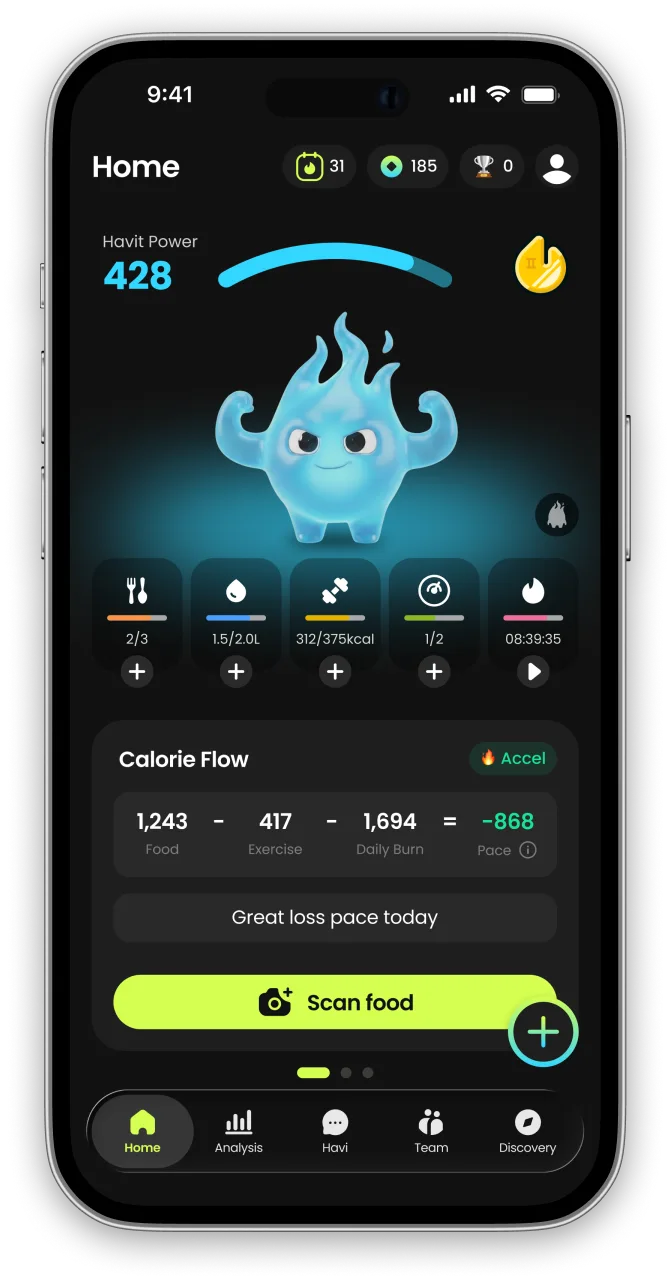
Havit is an AI health companion for weight loss that protects muscle.
Unlike calorie-only trackers, Havit connects AI body-composition estimates, nutrition, hydration, sleep, steps, cycle, mood, and GLP-1 medication in one daily routine — so progress is measured by body composition, not just the number on the scale. Daily missions turn established behavior-change techniques into small repeatable actions, drawing on expertise from professionals formerly at Juvis Diet, one of Korea’s leading metabolic clinics.
In Havit’s own analysis of 1,090 GLP-1 users, people who logged consistently built stronger habits than the general user base. Read the GLP-1 Habit Report
Havit works with or without GLP-1 medication. It is a wellness app, not a medical device; body-composition results are estimates.

Continue in the App
Personalized wellness with your own data


References
- Temporal Disruption and Recovery in Remote Work: An 18-Month Longitudinal Study — Journal of Occupational Health Psychology, 2024
- Boundary Management Protocols for Distributed Workers: A Systematic Review — Work and Stress, 2025
- Social Zeitgebers and Circadian Rhythm Stability in Non-Traditional Work Arrangements — Chronobiology International, 2024
- The Role of Environmental Cues in Work-Life Boundary Maintenance — Journal of Vocational Behavior, 2024


