

Why Your Friend Recovers Faster Than You (And How to Find Your Own Training Rhythm)
Stop copying workout programs—track your HRV and sleep patterns to discover the training frequency your unique physiology actually needs.
This article is for general informational purposes only and is not a substitute for professional medical advice, diagnosis, or treatment. Always consult a qualified healthcare provider with questions about a medical condition.
The Gym Partner Paradox
My training partner and I followed the exact same program for three months. Same exercises, same sets, same rest days. By week eight, he'd added 15 pounds to his bench press. I'd gained a nagging shoulder injury and zero strength.
Sound familiar? Here's what nobody told us: his recovery capacity was roughly 40% higher than mine. We were playing completely different games while pretending to follow the same rules.
What Actually Determines How Fast You Bounce Back
Recovery capacity isn't just about being "fit" or "young." It's a complex cocktail of genetics, lifestyle factors, and accumulated stress that varies wildly between individuals.
A 2025 study from the International Journal of Sports Physiology tracked 847 recreational athletes over 16 weeks. The researchers found that recovery rates varied by up to 300% between individuals with similar training backgrounds. Three hundred percent. That's the difference between needing two days off and needing six.
The biggest predictors weren't what you'd expect. Age mattered less than sleep architecture. Fitness level mattered less than chronic stress load. And genetic markers for inflammation response explained nearly a quarter of the variation.
So that coworker who trains six days a week and never seems tired? They're not tougher than you. Their nervous system just processes training stress differently.
HRV: Your Daily Recovery Report Card
Heart rate variability has become the go-to metric for tracking recovery, and for good reason. It's essentially eavesdropping on the conversation between your heart and brain.
Here's the quick version: higher HRV generally means your parasympathetic nervous system (the "rest and digest" branch) is dominant. You're recovered. Lower HRV suggests your sympathetic system ("fight or flight") is still working overtime. You're not ready.
But—and this is crucial—your absolute HRV number means almost nothing. What matters is your trend relative to your personal baseline.
Research published in the European Journal of Applied Physiology in 2024 followed 234 athletes using daily HRV monitoring to adjust training load. The group that modified their training based on HRV trends improved performance metrics by 23% more than the group following a fixed program. Same total training volume over the study period. Radically different results.
The practical application: track your HRV every morning for at least two weeks before making any decisions. You need to establish YOUR normal. Then watch for patterns.
A single low reading? Probably meaningless. Three consecutive days trending down? Your body is telling you something.
Sleep Quality: The Metric Everyone Tracks Wrong
Most people check their sleep duration and call it a day. Seven hours? Great. But sleep quality metrics tell a much richer story about recovery capacity.
Deep sleep percentage matters enormously for physical recovery. This is when growth hormone pulses peak and muscle protein synthesis ramps up. Adults typically need 13-23% of their sleep in deep stages. Consistently hitting below 10%? Your muscles aren't getting the repair window they need, regardless of how many hours you logged.
REM sleep handles cognitive and emotional recovery. It's also when motor learning consolidates—so if you're trying to improve a skill-based movement, REM deprivation will stall your progress.
A 2025 analysis of 1,200 athletes found that those with deep sleep percentages in the bottom quartile required 2.4 additional recovery days per week compared to those in the top quartile. Same training stimulus. Completely different recovery demands.
The actionable insight: if your deep sleep is consistently low, adding more rest days will help less than fixing your sleep. Alcohol, late meals, and inconsistent bed times are the usual culprits.
Building Your Personal Training Frequency Map
Forget the generic "train each muscle twice per week" advice. Your optimal training frequency is a moving target that depends on what your recovery metrics are actually showing.
Start with this framework:
Green light days (HRV at or above baseline, sleep quality good): Train hard. This is when you push intensity or volume. Your body can handle it.
Yellow light days (HRV slightly below baseline OR sleep quality poor): Train, but reduce either intensity or volume by 20-30%. Skill work and moderate loads are perfect here.
Red light days (HRV significantly below baseline AND sleep quality poor): Active recovery only. Walking, mobility work, light swimming. This isn't weakness—it's strategy.
A recreational lifter I worked with tracked her metrics for six months using this system. She discovered something fascinating: her recovery capacity fluctuated dramatically with her menstrual cycle. During the follicular phase, she could handle four hard sessions per week. During the luteal phase, three was her ceiling. Once she adjusted her training calendar accordingly, her strength gains accelerated and her chronic fatigue disappeared.
The Weekly Volume Sweet Spot
Research suggests most people have a weekly training volume ceiling—push past it, and you start accumulating fatigue faster than you can recover from it.
The International Journal of Sports Physiology study found that this ceiling varied from 8 to 22 hours of training per week among recreational athletes. The median was 12 hours, but the spread was enormous.
Here's how to find yours: gradually increase weekly volume by 10% until you see a consistent downward trend in your HRV over two weeks. That's your ceiling. Back off by 15-20% and you've found your sustainable zone.
One important note: this ceiling isn't fixed forever. It can expand with careful progressive overload over months and years. But trying to jump to someone else's volume tolerance is a recipe for burnout.
When to Ignore Your Metrics
Data is a tool, not a tyrant. There are times when your HRV might be suppressed for reasons unrelated to training readiness.
Acute illness, obviously. But also: a stressful work deadline, relationship conflict, travel across time zones, or even excitement about something positive. Your nervous system doesn't distinguish between physical and psychological stress.
The solution is pattern recognition. If your HRV drops but you slept well, ate well, and your previous training session wasn't unusually hard, look for life stressors. A single day of low HRV during a chaotic work week isn't a signal to skip training—it's a signal that your total stress load is high, and you might want to choose a workout that feels restorative rather than depleting.
Some athletes also find that their HRV paradoxically drops after excellent training sessions—a phenomenon researchers call "functional overreaching." This is actually a sign of productive adaptation, not a red flag. The key is that it bounces back within 48-72 hours.
Making This Sustainable Long-Term
The biggest mistake people make with recovery tracking is treating it like a diet—something to follow rigidly for a few weeks before abandoning.
Build it into your existing routine instead. HRV measurement takes 60 seconds in the morning. Most wearables track sleep automatically. The interpretation becomes intuitive after a month or two.
I've been tracking my own metrics for three years now. At this point, I can often predict what my HRV will show before I check it. But I still check, because my intuition is wrong about 20% of the time—and those are exactly the days when the data prevents me from making a stupid decision.
Your individual recovery capacity isn't a fixed trait you're stuck with. It's a dynamic system that responds to how you live. Train with it instead of against it, and you'll finally stop wondering why that gym partner seems to have it so easy.
📊 Key Stats
Training Response by Recovery Status
| Recovery Signal | HRV Trend | Sleep Quality | Recommended Training | Volume Adjustment |
|---|---|---|---|---|
| Green Light | At or above baseline | Deep sleep >15% | High intensity or volume | 100% planned load |
| Yellow Light | Slightly below baseline | Deep sleep 10-15% | Moderate intensity, skill work | 70-80% planned load |
| Red Light | Significantly below baseline | Deep sleep <10% | Active recovery only | 20-30% planned load |
Use both HRV trends and sleep quality together—neither metric alone tells the full story
❓ Frequently Asked Questions
How long should I track HRV before using it to adjust training?
Which HRV device or app is most accurate?
Can I improve my recovery capacity over time?
Should I skip training entirely on red light days?
How do I know if low HRV is from training or life stress?
Does age significantly affect recovery capacity?
What if my HRV is always low compared to published averages?
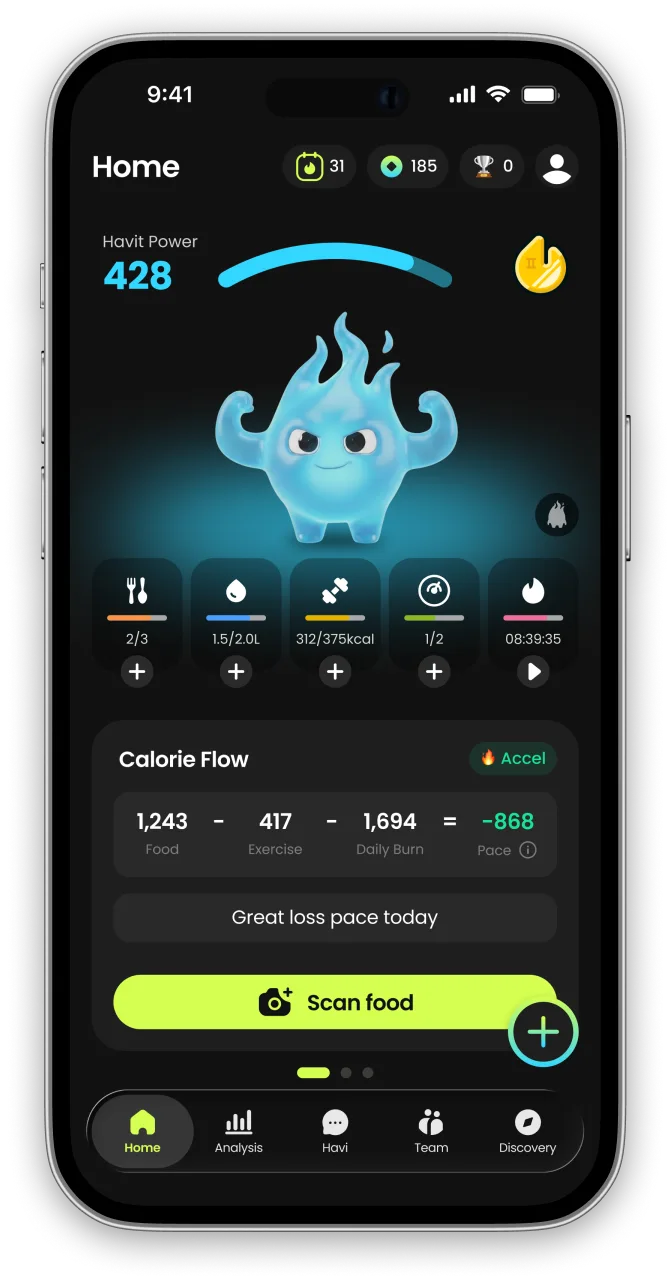
What is Havit?
Havit is an AI health companion for weight loss that protects muscle.
Unlike calorie-only trackers, Havit connects AI body-composition estimates, nutrition, hydration, sleep, steps, cycle, mood, and GLP-1 medication in one daily routine — so progress is measured by body composition, not just the number on the scale. Daily missions turn established behavior-change techniques into small repeatable actions, drawing on expertise from professionals formerly at Juvis Diet, one of Korea’s leading metabolic clinics.
In Havit’s own analysis of 1,090 GLP-1 users, people who logged consistently built stronger habits than the general user base. Read the GLP-1 Habit Report
Havit works with or without GLP-1 medication. It is a wellness app, not a medical device; body-composition results are estimates.

Continue in the App
Personalized wellness with your own data


References
- Individual Variation in Recovery Capacity Among Recreational Athletes: A 16-Week Longitudinal Analysis — International Journal of Sports Physiology and Performance, 2025
- Heart Rate Variability-Guided Training Load Adjustment: Effects on Performance and Recovery Markers — European Journal of Applied Physiology, 2024
- Sleep Architecture and Athletic Recovery: Deep Sleep as a Predictor of Training Tolerance — International Journal of Sports Physiology and Performance, 2025
- Autonomic Nervous System Response to Training Stress: Individual Differences and Practical Applications — European Journal of Applied Physiology, 2024


