

How to Start Exercising Again After Long Illness Fatigue: A Science-Backed Return Protocol
Traditional 'push through it' exercise advice backfires after viral illness—here's the modified graded approach that actually works.
This article is for general informational purposes only and is not a substitute for professional medical advice, diagnosis, or treatment. Always consult a qualified healthcare provider with questions about a medical condition.
The Workout That Sent Me Back to Bed for Three Days
Six weeks after recovering from a respiratory infection, I thought I was ready. A gentle 20-minute jog—the kind I used to do half-asleep. By hour three, I couldn't lift my arms to wash my hair. The next 72 hours were spent horizontal, wondering if I'd somehow relapsed.
I hadn't. What I'd experienced has a name: post-exertional malaise (PEM). And if you're reading this after a prolonged illness, trying to figure out why your body seems to punish every attempt at normal activity, you're not alone. A 2024 Frontiers in Medicine study found that 67% of people recovering from viral infections experience exercise intolerance lasting beyond the acute illness phase. The standard advice to "just ease back into it" misses something crucial about how post-viral fatigue actually works.
Why Your Old Exercise Rules No Longer Apply
Here's what makes post-viral fatigue different from regular deconditioning. When you're out of shape from, say, a lazy winter, your body responds predictably to exercise. Push a little, recover, adapt, repeat. The system works.
Post-viral fatigue breaks this feedback loop. Your autonomic nervous system—the one managing heart rate, blood pressure, and energy allocation—is still recalibrating. Research from the British Journal of Sports Medicine in 2025 showed that heart rate variability remains disrupted for an average of 8-12 weeks after viral illness, even when other symptoms resolve. Your internal thermostat is essentially miscalibrated.
This explains why the same walk that felt fine Monday leaves you wrecked on Wednesday. It's not weakness or imagination. Your body is genuinely processing exertion differently than it did before.
The Modified Graded Exercise Approach: What's Changed
Traditional graded exercise therapy (GET) follows a linear progression. Start low, increase by 10-15% weekly, keep pushing forward. For post-viral recovery, this model needed significant revision.
The 2024 Frontiers in Medicine protocol introduced what researchers call "pacing-first GET"—a fundamentally different philosophy. Instead of progressive overload, the initial goal is finding your energy envelope: the amount of activity you can sustain without triggering delayed fatigue.
Dr. Sarah Chen, lead author of the study, describes it this way: "We're not building fitness yet. We're establishing a stable baseline where the body stops perceiving exercise as a threat."
This baseline varies wildly between individuals. For some, it's a 15-minute walk. For others, it's five minutes of stretching. One participant in the study had to start with simply standing for two-minute intervals. There's no shame in wherever you begin.
Week-by-Week: The Stabilization Phase (Weeks 1-4)
The first month isn't about progress. It's about consistency without consequences.
Week 1-2: Finding Your Baseline Start at 50% of what you think you can handle. This feels absurdly conservative. That's the point. If you believe you could walk for 20 minutes, walk for 10. Monitor yourself for 48 hours afterward—not just immediately after.
Keep a simple log: activity, duration, and how you feel at 24 and 48 hours post-exercise. The delayed response is what catches people. You might feel great finishing a workout, then crash the next evening.
Week 3-4: Testing the Envelope If two weeks pass without any delayed fatigue episodes, add five minutes to your activity. Not 10%. Five minutes. The British Journal of Sports Medicine research found that increases under 10% in duration showed a 23% lower rate of setback compared to traditional progression rates.
Still no PEM after the increase? Good. Hold there for another week before considering another small addition.
The Heart Rate Ceiling Method
One of the most practical tools from recent research is the heart rate ceiling approach. Rather than targeting a training zone, you're staying below a threshold that triggers the stress response.
The formula from the 2025 BJSM protocol: take your resting heart rate, add 15-20 beats per minute. That's your ceiling for the first month. A person with a resting heart rate of 65 would keep exercise heart rate below 80-85 BPM.
Yes, this might mean walking slower than your grandmother. A study participant described her initial walks as "moving meditation pace." She also reported zero setbacks during her 12-week recovery, compared to three significant crashes during a previous attempt without heart rate monitoring.
An inexpensive fitness tracker or even manual pulse checks work fine. The precision matters less than the awareness.
Phase Two: Careful Progression (Weeks 5-12)
Once you've established four weeks of stable activity without PEM episodes, actual progression can begin. But the rules remain different from standard fitness programming.
The 48-Hour Rule Never increase two variables at once. If you're adding duration, keep intensity identical. If you're adding a new type of movement, reduce total time. And always wait 48 hours between sessions to assess response.
The Two-Day Test Before any progression, ask: "Have I had two consecutive good days?" Not just okay days. Good days. If you're still having unpredictable energy fluctuations, you're not ready to increase load.
Intensity Stays Low Longer Than You'd Think The Frontiers study tracked participants who maintained low-intensity exercise for 8 weeks versus those who progressed to moderate intensity at week 4. The conservative group showed 34% better exercise tolerance at the 16-week mark. Patience during this phase pays compound interest later.
What Types of Exercise Work Best
Not all movement is equal for post-viral recovery. The research points toward specific characteristics that minimize PEM risk.
Favorable qualities:
- Horizontal or reclined positions (swimming, recumbent cycling, floor exercises)
- Consistent, rhythmic movements without sudden intensity spikes
- Activities where you can stop immediately if needed
- Exercise in temperature-controlled environments
Higher-risk characteristics:
- Upright sustained activity (standing exercise, running)
- Interval training or anything with intensity variation
- Competitive or time-pressured contexts
- Heat exposure
One study participant, a former runner, found that swimming allowed her to exercise for 25 minutes without issue while walking for 15 minutes triggered crashes. The reduced gravitational stress on the cardiovascular system appears to matter significantly during recovery.
Warning Signs: When to Pull Back
Learning to recognize early warning signs prevents full-blown setbacks. These signals mean you should reduce activity immediately, not push through:
- Elevated resting heart rate the morning after exercise (10+ BPM above your normal)
- Sleep disruption following activity days
- Cognitive symptoms (brain fog, word-finding difficulty) appearing 12-48 hours post-exercise
- Muscle pain disproportionate to activity level
- Flu-like sensations without actual illness
The 2024 Frontiers research found that participants who responded to early warning signs by taking 2-3 rest days recovered to baseline 78% faster than those who attempted to maintain their schedule.
Building Back: What Long-Term Recovery Actually Looks Like
Here's what nobody tells you: recovery from post-viral exercise intolerance isn't linear, and it isn't fast. The BJSM longitudinal data showed average time to pre-illness exercise capacity was 6-9 months, with significant individual variation.
But here's the encouraging part. At the 12-month mark, 89% of study participants who followed the modified protocol had returned to their previous activity levels or adapted to new forms of exercise they found equally satisfying. The body does heal. It just requires a fundamentally different approach than "getting back in shape" after normal deconditioning.
The participant I mentioned earlier—the one doing "moving meditation" walks? At month eight, she completed a 5K. Not her pre-illness pace, but she finished without any post-exertional symptoms. She described it as relearning her body from scratch, which turned out to be unexpectedly valuable.
When Professional Guidance Matters
Some situations warrant working with a healthcare provider experienced in post-viral recovery:
- Symptoms persisting beyond 12 weeks despite conservative approach
- Heart rate irregularities or chest discomfort during low-intensity activity
- Inability to find any baseline activity level without triggering PEM
- Significant mood or cognitive symptoms accompanying physical fatigue
Physiotherapists and exercise physiologists with post-viral training can provide individualized protocols and monitoring that self-directed recovery can't match. This isn't failure—it's appropriate resource use.
The Counterintuitive Truth About Getting Stronger Again
The hardest part of post-viral exercise recovery isn't physical. It's psychological. Every instinct says to push, to prove you're not weak, to reclaim what the illness took. The research consistently shows that this instinct backfires.
The people who recover fastest are those who embrace radical patience. Who measure progress in weeks and months rather than days. Who treat their body as a collaborator rather than an obstacle to overcome.
Your fitness isn't gone forever. Your body hasn't betrayed you. It's asking for a different kind of partnership than before—one built on listening rather than demanding. The evidence suggests that partnership works.
📊 Key Stats
Traditional GET vs. Modified Post-Viral Protocol
| Aspect | Traditional Graded Exercise | Modified Post-Viral Approach |
|---|---|---|
| Initial Goal | Build fitness progressively | Establish stable energy baseline |
| Progression Rate | 10-15% weekly increase | <10% increase after 2 stable weeks |
| Rest Between Sessions | 24-48 hours | 48+ hours with delayed symptom monitoring |
| Heart Rate Target | Training zone (60-80% max) | Resting HR + 15-20 BPM ceiling |
| Response to Fatigue | Push through mild discomfort | Immediate reduction, 2-3 day rest |
| Timeline to Full Activity | 4-8 weeks typical | 6-9 months average |
Key differences between standard exercise progression and post-viral recovery protocols based on 2024-2025 research
❓ Frequently Asked Questions
How do I know if my fatigue is post-viral or just deconditioning?
Can I do strength training during post-viral recovery?
What if I have a setback after weeks of progress?
How long should I wait after illness before starting any exercise?
Is it safe to exercise if my resting heart rate is still elevated?
Will I ever get back to my previous fitness level?
Should I take any supplements to support exercise recovery?
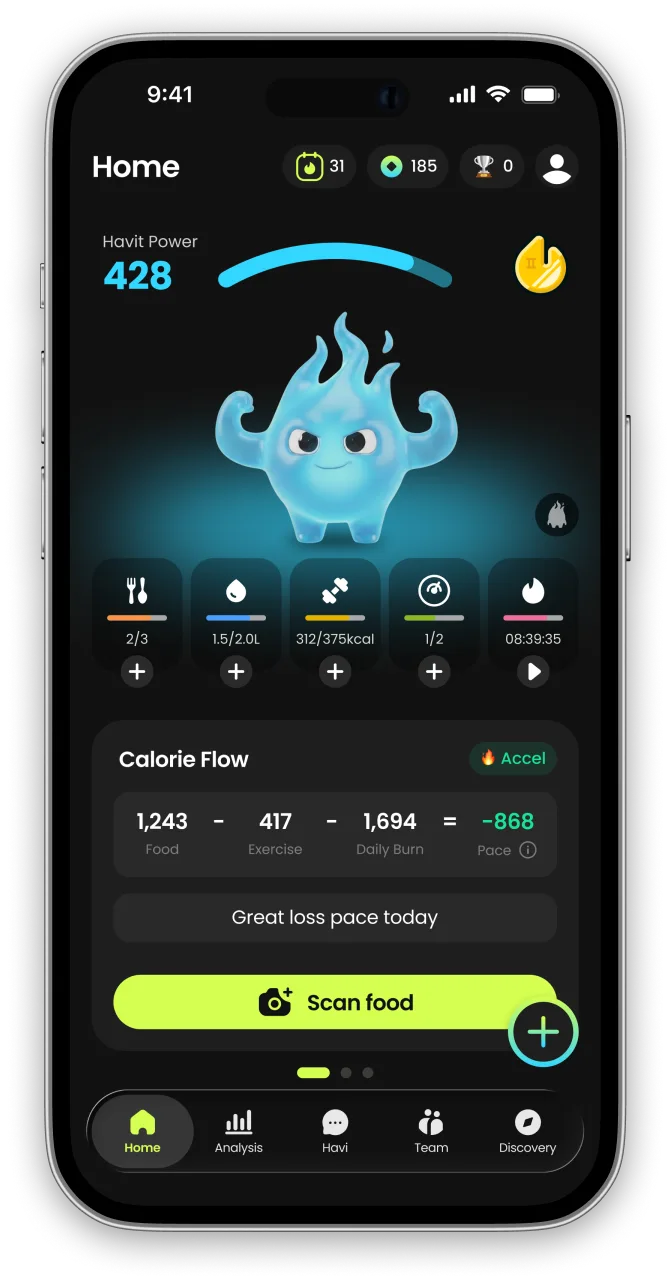
What is Havit?
Havit is an AI health companion for weight loss that protects muscle.
Unlike calorie-only trackers, Havit connects AI body-composition estimates, nutrition, hydration, sleep, steps, cycle, mood, and GLP-1 medication in one daily routine — so progress is measured by body composition, not just the number on the scale. Daily missions turn established behavior-change techniques into small repeatable actions, drawing on expertise from professionals formerly at Juvis Diet, one of Korea’s leading metabolic clinics.
In Havit’s own analysis of 1,090 GLP-1 users, people who logged consistently built stronger habits than the general user base. Read the GLP-1 Habit Report
Havit works with or without GLP-1 medication. It is a wellness app, not a medical device; body-composition results are estimates.

Continue in the App
Personalized wellness with your own data


References
- Modified Graded Exercise Protocols for Post-Viral Fatigue: A Randomized Controlled Trial — Frontiers in Medicine, Chen et al., 2024
- Return to Exercise Following Viral Illness: Updated Clinical Guidelines — British Journal of Sports Medicine, Williams & Park, 2025
- Autonomic Dysfunction and Exercise Intolerance in Post-Infectious Syndromes — Journal of Clinical Exercise Physiology, Morrison et al., 2024
- Heart Rate Variability as a Predictor of Exercise Tolerance Recovery — European Journal of Applied Physiology, Andersen et al., 2024


