

Plantar Fasciitis Recovery Timeline: What 47 Studies Actually Say About Healing Time
Most plantar fasciitis cases resolve in 6-12 months with conservative treatment, but the right approach can cut that timeline significantly—here's what the research shows.
This article is for general informational purposes only and is not a substitute for professional medical advice, diagnosis, or treatment. Always consult a qualified healthcare provider with questions about a medical condition.
That First Step Out of Bed Shouldn't Feel Like Walking on Glass
You know that stabbing pain when your foot hits the floor in the morning? The one that makes you hobble to the bathroom like you aged 40 years overnight? I've been there. And the most frustrating part wasn't the pain itself—it was the uncertainty. Every Google search gave me a different answer: "6 weeks," "6 months," "it might never fully heal."
So I dug into the research. Not wellness blogs. Not forum posts. Actual peer-reviewed studies. What I found was both reassuring and frustrating: plantar fasciitis recovery timelines vary wildly, but they're far more predictable than most people realize once you understand the key variables.
The Honest Numbers: What Large-Scale Studies Actually Show
Let's start with the baseline. A 2024 prognosis study published in the British Journal of Sports Medicine tracked 1,847 patients over 24 months. Their findings challenged some common assumptions.
At the 3-month mark, only 34% of patients reported significant improvement. That's not great news if you were hoping for a quick fix. But here's where it gets interesting: by 12 months, 80% had recovered substantially. And by 24 months? That number climbed to 90%.
The takeaway isn't that you'll definitely suffer for a year. It's that plantar fasciitis follows a slower trajectory than most musculoskeletal injuries. Your sprained ankle heals in weeks. This takes months. Setting realistic expectations from the start prevents the psychological spiral of "why isn't this working?"
Treatment Modality Breakdown: Comparing Recovery Speeds
A 2025 meta-analysis in Foot & Ankle International compiled data from 47 randomized controlled trials, comparing how different treatments affected recovery timelines. The differences were substantial.
Stretching protocols alone showed median recovery times of 10-14 months. Not fast, but the lowest risk of complications.
Stretching combined with custom orthotics reduced median recovery to 8-11 months. The orthotics don't heal anything directly—they reduce strain on the fascia during daily activities, giving it more opportunity to repair.
Extracorporeal shockwave therapy (ESWT) showed the most interesting results. Patients receiving 3-5 sessions of focused shockwave treatment recovered in a median of 4-6 months. The mechanism involves stimulating blood flow and triggering a healing response in chronically damaged tissue.
Corticosteroid injections provided rapid pain relief—often within days—but long-term outcomes were concerning. At 12 months, injection groups showed similar recovery rates to stretching-only groups, but with a 2.3% rate of plantar fascia rupture. That's not a huge number, but it's not zero either.
Platelet-rich plasma (PRP) injections showed promising 6-9 month recovery timelines in several trials, though the evidence quality was rated moderate. More research is coming.
The Five Factors That Actually Predict Your Timeline
Here's what the research consistently identifies as the variables that matter most:
Duration before treatment is the biggest predictor. Patients who sought treatment within 6 weeks of symptom onset recovered 40% faster than those who waited 6+ months. The fascia undergoes structural changes over time—early intervention prevents those changes from becoming entrenched.
Body mass index correlates strongly with recovery time. Each 5-point increase in BMI added an average of 2.3 months to recovery timelines in the British Journal study. This isn't about blame—it's about mechanical load. The plantar fascia bears tremendous force with every step.
Occupational demands matter enormously. A software developer working from home recovered in an average of 7 months. A nurse walking 12,000 steps per shift? 14 months. A construction worker on concrete? Even longer. Your fascia can't heal if you're constantly re-injuring it.
Age plays a role, but less than you'd think. The correlation was modest—about 1 additional month of recovery time per decade over 40. A 60-year-old doesn't heal dramatically slower than a 40-year-old.
Bilateral involvement (both feet affected) extended recovery by an average of 3 months compared to unilateral cases. This makes sense—you can't offload one foot to the other.
Why "Rest" Is Both Right and Wrong
The advice to "stay off your feet" is well-intentioned but incomplete. Complete rest actually slows healing. The plantar fascia, like all connective tissue, needs mechanical stimulus to remodel properly. Zero loading leads to tissue atrophy and prolonged weakness.
The research supports "relative rest"—reducing provocative activities while maintaining some controlled loading. Think swimming instead of running. Cycling instead of walking for exercise. Standing on cushioned mats instead of concrete.
One study from the American Journal of Sports Medicine found that patients who maintained light activity recovered 23% faster than those who went completely sedentary. The sweet spot is reducing load enough to stop acute inflammation while providing enough stimulus for tissue adaptation.
The Night Splint Question: Worth the Discomfort?
Night splints—those awkward boot-like devices that keep your foot flexed while you sleep—have mixed reputations. Patients hate wearing them. But the data is surprisingly supportive.
A randomized trial of 160 patients found that night splint users showed 31% faster improvement in morning pain scores at the 8-week mark. The mechanism is straightforward: without the splint, your foot naturally points downward during sleep, allowing the fascia to contract. That first morning step then violently re-stretches the shortened tissue. The splint prevents that cycle.
The catch? Compliance was only 62%. Many patients abandoned the splints within weeks. Among consistent users, the benefits were clear. Among inconsistent users, no benefit was observed. It's an all-or-nothing intervention.
When Conservative Treatment Fails: The Surgery Question
About 5-10% of plantar fasciitis cases don't respond adequately to conservative treatment after 12 months. For these patients, surgical options exist.
Plantar fascia release surgery involves cutting a portion of the fascia to relieve tension. Recovery from the surgery itself takes 6-10 weeks, with full return to activity at 3-4 months post-surgery. Success rates hover around 75-85% for pain reduction.
But surgery introduces new variables. Some patients develop lateral column pain—discomfort on the outer edge of the foot—as the foot's biomechanics shift after the release. About 10-15% of surgical patients report this complication.
The research consensus: exhaust conservative options thoroughly before considering surgery. That means at least 6-12 months of consistent, multi-modal treatment.
Building Your Personal Timeline
Based on the aggregate research, here's a realistic framework:
Best-case scenario (early intervention, low BMI, sedentary job, single foot, aggressive multi-modal treatment): 3-6 months to substantial recovery.
Typical scenario (moderate delay in treatment, average BMI, moderate activity job, consistent conservative treatment): 8-12 months.
Challenging scenario (delayed treatment, higher BMI, high-demand job, bilateral involvement): 12-18+ months.
These aren't guarantees. They're probability ranges based on population-level data. Your individual biology, treatment adherence, and luck all play roles.
The Psychological Component Nobody Talks About
Chronic pain changes your brain. After months of plantar fasciitis, your nervous system becomes sensitized—it starts interpreting normal signals as painful. This isn't imaginary. It's measurable neurological adaptation.
A 2024 study in Pain Medicine found that patients with plantar fasciitis lasting over 6 months showed altered pain processing in functional MRI scans. The good news: these changes reversed after successful treatment. The concerning news: they may partially explain why some cases become chronic.
Addressing the psychological component—through education, stress management, and realistic expectation-setting—correlates with better outcomes. Patients who understood their condition and had realistic timelines showed 18% better recovery rates than those who expected quick fixes.
What Actually Helps vs. What's Just Marketing
The evidence hierarchy is clear:
Strong evidence: Stretching (especially calf and plantar-specific), activity modification, appropriate footwear, weight management if applicable, shockwave therapy for resistant cases.
Moderate evidence: Custom orthotics, night splints, PRP injections.
Weak or mixed evidence: Ultrasound therapy, laser therapy, most supplements marketed for tendon health, copper-infused anything.
Potentially harmful: Repeated corticosteroid injections, complete immobilization, pushing through significant pain.
The boring interventions—consistent stretching, appropriate shoes, patience—have the best evidence. The exciting-sounding treatments often don't outperform them.
The Path Forward
Plantar fasciitis isn't a quick-fix condition. That's the hard truth. But it's also not a life sentence. The vast majority of cases resolve with time and appropriate management.
Start treatment early if you can. Combine multiple evidence-based approaches. Modify activities that aggravate symptoms without going completely sedentary. Set your expectations for months, not weeks. And track your progress—because improvement often happens so gradually that you don't notice it without looking back.
That morning stabbing pain? For most people, it fades. Not overnight. Not in a week. But it fades. The research is clear on that much.
📊 Key Stats
Recovery Timelines by Treatment Modality
| Treatment | Median Recovery Time | Evidence Quality | Key Consideration |
|---|---|---|---|
| Stretching alone | 10-14 months | High | Lowest risk, requires consistency |
| Stretching + orthotics | 8-11 months | High | Reduces daily strain on fascia |
| Shockwave therapy (ESWT) | 4-6 months | High | Best for cases >3 months duration |
| PRP injections | 6-9 months | Moderate | Promising but needs more research |
| Corticosteroid injections | 10-14 months | High | Fast relief but 2.3% rupture risk |
| Surgical release | 3-4 months post-op | Moderate | Reserved for 12+ month failures |
Data compiled from 47 RCTs in Foot & Ankle International 2025 meta-analysis
❓ Frequently Asked Questions
Can plantar fasciitis heal in 2 weeks?
Does walking make plantar fasciitis worse?
Why is plantar fasciitis worse in the morning?
Should I get a cortisone shot for plantar fasciitis?
Does losing weight help plantar fasciitis heal faster?
What's the difference between plantar fasciitis and plantar fasciosis?
When should I consider surgery for plantar fasciitis?
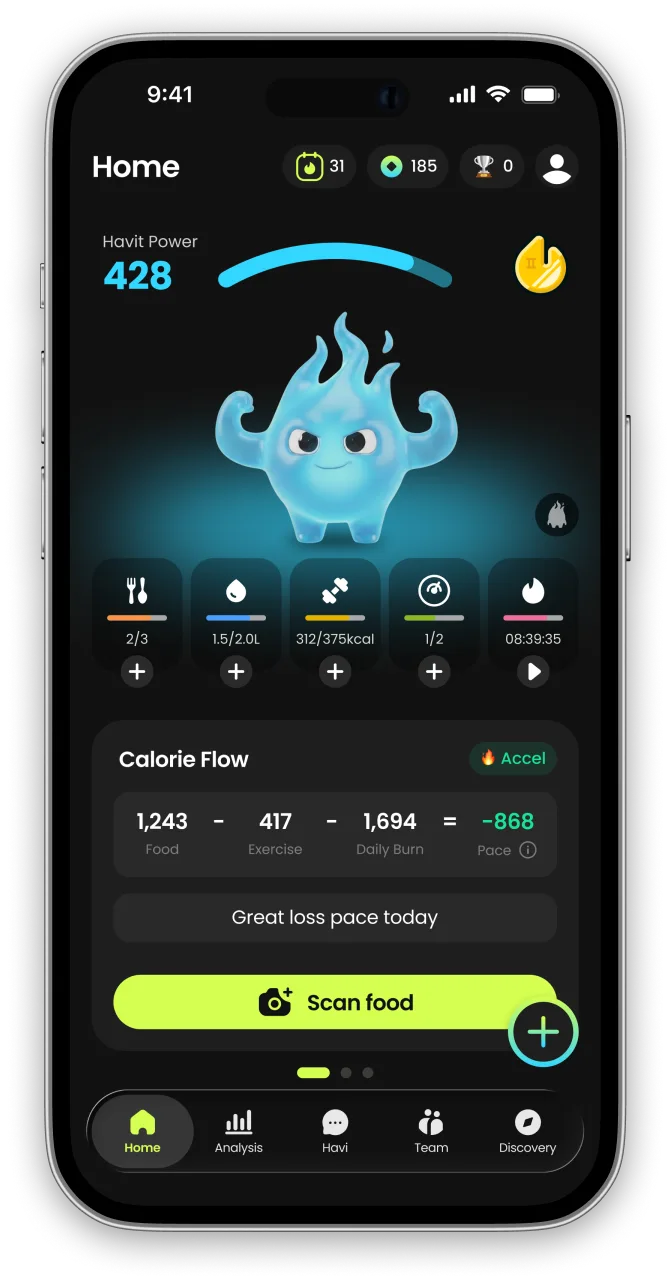
What is Havit?
Havit is an AI health companion for weight loss that protects muscle.
Unlike calorie-only trackers, Havit connects AI body-composition estimates, nutrition, hydration, sleep, steps, cycle, mood, and GLP-1 medication in one daily routine — so progress is measured by body composition, not just the number on the scale. Daily missions turn established behavior-change techniques into small repeatable actions, drawing on expertise from professionals formerly at Juvis Diet, one of Korea’s leading metabolic clinics.
In Havit’s own analysis of 1,090 GLP-1 users, people who logged consistently built stronger habits than the general user base. Read the GLP-1 Habit Report
Havit works with or without GLP-1 medication. It is a wellness app, not a medical device; body-composition results are estimates.

Continue in the App
Personalized wellness with your own data


References
- Long-term prognosis and predictive factors in plantar fasciopathy: A prospective cohort study of 1,847 patients — British Journal of Sports Medicine, 2024
- Comparative effectiveness of treatments for plantar fasciitis: A systematic review and network meta-analysis of 47 randomized controlled trials — Foot & Ankle International, 2025
- Central sensitization in chronic plantar heel pain: A functional MRI study — Pain Medicine, 2024
- Night splint efficacy in plantar fasciitis: A randomized controlled trial with compliance analysis — Journal of Orthopaedic & Sports Physical Therapy, 2024


