

Acid Reflux Causes Beyond Stomach Acid: Why Antacids Often Miss the Real Problem
Acid reflux usually stems from valve problems, slow stomach emptying, or nerve issues—not excess acid production—which explains why antacids don't work for everyone.
This article is for general informational purposes only and is not a substitute for professional medical advice, diagnosis, or treatment. Always consult a qualified healthcare provider with questions about a medical condition.
The Antacid Paradox: When Less Acid Makes Things Worse
Here's something that might surprise you: people with acid reflux often have normal or even low stomach acid levels. I spent years popping Tums like candy before a gastroenterologist told me this, and honestly, I felt a little betrayed. All those commercials showing stomach acid as the villain? Turns out the story is way more complicated.
A 2025 review in Gastroenterology examined 847 patients with chronic reflux symptoms. Only 23% showed evidence of excessive acid production. The rest? Their acid levels were perfectly normal. Some were actually producing less acid than average. So what's actually going on here?
Your Lower Esophageal Sphincter: The Real Gatekeeper
Picture a muscular ring sitting right where your esophagus meets your stomach. This is your lower esophageal sphincter, or LES, and it has one job: stay closed except when you swallow food. When it works properly, stomach contents stay where they belong.
When it doesn't? Chaos.
The LES can malfunction in several ways. It might relax at random moments (called transient LES relaxations, or TLESRs). It could be structurally weak, unable to maintain enough pressure to keep things sealed. Or it might be positioned wrong due to a hiatal hernia, where part of your stomach pushes up through your diaphragm.
Researchers at the University of Leuven tracked LES pressure in 312 reflux patients over 24 hours. They found that 67% of reflux episodes occurred during random LES relaxations—not during meals or obvious triggers. The sphincter just... opened. No warning, no reason. And here's the kicker: these patients had completely normal acid levels. The problem wasn't what was coming up. It was that anything was coming up at all.
Delayed Gastric Emptying: When Food Overstays Its Welcome
Your stomach is supposed to process a meal and send it along to your small intestine within about 4 hours. But for roughly 40% of people with chronic reflux, this process drags on much longer. Food sits there. Pressure builds. Eventually, something's got to give.
This condition—gastroparesis when severe, delayed gastric emptying when milder—creates a perfect storm for reflux. Think of it like overfilling a water balloon. The balloon isn't defective. There's just too much inside, and the pressure forces contents back up through whatever weak point exists.
A 2024 study in Gut used wireless motility capsules to track digestion in 156 reflux patients. Average gastric emptying time in the reflux group was 5.8 hours, compared to 3.2 hours in healthy controls. Patients with the slowest emptying times reported the most severe symptoms—even though their acid levels were identical to the control group.
What causes slow emptying? The list is long. Diabetes damages the vagus nerve that controls stomach contractions. Certain medications (opioids, some antidepressants, calcium channel blockers) put the brakes on motility. Sometimes there's no identifiable cause at all. The stomach just... takes its time.
The Esophageal Clearance Problem
So acid splashes up into your esophagus. Now what? In a healthy system, your esophagus performs a wave-like contraction (peristalsis) that pushes that acid back down within seconds. Saliva washes down to neutralize whatever remains. Problem solved.
Except when it isn't.
Many reflux sufferers have what's called ineffective esophageal motility. Their peristaltic waves are weak, uncoordinated, or absent altogether. Acid that refluxes upward just... sits there. One study found that patients with weak peristalsis had acid contact times three times longer than those with normal motility. Same amount of acid, same number of reflux events—but dramatically different damage potential.
This explains something puzzling: why two people with identical reflux measurements can have wildly different symptoms. Person A clears acid in 8 seconds and barely notices. Person B takes 45 seconds and feels like their chest is on fire.
The Hiatal Hernia Factor
About 60% of people over 50 have some degree of hiatal hernia. Most never know it. But for some, this anatomical quirk becomes a major player in their reflux story.
Normally, your diaphragm wraps around your esophagus right at the LES, providing extra squeeze pressure. It's like having a backup security system. When a hiatal hernia develops, part of your stomach slides up above the diaphragm. Now your LES is working alone, without that muscular reinforcement.
Worse, the herniated portion of stomach creates a little pouch that can trap acid. Even if your LES works perfectly, that trapped acid can still reflux up. It's a design flaw, essentially—one that no amount of acid-reducing medication can fix because the acid isn't the problem. The plumbing is.
Nerve Dysfunction and Hypersensitivity
Here's where things get really interesting. Some people experience severe reflux symptoms with minimal actual acid exposure. Their esophageal lining looks normal under endoscopy. pH monitoring shows barely any acid reflux. And yet they're miserable.
This phenomenon—called functional heartburn or reflux hypersensitivity—involves the nervous system rather than the digestive system. The nerves in the esophagus become hypervigilant, interpreting normal sensations as painful. It's similar to how chronic pain conditions work elsewhere in the body.
A 2024 analysis found that 30-40% of patients who don't respond to proton pump inhibitors fall into this category. Their problem isn't acid. It's perception. And treating them with stronger acid blockers is like turning down the volume on a speaker that's already silent.
Why Standard Treatments Miss the Mark
Proton pump inhibitors (PPIs) like omeprazole are incredibly effective at reducing stomach acid production. They can cut acid output by 90% or more. For someone whose primary problem is excess acid, this is transformative.
But think about everything we've covered. LES dysfunction? PPIs don't strengthen the sphincter. Delayed gastric emptying? PPIs don't speed up digestion. Weak esophageal peristalsis? PPIs don't improve motility. Hiatal hernia? PPIs don't fix anatomy. Nerve hypersensitivity? PPIs don't calm overactive neurons.
This explains the frustrating statistics. About 30-40% of people taking PPIs for reflux symptoms don't get adequate relief. They're told to take higher doses, try different brands, add antacids on top. Sometimes it helps marginally. Often it doesn't. Because they're treating a symptom while the underlying mechanism continues unchecked.
What Actually Helps: Mechanism-Specific Approaches
Once you understand why reflux is happening, treatment options expand considerably.
For LES dysfunction, there are now surgical options like magnetic sphincter augmentation (the LINX device) that physically reinforce the valve. Certain medications called GABA-B agonists can reduce the frequency of random LES relaxations. Even something as simple as avoiding meals close to bedtime gives the LES less to deal with during its weakest hours.
Delayed gastric emptying responds to prokinetic medications that stimulate stomach contractions. Dietary modifications help too—smaller meals, lower fat content, avoiding foods that slow digestion. Some patients benefit from gastric electrical stimulation, essentially a pacemaker for the stomach.
Weak esophageal peristalsis is trickier. Elevating the head of your bed uses gravity to assist clearance. Chewing gum after meals increases saliva production, providing more natural buffering. Some research suggests that certain neuromodulators can improve peristaltic strength, though this remains experimental.
For hypersensitivity, the approach shifts entirely. Neuromodulators like low-dose tricyclic antidepressants can dial down nerve sensitivity. Cognitive behavioral therapy helps some patients. Hypnotherapy targeting gut-brain connections has shown surprising effectiveness in clinical trials.
The Bigger Picture
I'm not saying stomach acid doesn't matter. It absolutely does. Acid is what causes the burning sensation, the tissue damage, the long-term complications. Reducing acid exposure remains important.
But acid is usually the weapon, not the criminal. Blaming acid for reflux is like blaming bullets for a shooting while ignoring the gun. You need to address both—the damaging agent and the mechanism allowing it access where it doesn't belong.
If you've been managing reflux for years with limited success, it might be worth asking: what's actually causing my reflux? Is it truly excess acid? Or is something else going on—a lazy sphincter, a sluggish stomach, a hypersensitive esophagus, an anatomical quirk?
The answer changes everything.
📊 Key Stats
Acid Reflux Mechanisms: Beyond Excess Acid Production
| Mechanism | What Goes Wrong | Why PPIs Don't Fully Help | Alternative Approaches |
|---|---|---|---|
| LES Dysfunction | Sphincter relaxes randomly or lacks pressure | PPIs reduce acid but don't strengthen the valve | LINX device, GABA-B agonists, lifestyle timing |
| Delayed Gastric Emptying | Food stays in stomach too long, building pressure | PPIs don't affect stomach motility | Prokinetics, smaller meals, low-fat diet |
| Weak Esophageal Peristalsis | Acid isn't cleared quickly from esophagus | PPIs reduce acid but don't improve clearance | Bed elevation, increased saliva production |
| Hiatal Hernia | Stomach portion above diaphragm traps acid | PPIs can't fix anatomical displacement | Surgical repair, positioning strategies |
| Nerve Hypersensitivity | Normal sensations perceived as painful | No excess acid to reduce | Neuromodulators, CBT, gut-directed hypnotherapy |
Understanding the specific mechanism driving reflux symptoms guides more effective treatment selection
❓ Frequently Asked Questions
Can you have acid reflux with low stomach acid?
Why don't antacids work for my reflux?
What is a transient LES relaxation?
How do I know if I have delayed gastric emptying?
Can stress cause acid reflux even without excess acid?
Should I stop taking my PPI if it's not working?
Is surgery the only option for a hiatal hernia causing reflux?
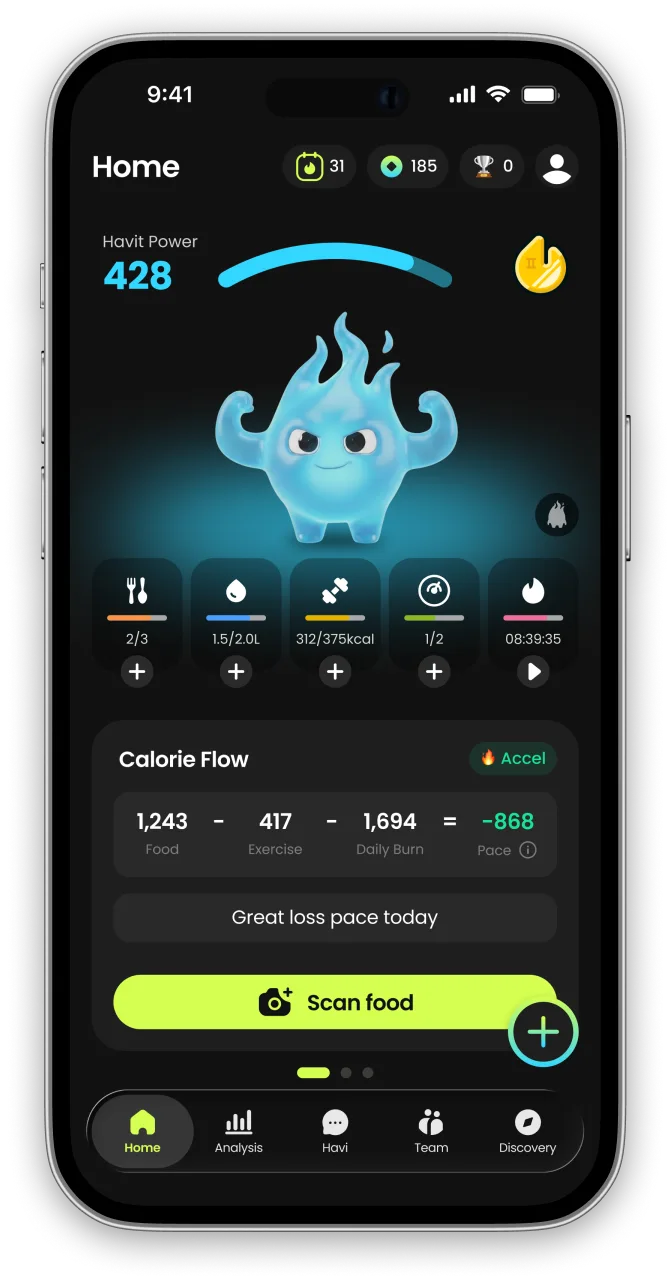
What is Havit?
Havit is an AI health companion for weight loss that protects muscle.
Unlike calorie-only trackers, Havit connects AI body-composition estimates, nutrition, hydration, sleep, steps, cycle, mood, and GLP-1 medication in one daily routine — so progress is measured by body composition, not just the number on the scale. Daily missions turn established behavior-change techniques into small repeatable actions, drawing on expertise from professionals formerly at Juvis Diet, one of Korea’s leading metabolic clinics.
In Havit’s own analysis of 1,090 GLP-1 users, people who logged consistently built stronger habits than the general user base. Read the GLP-1 Habit Report
Havit works with or without GLP-1 medication. It is a wellness app, not a medical device; body-composition results are estimates.

Continue in the App
Personalized wellness with your own data


References
- Pathophysiology of Gastroesophageal Reflux Disease: Moving Beyond Acid — Gastroenterology, 2025
- Esophageal Motility Disorders and Their Role in Reflux Symptom Generation — Gut, 2024
- Transient Lower Esophageal Sphincter Relaxations: Mechanisms and Clinical Implications — American Journal of Gastroenterology, 2024
- Gastroparesis and Gastroesophageal Reflux: Understanding the Connection — Neurogastroenterology & Motility, 2024
- Functional Heartburn and Reflux Hypersensitivity: Diagnosis and Management — Clinical Gastroenterology and Hepatology, 2025


