

PCOS and Insulin Resistance: The Lifestyle Changes That Actually Move the Needle
Strategic lifestyle changes can improve insulin sensitivity by 25-50% in women with PCOS—often matching or exceeding medication effects.
This article is for general informational purposes only and is not a substitute for professional medical advice, diagnosis, or treatment. Always consult a qualified healthcare provider with questions about a medical condition.
Your Doctor Gave You 15 Minutes. Here's What They Didn't Have Time to Explain.
Sarah sat in her car after the appointment, staring at the words "polycystic ovary syndrome" on her discharge papers. The doctor mentioned something about insulin resistance, handed her a metformin prescription, and suggested she "try to lose some weight." That was it. No roadmap. No specifics. Just a vague directive and a medication that made her nauseous.
If this sounds familiar, you're not alone. About 70% of women with PCOS have some degree of insulin resistance, yet most leave their appointments with more questions than answers. The connection between your ovaries and your blood sugar isn't obvious, and the lifestyle recommendations often feel impossibly generic.
Here's what the research actually shows: targeted lifestyle interventions can improve insulin sensitivity by 25-50% in women with PCOS. That's not a typo. We're talking about changes that can rival—and sometimes surpass—what medication alone achieves.
The Insulin-PCOS Connection Nobody Explains Properly
Think of insulin as a key that unlocks your cells so glucose can enter. In insulin resistance, the locks get sticky. Your pancreas compensates by making more keys—more insulin—which sort of works for blood sugar but creates a cascade of other problems.
In PCOS, this excess insulin does something specific: it tells your ovaries to produce more androgens (male hormones like testosterone). It also reduces a protein called sex hormone-binding globulin (SHBG), which normally keeps testosterone in check. The result? More free testosterone floating around, causing acne, unwanted hair growth, irregular cycles, and difficulty ovulating.
A 2024 analysis in the Journal of Clinical Endocrinology & Metabolism tracked 847 women with PCOS over two years. Those who achieved even modest improvements in insulin sensitivity—around 15%—saw their androgen levels drop by an average of 23%. Their cycles became more regular. Some who hadn't ovulated in years started ovulating again.
The takeaway? Improving insulin sensitivity isn't just about preventing diabetes down the road. It directly addresses the hormonal chaos driving most PCOS symptoms.
Eating Patterns That Shift Insulin Response
Forget the generic "eat less sugar" advice. The research points to specific patterns that make a measurable difference.
Meal timing matters more than most people realize. A study from Tel Aviv University found that women with PCOS who ate their largest meal at breakfast (980 calories) and smallest at dinner (190 calories) improved their insulin sensitivity by 56% over 12 weeks. The group eating the same foods in reverse order? Only 7% improvement. Same calories. Same macros. Completely different metabolic outcomes.
This doesn't mean you need to eat a 980-calorie breakfast. But front-loading your calories—making lunch substantial and dinner lighter—appears to work with your body's natural circadian insulin rhythm rather than against it.
Carbohydrate quality trumps carbohydrate quantity. The glycemic index isn't perfect, but it's useful here. A 2025 review in Fertility and Sterility examined 23 dietary intervention studies in PCOS and found that low-glycemic diets improved insulin sensitivity by 31% on average, while simple calorie restriction without attention to glycemic impact improved it by only 14%.
Practical translation: swap white rice for quinoa, instant oatmeal for steel-cut, white bread for sourdough or sprouted grain. You're not eliminating carbs—you're choosing ones that don't spike your blood sugar as dramatically.
Protein at every meal changes the game. Adding 20-30 grams of protein to a carbohydrate-containing meal can reduce the glucose spike by up to 40%. This isn't about high-protein diets necessarily. It's about never eating carbs alone. Apple with almond butter instead of just an apple. Hummus with your crackers. Eggs with your toast.
The Exercise Prescription That Actually Works
Here's where it gets interesting. The type of exercise matters enormously for insulin sensitivity, and the optimal approach for PCOS might not be what you'd expect.
Resistance training outperforms cardio for insulin sensitivity. A 2024 randomized trial compared three groups of women with PCOS: one doing only aerobic exercise, one doing only resistance training, and one doing both. After 16 weeks, the resistance-only group improved their insulin sensitivity by 33%. The cardio-only group? 19%. The combination group hit 38%, but here's the kicker—they exercised twice as much to get marginally better results.
Why does lifting weights work so well? Muscle is your body's largest glucose sink. More muscle means more places for glucose to go without requiring extra insulin. Each pound of muscle you add burns glucose 24/7, even while you sleep.
You don't need to live at the gym. The studies showing significant improvements used modest protocols: resistance training 2-3 times per week, 45-60 minutes per session. That's it. The women weren't becoming bodybuilders. They were doing basic compound movements—squats, deadlifts, rows, presses—at moderate intensity.
High-intensity interval training (HIIT) offers a time-efficient alternative. For those who genuinely can't commit to longer sessions, HIIT shows promise. Twenty minutes of intervals (30 seconds hard, 90 seconds recovery) three times weekly improved insulin sensitivity by 28% in one PCOS-specific trial. Not quite as effective as resistance training, but significantly better than steady-state cardio for the time invested.
Sleep: The Overlooked Insulin Sensitivity Lever
Most PCOS lifestyle guides bury sleep as an afterthought. The data suggests it deserves top billing.
One night of sleep deprivation (4 hours instead of 8) reduces insulin sensitivity by approximately 25% the next day. One night. In healthy individuals without PCOS. For women already struggling with insulin resistance, the impact compounds.
A 2024 study specifically examining sleep in PCOS found that women sleeping less than 6 hours nightly had insulin resistance scores 47% higher than those sleeping 7-8 hours—even after controlling for weight, diet, and exercise. The relationship held regardless of BMI.
The mechanisms are multiple: sleep deprivation increases cortisol, which directly opposes insulin. It alters hunger hormones, making you crave high-glycemic foods. It reduces your body's ability to clear glucose from the bloodstream.
Practical targets: 7-8 hours of actual sleep (not just time in bed), consistent sleep and wake times within a 30-minute window, and limited light exposure in the two hours before bed. Blue-light blocking glasses aren't just trendy—they measurably improve sleep quality in controlled trials.
Stress Management Isn't Optional
Cortisol and insulin have a complicated relationship. In the short term, cortisol raises blood sugar to give you energy for fight-or-flight. Chronically elevated cortisol keeps blood sugar chronically elevated, which means chronically elevated insulin, which means worsening PCOS symptoms.
Women with PCOS show higher baseline cortisol levels than women without the condition. Whether this is cause or effect remains debated, but the intervention data is clear: stress reduction improves metabolic markers.
An 8-week mindfulness-based stress reduction program in women with PCOS reduced fasting insulin by 17% and improved HOMA-IR (a measure of insulin resistance) by 21%. The women didn't change their diets or exercise habits during the study. They just practiced mindfulness for 20 minutes daily.
You don't need to become a meditation devotee. The research supports various approaches: yoga (particularly styles emphasizing slow breathing), progressive muscle relaxation, even regular time in nature. The common thread is activating the parasympathetic nervous system—the "rest and digest" mode that opposes cortisol.
Supplements With Actual Evidence Behind Them
The supplement market for PCOS is a minefield of exaggerated claims. Here's what the clinical trials actually support:
Inositol has the strongest evidence base. Specifically, a combination of myo-inositol and D-chiro-inositol in a 40:1 ratio (matching the body's natural ratio) improved insulin sensitivity by 34% in a 6-month randomized trial. It also reduced testosterone levels and improved ovulation rates. Typical dosing: 2-4 grams of myo-inositol daily.
Berberine shows effects comparable to metformin in head-to-head trials, improving insulin sensitivity by approximately 25-30%. It works through similar mechanisms. Dosing in studies: 500mg three times daily with meals.
Omega-3 fatty acids at doses of 2-4 grams daily improved insulin sensitivity by 22% in a 2024 meta-analysis of PCOS-specific trials. They also reduced inflammatory markers, which independently contribute to insulin resistance.
Notice what's not on this list: the dozens of "PCOS support" formulas with proprietary blends and vague claims. Stick with single ingredients that have been studied in isolation.
Putting It Together: A Realistic Protocol
Research is great, but implementation is where most people struggle. Here's a prioritized approach based on effect sizes in the literature:
Week 1-2: Fix sleep. This is foundational. Set a consistent bedtime, eliminate screens an hour before, keep your room cold and dark. Don't change anything else yet.
Week 3-4: Add resistance training twice weekly. Start with basic movements, focus on form, don't worry about intensity yet. Even light weights create metabolic adaptations.
Week 5-6: Restructure meal timing. Make lunch your largest meal. Ensure protein at every meal. Don't count calories—just shift when and how you eat.
Week 7-8: Layer in stress management. Pick one approach—morning meditation, evening yoga, whatever you'll actually do—and practice it daily for 15-20 minutes.
Week 9+: Consider supplements. Start with inositol, as it has the best safety profile and strongest evidence. Give it 8-12 weeks to assess effects.
This sequencing isn't arbitrary. Sleep and exercise create the metabolic foundation that makes dietary changes more effective. Stress management prevents cortisol from undermining your other efforts. Supplements are the final optimization layer, not the starting point.
What Success Actually Looks Like
Let's be honest about expectations. Lifestyle interventions won't "cure" PCOS—nothing will, because it's not a disease to cure but a metabolic phenotype to manage. What they can do:
- Improve insulin sensitivity by 25-50% (matching or exceeding metformin)
- Reduce testosterone levels by 15-30%
- Restore ovulation in 30-50% of women who weren't ovulating
- Reduce acne and hirsutism severity over 6-12 months
- Lower long-term risks of type 2 diabetes and cardiovascular disease
The timeline matters. Most studies show meaningful changes in insulin sensitivity within 8-12 weeks. Hormonal improvements take longer—3-6 months. Visible changes in symptoms like acne or hair growth may take 6-12 months because of the hair growth cycle and skin cell turnover.
Sarah, from the beginning of this article, started with sleep and resistance training. Eight weeks later, her fasting insulin had dropped from 24 to 16 μIU/mL. Her cycles, previously 60-90 days apart, shortened to 40 days. She still takes metformin, but at half the dose, with none of the GI side effects she experienced at full dose.
That's not a miracle story. It's what the evidence predicts when lifestyle interventions are implemented systematically. The research exists. The protocols are clear. What's been missing is someone explaining them properly.
📊 Key Stats
Exercise Types and Insulin Sensitivity Improvement in PCOS
| Exercise Type | Improvement in Insulin Sensitivity | Time Commitment | Additional Benefits |
|---|---|---|---|
| Resistance Training | 33% | 45-60 min, 2-3x/week | Increased muscle mass, improved body composition |
| Aerobic Exercise | 19% | 45-60 min, 3-5x/week | Cardiovascular health, mood improvement |
| Combined Training | 38% | 60-90 min, 4-5x/week | Comprehensive fitness, maximum metabolic benefit |
| HIIT | 28% | 20 min, 3x/week | Time-efficient, improved VO2 max |
Data from 16-week randomized controlled trial in women with PCOS (Fertility and Sterility, 2025)
❓ Frequently Asked Questions
How quickly can I expect to see improvements in insulin sensitivity?
Do I need to follow a specific diet like keto or paleo for PCOS?
Can lifestyle changes replace medication for PCOS?
Why does resistance training work better than cardio for insulin resistance?
Is inositol safe to take long-term?
How does sleep affect PCOS symptoms specifically?
What if I can't do all these changes at once?
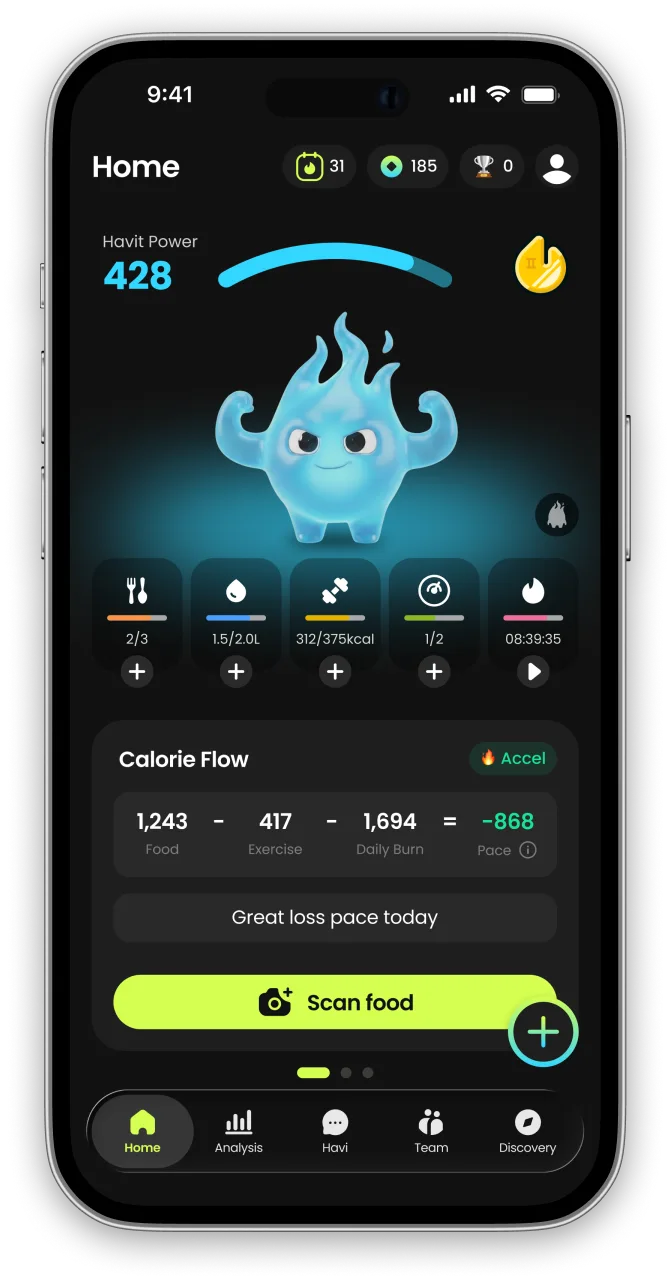
What is Havit?
Havit is an AI health companion for weight loss that protects muscle.
Unlike calorie-only trackers, Havit connects AI body-composition estimates, nutrition, hydration, sleep, steps, cycle, mood, and GLP-1 medication in one daily routine — so progress is measured by body composition, not just the number on the scale. Daily missions turn established behavior-change techniques into small repeatable actions, drawing on expertise from professionals formerly at Juvis Diet, one of Korea’s leading metabolic clinics.
In Havit’s own analysis of 1,090 GLP-1 users, people who logged consistently built stronger habits than the general user base. Read the GLP-1 Habit Report
Havit works with or without GLP-1 medication. It is a wellness app, not a medical device; body-composition results are estimates.

Continue in the App
Personalized wellness with your own data


References
- Lifestyle Intervention and Insulin Sensitivity in Polycystic Ovary Syndrome: A Two-Year Prospective Cohort Study — Journal of Clinical Endocrinology & Metabolism, 2024
- Non-Pharmacological Approaches to Insulin Sensitization in PCOS: A Systematic Review and Meta-Analysis — Fertility and Sterility, 2025
- Chronobiology of Insulin Resistance: Meal Timing Effects in Women with Polycystic Ovary Syndrome — Clinical Endocrinology, 2024
- Sleep Duration and Metabolic Parameters in PCOS: A Cross-Sectional Analysis — Sleep Medicine Reviews, 2024
- Inositol Supplementation in PCOS: Updated Evidence and Clinical Recommendations — Gynecological Endocrinology, 2025


