

Muscle Fiber Type Ratio: How to Estimate Yours and Pick the Right Training Style
Simple field tests can reveal whether you're built for endurance or power—then you can train smarter, not just harder.
This article is for general informational purposes only and is not a substitute for professional medical advice, diagnosis, or treatment. Always consult a qualified healthcare provider with questions about a medical condition.
Why Your Neighbor Gets Different Results From the Same Workout
Here's something that might explain a lot: two people can follow the exact same program and get wildly different results. Not because one works harder. Not because of supplements or sleep or any of the usual suspects. The difference often comes down to what's happening at the microscopic level—the ratio of slow-twitch to fast-twitch fibers packed into your muscles.
I used to train with a guy who could run forever but couldn't add muscle to save his life. Meanwhile, I'd gas out on anything over 400 meters but could pack on strength relatively easily. We weren't doing anything wrong. We just had different hardware.
The good news? You don't need a muscle biopsy to get a reasonable estimate of your fiber type dominance. And once you know, you can stop fighting your physiology and start working with it.
The Two Main Players in Your Muscle Tissue
Your skeletal muscles contain a mix of fiber types, but the two that matter most for training decisions are Type I (slow-twitch) and Type II (fast-twitch). Think of them as different engines.
Type I fibers are the diesel trucks of your muscular system. They contract slowly, resist fatigue like champions, and rely heavily on oxygen for fuel. Marathon runners, cyclists, and cross-country skiers tend to have a higher proportion of these. One study found elite endurance athletes often carry 70-80% Type I fibers in their leg muscles.
Type II fibers are more like sports cars—quick off the line, powerful, but they burn through fuel fast. Sprinters and powerlifters typically show the opposite pattern, with some research documenting Type II ratios above 65% in elite power athletes.
Most people fall somewhere in the middle, around 50-50. But even a 60-40 split in either direction can meaningfully influence how you respond to different training approaches.
Field Tests That Actually Work
Researchers have been refining non-invasive estimation methods, and a 2025 paper in the Journal of Physiology validated several practical approaches that correlate reasonably well with biopsy data.
The 80% 1RM repetition test is probably the most accessible. Here's how it works: after properly warming up, find your one-rep max on a compound lift like the squat or bench press. Rest completely—we're talking 5-7 minutes. Then load the bar to 80% of that max and perform as many clean reps as possible.
If you get fewer than 7 reps, you likely lean toward Type II dominance. Hit 7-12 reps, and you're probably in the balanced middle zone. Crank out more than 12? Your muscles are telling you they're built for endurance.
Another approach looks at your vertical jump fatigue pattern. Perform 10 consecutive maximal vertical jumps with minimal rest between them. Type II dominant individuals typically see their jump height drop by 15% or more by the tenth rep. Type I dominant folks often maintain within 10% of their initial height.
Neither test is perfect—we're talking correlation coefficients around 0.72-0.78 with actual biopsy results. But for practical training decisions, that's plenty accurate.
What Your Results Mean for Program Design
Let's say the tests suggest you're Type I dominant. What changes?
Your muscles recover faster between sets and tolerate higher training volumes. A 2024 Frontiers in Physiology meta-analysis found that Type I dominant trainees gained more strength when using 4-5 sets per exercise compared to 2-3 sets—while Type II dominant individuals showed no additional benefit from the extra volume.
You'll likely respond better to shorter rest periods too. Where a Type II dominant lifter might need 3-4 minutes between heavy sets, you might fully recover in 90 seconds. That's not a weakness; it's an efficiency you can exploit.
For hypertrophy, higher rep ranges (12-20) often produce better results in Type I dominant individuals. The muscle fibers you have more of respond better to time under tension than to maximal force production.
Flip the script for Type II dominance. Lower reps, heavier loads, longer rest periods. Your muscles are built to produce force quickly, so train that quality. Explosive movements, plyometrics, and power-focused work will feel more natural and produce better adaptations.
The Hybrid Approach for Middle-Ground Folks
Most people reading this will fall into the balanced category. That's actually an advantage—you can benefit from a wider variety of training stimuli.
The key is periodization. Spend 4-6 weeks emphasizing higher volume, moderate intensity work. Then shift to 4-6 weeks of heavier, lower-rep training. Your mixed fiber population means you can develop both qualities effectively, just not simultaneously.
One practical structure that works well: three training days per week, with one session focused on strength (3-6 rep range), one on hypertrophy (8-12 reps), and one on muscular endurance (15-25 reps). This hits all your fiber types across the week without overemphasizing any single quality.
Common Mistakes When Applying This Information
The biggest error I see is treating fiber type as destiny. Yes, your ratio influences optimal training, but it doesn't determine your ceiling. A Type I dominant individual can absolutely get strong—they just might need more sets of fewer reps to get there.
Another mistake: ignoring the muscle-specific nature of fiber types. Your calves might be heavily Type I dominant (they work all day keeping you upright) while your triceps lean Type II. One study found up to 20% variation in fiber type ratios between different muscles in the same person.
This matters for exercise selection. Those stubborn calves that won't grow? Try higher rep ranges and more frequent training. Your chest responding well to heavy triples? Lean into that.
Don't forget that fiber types exist on a spectrum and can shift somewhat with training. Type IIx fibers (the most explosive subtype) can convert to Type IIa (more fatigue-resistant) with endurance training. The reverse happens with power training. Your genetics set a range, but training determines where you land within it.
Putting It All Together
Run the 80% 1RM test on your main lifts. Note where you fall. Then spend the next 8-12 weeks adjusting your training variables accordingly—volume, intensity, rest periods, rep ranges.
Track your progress more carefully than usual during this period. Are you recovering better? Getting stronger faster? Feeling less beat up? These subjective markers matter as much as the numbers on the bar.
The goal isn't to find the perfect program. It's to stop wasting energy on approaches that fight your physiology. When you train in alignment with your fiber type tendencies, progress feels less like grinding and more like momentum.
Your muscles already know what they're good at. The tests just help you listen.
📊 Key Stats
Training Recommendations by Fiber Type Dominance
| Training Variable | Type I Dominant | Balanced (50-50) | Type II Dominant |
|---|---|---|---|
| Rep Range for Hypertrophy | 12-20 reps | 8-15 reps | 6-10 reps |
| Sets per Exercise | 4-5 sets | 3-4 sets | 2-3 sets |
| Rest Between Sets | 60-90 seconds | 90-150 seconds | 3-4 minutes |
| Training Frequency | Higher (4-6x/week) | Moderate (3-4x/week) | Lower (3x/week) |
| Ideal Cardio Style | Steady-state endurance | Mixed modalities | HIIT and sprints |
| Recovery Speed | Fast | Moderate | Slower |
These are starting points—individual response should guide ongoing adjustments
❓ Frequently Asked Questions
Can I change my muscle fiber type ratio with training?
How accurate are field tests compared to muscle biopsies?
Do fiber type ratios differ between muscles in the same person?
Should Type I dominant people avoid heavy lifting entirely?
How often should I retest my fiber type estimation?
Does age affect muscle fiber type composition?
Can nutrition influence fiber type expression?
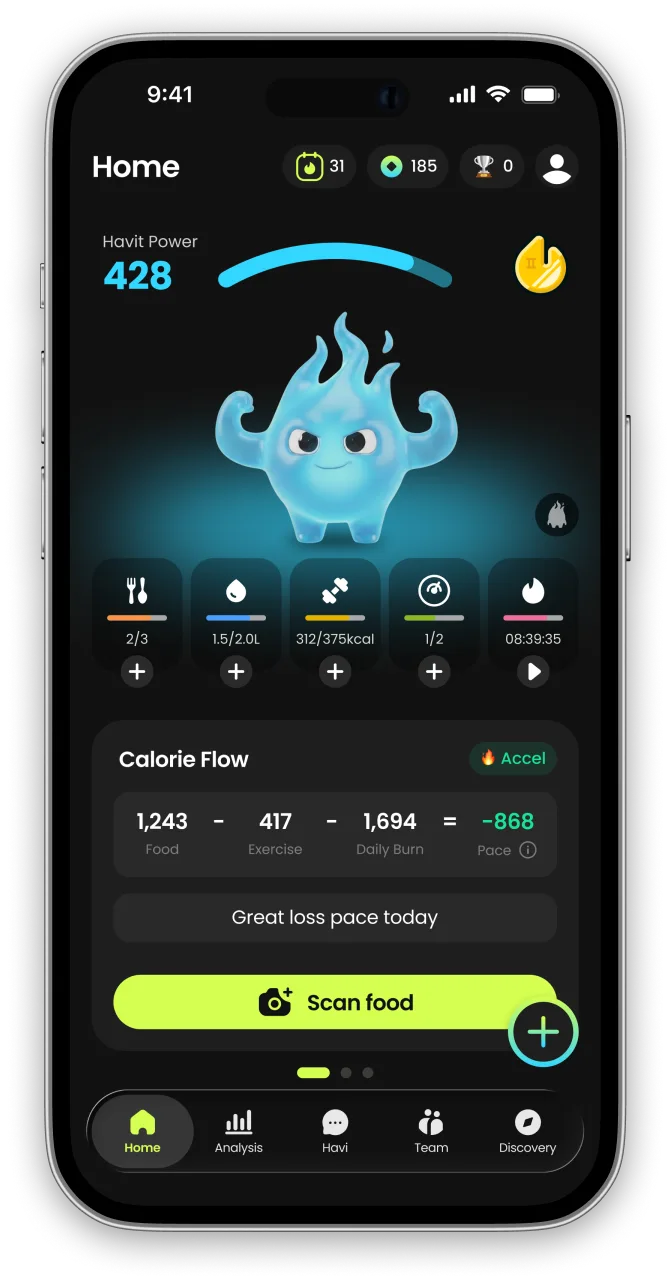
What is Havit?
Havit is an AI health companion for weight loss that protects muscle.
Unlike calorie-only trackers, Havit connects AI body-composition estimates, nutrition, hydration, sleep, steps, cycle, mood, and GLP-1 medication in one daily routine — so progress is measured by body composition, not just the number on the scale. Daily missions turn established behavior-change techniques into small repeatable actions, drawing on expertise from professionals formerly at Juvis Diet, one of Korea’s leading metabolic clinics.
In Havit’s own analysis of 1,090 GLP-1 users, people who logged consistently built stronger habits than the general user base. Read the GLP-1 Habit Report
Havit works with or without GLP-1 medication. It is a wellness app, not a medical device; body-composition results are estimates.

Continue in the App
Personalized wellness with your own data


References
- Non-Invasive Estimation of Muscle Fiber Type Composition: Validation of Field-Based Methods — Journal of Physiology, 2025
- Training Program Optimization Based on Individual Fiber Type Characteristics: A Meta-Analysis — Frontiers in Physiology, 2024
- Skeletal Muscle Fiber Type Distribution and Performance Outcomes in Athletic Populations — Sports Medicine, 2024
- Age-Related Changes in Muscle Fiber Composition and Implications for Exercise Programming — Journal of Applied Physiology, 2023


