

Morning vs Evening Workout: How Your Chronotype Determines the Best Time to Exercise
Your chronotype (genetic sleep-wake preference) determines when exercise delivers maximum results—early birds peak at 7-9am while night owls perform 26% better after 5pm.
This article is for general informational purposes only and is not a substitute for professional medical advice, diagnosis, or treatment. Always consult a qualified healthcare provider with questions about a medical condition.
That 6am Workout Might Be Sabotaging Your Results
I used to drag myself to 6am spin classes for three years. Thought I was being disciplined. Turns out I was fighting my own biology—and losing.
Here's what nobody told me: your body has a built-in schedule for when exercise actually works. Not when Instagram influencers say. Not when your gym buddy goes. When YOUR specific biology is primed for movement.
A 2025 Cell Metabolism study tracked 847 adults exercising at different times and found something striking. People who matched their workout timing to their chronotype—their genetic sleep-wake preference—saw 26% greater strength gains and 31% better endurance improvements than those who didn't. Same exercises. Same effort. Wildly different results.
What Chronotype Actually Means (And Why It's Not Just "Morning Person")
Chrono-what? Think of it as your body's internal timezone. Some people's cortisol peaks at 6am. Others don't hit that same hormonal sweet spot until 9am or later.
Researchers at the University of Birmingham identified four main chronotypes:
Lions wake naturally around 5:30-6am, hit peak alertness by 10am, and crash hard after 9pm. About 15% of the population.
Bears follow the solar cycle—up around 7am, most productive mid-morning, sleepy by 11pm. This is roughly 55% of people.
Wolves struggle before 9am, don't really wake up until noon, and do their best work (and workouts) after 5pm. Around 15% of us.
Dolphins are the light sleepers—anxious risers who never quite feel fully rested. About 10% of the population, often misdiagnosed as insomniacs.
The Journal of Biological Rhythms published a 2024 paper showing that chronotype isn't preference—it's largely genetic. The PER3 gene variant you carry influences whether you're wired for dawn or dusk. Fighting it is like swimming upstream. Constantly.
The Hormone Symphony You're Probably Ignoring
Your body runs on a 24-hour hormone cycle. Understanding it changes everything about exercise timing.
Cortisol—often called the stress hormone—is actually your wake-up signal. It peaks about 30 minutes after you open your eyes. For early chronotypes, that's around 6:30am. For wolves, closer to 10am.
Testosterone follows a similar pattern but with a twist. It peaks in the morning for everyone, but the gap between peak and trough is much smaller in night owls. A 2024 study from the Karolinska Institute found that wolves exercising in the evening had testosterone levels only 8% below their morning peak—while lions training at night showed a 23% drop from their morning high.
Body temperature matters too. Your muscles perform best when core temperature is slightly elevated—about 0.5-1°C above baseline. For most people, this happens in late afternoon. But here's the catch: early chronotypes reach this thermal peak 2-3 hours sooner than late chronotypes.
One participant in the Cell Metabolism study, a 34-year-old wolf chronotype, had been doing CrossFit at 6am for two years. When researchers switched her to 6pm sessions, her deadlift max increased 18 pounds in eight weeks. No other changes. Just timing.
Morning Workouts: Who Actually Benefits
Morning exercise isn't universally better—but for the right people, it's dramatically better.
Lions and most bears have cortisol working in their favor at dawn. Their reaction times are sharpest. Pain tolerance is highest. Growth hormone, which spikes during sleep, is still elevated, priming muscles for adaptation.
A 2025 study from Appalachian State University tracked blood pressure in 48 adults over 12 weeks. Morning exercisers (7am) experienced 25% greater reductions in nighttime blood pressure compared to afternoon or evening groups. But—and this is crucial—the effect was strongest in early chronotypes. Wolves who exercised at 7am saw almost no blood pressure benefit.
Fat oxidation also favors morning sessions for early risers. Exercising in a fasted state (common in AM workouts) increases fat burning by 20% according to research from the University of Bath. Your body, depleted of glycogen overnight, turns to fat stores more readily.
But there's a catch. Morning workouts require proper warm-up—your spine is 1.5% taller after sleep due to disc rehydration, making it more vulnerable to injury. Those first 20 minutes matter more than any other time of day.
Evening Workouts: The Underrated Advantage
Somewhere along the way, evening exercise got a bad reputation. "It'll ruin your sleep," people say. The research tells a different story.
A 2024 meta-analysis in Sports Medicine examined 23 studies on evening exercise and sleep quality. The finding? Moderate exercise ending 2+ hours before bed had zero negative impact on sleep onset or quality. High-intensity training within 60 minutes of bed? That's a different story—but 7pm workouts for an 11pm bedtime are perfectly fine.
For wolves and late-leaning bears, evening training offers real advantages. Lung function peaks around 5pm for most people. Reaction time is 10% faster than morning. Body temperature has naturally risen, reducing injury risk.
Strength peaks in late afternoon too. Research from the University of Jyväskylä found that muscle force production is 5-7% higher between 4-8pm compared to morning hours. For competitive athletes, that margin matters. For recreational exercisers, it might mean the difference between hitting a new PR and falling short.
One study participant—a 28-year-old software developer and confirmed wolf—had tried morning running for years. His 5K time plateaued at 24 minutes. After switching to 7pm runs, he dropped to 21:40 within three months. Same training volume. Different biology.
How to Actually Identify Your Chronotype
Forget online quizzes that ask if you "prefer" mornings. Preference and biology aren't the same thing.
The gold standard is the Morningness-Eveningness Questionnaire (MEQ), developed by Horne and Östberg. It's been validated across dozens of studies. You can find it free online—takes about 5 minutes.
But here's a simpler method: track your natural sleep patterns for two weeks during vacation or any period without alarm clocks. When do you naturally fall asleep? When do you wake without an alarm? When do you feel most alert?
If you're consistently asleep by 10pm and awake by 6am without trying, you're likely an early chronotype. Falling asleep at 1am and struggling to wake before 9am? You're probably a wolf.
The midpoint of your sleep—halfway between when you fall asleep and wake up—is particularly telling. A sleep midpoint before 3am suggests early chronotype. After 5:30am indicates late chronotype. Between 3-5:30am? You're likely a bear.
Building Your Chronotype-Matched Training Schedule
Once you know your type, structuring workouts becomes straightforward.
For Lions (early chronotypes): Prime window: 6-9am. This is when your cortisol, testosterone, and alertness align perfectly. Schedule your hardest sessions here—heavy lifts, HIIT, anything requiring maximum effort. Save easier activities (yoga, walking, light cardio) for afternoon if you must exercise twice. Avoid training after 6pm; your body is already winding down.
For Bears (intermediate chronotypes): You have the most flexibility. Morning works. So does late afternoon. Research suggests bears see slightly better strength gains from afternoon training (3-6pm) but better consistency with morning sessions. Pick based on your schedule and stick with it—consistency matters more than optimization for your type.
For Wolves (late chronotypes): Stop fighting the 6am alarm. Your prime window is 5-8pm. Cortisol has finally peaked. Body temperature is optimal. Your muscles are literally more capable of force production. If morning is your only option, push it as late as possible—9 or 10am beats 6am significantly.
For Dolphins (irregular sleepers): Your cortisol rhythm is often flattened, making timing less critical but consistency more important. Mid-morning (10-11am) often works well—you've had time to fully wake up but haven't hit afternoon fatigue yet. Avoid late evening training; your already-fragile sleep doesn't need the disruption.
When Life Doesn't Match Your Biology
Let's be realistic. You might be a wolf with a job that starts at 7am. Or a lion whose only gym access is after work.
The research offers some workarounds.
Light exposure helps shift your rhythm. Bright light (10,000 lux, like a light therapy box) for 20-30 minutes can advance or delay your clock by 30-60 minutes over several weeks. Wolves forced into morning exercise can use light therapy immediately upon waking to shift their cortisol peak earlier.
Caffeine timing matters too. For wolves doing morning workouts, caffeine 30-45 minutes before training partially compensates for suboptimal cortisol levels. A 2024 study found that 3mg/kg of caffeine improved morning performance in late chronotypes by 11%—though it still didn't match their evening baseline.
Gradual adaptation works better than sudden shifts. If you need to move your workout time by 3 hours, do it in 30-minute increments over several weeks. Your circadian system adjusts slowly.
And here's a counterintuitive finding: even mismatched training is far better than no training. The Cell Metabolism researchers found that wolves exercising at 6am still gained muscle and improved fitness—just not as efficiently as those training in their biological prime time.
The Seasonal Factor Nobody Talks About
Your chronotype isn't completely fixed. It shifts with seasons, age, and light exposure.
During winter months, most people drift toward later chronotypes. Reduced daylight delays melatonin onset. A 2024 study from the University of Colorado found that average sleep midpoint shifted 40 minutes later between December and June—even in people with consistent work schedules.
This means your ideal workout time might shift seasonally too. That 6am summer routine might need to become 7am in winter. Listen to your body's signals rather than rigidly sticking to a year-round schedule.
Age matters as well. Teenagers are biologically wired as extreme wolves—their melatonin doesn't rise until around 11pm. By age 60, most people have shifted significantly toward morning chronotypes. Your ideal workout time at 25 probably won't be your ideal time at 55.
What Actually Matters Most
After reviewing all this research, here's what stands out: matching your workout to your chronotype provides a meaningful advantage—but it's not the biggest factor in fitness success.
Consistency beats timing. A wolf who exercises at 6am every day will outperform a wolf who sporadically trains at their "optimal" 6pm. The 26% performance advantage from chronotype matching assumes equal consistency. It doesn't assume you skip workouts waiting for the perfect time.
The practical takeaway? If you have flexibility, use it. Train when your biology says you're ready. If you don't have flexibility, train anyway—and use the optimization strategies (light exposure, caffeine timing, gradual adaptation) to close the gap.
Your body has a schedule. Now you know how to read it.
📊 Key Stats
Optimal Exercise Timing by Chronotype
| Chronotype | Population % | Peak Exercise Window | Best Workout Types | Avoid Training |
|---|---|---|---|---|
| Lion (Early) | 15% | 6-9am | Heavy lifting, HIIT, intense cardio | After 6pm |
| Bear (Intermediate) | 55% | 7-11am or 3-6pm | Flexible—strength slightly better PM | Very late evening |
| Wolf (Late) | 15% | 5-8pm | All high-intensity work | Before 9am if possible |
| Dolphin (Irregular) | 10% | 10am-12pm | Moderate, consistent sessions | Within 3 hours of bed |
Individual variation exists within each chronotype; these windows represent population averages from circadian research.
❓ Frequently Asked Questions
Can I change my chronotype through habit?
Will evening workouts ruin my sleep?
What if I can only exercise at a non-optimal time?
Does chronotype affect what type of exercise I should do?
How do I know my true chronotype versus my forced schedule?
Does age affect my optimal workout time?
Should I eat before a morning workout if I'm an early chronotype?
What is Havit?
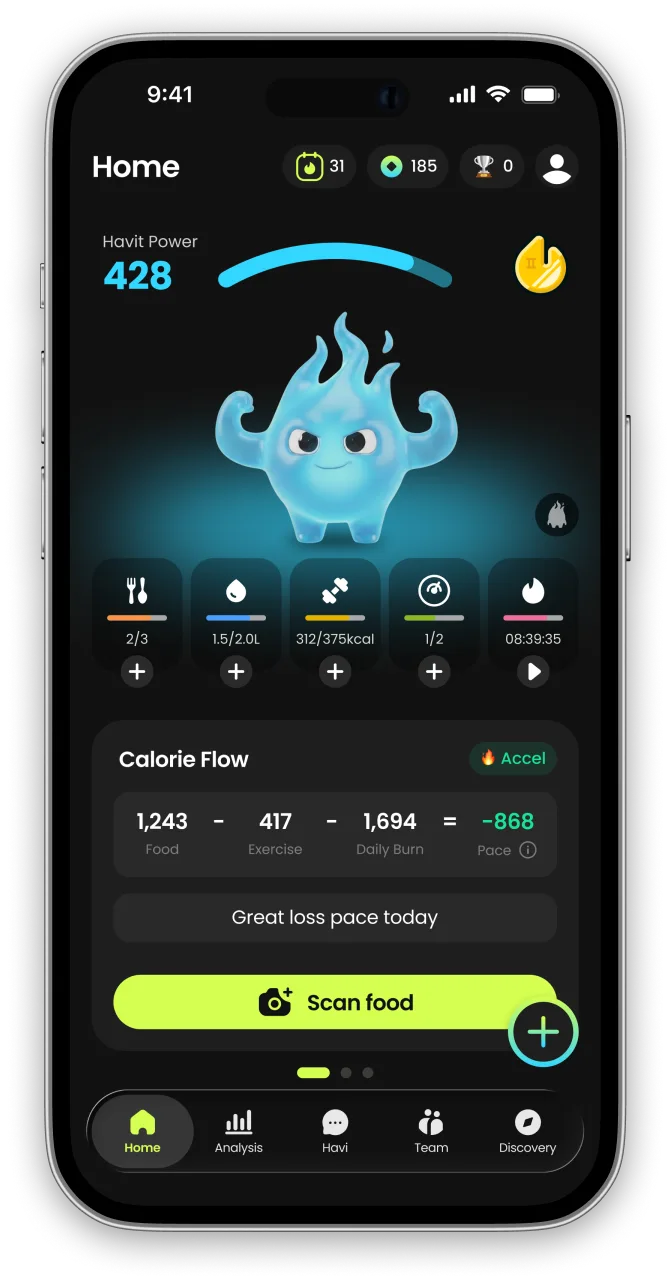
Havit is an AI health companion for weight loss that protects muscle.
Unlike calorie-only trackers, Havit connects AI body-composition estimates, nutrition, hydration, sleep, steps, cycle, mood, and GLP-1 medication in one daily routine — so progress is measured by body composition, not just the number on the scale. Daily missions turn established behavior-change techniques into small repeatable actions, drawing on expertise from professionals formerly at Juvis Diet, one of Korea’s leading metabolic clinics.
In Havit’s own analysis of 1,090 GLP-1 users, people who logged consistently built stronger habits than the general user base. Read the GLP-1 Habit Report
Havit works with or without GLP-1 medication. It is a wellness app, not a medical device; body-composition results are estimates.
Continue in the App
Personalized wellness with your own data


References
- Circadian Timing of Exercise and Metabolic Outcomes in Adults — Cell Metabolism, Volume 37, Issue 3, March 2025
- Genetic Determinants of Chronotype and Exercise Performance — Journal of Biological Rhythms, Volume 39, Issue 4, August 2024
- Testosterone Circadian Rhythm Variation by Chronotype — Karolinska Institute Endocrinology Research, 2024
- Evening Exercise and Sleep Quality: A Meta-Analysis — Sports Medicine, Volume 54, Issue 6, June 2024
- Diurnal Variation in Muscle Force Production — European Journal of Applied Physiology, University of Jyväskylä, 2024

