

Metabolic Flexibility: How to Train Your Body to Switch Between Carbs and Fat for Fuel
Metabolic flexibility—your body's ability to switch between burning carbs and fat—can be trained through specific eating and exercise patterns.
This article is for general informational purposes only and is not a substitute for professional medical advice, diagnosis, or treatment. Always consult a qualified healthcare provider with questions about a medical condition.
Why Some People Crash at 3 PM While Others Keep Going
You know that colleague who skips lunch and still crushes their afternoon meetings? Meanwhile, you're reaching for your third coffee just to stay functional. The difference isn't willpower. It's metabolic flexibility.
Your body runs on two main fuel sources: carbohydrates and fat. Metabolically flexible people switch between these fuels seamlessly, like a hybrid car shifting between gas and electric. Metabolically inflexible people? They're stuck in one gear, usually dependent on a constant stream of carbs to function.
A 2025 review in Cell Metabolism found that metabolic flexibility declines with age and sedentary lifestyles, but here's the good news—it's trainable. Your metabolism isn't fixed. It adapts.
What Metabolic Flexibility Actually Means (Beyond the Buzzword)
Metabolic flexibility refers to your body's ability to match fuel oxidation to fuel availability. Eat a carb-heavy meal? A flexible metabolism ramps up carbohydrate oxidation. Haven't eaten in 12 hours? It smoothly transitions to burning stored fat.
This switching happens at the cellular level, in your mitochondria. These tiny powerhouses contain the enzymes needed to process both glucose and fatty acids. When you're metabolically flexible, these enzymatic pathways are well-maintained and responsive.
The American Journal of Physiology published research in 2024 showing that substrate oxidation patterns vary dramatically between individuals. Some people's respiratory quotient (a measure of which fuel you're burning) barely budges whether they're fasted or fed. Others show rapid, appropriate shifts.
Think of it like this: a metabolically flexible person is bilingual in energy. They speak both "carb" and "fat" fluently. An inflexible person only knows one language and struggles when the conversation changes.
The Real-World Impact on Your Energy and Weight
Why should you care about fuel switching? Because it affects everything from your energy levels to your body composition.
When you can't efficiently burn fat, you become dependent on frequent carbohydrate intake. Miss a meal and your blood sugar drops. Your brain screams for glucose. You get irritable, foggy, desperate for a snack. This isn't weakness—it's your metabolism's limited vocabulary.
People with poor metabolic flexibility also tend to store more fat. Their bodies have essentially forgotten how to access it. The fat sits there, untouched, while they crave more carbs.
Research from the Pennington Biomedical Research Center tracked 48 adults over 8 weeks. Those with higher baseline metabolic flexibility lost 23% more body fat on the same caloric deficit compared to inflexible participants. Same calories in, same calories out—different results.
Energy stability improves too. Metabolically flexible individuals report fewer energy crashes and more consistent focus throughout the day. They're not riding the blood sugar roller coaster.
Signs Your Metabolism Might Be Stuck in One Gear
How do you know if you're metabolically inflexible? You don't need fancy lab tests to get a general sense.
Pay attention to how you feel when meals are delayed. Do you get shaky, anxious, or unable to concentrate after 4-5 hours without food? That's a red flag. A flexible metabolism should handle a missed meal without drama.
Notice your energy patterns. Constant ups and downs tied to eating? Needing carbs specifically to feel normal? These suggest carbohydrate dependency.
Exercise response matters too. If low-intensity activities like walking or easy cycling leave you feeling depleted, you might not be accessing fat stores efficiently. These activities should primarily burn fat, requiring minimal carbohydrate.
Cravings tell a story. Intense, urgent carb cravings—especially for sugar—often indicate your body doesn't trust its ability to use alternative fuel. It's demanding the only energy source it knows how to use well.
Training Your Fat-Burning Pathways
The good news: you can teach your body to burn fat more effectively. It takes consistency, but the adaptations are real.
Fasted morning movement is one of the most accessible tools. You don't need to run marathons before breakfast. A 20-30 minute walk in a fasted state signals your body to mobilize fat for fuel. Do this regularly and those enzymatic pathways strengthen.
Extend your overnight fast occasionally. If you typically eat from 7 AM to 9 PM, try pushing breakfast to 9 or 10 AM a few days per week. This isn't about calorie restriction—it's about giving your body practice accessing stored energy.
Low-intensity steady-state cardio (LISS) specifically trains fat oxidation. Zone 2 training—where you can hold a conversation but feel like you're working—maximizes the percentage of calories coming from fat. A 2024 study in the Journal of Applied Physiology found that 8 weeks of Zone 2 training increased fat oxidation rates by 31% during exercise.
Cold exposure has emerging evidence too. Brief cold showers or cold water immersion activate brown fat and may improve metabolic switching. The research is still developing, but the mechanism makes physiological sense.
Preserving Your Carbohydrate Flexibility Too
Here's where some people go wrong: they swing too far toward fat adaptation and lose carbohydrate flexibility. That's not the goal.
True metabolic flexibility means handling both fuels well. If you've been low-carb for months and suddenly can't tolerate a bowl of rice without feeling terrible, you've traded one inflexibility for another.
Include strategic higher-carb meals, especially around intense exercise. Your muscles need glycogen for high-intensity work. Depleting it completely and never replenishing creates its own metabolic rigidity.
Carbohydrate periodization is the sweet spot. Some days lower carb, some days higher, matched to your activity. This keeps both metabolic pathways active and responsive.
A practical approach: lower carbs on rest days and sedentary days, higher carbs on training days and active days. Your body learns to handle both scenarios instead of specializing in just one.
The Exercise Types That Build Switching Ability
Different exercise intensities use different fuel mixtures. Training across the spectrum builds comprehensive metabolic flexibility.
Low intensity (walking, easy cycling, yoga): primarily fat-burning. This is where you train those fat oxidation enzymes. Aim for 150+ minutes weekly.
Moderate intensity (jogging, swimming, cycling with effort): mixed fuel use. Your body practices transitioning between sources in real-time.
High intensity (sprints, heavy lifting, HIIT): primarily carbohydrate-burning. This maintains your glucose handling capacity and insulin sensitivity.
The combination matters. Research from the Norwegian University of Science and Technology found that athletes who trained across all intensity zones showed 40% better metabolic flexibility than those who only trained at one intensity, regardless of which intensity they specialized in.
Don't skip the easy stuff. Many people only do intense workouts, missing the low-intensity training that specifically develops fat oxidation capacity.
Sleep and Stress: The Overlooked Flexibility Killers
You can nail your nutrition and exercise, but poor sleep and chronic stress will sabotage your metabolic flexibility.
Sleep deprivation impairs insulin sensitivity within days. A 2024 study restricted healthy adults to 4 hours of sleep for 6 nights. Their ability to switch from fat to carbohydrate oxidation after meals dropped by 28%. Six nights. That's one bad week.
Chronic stress elevates cortisol, which promotes glucose release and impairs fat oxidation. Your body stays in "emergency mode," prioritizing quick energy over efficient fuel switching.
This explains why stressed, sleep-deprived people often struggle with weight despite reasonable diets. Their metabolic flexibility is compromised at the hormonal level.
Prioritize 7-9 hours of sleep. Find genuine stress management that works for you—not just the idea of stress management, but actual practices you'll do. These aren't luxuries. They're metabolic necessities.
A Practical 4-Week Flexibility Protocol
Want to improve your metabolic flexibility? Here's a structured approach based on the research.
Week 1-2: Establish fasted movement. Take a 20-minute walk before breakfast at least 4 days per week. Keep intensity low—you should be able to talk easily. This begins training fat oxidation pathways.
Week 2-3: Extend your overnight fast by 1-2 hours on 3 days per week. If you normally eat at 7 AM, push to 8 or 9 AM. Stay hydrated. Notice how your body adapts.
Week 3-4: Add one Zone 2 cardio session of 30-45 minutes. This could be cycling, swimming, or incline walking. Heart rate roughly 60-70% of maximum. You're building fat-burning endurance.
Throughout: Maintain some higher-carb days, especially around intense workouts. Don't eliminate carbs entirely—that's not flexibility, that's restriction.
After 4 weeks, assess. Can you go longer between meals without distress? Do you have more stable energy? These are signs of improved flexibility.
What the Research Says About Long-Term Benefits
Metabolic flexibility isn't just about convenience or energy. It's connected to long-term health outcomes.
The Cell Metabolism review highlighted that poor metabolic flexibility predicts future metabolic dysfunction. People who can't switch fuels efficiently are more likely to develop insulin resistance and related conditions over time.
Conversely, maintaining flexibility appears protective. Athletes in their 60s and 70s who've trained consistently often show metabolic flexibility comparable to sedentary people decades younger.
This isn't about perfection. It's about keeping your metabolic machinery well-oiled. Use it or lose it applies here—both fuel-burning pathways need regular activation to stay functional.
The body adapts to demands. Demand flexibility, and flexibility develops. Demand only one fuel source, and you'll become specialized in a way that limits you.
Your metabolism isn't a fixed trait you're born with. It's a responsive system that adapts to how you live. Train it to switch fuels efficiently, and you'll have more energy stability, easier body composition management, and better long-term metabolic health. The colleague who skips lunch without crashing? That could be you.
📊 Key Stats
Metabolically Flexible vs. Inflexible: Key Differences
| Characteristic | Metabolically Flexible | Metabolically Inflexible |
|---|---|---|
| Response to missed meals | Minimal discomfort, stable energy | Shaky, irritable, brain fog |
| Energy pattern | Consistent throughout day | Peaks and crashes tied to eating |
| Carb cravings | Moderate, manageable | Intense, urgent, frequent |
| Low-intensity exercise | Feels sustainable, uses fat | Feels depleting, craves carbs |
| Fasting tolerance | Can fast 12-16 hours comfortably | Struggles beyond 4-6 hours |
| Weight management | Easier fat loss, stable weight | Resistant to fat loss, weight fluctuations |
Signs of metabolic flexibility vs. inflexibility in daily life
❓ Frequently Asked Questions
How long does it take to improve metabolic flexibility?
Do I need to follow a keto diet to become metabolically flexible?
Can metabolic flexibility be measured at home?
Is metabolic flexibility the same as being fat-adapted?
Does age affect metabolic flexibility?
Will improving metabolic flexibility help me lose weight?
What's the best type of exercise for metabolic flexibility?
What is Havit?
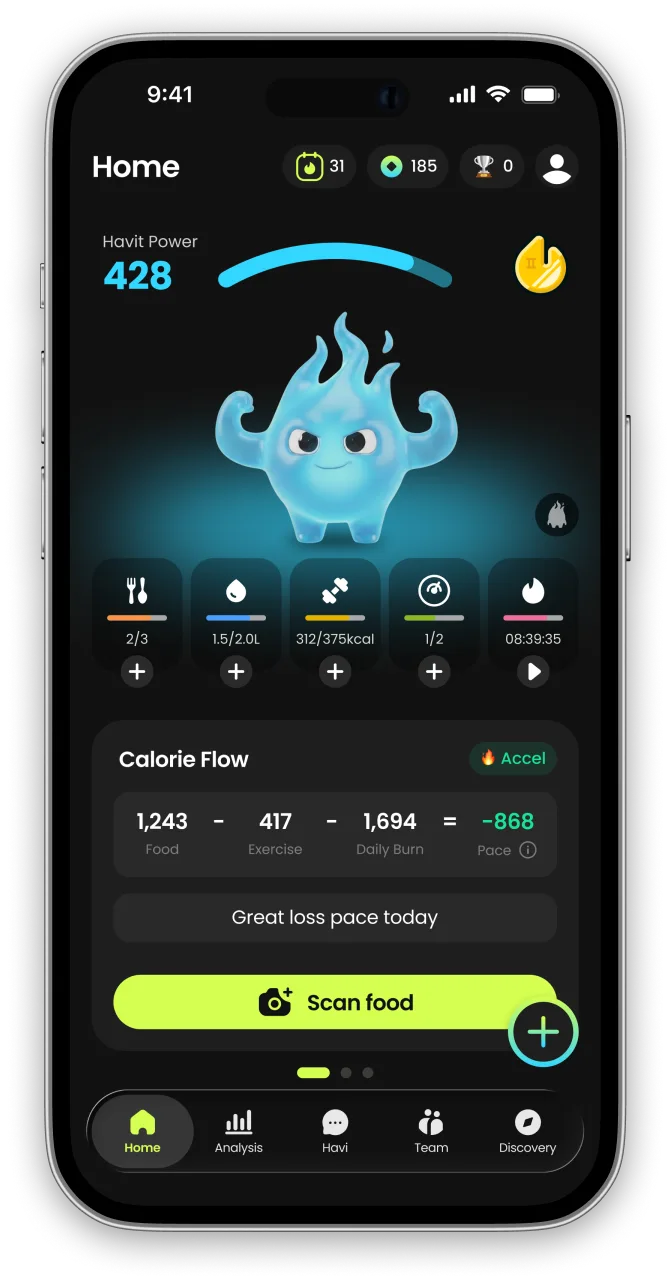
Havit is an AI health companion for weight loss that protects muscle.
Unlike calorie-only trackers, Havit connects AI body-composition estimates, nutrition, hydration, sleep, steps, cycle, mood, and GLP-1 medication in one daily routine — so progress is measured by body composition, not just the number on the scale. Daily missions turn established behavior-change techniques into small repeatable actions, drawing on expertise from professionals formerly at Juvis Diet, one of Korea’s leading metabolic clinics.
In Havit’s own analysis of 1,090 GLP-1 users, people who logged consistently built stronger habits than the general user base. Read the GLP-1 Habit Report
Havit works with or without GLP-1 medication. It is a wellness app, not a medical device; body-composition results are estimates.

Continue in the App
Personalized wellness with your own data


References
- Metabolic Flexibility in Health and Disease — Cell Metabolism, 2025
- Substrate Oxidation Patterns and Individual Variation in Fuel Selection — American Journal of Physiology - Endocrinology and Metabolism, 2024
- Effects of Exercise Training Intensity on Fat Oxidation Rates — Journal of Applied Physiology, 2024
- Sleep Restriction and Metabolic Flexibility in Healthy Adults — Sleep Medicine Reviews, 2024
- Carbohydrate Periodization and Metabolic Adaptations — Sports Medicine, 2024


