

Your Sweat Sodium Concentration Might Be 10x Different From Mine—Here's Why It Matters
Sweat sodium concentration varies 10-fold between individuals, making personalized hydration strategies far more effective than one-size-fits-all sports drinks.
This article is for general informational purposes only and is not a substitute for professional medical advice, diagnosis, or treatment. Always consult a qualified healthcare provider with questions about a medical condition.
The Sports Drink Industry's Dirty Little Secret
I watched a marathoner collapse at mile 22 last spring. She'd been drinking exactly what her training plan recommended—16 ounces every 30 minutes, standard electrolyte mix. Her sodium levels had dropped dangerously low. Not from dehydration. From drinking too much of the wrong thing.
Here's what nobody tells you: the person running next to you might lose 200mg of sodium per liter of sweat while you're losing 2,000mg. That's not a typo. A 2025 study in the Journal of the International Society of Sports Nutrition tested 412 endurance athletes and found sweat sodium concentrations ranging from 230 to 2,310 mg/L. Same workout. Same conditions. Wildly different bodies.
Your standard sports drink contains about 400-500mg of sodium per liter. For some people, that's perfect. For others, it's replacing barely a quarter of what they're losing.
Why Your Body Sweats Differently Than Everyone Else's
Sweat glands are weird. You have between 2 and 4 million of them, and their behavior depends on factors you've never thought about.
Genetics plays the biggest role. A 2024 meta-analysis in Sports Medicine identified specific gene variants affecting the CFTR protein—the same one involved in cystic fibrosis—that can double or triple sweat sodium output. If your parents were "salty sweaters," you probably are too.
But it's not just DNA. Your current fitness level matters. Highly trained athletes typically have lower sweat sodium concentrations because their bodies adapt to conserve electrolytes. A recreational runner might lose 1,400mg/L while an elite marathoner loses 800mg/L under identical conditions.
Heat acclimatization changes things too. Spend two weeks training in hot weather and your sweat sodium drops by 20-40%. Your body learns to hold onto salt when it realizes you're going to keep doing this.
Diet creates short-term swings. Eat a high-sodium meal the night before a workout and your kidneys will dump some excess into your sweat. That's why testing protocols ask you to eat normally for 48 hours beforehand.
The Math That Changes Everything
Let me show you why this matters with actual numbers.
Athlete A sweats 1.5 liters per hour with a sodium concentration of 400mg/L. Total hourly loss: 600mg.
Athlete B sweats 1.2 liters per hour with a sodium concentration of 1,800mg/L. Total hourly loss: 2,160mg.
Both athletes grab the same sports drink (500mg sodium per liter) and drink a liter per hour.
Athlete A replaces 83% of their sodium. They feel fine.
Athlete B replaces 23% of their sodium. After three hours, they've accumulated a deficit of nearly 5,000mg. Their muscles cramp. Their thinking gets foggy. Their performance tanks.
This isn't hypothetical. A 2024 study tracked 89 Ironman competitors and found that athletes who matched their sodium replacement to their individual losses finished an average of 47 minutes faster than those using generic hydration plans. Same training backgrounds. Same fitness levels. Different electrolyte strategies.
How to Figure Out Your Sweat Sodium Profile
You have three options, ranging from free to expensive.
The simplest method costs nothing: observation. After a hard workout, look at your clothes. Heavy white residue means high sodium concentration. Minimal residue suggests lower levels. Taste your sweat—intensely salty indicates higher concentrations. This won't give you numbers, but it tells you which end of the spectrum you're on.
The mid-range approach uses sweat patch testing. Companies like Precision Fuel & Hydration and Gatorade's Gx system offer patches you wear during exercise. The patch changes color based on sodium concentration, giving you a rough estimate within about 15% accuracy. Cost runs $25-50 per test.
The gold standard is laboratory sweat testing. A technician applies a small electrical current to stimulate local sweating (it feels like mild tingling), collects the sample, and analyzes it. Results are accurate within 3-5%. Expect to pay $150-300, but you only need to do it once—your baseline sodium concentration stays relatively stable over time.
Building Your Personal Hydration Formula
Once you know your numbers, the strategy becomes straightforward.
Start with your sweat rate. Weigh yourself before and after a one-hour workout (minimal fluid intake during). Every pound lost equals roughly 16 ounces of sweat. Do this in different conditions—hot, cold, humid, dry—because your rate changes.
Multiply sweat rate by sodium concentration. If you sweat 32 ounces (about 950ml) per hour and your concentration is 1,200mg/L, you're losing roughly 1,140mg of sodium hourly.
Now work backward. Most sports drinks provide 300-500mg per 16 ounces. If you need 1,140mg and you're drinking 32 ounces of a 400mg/16oz drink, you're getting 800mg. You need to either add sodium (salt tablets, electrolyte capsules) or find a higher-sodium drink.
High sodium sweaters—those above 1,000mg/L—often do better with products specifically designed for them. Precision Hydration makes a 1,500mg/L formula. SaltStick capsules add 215mg each. Some athletes just dissolve a quarter teaspoon of table salt (590mg sodium) into their water bottle.
Low sodium sweaters can often get away with plain water plus occasional light electrolyte drinks. Over-supplementing sodium when you don't need it forces your kidneys to work harder and can cause its own problems.
The Timing Question Nobody Talks About
When you replace sodium matters almost as much as how much.
Your gut can only absorb so much at once. Dumping 1,000mg of sodium into your stomach in one shot means a lot of it passes through unused—and might cause GI distress. The current research suggests spreading intake across the hour works better than front-loading or back-loading.
A 2025 study split 64 cyclists into three groups: same total sodium, different timing patterns. The group that took small amounts every 15 minutes maintained more stable blood sodium levels than those who took larger doses every 45 minutes.
Practically, this means sipping your electrolyte drink continuously rather than chugging at aid stations. If you're using salt capsules, take them every 30-45 minutes rather than doubling up less frequently.
Pre-loading has its place too. Taking extra sodium in the 2-3 hours before a long event helps your body start with fuller reserves. The classic approach: 1,000-1,500mg with 16-24 ounces of water, finishing about 90 minutes before start time.
When Generic Advice Actually Works
Let me be fair to the sports drink companies. For workouts under 60-90 minutes, most people don't need to obsess over this.
Your body has substantial sodium reserves—about 2,500mg circulating in your blood at any time, plus much more stored in bones and tissues. A moderate deficit during a short workout gets corrected naturally afterward.
The math only gets critical when duration extends beyond 2 hours, intensity stays high, or conditions are hot and humid. That's when individual variation starts separating people who feel great from people who bonk hard.
For the casual gym-goer doing 45-minute sessions, water is probably fine. For the weekend warrior doing a 3-hour bike ride, standard sports drinks work for most people. It's the serious endurance athletes—marathoners, triathletes, ultra runners, long-distance cyclists—who benefit most from dialing in their personal numbers.
The Hyponatremia Warning
This is the part I wish more people understood.
Hyponatremia—dangerously low blood sodium—kills more marathon runners than dehydration does. It happens when you drink too much plain water (or low-sodium fluid) relative to your losses, diluting your blood sodium below safe levels.
Symptoms start subtle: nausea, headache, confusion. They can progress to seizures, coma, and death. The scary part? Early hyponatremia feels a lot like dehydration, so people often respond by drinking more water, making things worse.
High sodium sweaters are at elevated risk because their losses are greater. But anyone can develop it by over-drinking during long events. The solution isn't to drink less—it's to match your sodium intake to your actual losses.
Knowing your sweat sodium concentration isn't just about performance optimization. For some athletes, it's genuinely a safety issue.
Putting It All Together
My friend Sarah used to cramp badly in every race longer than a half marathon. She'd tried everything—more stretching, more potassium, different shoes. Nothing worked.
Then she got her sweat tested. Her sodium concentration came back at 1,890mg/L—nearly double the average. She'd been replacing maybe 30% of her losses.
She switched to a high-sodium drink, added salt capsules during long runs, and started pre-loading before races. Her next marathon? No cramps. Negative split. PR by 11 minutes.
That's one person's story. But the research backs it up across hundreds of athletes. When you give your body what it actually needs instead of what the average person needs, it performs better. Simple as that.
Your sweat is as individual as your fingerprint. Maybe it's time to stop guessing and start measuring.
📊 Key Stats
Sweat Sodium Testing Methods Compared
| Method | Accuracy | Cost | Best For |
|---|---|---|---|
| Visual observation (salt residue) | Rough estimate only | Free | Initial screening |
| Sweat patch testing | ±15% accuracy | $25-50 per test | Recreational athletes |
| Laboratory sweat analysis | ±3-5% accuracy | $150-300 one-time | Competitive endurance athletes |
Testing accuracy and cost vary significantly—choose based on your training level and goals
❓ Frequently Asked Questions
How often should I retest my sweat sodium concentration?
Can I just add more salt to my regular sports drink?
Does caffeine affect sweat sodium concentration?
Are salt tablets safe to use during exercise?
Why do I cramp even when I'm drinking electrolyte drinks?
Does age affect sweat sodium concentration?
Should I adjust my strategy for different weather conditions?
What is Havit?
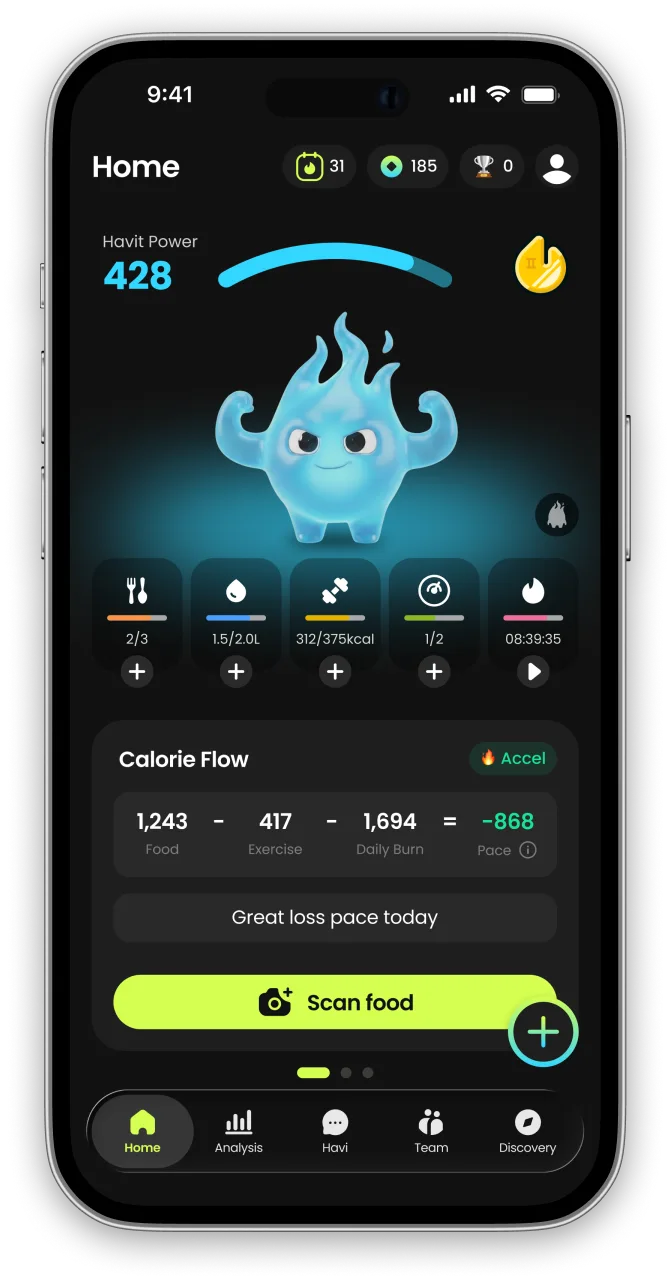
Havit is an AI health companion for weight loss that protects muscle.
Unlike calorie-only trackers, Havit connects AI body-composition estimates, nutrition, hydration, sleep, steps, cycle, mood, and GLP-1 medication in one daily routine — so progress is measured by body composition, not just the number on the scale. Daily missions turn established behavior-change techniques into small repeatable actions, drawing on expertise from professionals formerly at Juvis Diet, one of Korea’s leading metabolic clinics.
In Havit’s own analysis of 1,090 GLP-1 users, people who logged consistently built stronger habits than the general user base. Read the GLP-1 Habit Report
Havit works with or without GLP-1 medication. It is a wellness app, not a medical device; body-composition results are estimates.
Continue in the App
Personalized wellness with your own data


References
- Individual Variation in Sweat Sodium Concentration Among Endurance Athletes: Implications for Personalized Hydration — Journal of the International Society of Sports Nutrition, Baker et al., 2025
- Individualized Hydration Strategies and Endurance Performance: A Systematic Review and Meta-Analysis — Sports Medicine, Hoffman et al., 2024
- Genetic Determinants of Sweat Electrolyte Composition — European Journal of Applied Physiology, Santos-Silva et al., 2024
- Exercise-Associated Hyponatremia: Updated Consensus Statement — Clinical Journal of Sport Medicine, Hew-Butler et al., 2024


