

Gut Transit Time: The Missing Variable in Your Fiber Strategy (And How to Find It)
Measuring your personal gut transit time (12-72 hours) lets you choose the right fiber types and amounts instead of following generic recommendations that may backfire.
This article is for general informational purposes only and is not a substitute for professional medical advice, diagnosis, or treatment. Always consult a qualified healthcare provider with questions about a medical condition.
The Corn Kernel Experiment That Changed Everything
Eat a handful of whole corn kernels. Note the time. Wait for them to reappear. That gap—anywhere from 12 to 72 hours depending on who you are—is your gut transit time. And it might explain why your friend thrives on overnight oats while you spend the morning bloated and uncomfortable.
A 2025 study in Gut tracked transit times across 4,000 participants and found something striking: the range varied by a factor of six between individuals, yet fiber recommendations treat everyone the same. Twenty-five to thirty grams daily, we're told. But if your gut moves food through in 18 hours versus 60 hours, that identical fiber prescription produces wildly different outcomes.
This isn't about eating more or less fiber. It's about matching the type and timing to your personal digestive rhythm.
Why Transit Time Matters More Than Total Fiber Grams
Think of your gut as a fermentation chamber. Fiber arrives, bacteria get to work, gases and beneficial compounds emerge. The speed of that chamber determines everything.
Fast transit (under 24 hours) means fiber spends less time with your microbiome. The bacteria don't fully break it down. You might see undigested food in your stool. Soluble fiber—the kind that dissolves and forms gels—often works better here because it's easier for bacteria to access quickly.
Slow transit (over 48 hours) creates the opposite problem. Fiber sits. Fermentation continues. Gas accumulates. That insoluble fiber everyone recommends for regularity? It might just be sitting in your colon, feeding bacteria that produce excess methane.
The American Journal of Gastroenterology published data in 2024 showing that personalized fiber protocols based on transit time reduced bloating symptoms by 47% compared to standard recommendations. Nearly half the discomfort—gone—just by matching fiber to digestive speed.
How to Measure Your Transit Time at Home
Forget expensive tests. You need corn, beets, or sesame seeds—anything your body can't fully digest that you'll recognize on the other end.
The corn method works best for most people. Eat a quarter cup of whole kernel corn with dinner. Don't chew thoroughly—you want intact kernels. Record the exact time. Then watch. When you see the first kernels appear, note that time too.
Repeat this three times over two weeks. Your transit time fluctuates based on stress, sleep, and what else you've eaten, so averaging gives you a more accurate baseline.
One woman I spoke with discovered her transit time was 19 hours—much faster than she'd assumed. She'd been loading up on psyllium husk for constipation that didn't actually exist. Her real issue was incomplete fermentation. Switching to more soluble sources like oat bran and cooked vegetables resolved her symptoms within ten days.
The Fiber Type Matrix: Matching Sources to Your Speed
Not all fiber behaves the same way in your gut. The distinction between soluble and insoluble matters, but fermentability matters even more.
Highly fermentable fibers (inulin, chicory root, Jerusalem artichoke) feed bacteria aggressively. If you have slow transit, these can become gas factories. One study found that individuals with transit times over 50 hours produced 340% more hydrogen gas from inulin compared to those under 30 hours.
Moderately fermentable fibers (oats, barley, most fruits) offer a middle ground. They feed bacteria steadily without overwhelming the system. These tend to work across transit time ranges.
Poorly fermentable fibers (wheat bran, celery, leafy greens) add bulk without much bacterial activity. They're the workhorses for slow-transit guts that need mechanical movement rather than more fermentation.
Here's what this looks like practically: someone with 20-hour transit might eat steel-cut oats, chia seeds, and cooked apples. Someone with 55-hour transit might focus on raw vegetables, wheat bran, and limit the trendy prebiotic supplements entirely.
The Timing Dimension Nobody Talks About
When you eat fiber shapes its effects as much as what type you choose.
Morning fiber hits an active gut. Motility peaks in the first few hours after waking. A fiber-rich breakfast moves through your system during its most active window. For slow-transit individuals, front-loading fiber makes sense.
Evening fiber encounters a sluggish system. Gut motility decreases as melatonin rises. That late-night apple might sit in your stomach longer than you'd expect. Fast-transit people sometimes benefit from evening fiber to slow things down.
A gastroenterologist in Melbourne ran an informal experiment with 80 patients. She had slow-transit individuals move 70% of their daily fiber to breakfast and lunch. Fast-transit individuals shifted 60% to dinner. After six weeks, 71% reported improved symptoms without changing total fiber intake at all.
The same amount of fiber. Different timing. Different results.
Building Your Personal Fiber Protocol
Start with your transit time measurement. Then adjust systematically.
If your transit time falls under 28 hours, you likely need more soluble, moderately fermentable fiber. Think oatmeal, cooked vegetables, chia seeds soaked in liquid, and ripe bananas. Spread intake throughout the day with a slight emphasis on evening meals. Start at 20 grams daily and increase by 5 grams weekly until you find your threshold.
If your transit time exceeds 45 hours, prioritize insoluble, less fermentable fiber. Raw vegetables, wheat bran, nuts, and seeds become your foundation. Front-load fiber into morning and midday meals. You might tolerate higher total amounts—some slow-transit individuals do well with 40+ grams—because less fermentation means less gas production.
If you fall in the middle range (28-45 hours), you have more flexibility. A mix of fiber types usually works. Pay attention to specific foods rather than categories. Some people with normal transit times react badly to specific fermentable fibers like onions or garlic while tolerating others perfectly.
When Personalization Reveals Bigger Issues
Sometimes measuring transit time uncovers patterns worth discussing with a healthcare provider.
Transit under 14 hours consistently might indicate malabsorption. Food moves too fast for proper nutrient extraction. This isn't a fiber problem—it's a medical question.
Transit over 72 hours consistently suggests significant motility issues. Adding more fiber to an extremely slow system often makes things worse. Motility support might need to come before fiber optimization.
Wildly inconsistent transit times (say, 18 hours one week and 55 hours the next) point toward stress, hormonal fluctuations, or dietary triggers worth investigating. The variability itself becomes useful information.
One participant in the Gut 2025 study discovered her transit time varied by 40 hours depending on her menstrual cycle phase. Luteal phase slowed everything down. She now adjusts her fiber approach throughout the month—more insoluble fiber during the slow phase, more soluble during the fast phase.
The Hydration Multiplier Effect
Fiber without adequate water creates problems regardless of transit time. But the water requirement scales with both fiber amount and transit speed.
Fast transit means less time for water absorption. Soluble fiber in a dehydrated fast-transit gut can actually pull water from tissues, worsening the situation. These individuals often need to drink water with fiber rather than relying on catching up later.
Slow transit allows more water absorption time. Fiber can become compacted if fluid intake doesn't keep pace. The old advice of eight glasses daily undersells what high-fiber, slow-transit people actually need. Some do better with 12 cups or more.
A useful rule: add one cup of water for every 5 grams of fiber above 15 grams daily. Adjust based on your transit time—faster transit, drink with meals; slower transit, spread throughout the day.
Tracking What Actually Matters
Forget food diaries that track every gram. They create anxiety without insight. Instead, track outcomes.
Note three things daily: energy level after meals (1-5 scale), bloating (yes/no and severity), and stool quality (Bristol scale 1-7). Do this for two weeks while eating your normal diet. Then make one fiber change—type, timing, or amount—and track for another two weeks.
Patterns emerge quickly. One person might discover that beans cause bloating regardless of transit time—a FODMAP sensitivity masquerading as a fiber problem. Another might find that their afternoon energy crash disappears when they add soluble fiber to lunch.
The goal isn't perfect optimization. It's finding the 80% solution that works for your body without requiring a nutrition degree to maintain.
What the Research Suggests for 2026 and Beyond
Transit time testing may eventually become routine. Several companies are developing at-home kits using blue dye markers and smartphone apps to track results more precisely than the corn method. Early validation studies show strong correlation with clinical transit time measurements.
The bigger shift is conceptual. Nutrition science is moving away from population averages toward individual variation. Fiber recommendations might eventually come with transit time qualifiers: "25-30 grams daily for average transit; adjust based on your personal measurement."
Until then, you have the tools to run your own experiment. Measure your transit time. Match your fiber types. Adjust your timing. Pay attention to results rather than rules.
Your gut has been telling you what it needs. The corn kernels just help you listen.
📊 Key Stats
Fiber Strategy by Transit Time Category
| Transit Time | Best Fiber Types | Timing Strategy | Starting Amount |
|---|---|---|---|
| Fast (<28 hours) | Soluble, moderately fermentable (oats, chia, cooked fruit) | Spread throughout day, slight evening emphasis | 20g, increase 5g/week |
| Normal (28-45 hours) | Mixed soluble and insoluble, monitor individual triggers | Even distribution across meals | 25g, adjust based on response |
| Slow (>45 hours) | Insoluble, less fermentable (raw vegetables, wheat bran, nuts) | Front-load to morning and midday | 30g+, may tolerate higher amounts |
Personalized fiber recommendations based on measured gut transit time
❓ Frequently Asked Questions
How accurate is the corn kernel method for measuring transit time?
Can transit time change over time?
Why do I get bloated from fiber even though I have slow transit?
Should I take fiber supplements or get fiber from food?
How long does it take to see results from changing my fiber approach?
Does coffee or caffeine affect transit time measurements?
What if my transit time varies dramatically week to week?
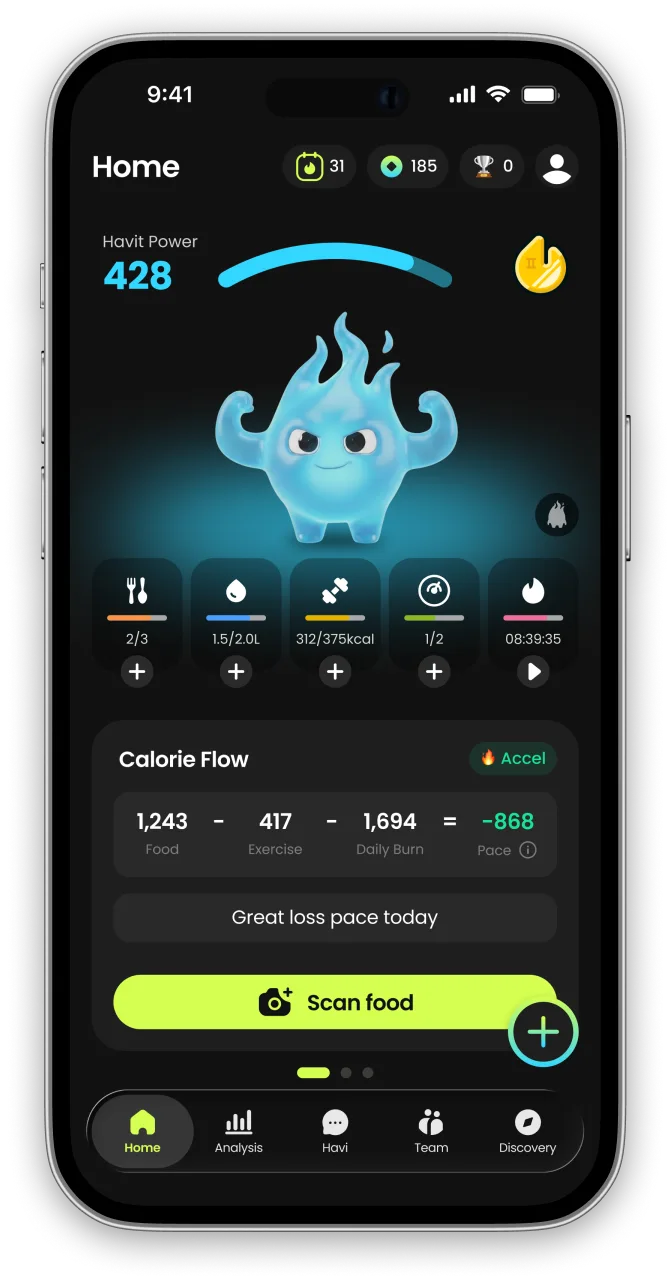
What is Havit?
Havit is an AI health companion for weight loss that protects muscle.
Unlike calorie-only trackers, Havit connects AI body-composition estimates, nutrition, hydration, sleep, steps, cycle, mood, and GLP-1 medication in one daily routine — so progress is measured by body composition, not just the number on the scale. Daily missions turn established behavior-change techniques into small repeatable actions, drawing on expertise from professionals formerly at Juvis Diet, one of Korea’s leading metabolic clinics.
In Havit’s own analysis of 1,090 GLP-1 users, people who logged consistently built stronger habits than the general user base. Read the GLP-1 Habit Report
Havit works with or without GLP-1 medication. It is a wellness app, not a medical device; body-composition results are estimates.

Continue in the App
Personalized wellness with your own data


References
- Individual Variation in Gut Transit Time and Implications for Dietary Fiber Recommendations — Gut, 2025
- Personalized Fiber Interventions Based on Colonic Transit: A Randomized Controlled Trial — American Journal of Gastroenterology, 2024
- Fermentation Patterns of Dietary Fibers in Relation to Transit Time — Journal of Nutrition, 2024
- Home-Based Transit Time Assessment: Validation of Simple Marker Methods — Neurogastroenterology & Motility, 2025


