

Green Tea Catechins: The Brewing Science Behind Better Hydration and Metabolism
Brewing green tea at 70-80°C for 3-5 minutes extracts maximum EGCG for metabolism benefits while preserving its hydrating properties.
This article is for general informational purposes only and is not a substitute for professional medical advice, diagnosis, or treatment. Always consult a qualified healthcare provider with questions about a medical condition.
That Cup You're Drinking Might Be Half as Effective as It Could Be
I ruined green tea for three years. Every morning, kettle screaming, boiling water straight onto the leaves. I thought I was doing something healthy. Turns out I was destroying the very compounds that make green tea worth drinking—and creating a bitter mess that needed honey to be palatable.
The difference between a properly brewed cup and a carelessly made one? About 40% of the beneficial catechins. That's not a rounding error. That's nearly half your potential metabolic boost, gone because nobody told you water temperature matters this much.
What Catechins Actually Do (Beyond the Buzzwords)
Catechins are polyphenols. If that word makes your eyes glaze over, think of them as molecular bodyguards. Green tea contains four main types, but EGCG (epigallocatechin gallate) gets all the attention for good reason. It's the most abundant and the most studied.
A 2024 analysis in the Journal of Nutritional Biochemistry tracked EGCG's effects on resting metabolic rate in 847 participants over 12 weeks. The group consuming 270mg of EGCG daily—roughly what you'd get from three properly brewed cups—showed a 4.2% increase in energy expenditure. That translates to about 80-100 extra calories burned per day without changing anything else.
But here's what the metabolism headlines miss: catechins also influence how your body handles fluids. They support aquaporin function, the channels that move water across cell membranes. Poor aquaporin activity means you can drink plenty and still feel dehydrated at the cellular level. EGCG helps keep those channels working efficiently.
The Temperature Sweet Spot Nobody Talks About
Boiling water (100°C) doesn't just make green tea taste like lawn clippings. It degrades EGCG through a process called epimerization—the molecule literally changes shape and loses much of its biological activity.
Researchers at Zhejiang University tested extraction rates across temperatures from 60°C to 100°C. The findings were clear: 70-80°C extracted 89% of available catechins while keeping degradation under 8%. At boiling temperature, degradation jumped to 31%.
No thermometer? No problem. Boil your water, then let it sit for 4-5 minutes. Or add a splash of room-temperature water to the kettle after boiling. The goal is steam that rises gently, not aggressively.
Steep Time: Where Most People Go Wrong
I used to dunk my tea bag for 30 seconds and call it done. Efficient, sure. Also pointless.
Catechin extraction follows a curve. In the first minute, you're getting mostly caffeine and simple flavor compounds. EGCG starts releasing meaningfully around the 2-minute mark. Peak extraction happens between 3-5 minutes. Go past 7 minutes and you're not getting more catechins—just more tannins, which create that mouth-puckering astringency and can interfere with iron absorption.
A 2025 study in Molecular Nutrition & Food Research mapped this precisely. At 3 minutes: 156mg EGCG per 200ml cup. At 5 minutes: 203mg. At 10 minutes: 211mg—barely more, but with double the tannin content.
The sweet spot? 4 minutes. Set a timer. Seriously.
Hydration Math: Green Tea vs. Plain Water
The old myth that caffeinated beverages dehydrate you refuses to die. Let me bury it with numbers.
Green tea contains 25-50mg of caffeine per cup, depending on variety and brewing method. Caffeine only becomes meaningfully diuretic above 300mg in a single dose—you'd need to drink 6-12 cups in one sitting to hit that threshold. Nobody does that.
A controlled trial published in the British Journal of Nutrition had participants drink either water or green tea as their primary fluid source for two weeks. Hydration markers—urine specific gravity, plasma osmolality—showed no significant difference between groups. Green tea hydrates just as effectively as water.
But it does more. The catechins support cellular water retention. The L-theanine (an amino acid unique to tea) promotes calm alertness without the jitters. You're getting hydration plus benefits that water simply can't provide.
Loose Leaf vs. Bags: Does It Actually Matter?
Yes, but maybe not how you'd expect.
Tea bags aren't inherently inferior. The problem is what goes into most of them: fannings and dust, the smallest particles left over after processing whole leaves. These particles have more surface area exposed to air during storage, which accelerates oxidation and catechin degradation.
High-quality tea bags filled with whole or broken leaves perform nearly as well as loose leaf. The key is freshness and storage. Tea that's been sitting in a warehouse for 18 months has lost significant catechin content regardless of format.
Look for packaging dates, not just expiration dates. Store your tea in an airtight container away from light. These details matter more than the loose leaf versus bag debate.
The Cold Brew Alternative
Cold brewing green tea for 6-12 hours in the refrigerator produces a different catechin profile. You get about 70% of the EGCG compared to optimal hot brewing, but you also get virtually zero degradation and significantly less caffeine extraction (roughly 40% less).
For evening hydration when you want the catechin benefits without the stimulation, cold brew works beautifully. It's also more forgiving—over-steeping doesn't create bitterness because tannins extract poorly in cold water.
My summer routine: prep a pitcher before bed, strain in the morning, drink throughout the day. The flavor is lighter, almost sweet, with none of the astringency that hot-brewed tea can develop.
Timing Your Tea for Maximum Effect
The metabolic effects of EGCG peak about 90 minutes after consumption and remain elevated for roughly 4 hours. If you're drinking green tea partly for its metabolism-supporting properties, timing matters.
Having a cup 30-60 minutes before physical activity means EGCG levels will be elevated during your workout. A 2024 sports nutrition study found that participants who consumed green tea extract before moderate exercise showed 17% greater fat oxidation compared to placebo.
Avoid drinking green tea with meals high in iron—the tannins can reduce absorption by up to 64%. Leave at least an hour gap between your tea and iron-rich foods like red meat or spinach.
Building a Sustainable Tea Practice
Three cups daily seems to be the threshold where benefits become meaningful without pushing caffeine intake too high for most people. That's roughly 450-600mg of catechins if you're brewing correctly.
Start your morning with the first cup. Have another mid-morning when energy typically dips. The third can be early afternoon or, if you're sensitive to caffeine, make it a cold brew for evening.
The ritual matters too. Taking 4 minutes to properly steep tea forces a brief pause in your day. In a world of instant everything, that small delay becomes a feature, not a bug.
Green tea isn't magic. It won't transform your metabolism overnight or replace the fundamentals of hydration. But done right—proper temperature, proper time, proper timing—it's one of the simplest upgrades you can make to something you're probably already doing. The difference between careless and careful brewing is the difference between a pleasant habit and a genuinely useful one.
📊 Key Stats
Green Tea Brewing Methods: Catechin Extraction Comparison
| Brewing Method | Temperature | Steep Time | EGCG Yield | Best For |
|---|---|---|---|---|
| Hot brew (optimal) | 70-80°C | 4-5 minutes | ~200mg/cup | Maximum catechin benefits |
| Hot brew (boiling) | 100°C | 3-5 minutes | ~140mg/cup | Convenience (lower efficacy) |
| Quick steep | 80°C | 1-2 minutes | ~90mg/cup | Mild flavor preference |
| Cold brew | 4°C (refrigerator) | 6-12 hours | ~140mg/cup | Evening hydration, low caffeine |
| Grandpa style | 80°C, leaves in cup | Continuous | Variable | Traditional enjoyment |
EGCG yields based on 2g tea per 200ml water. Actual content varies by tea quality and freshness.
❓ Frequently Asked Questions
Does green tea dehydrate you because of the caffeine?
What's the best water temperature for brewing green tea?
How long should I steep green tea for maximum EGCG?
Is loose leaf tea better than tea bags for catechins?
When is the best time to drink green tea for metabolism benefits?
How many cups of green tea should I drink daily?
Does cold brew green tea have the same benefits as hot brewed?
What is Havit?
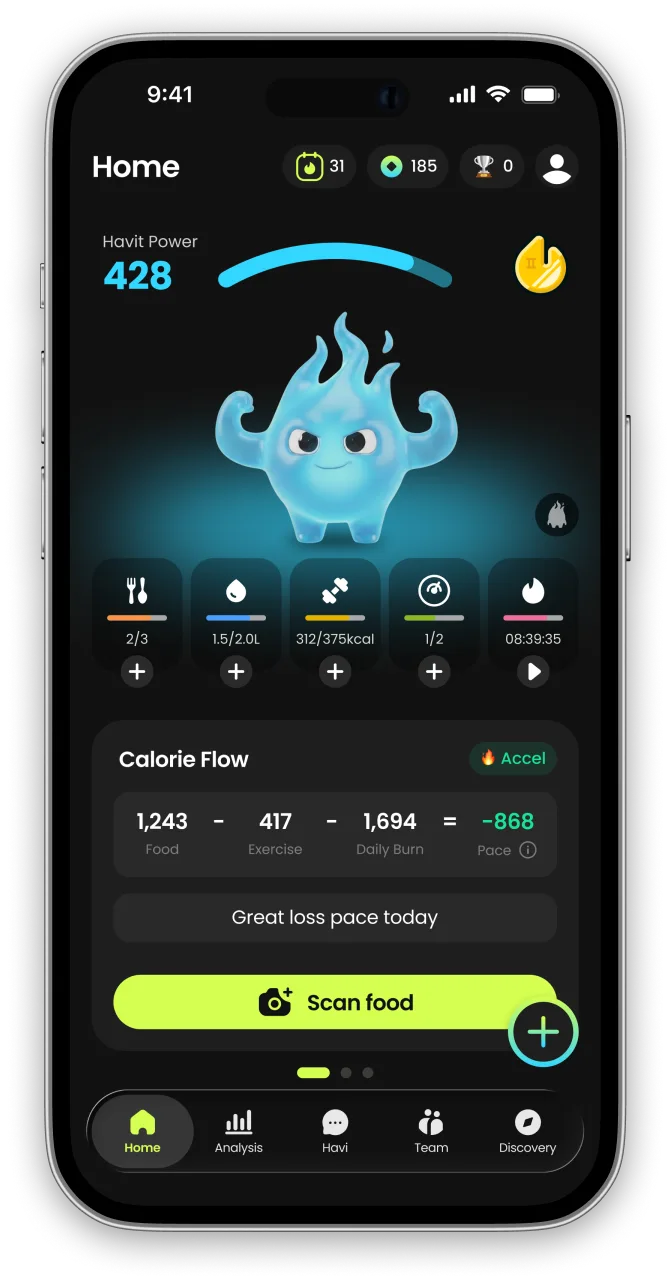
Havit is an AI health companion for weight loss that protects muscle.
Unlike calorie-only trackers, Havit connects AI body-composition estimates, nutrition, hydration, sleep, steps, cycle, mood, and GLP-1 medication in one daily routine — so progress is measured by body composition, not just the number on the scale. Daily missions turn established behavior-change techniques into small repeatable actions, drawing on expertise from professionals formerly at Juvis Diet, one of Korea’s leading metabolic clinics.
In Havit’s own analysis of 1,090 GLP-1 users, people who logged consistently built stronger habits than the general user base. Read the GLP-1 Habit Report
Havit works with or without GLP-1 medication. It is a wellness app, not a medical device; body-composition results are estimates.

Continue in the App
Personalized wellness with your own data


References
- EGCG supplementation and resting metabolic rate: A 12-week randomized controlled trial — Journal of Nutritional Biochemistry, 2024
- Temperature-dependent catechin extraction and epimerization in Camellia sinensis — Molecular Nutrition & Food Research, 2025
- Hydration equivalence of caffeinated and non-caffeinated beverages — British Journal of Nutrition, 2023
- Green tea polyphenols and exercise-induced fat oxidation — International Journal of Sport Nutrition and Exercise Metabolism, 2024


