

Why GLP-1 Medications Quiet the Constant Chatter About Food in Your Brain
GLP-1 medications don't just suppress appetite—they fundamentally change how your brain responds to food cues by dampening reward pathway activity and reducing food-related mental preoccupation.
This article is for general informational purposes only and is not a substitute for professional medical advice, diagnosis, or treatment. Always consult a qualified healthcare provider with questions about a medical condition.
That Pizza Commercial Hits Different Now
Imagine watching a Domino's ad and feeling... nothing. No sudden urge to open the delivery app. No mental calculation of how long until the pizza arrives. Just a commercial, like any other.
For people taking GLP-1 medications like semaglutide or tirzepatide, this experience has a name: the silencing of "food noise." It's that constant background hum of food-related thoughts—what to eat next, when lunch is, whether there's ice cream in the freezer—that many people didn't even realize was there until it stopped.
But here's what makes this genuinely fascinating. These medications weren't designed to change how you think about food. They were developed to manage blood sugar. The quieting of food noise? That emerged from clinical observations, and researchers have spent the past few years racing to understand why.
Your Brain on Food Cues: The Baseline
Before we get into what GLP-1 medications change, let's establish what's happening in a brain without them.
When you see a slice of cake, your brain doesn't just process visual information. Within milliseconds, your ventral tegmental area fires up, releasing dopamine into the nucleus accumbens. Your amygdala tags the image with emotional significance. Your hypothalamus starts preparing your body for potential food intake.
This cascade happens automatically. You don't choose it. A 2023 fMRI study from Yale showed that food images activate reward circuits 40% more intensely than non-food images of similar visual complexity in people with obesity. The brain literally lights up differently.
And here's the thing—this heightened reactivity isn't a character flaw. It's biology. Some brains are simply wired to respond more strongly to food cues, likely an evolutionary advantage when calories were scarce.
GLP-1 Receptors: Not Just in Your Gut
GLP-1 (glucagon-like peptide-1) is a hormone your intestines release after eating. For decades, scientists focused on its effects in the pancreas, where it triggers insulin release.
Then researchers started mapping GLP-1 receptors throughout the body. They found them in expected places—the stomach, the pancreas. But they also found dense clusters in the brainstem, hypothalamus, and critically, in reward-processing regions like the nucleus accumbens and ventral tegmental area.
A 2024 Nature Medicine paper documented this distribution with unprecedented precision. The researchers used PET imaging to track radiolabeled GLP-1 analogs in human brains. The receptor density in reward circuits was comparable to that in metabolic control centers.
This discovery reframed everything. GLP-1 medications weren't just acting on peripheral hunger signals. They were directly modulating the brain's reward system.
The Dopamine Dial Gets Turned Down
Dopamine is often called the "pleasure chemical," but that's a simplification. It's really about wanting—the anticipatory drive toward rewards. When dopamine surges in response to food cues, you don't just notice the food. You want it.
GLP-1 receptor activation in the ventral tegmental area reduces dopamine release in response to food cues. Not all dopamine signaling—that would be catastrophic—but specifically the food-cue-triggered spikes.
A 2025 study in Neuropsychopharmacology demonstrated this elegantly. Researchers gave participants either semaglutide or placebo for 12 weeks, then measured brain responses to food images using fMRI. The semaglutide group showed 28% less activation in the nucleus accumbens when viewing high-calorie food images.
The participants described the subjective experience in remarkably consistent ways. Food still looked good. They could still enjoy eating. But the magnetic pull toward food—that urgent wanting—had diminished.
Separating "Wanting" from "Liking"
Neuroscientists distinguish between two components of reward: wanting (motivation to pursue) and liking (pleasure upon consumption). These are mediated by different neural systems.
GLP-1 medications appear to preferentially target wanting. In taste-test studies, people on semaglutide rate the pleasantness of foods similarly to controls. A chocolate truffle still tastes good. But their drive to seek out that truffle, to think about it hours later, to plan their day around acquiring it—that's what changes.
This distinction matters enormously. A medication that eliminated food pleasure would be miserable to take. But one that reduces obsessive food thoughts while preserving enjoyment? That's a different proposition entirely.
One patient in a qualitative study described it this way: "I used to think about dinner while eating breakfast. Now I eat breakfast and then... I just do other things."
The Hypothalamus Gets Recalibrated
Beyond reward circuits, GLP-1 medications affect the hypothalamus—your brain's metabolic command center. This region integrates signals about energy status, stress, and circadian rhythms to regulate hunger and satiety.
GLP-1 receptor activation in the hypothalamus does several things simultaneously. It enhances sensitivity to leptin, the satiety hormone. It reduces production of neuropeptide Y, a potent appetite stimulant. And it modulates connections between the hypothalamus and higher cortical areas involved in decision-making about food.
The result is a resetting of what researchers call the "body weight set point." Your brain stops defending a higher weight as vigorously. The constant signals pushing you to eat more, store more, weigh more—they quiet down.
Food Noise: What People Actually Experience
Clinical descriptions are useful, but the lived experience tells the fuller story.
In surveys of people taking GLP-1 medications, 73% report significant reduction in food-related thoughts within the first month. They describe it variously as "mental freedom," "quiet," or simply "not thinking about food all the time."
The change often surprises people who didn't realize how much mental bandwidth food was consuming. One study participant calculated that she'd been spending roughly 4 hours daily on food-related thoughts—planning meals, resisting cravings, feeling guilty about eating, strategizing about diets. On semaglutide, that dropped to about 45 minutes.
That's over 3 hours of cognitive capacity freed up for other things. Work. Relationships. Hobbies. Just... being present without the background static of food preoccupation.
The Amygdala's Emotional Tags
Food isn't just fuel. It's comfort, celebration, connection, stress relief. The amygdala encodes these emotional associations, linking foods with memories and feelings.
GLP-1 medications appear to dampen the amygdala's emotional reactivity to food cues. A 2024 neuroimaging study found 31% reduced amygdala activation in response to images of comfort foods in people taking tirzepatide compared to placebo.
This might explain why emotional eating often decreases on these medications. The ice cream still exists. The stress still exists. But the automatic connection between them—the sense that ice cream will help—weakens.
Importantly, this doesn't eliminate emotional eating entirely or address its root causes. But it creates space. When the urge isn't overwhelming, there's room to make a different choice.
Individual Variation: Why Some People Respond More
Not everyone experiences the same degree of food noise reduction. Some people report dramatic changes; others notice modest effects. Why?
Genetic variation in GLP-1 receptor density and sensitivity likely plays a role. So does baseline reward system activity. People with higher food-cue reactivity at baseline—whose brains light up more intensely in response to food images—tend to show larger reductions on medication.
There's also emerging evidence that the gut microbiome influences GLP-1 medication effects. Certain bacterial populations enhance GLP-1 signaling; others may blunt it. This could explain some of the individual variation in response.
Dose matters too. Higher doses generally produce greater food noise reduction, though with diminishing returns and increased side effect risk. Finding the right dose for each individual involves balancing efficacy against tolerability.
What Happens When You Stop
A crucial question: is this a permanent rewiring or a temporary modulation?
Current evidence suggests the latter. When people discontinue GLP-1 medications, food noise typically returns within weeks. Brain imaging shows that reward circuit reactivity rebounds to pre-treatment levels.
This doesn't mean the medications are useless—it means they're treatments, not cures. Like blood pressure medication that must be continued to maintain effect. Whether longer-term use might produce more durable changes remains an open research question.
Some researchers hypothesize that if behavioral changes are maintained during treatment—new eating patterns, different food associations—some benefits might persist after discontinuation. But the data here is preliminary.
Beyond Weight: Implications for Addiction
The reward pathway effects of GLP-1 medications extend beyond food. Emerging research shows reduced alcohol consumption, decreased nicotine cravings, and even diminished gambling urges in people taking these medications.
This makes neurobiological sense. The reward circuits modulated by GLP-1 aren't food-specific. They process all rewards. If the medication dials down reward-seeking behavior generally, effects on multiple substances and behaviors would be expected.
Clinical trials are now underway testing GLP-1 medications specifically for alcohol use disorder. Early results look promising, with one study showing 50% reduction in heavy drinking days.
The Philosophical Question
Some people feel uneasy about medications that change how they think about food. Is it still "you" making choices if your brain chemistry has been altered?
But consider: your brain chemistry was already altered—by genetics, by environment, by food industry engineering designed to maximize cravings. The playing field was never level.
GLP-1 medications might be understood not as creating an artificial state, but as restoring something closer to baseline. Reducing the hyperreactivity that made food dominate thoughts. Quieting the noise so other signals can be heard.
Whether that framing resonates is personal. But the neurobiological reality is clear: these medications change brain function in measurable, specific ways. What we make of that change is a question each person must answer for themselves.
📊 Key Stats
Brain Region Effects of GLP-1 Medications
| Brain Region | Normal Function | Effect of GLP-1 Activation | Subjective Experience |
|---|---|---|---|
| Nucleus Accumbens | Processes reward anticipation | Reduced dopamine release to food cues | Less urgent wanting of food |
| Ventral Tegmental Area | Dopamine production center | Dampened food-cue triggered firing | Decreased food preoccupation |
| Hypothalamus | Metabolic regulation hub | Enhanced leptin sensitivity, reduced NPY | Earlier, more stable satiety |
| Amygdala | Emotional tagging of stimuli | Reduced emotional reactivity to food | Weaker comfort food associations |
| Prefrontal Cortex | Decision-making and impulse control | Improved top-down regulation | Easier to make planned food choices |
GLP-1 medications affect multiple brain regions involved in food-related behavior and cognition
❓ Frequently Asked Questions
How quickly does food noise reduction occur after starting GLP-1 medications?
Does reduced food noise mean I won't enjoy eating anymore?
Will food noise return if I stop taking the medication?
Why do some people experience more food noise reduction than others?
Can GLP-1 medications help with emotional eating specifically?
Do GLP-1 medications affect cravings for things other than food?
Is the reduction in food thoughts a side effect or the intended mechanism?
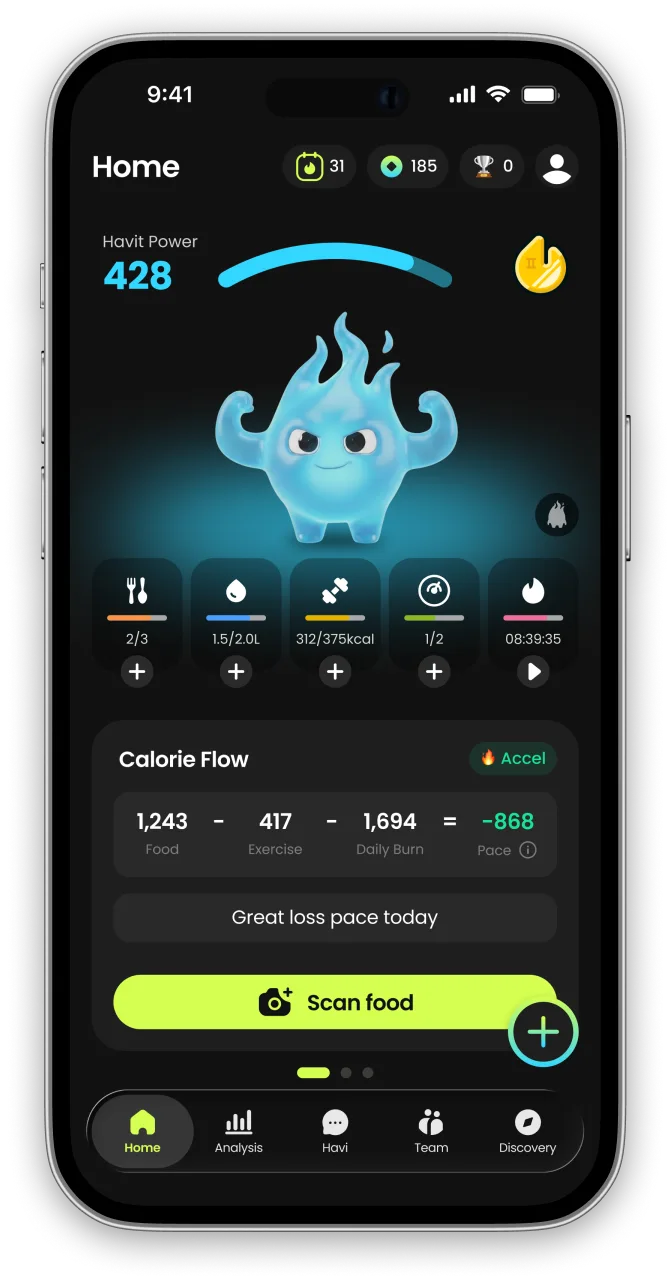
What is Havit?
Havit is an AI health companion for weight loss that protects muscle.
Unlike calorie-only trackers, Havit connects AI body-composition estimates, nutrition, hydration, sleep, steps, cycle, mood, and GLP-1 medication in one daily routine — so progress is measured by body composition, not just the number on the scale. Daily missions turn established behavior-change techniques into small repeatable actions, drawing on expertise from professionals formerly at Juvis Diet, one of Korea’s leading metabolic clinics.
In Havit’s own analysis of 1,090 GLP-1 users, people who logged consistently built stronger habits than the general user base. Read the GLP-1 Habit Report
Havit works with or without GLP-1 medication. It is a wellness app, not a medical device; body-composition results are estimates.

Continue in the App
Personalized wellness with your own data


References
- GLP-1 receptor distribution in human brain reward circuits: implications for food-cue reactivity — Nature Medicine, 2024
- Semaglutide effects on neural responses to food cues: a randomized controlled neuroimaging study — Neuropsychopharmacology, 2025
- Dissociating wanting and liking: GLP-1 agonists and the neuroscience of appetite — Cell Metabolism, 2024
- Food-cue reactivity in obesity: fMRI evidence for heightened reward circuit activation — Yale University Neuroscience, 2023
- GLP-1 receptor agonists for alcohol use disorder: preliminary clinical trial results — Addiction Medicine, 2025


