

Why Your Friend Can Drink Espresso at 9 PM: CYP1A2 and Personalized Caffeine Intake
CYP1A2 gene variants create massive differences in caffeine clearance, meaning your optimal coffee cutoff time is written in your DNA.
This article is for general informational purposes only and is not a substitute for professional medical advice, diagnosis, or treatment. Always consult a qualified healthcare provider with questions about a medical condition.
The Midnight Espresso Mystery
My college roommate used to drink a double shot at 11 PM and fall asleep twenty minutes later. I'd have half a cup at 2 PM and stare at my ceiling until 3 AM. For years, I assumed she had some superhuman tolerance. Turns out, we just have different versions of the same gene.
The gene is called CYP1A2, and it's responsible for producing the liver enzyme that breaks down about 95% of the caffeine in your body. Some people have variants that make this enzyme work like a Ferrari engine. Others—like me—have versions that process caffeine more like a bicycle. A 2025 study in the Journal of Clinical Pharmacology found that the difference between the fastest and slowest metabolizers can be as dramatic as 40-fold. That's not a typo. Forty times.
What CYP1A2 Actually Does in Your Liver
When you drink coffee, caffeine enters your bloodstream within about 15 minutes. It crosses the blood-brain barrier and blocks adenosine receptors, which is why you feel alert instead of sleepy. But here's where genetics take over: your liver needs to eventually clear that caffeine out.
The CYP1A2 enzyme handles this job. Think of it as a bouncer escorting caffeine out of the club. Some people have bouncers who work incredibly fast—they can clear half the caffeine from their system in under two hours. Others have bouncers who take smoke breaks. Their half-life extends to eight hours or more.
The most common genetic variants fall into two categories. The *1A/*1A genotype produces rapid metabolizers. The *1F variant, especially when combined with certain other alleles, creates slow metabolizers. A meta-analysis published in Nutrients in 2024 analyzed 23 studies covering over 14,000 participants and confirmed that these genetic differences predict caffeine sensitivity with remarkable accuracy.
The 6-Hour Rule Doesn't Apply to Everyone
You've probably heard the advice to stop drinking coffee six hours before bed. It's decent general guidance, based on caffeine's average half-life of about five hours. But averages hide enormous variation.
For rapid metabolizers (roughly 45% of the population), a four-hour cutoff might be perfectly fine. Their bodies have already cleared most of the caffeine by bedtime. But for slow metabolizers (about 10% of people), six hours isn't nearly enough. They might need eight to ten hours of clearance time to avoid sleep disruption.
Here's a concrete example. Say you drink a 200mg coffee—about the amount in a typical medium drip. A rapid metabolizer will have roughly 50mg left in their system after four hours. A slow metabolizer might still have 150mg circulating. That's the difference between a minor background hum and a full alarm bell ringing in your nervous system.
Signs You Might Be a Slow Metabolizer
Genetic testing can confirm your CYP1A2 status, but your body has probably already been sending you signals. Slow metabolizers tend to notice caffeine's effects more intensely and for longer periods. One cup feels like two. The jitters last all afternoon.
Sleep disruption is the biggest clue. If you consistently struggle to fall asleep after afternoon coffee—even when you feel tired—slow metabolism is a likely culprit. A 2024 study tracking 847 adults found that slow metabolizers who consumed caffeine after 2 PM had 23% worse sleep efficiency scores compared to rapid metabolizers with identical intake timing.
Anxiety responses also differ. Slow metabolizers report higher rates of caffeine-induced anxiety, probably because the stimulant hangs around longer at higher concentrations. If coffee makes you feel wired and worried rather than alert and focused, your genetics might be the reason.
Rapid Metabolizers Have Different Problems
Being a fast processor isn't all upside. Rapid metabolizers often find that coffee "doesn't work" for them the way it seems to work for others. They need larger doses to feel the same effect, which can lead to higher consumption patterns.
There's also a cardiovascular consideration. Interestingly, the relationship between coffee and heart health appears to differ by genotype. Research from 2024 found that rapid metabolizers showed neutral or even protective cardiovascular associations with moderate coffee consumption. Slow metabolizers, however, showed elevated blood pressure responses to the same amounts.
This doesn't mean slow metabolizers should avoid coffee entirely. It means they might benefit from lower doses spread differently throughout the day.
Building Your Personal Caffeine Strategy
Once you have a sense of your metabolism type—whether through genetic testing, careful self-observation, or both—you can start optimizing your intake.
For slow metabolizers, the morning becomes prime caffeine territory. Front-loading your intake means you get the alertness benefits while giving your body maximum clearance time. A practical approach: finish your last caffeinated drink by noon or 1 PM. Yes, that might feel early. But if you've been wondering why you can't sleep despite feeling exhausted, this single change often produces dramatic results within a week.
For rapid metabolizers, timing matters less than dosing. Because caffeine clears quickly, you might find that a single morning coffee wears off by 10 AM. Strategic redosing—a smaller afternoon cup, for instance—can maintain steady alertness without sleep consequences. Just watch the total daily amount; rapid clearance can mask how much you're actually consuming.
Other Factors That Modify CYP1A2 Activity
Genetics set your baseline, but other variables can shift your enzyme activity up or down. Smoking dramatically increases CYP1A2 activity—smokers clear caffeine about twice as fast as non-smokers. This partly explains why some people increase their coffee intake after quitting cigarettes; their metabolism slows, and the same amount suddenly feels stronger.
Certain foods also matter. Cruciferous vegetables like broccoli and Brussels sprouts can slightly increase CYP1A2 activity. Grapefruit juice does the opposite, inhibiting the enzyme and extending caffeine's half-life. These effects are modest compared to genetic variation, but they stack.
Hormonal factors play a role too. Women on oral contraceptives metabolize caffeine about 50% slower than those who aren't. Pregnancy slows metabolism even more dramatically—by the third trimester, caffeine half-life can extend to 15 hours. These aren't permanent changes, but they're significant enough to warrant adjusted intake during those periods.
The Practical Takeaway
Knowing your CYP1A2 status won't change your love of coffee. But it might change when and how much you drink. The person who can handle an evening espresso isn't tougher than you. They just have different genetic machinery.
Start by tracking your sleep quality against your caffeine timing for two weeks. Note what time you have your last caffeinated drink and how long it takes you to fall asleep. Patterns will emerge. If afternoon coffee consistently precedes poor sleep, experiment with an earlier cutoff—even if it feels unnecessarily strict.
Your optimal caffeine strategy is personal. It's written in your genes, modified by your lifestyle, and refined through attention to how your body actually responds. The generic advice exists because it works for average people. But you're not average. Nobody is.
📊 Key Stats
Caffeine Response by CYP1A2 Metabolizer Type
| Characteristic | Rapid Metabolizer | Slow Metabolizer |
|---|---|---|
| Caffeine half-life | 2-3 hours | 6-8+ hours |
| Population percentage | ~45% | ~10% |
| Recommended last caffeine | 4-5 hours before bed | 8-10 hours before bed |
| Typical sensitivity | May need higher doses for effect | Strong response to small amounts |
| Sleep disruption risk | Lower with afternoon intake | Higher with afternoon intake |
| Anxiety likelihood | Lower at moderate doses | Higher at same doses |
Individual responses vary; use this as a starting framework for personal experimentation
❓ Frequently Asked Questions
How can I find out my CYP1A2 genotype?
Can I change my caffeine metabolism speed?
Why does caffeine affect me more than my friends?
Is it safe for slow metabolizers to drink coffee?
Does caffeine tolerance override genetic metabolism?
What about tea and other caffeine sources?
Should I stop drinking coffee if I'm a slow metabolizer?
What is Havit?
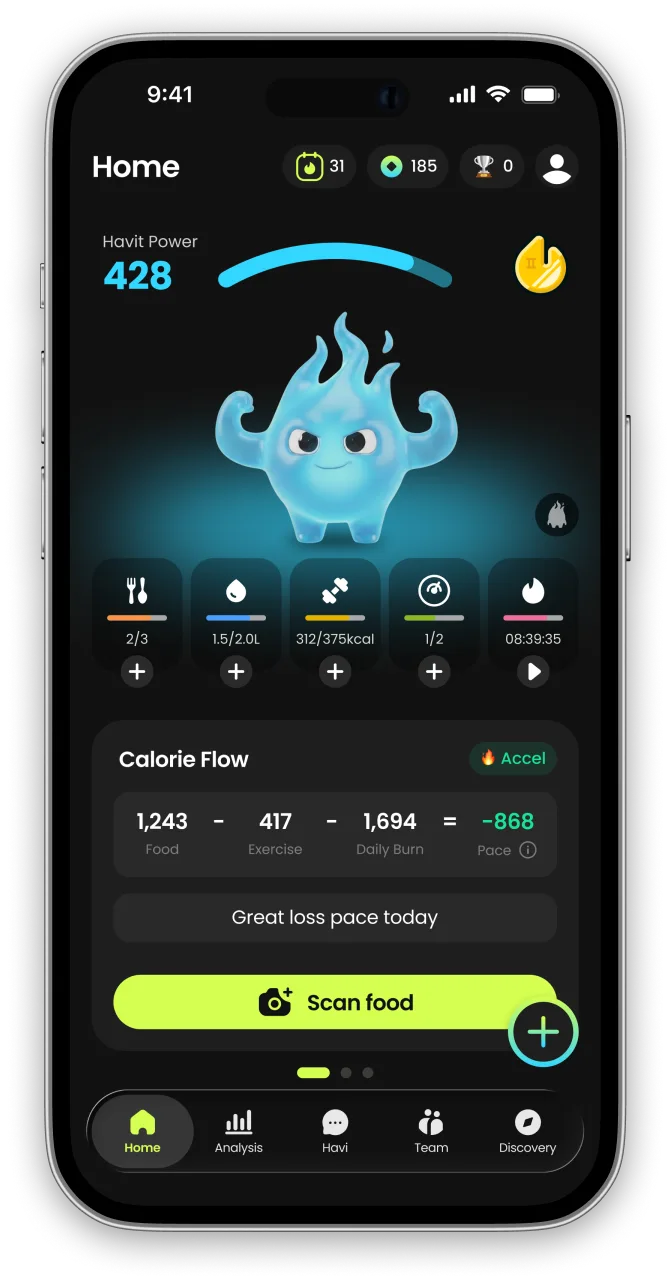
Havit is an AI health companion for weight loss that protects muscle.
Unlike calorie-only trackers, Havit connects AI body-composition estimates, nutrition, hydration, sleep, steps, cycle, mood, and GLP-1 medication in one daily routine — so progress is measured by body composition, not just the number on the scale. Daily missions turn established behavior-change techniques into small repeatable actions, drawing on expertise from professionals formerly at Juvis Diet, one of Korea’s leading metabolic clinics.
In Havit’s own analysis of 1,090 GLP-1 users, people who logged consistently built stronger habits than the general user base. Read the GLP-1 Habit Report
Havit works with or without GLP-1 medication. It is a wellness app, not a medical device; body-composition results are estimates.
Continue in the App
Personalized wellness with your own data


References
- CYP1A2 Polymorphisms and Caffeine Pharmacokinetics: Clinical Implications for Personalized Consumption Guidelines — Journal of Clinical Pharmacology, 2025
- Genetic Determinants of Caffeine Sensitivity: A Systematic Review and Meta-Analysis of 23 Studies — Nutrients, 2024
- Interindividual Variability in Caffeine Metabolism and Sleep Quality Outcomes — Sleep Medicine Reviews, 2024
- Environmental and Hormonal Modifiers of CYP1A2 Activity: Implications for Caffeine Consumption — Drug Metabolism and Disposition, 2024


