

Functional Dyspepsia Treatment in 2026: Why Your Gut and Brain Need Couples Therapy
Functional dyspepsia is a gut-brain communication disorder, not just a stomach problem—and treating both systems together works better than targeting either alone.
This article is for general informational purposes only and is not a substitute for professional medical advice, diagnosis, or treatment. Always consult a qualified healthcare provider with questions about a medical condition.
That Persistent Stomach Discomfort Isn't All in Your Head (But Your Head Is Involved)
You've had the endoscopy. The ultrasound came back clean. Your doctor shrugged and said everything looks normal. Yet here you are, three bites into dinner, feeling like you swallowed a brick.
If this sounds familiar, you're one of roughly 200 million people worldwide living with functional dyspepsia. For decades, this condition existed in a frustrating gray zone—too real to ignore, too invisible to explain. But something shifted in how gastroenterologists understand this disorder. The Rome IV criteria, updated through 2025, now officially classify functional dyspepsia as a "disorder of gut-brain interaction." That clinical jargon actually matters. It means your symptoms aren't imaginary, and it points toward treatments that address the real problem.
What Functional Dyspepsia Actually Feels Like (Beyond the Textbook)
The medical definition involves upper abdominal pain, burning, early fullness, or uncomfortable satiation. But lived experience tells a different story.
Sarah, a 34-year-old marketing manager in Chicago, described it this way: "I'd eat half a sandwich and feel like I'd finished Thanksgiving dinner. Then the burning would start. Not heartburn exactly—more like someone lit a small campfire right below my ribcage."
Functional dyspepsia splits into two main subtypes. Postprandial distress syndrome centers on fullness and early satiation—you can't finish meals, and food seems to sit in your stomach for hours. Epigastric pain syndrome involves burning or pain in the upper abdomen, sometimes unrelated to eating. About 35% of patients experience both.
The symptoms wax and wane. Stress makes everything worse. Certain foods trigger flares, though the culprits vary wildly between individuals. One person can't tolerate coffee; another handles espresso fine but falls apart after eating tomatoes.
The Gut-Brain Highway: Why Communication Breaks Down
Your digestive system contains 500 million neurons. That's more than your spinal cord. This "second brain" constantly sends signals upward through the vagus nerve, while your actual brain sends instructions back down. In functional dyspepsia, this two-way communication goes haywire.
Research published in Gastroenterology in 2025 identified several specific breakdowns. The stomach's ability to relax and accommodate food (called gastric accommodation) becomes impaired in about 40% of patients. Visceral hypersensitivity—where normal stomach stretching triggers pain signals—affects roughly 34%. The stomach empties too slowly in some patients, too quickly in others.
But here's what makes functional dyspepsia a true gut-brain disorder: the brain's interpretation of these signals matters as much as the signals themselves. Brain imaging studies show that patients with functional dyspepsia process stomach sensations in areas associated with emotional response and threat detection. Their brains essentially treat normal digestion as a potential danger.
Anxiety and depression don't cause functional dyspepsia, but they amplify it significantly. A 2024 study in Gut found that patients with concurrent anxiety had 2.3 times higher symptom severity scores than those without.
Why Single-Target Treatments Often Disappoint
The traditional approach went something like this: acid? Try a proton pump inhibitor. Slow emptying? Here's a prokinetic. Still suffering? Maybe it's stress—have you tried relaxing?
This piecemeal strategy helps some patients. PPIs work for about 30-40% of people with functional dyspepsia, particularly those with the epigastric pain subtype. Prokinetics help maybe 25-30%. But that leaves a lot of people still searching for relief.
The problem is treating a communication disorder by addressing only one end of the conversation. Imagine trying to fix a troubled marriage by only talking to one spouse. You might make some progress, but you're missing half the equation.
Multimodal Treatment: Addressing Both Ends of the Connection
The shift toward multimodal treatment means combining therapies that target the gut, the brain, and the communication pathway between them. It's not about throwing everything at the wall—it's about strategic combinations based on each patient's specific dysfunction pattern.
Gut-directed approaches remain the foundation. Dietary modification helps many patients, though not through generic advice like "avoid spicy food." The evidence now supports low-FODMAP diets for a subset of patients, particularly those with overlap irritable bowel syndrome. Smaller, more frequent meals reduce the accommodation burden on the stomach. Specific trigger identification through careful food diaries beats blanket restrictions.
Neuromodulators work on the brain's processing of gut signals. Low-dose tricyclic antidepressants like amitriptyline (10-50mg at bedtime) help 50-60% of patients in clinical trials—not because functional dyspepsia is depression, but because these medications alter how the brain interprets visceral signals. The 2024 Gut study on neuromodulation found that patients on combination therapy (PPI plus low-dose TCA) showed 47% greater symptom improvement than those on either medication alone.
Brain-gut behavioral therapies represent the newest addition to the toolkit. Gut-directed hypnotherapy, delivered over 7-12 sessions, produces lasting improvement in 60-70% of patients. Cognitive behavioral therapy adapted for gastrointestinal conditions teaches patients to recognize and interrupt the anxiety-symptom cycle.
The Vagus Nerve: A Promising Target
The vagus nerve carries about 80% of the communication between gut and brain. Researchers are now exploring ways to modulate this pathway directly.
Transcutaneous vagus nerve stimulation uses a small device placed on the ear to deliver electrical pulses to vagal fibers. Early trials show promise—a 2024 study demonstrated 38% symptom reduction after four weeks of daily stimulation. The treatment is non-invasive and has minimal side effects, though long-term data remains limited.
Deep breathing exercises also stimulate the vagus nerve, which partly explains why relaxation techniques help some patients. Five minutes of slow, diaphragmatic breathing (about six breaths per minute) measurably increases vagal tone.
Building Your Treatment Stack: A Practical Framework
No single protocol works for everyone, but evidence supports a general approach.
Start with the basics. Dietary modification, regular meal timing, and stress management form the foundation. These interventions carry no risk and help a meaningful percentage of patients. Give them 4-6 weeks.
Add targeted medication based on subtype. Epigastric pain responds better to acid suppression and neuromodulators. Postprandial distress often improves with prokinetics and accommodation-enhancing agents like buspirone (which relaxes the stomach fundus). A trial of 8-12 weeks provides adequate time to assess response.
Consider brain-gut behavioral therapy if symptoms persist or if anxiety/depression are prominent features. These therapies require more time investment but produce durable results without ongoing medication.
Reassess and adjust. Functional dyspepsia tends to fluctuate. A treatment that works during a high-stress period might become unnecessary when life calms down. Regular check-ins with your gastroenterologist allow for appropriate adjustments.
What the Research Shows About Long-Term Outcomes
Functional dyspepsia isn't a progressive disease—it doesn't damage your stomach or increase cancer risk. But it can be remarkably persistent. Population studies suggest that about 50% of patients still have symptoms after 5 years, though severity often decreases.
The good news: multimodal treatment improves these odds. Patients who receive comprehensive care addressing both gut and brain components show 65-70% response rates in recent trials, compared to 30-40% for single-modality treatment.
Complete symptom resolution happens for some patients. More commonly, people achieve what researchers call "adequate relief"—symptoms that no longer significantly impact daily life. That might sound like a modest goal, but ask anyone who's spent years unable to enjoy meals with family, and they'll tell you it's transformative.
The Future of Functional Dyspepsia Treatment
Several developments are worth watching. Microbiome-targeted therapies show early promise, with specific probiotic strains demonstrating modest benefits in small trials. Personalized medicine approaches aim to match treatments to individual dysfunction patterns—identifying which patients have impaired accommodation versus visceral hypersensitivity versus delayed emptying, then targeting accordingly.
Digital therapeutics, including app-based gut-directed hypnotherapy, are expanding access to behavioral treatments that were previously available only through specialized centers. These programs maintain effectiveness while reducing cost and geographic barriers.
The fundamental shift, though, has already happened. Functional dyspepsia is no longer a diagnosis of exclusion—a label applied when tests find nothing. It's a recognized disorder with understood mechanisms and effective treatments. Your gut and brain need to communicate better. Now we have tools to help them do exactly that.
📊 Key Stats
Functional Dyspepsia Treatment Approaches Compared
| Treatment Type | Target | Response Rate | Time to Effect | Best For |
|---|---|---|---|---|
| Proton Pump Inhibitors | Acid secretion | 30-40% | 2-4 weeks | Epigastric pain subtype |
| Prokinetics | Gastric motility | 25-30% | 2-4 weeks | Postprandial distress |
| Low-dose TCAs | Brain signal processing | 50-60% | 4-8 weeks | Visceral hypersensitivity |
| Gut-directed hypnotherapy | Brain-gut communication | 60-70% | 7-12 sessions | Persistent symptoms, anxiety |
| Vagus nerve stimulation | Vagal pathway | 38% reduction | 4+ weeks | Emerging option |
Response rates from clinical trials; individual results vary based on symptom subtype and comorbidities
❓ Frequently Asked Questions
Is functional dyspepsia the same as irritable bowel syndrome?
Can functional dyspepsia be cured permanently?
Why do antidepressants help if functional dyspepsia isn't depression?
Does H. pylori cause functional dyspepsia?
Are there foods I should definitely avoid with functional dyspepsia?
How long should I try a treatment before deciding it doesn't work?
Can stress alone cause functional dyspepsia?
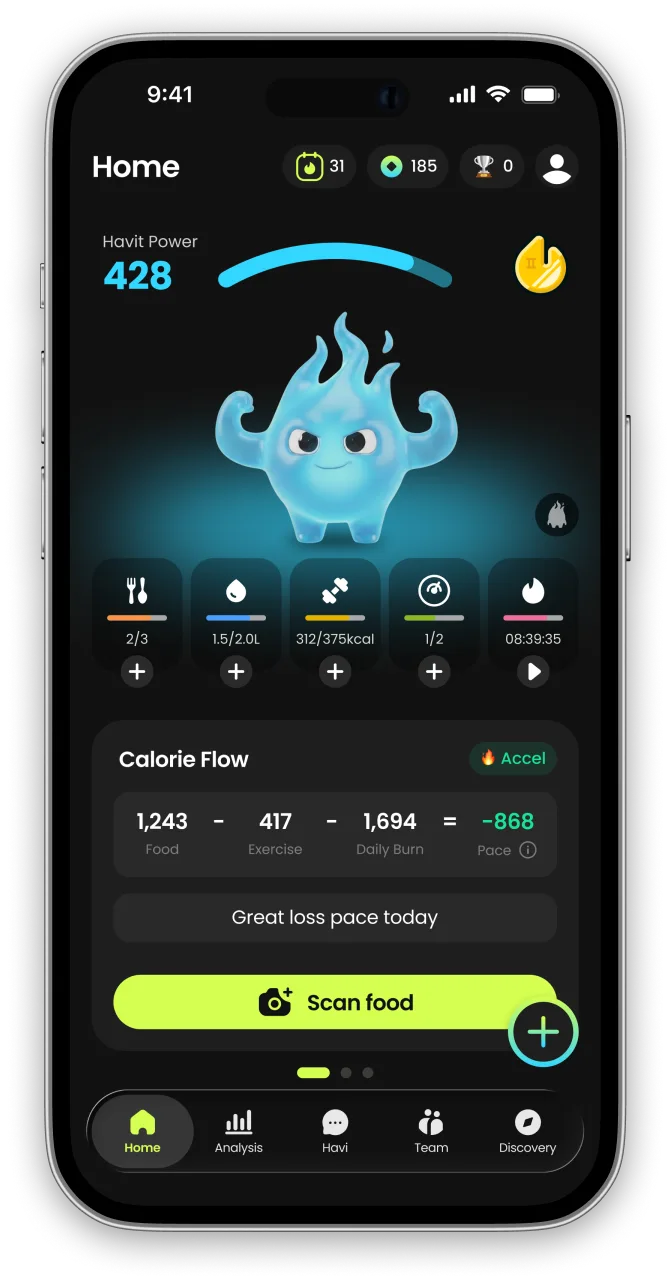
What is Havit?
Havit is an AI health companion for weight loss that protects muscle.
Unlike calorie-only trackers, Havit connects AI body-composition estimates, nutrition, hydration, sleep, steps, cycle, mood, and GLP-1 medication in one daily routine — so progress is measured by body composition, not just the number on the scale. Daily missions turn established behavior-change techniques into small repeatable actions, drawing on expertise from professionals formerly at Juvis Diet, one of Korea’s leading metabolic clinics.
In Havit’s own analysis of 1,090 GLP-1 users, people who logged consistently built stronger habits than the general user base. Read the GLP-1 Habit Report
Havit works with or without GLP-1 medication. It is a wellness app, not a medical device; body-composition results are estimates.

Continue in the App
Personalized wellness with your own data


References
- Rome IV Diagnostic Criteria for Functional Dyspepsia: 2025 Update — Gastroenterology, 2025
- Neuromodulation Therapy in Functional Dyspepsia: A Randomized Controlled Trial — Gut, 2024
- Brain-Gut Behavioral Therapies for Disorders of Gut-Brain Interaction — American Journal of Gastroenterology, 2024
- Pathophysiology of Functional Dyspepsia: Current Understanding and Future Directions — Nature Reviews Gastroenterology & Hepatology, 2024


