

Fiber for Weight Loss: The Exact Grams You Need for Real Satiety
Eating 25-35g of fiber daily can reduce appetite by up to 31%, with viscous fibers before meals showing the strongest satiety effects.
This article is for general informational purposes only and is not a substitute for professional medical advice, diagnosis, or treatment. Always consult a qualified healthcare provider with questions about a medical condition.
That 3pm Hunger That Won't Quit
You ate lunch two hours ago. A proper lunch—salad, protein, the works. Yet here you are, staring at the vending machine like it holds the answers to life's deepest questions. Sound familiar?
Here's what's probably happening: your lunch was missing the one macronutrient that actually keeps hunger hormones in check for hours. Not protein (though that helps). Not fat. Fiber. And not just "some" fiber—a specific amount that triggers your body's fullness signals.
I spent weeks digging through the latest satiety research, and what I found surprised me. The relationship between fiber and appetite isn't linear. There's a threshold where the magic happens, and most people aren't hitting it.
The Dose That Actually Works
A 2024 analysis published in the Journal of Nutrition tracked fiber intake against appetite ratings across 4,200 participants. The findings were remarkably consistent: satiety benefits kicked in around 25 grams daily, peaked between 30-35 grams, and showed diminishing returns beyond 40 grams.
Think of it like a volume knob. Going from 15g to 25g? Dramatic difference. Going from 35g to 45g? You might just end up bloated without much extra hunger control.
The average American eats about 16 grams of fiber daily. That's roughly half the minimum threshold for meaningful satiety effects. We're collectively stuck at volume level 3 when we need to be at 7.
What makes this interesting is the mechanism. Fiber doesn't just "fill you up" mechanically. It triggers a cascade of hormonal responses. GLP-1, CCK, PYY—these appetite-regulating hormones increase significantly when viscous fiber hits your small intestine. Your brain literally receives different hunger signals.
Why Fiber Type Matters More Than Total Grams
Not all fiber is created equal for satiety. This is where most advice falls short.
Viscous (soluble) fibers—the kind that forms a gel in your gut—outperform insoluble fiber for hunger control by a significant margin. A 2025 review in Appetite found that viscous fiber reduced subsequent calorie intake by 10-14%, while insoluble fiber showed minimal effect on appetite.
Beta-glucan from oats. Psyllium husk. Pectin from apples and citrus. Glucomannan from konjac root. These are your heavy hitters.
Insoluble fiber (think wheat bran, vegetable skins) has its own benefits—digestive regularity, gut health—but if pure satiety is your goal, viscous fibers deliver more bang for your gram.
Here's a practical example. Two breakfasts, both containing 8 grams of fiber:
Breakfast A: Whole wheat toast with almond butter (mostly insoluble fiber) Breakfast B: Steel-cut oats with raspberries and chia seeds (mostly viscous fiber)
Breakfast B will likely keep you satisfied 45-90 minutes longer. Same fiber count, different satiety outcome.
Timing: The Underrated Variable
When you eat fiber matters almost as much as how much you eat.
Research shows that consuming fiber 15-30 minutes before a meal reduces total calorie intake more effectively than eating it during the meal. The gel-forming process needs time. Drinking a glass of water with psyllium husk 20 minutes before dinner? That's strategic. Sprinkling fiber powder on your pasta mid-meal? Less effective.
One study had participants consume 6 grams of glucomannan before their largest meal daily. After 8 weeks, they'd lost an average of 5.5 pounds more than the control group—without any other dietary changes. The fiber created a "pre-load" effect that naturally reduced portion sizes.
This doesn't mean you need supplements. A medium apple (4.4g fiber, mostly pectin) eaten 20 minutes before dinner accomplishes something similar. So does a small bowl of vegetable soup.
Building Your Daily Fiber Stack
Let's get practical. Here's how to hit 30 grams without feeling like you're forcing down cardboard.
Morning (target: 10-12g) Steel-cut oats (1 cup cooked) = 4g Raspberries (1 cup) = 8g Chia seeds (1 tbsp) = 5g
That's 17 grams before you've left the house. Already above the American average for an entire day.
Lunch (target: 8-10g) Lentils (½ cup) = 8g Mixed greens (2 cups) = 2g Avocado (half) = 5g
Dinner (target: 8-10g) Broccoli (1 cup) = 5g Black beans (½ cup) = 7.5g Sweet potato (medium) = 4g
Total: 48.5 grams. That's actually more than you need. The point is that hitting 30g becomes easy once you know which foods pull their weight.
Notice what's missing? Fiber supplements. Processed "fiber-enriched" products. You don't need them if you're eating actual food. A single cup of raspberries contains more fiber than most fiber bars.
The Gradual Ramp-Up Protocol
Here's where people sabotage themselves. They read about fiber's benefits, get excited, and jump from 15 grams to 35 grams overnight. Then they spend three days bloated and uncomfortable, decide fiber "doesn't work for them," and quit.
Your gut microbiome needs time to adjust. The bacteria that ferment fiber need to multiply. This takes roughly 2-3 weeks.
A smarter approach:
Week 1: Add 5 grams daily (one piece of fruit or ½ cup beans) Week 2: Add another 5 grams Week 3: Add another 5 grams Week 4: Fine-tune based on how you feel
Drink more water as you increase fiber. The gel-forming process requires liquid. Without adequate hydration, you'll get constipated instead of satisfied.
What the Research Says About Long-Term Weight Loss
Short-term satiety is one thing. Does higher fiber intake actually translate to sustained weight loss?
The evidence is surprisingly strong. A meta-analysis of 62 trials found that increasing fiber intake by 14 grams daily was associated with a 10% decrease in calorie intake and approximately 4.2 pounds of weight loss over 4 months—without intentional dieting.
That's not dramatic. But consider: these participants weren't trying to eat less. They naturally ate fewer calories because they felt fuller. No willpower required. No hunger to fight through.
Over a year, that passive calorie reduction could mean 10-15 pounds. Over five years? The math gets interesting.
The 2025 Appetite review noted something else: high-fiber diets showed better weight maintenance than low-fiber diets. People who lost weight and kept it off consistently ate more fiber than those who regained. Fiber seems to reset hunger baselines over time.
Common Mistakes That Undermine Fiber's Benefits
Mistake 1: Relying on processed "fiber-added" foods That protein bar with "10g fiber" from chicory root? It might not deliver the same satiety as 10g from whole foods. Isolated fibers behave differently than fiber in its natural food matrix.
Mistake 2: Eating fiber without protein Fiber and protein together create stronger satiety signals than either alone. Beans and lentils are perfect—they contain both. Adding Greek yogurt to your oatmeal works too.
Mistake 3: Ignoring the liquid factor Fiber absorbs water. If you're not drinking enough, fiber can actually slow digestion uncomfortably. Aim for an extra 8-12 ounces of water for every 10 grams of fiber above your baseline.
Mistake 4: All-or-nothing thinking Missed your fiber target today? Tomorrow's a new day. Consistency over perfection. Even averaging 25 grams puts you ahead of 90% of the population.
Your Practical Starting Point
Forget complicated meal plans. Start with one change: add a high-fiber food to your first meal of the day. Oatmeal. Berries. Chia pudding made the night before. A pear.
Do this for two weeks. Notice if your mid-morning hunger changes. Notice if you naturally eat less at lunch.
Then add a second high-fiber food to another meal. Build gradually. Let your body adapt.
The research is clear: somewhere between 25-35 grams daily, your hunger hormones shift. Food stops being something you think about constantly. Meals become satisfying rather than just filling. That 3pm vending machine loses its gravitational pull.
It won't happen overnight. But fiber is playing the long game—and so should you.
📊 Key Stats
High-Fiber Foods Ranked by Satiety Impact
| Food | Fiber (per serving) | Fiber Type | Satiety Rating |
|---|---|---|---|
| Raspberries (1 cup) | 8g | Viscous + Insoluble | ★★★★★ |
| Lentils (½ cup cooked) | 8g | Viscous + Insoluble | ★★★★★ |
| Chia seeds (2 tbsp) | 10g | Highly Viscous | ★★★★★ |
| Black beans (½ cup) | 7.5g | Viscous + Insoluble | ★★★★☆ |
| Steel-cut oats (1 cup) | 4g | Viscous (beta-glucan) | ★★★★☆ |
| Avocado (half) | 5g | Viscous | ★★★★☆ |
| Apple with skin | 4.4g | Viscous (pectin) | ★★★★☆ |
| Broccoli (1 cup) | 5g | Mostly Insoluble | ★★★☆☆ |
| Whole wheat bread (2 slices) | 4g | Mostly Insoluble | ★★☆☆☆ |
Satiety rating based on viscous fiber content and research on appetite suppression
❓ Frequently Asked Questions
How much fiber per day is best for weight loss?
Does fiber type matter for feeling full?
When should I eat fiber for maximum satiety?
Can I just take fiber supplements for weight loss?
How quickly will I notice reduced hunger from more fiber?
Why do I feel bloated when I eat more fiber?
What's the easiest way to add more fiber to my diet?
What is Havit?
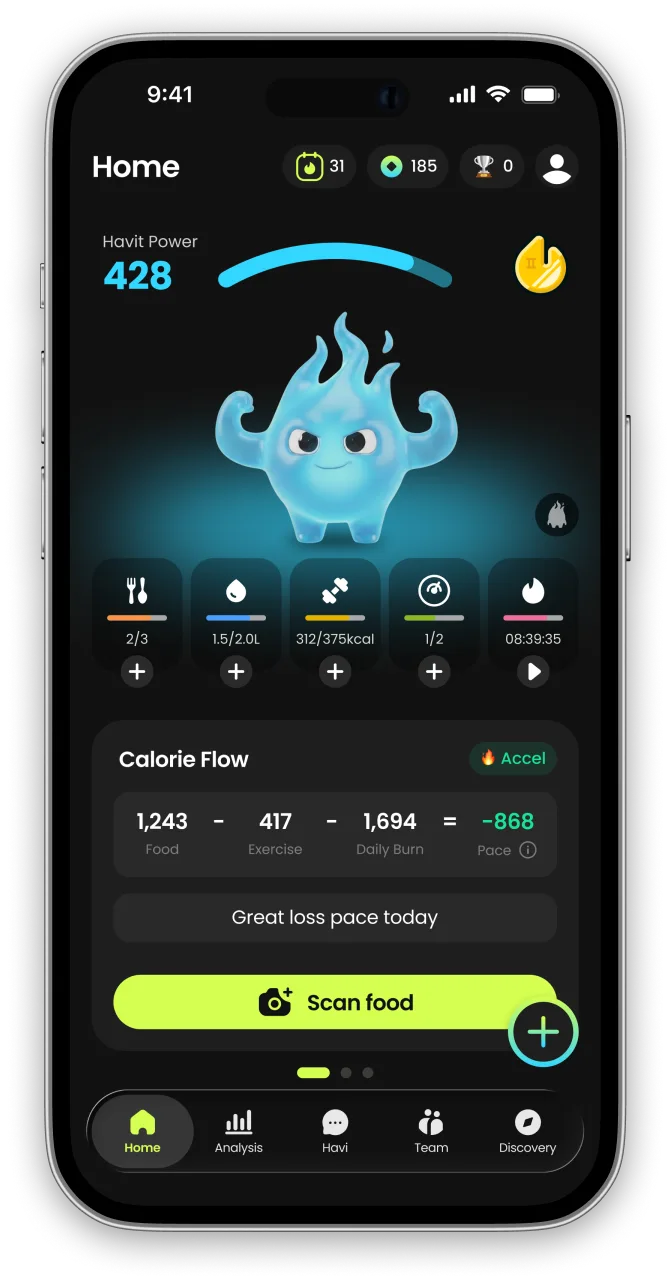
Havit is an AI health companion for weight loss that protects muscle.
Unlike calorie-only trackers, Havit connects AI body-composition estimates, nutrition, hydration, sleep, steps, cycle, mood, and GLP-1 medication in one daily routine — so progress is measured by body composition, not just the number on the scale. Daily missions turn established behavior-change techniques into small repeatable actions, drawing on expertise from professionals formerly at Juvis Diet, one of Korea’s leading metabolic clinics.
In Havit’s own analysis of 1,090 GLP-1 users, people who logged consistently built stronger habits than the general user base. Read the GLP-1 Habit Report
Havit works with or without GLP-1 medication. It is a wellness app, not a medical device; body-composition results are estimates.

Continue in the App
Personalized wellness with your own data


References
- Dose-Response Relationship Between Dietary Fiber Intake and Subjective Appetite Ratings — Journal of Nutrition, 2024
- Dietary Fiber and Weight Management: A Systematic Review and Meta-Analysis — Appetite, 2025
- Viscous Dietary Fibers and Appetite Control: Mechanisms and Clinical Evidence — Nutrition Reviews, 2024
- Dietary Guidelines for Americans 2025-2030: Fiber Intake Recommendations — USDA/HHS, 2025


