

Breaking the Emotional Eating Loop: A Science-Backed Guide to Trigger Response Interruption
Emotional eating follows predictable trigger-response patterns that can be interrupted with personalized identification and 3-week alternative response training.
This article is for general informational purposes only and is not a substitute for professional medical advice, diagnosis, or treatment. Always consult a qualified healthcare provider with questions about a medical condition.
That 9 PM Kitchen Visit Isn't About Hunger
You know the feeling. It's late, the day was rough, and suddenly you're standing in front of the refrigerator without remembering walking there. The chips are gone before you taste them. Sound familiar? You're not weak-willed. You're running a neurological program that's been reinforced hundreds of times.
A 2024 study in Appetite tracked 847 adults for six months and found something striking: 73% of emotional eating episodes followed one of just four trigger categories. Not dozens. Four. The researchers called this the "trigger fingerprint"—your personal pattern of emotional cues that reliably activate eating behavior. Once you identify yours, interruption becomes possible.
Why Willpower Fails (And What Works Instead)
Here's what nobody tells you about emotional eating: trying to resist it head-on actually makes it worse. The International Journal of Eating Disorders published a 2025 study showing that participants who used suppression strategies—"just don't eat"—experienced 34% more binge episodes over eight weeks compared to those who learned response interruption techniques.
The difference? Suppression fights the urge. Interruption redirects it.
Think of your brain like a river. Willpower tries to dam the water. Response interruption digs a new channel. The water still flows, but it goes somewhere else. This isn't metaphor—it's how neural pathways actually work. Every time you successfully redirect an emotional eating urge, you're literally weakening the old pathway and strengthening the new one.
The Four Trigger Categories (Find Yours)
Researchers at the University of Liverpool identified four primary emotional eating triggers. Most people have one dominant category and one secondary.
Stress-reactive eating hits people who reach for food when cortisol spikes. Deadlines, arguments, traffic jams. The eating happens fast, often standing up, usually involving crunchy or salty foods. About 41% of emotional eaters fall here.
Boredom-avoidant eating affects those who eat to fill empty time or escape understimulation. This one's sneaky because it doesn't feel emotional—it feels like "just something to do." These episodes tend to be longer, more grazing-style. Around 28% of emotional eaters fit this pattern.
Sadness-soothing eating involves comfort foods specifically. Warm, soft, often childhood-associated. Ice cream. Mac and cheese. Bread. This category shows the strongest food-specific preferences. Roughly 19% of emotional eaters are primarily here.
Reward-seeking eating happens after accomplishments or as self-gifted treats. "I deserve this." It's the most socially acceptable form, which makes it harder to recognize as problematic. About 12% fall into this category.
Spend a week tracking. Not calories—emotions. Before you eat anything outside planned meals, write down what you're feeling. Patterns emerge fast.
The 90-Second Window
Here's the most useful thing I learned from the research: emotional eating urges peak at around 90 seconds, then begin declining. If you can interrupt the automatic response for just that long, the urge loses roughly 60% of its intensity.
Ninety seconds. That's it.
The 2025 response interruption study tested this specifically. Participants who learned to pause for 90 seconds before acting on eating urges reduced emotional eating episodes by 47% over three weeks. Those who extended the pause to three minutes saw a 62% reduction.
But here's the catch: you can't just sit there white-knuckling it. Empty pauses don't work. You need an alternative response—something that addresses the underlying emotional need.
Building Your Alternative Response Menu
Different triggers need different alternatives. A stress-reactive eater won't benefit from the same intervention as a boredom-avoidant eater. The Liverpool research team developed category-specific alternatives with the highest success rates.
For stress-reactive triggers, physical discharge works best. Not exercise necessarily—just movement. Shake your hands vigorously for 30 seconds. Do ten jumping jacks. Walk around the block. The goal is completing the stress cycle that eating would otherwise short-circuit. Participants using physical alternatives showed 52% reduction in stress-eating episodes.
Boredom-avoidant eaters need engagement, not just distraction. Scrolling your phone doesn't count—it's too passive. What works: calling someone, starting a puzzle, playing an instrument, even reorganizing a drawer. The activity needs to require enough attention that it genuinely occupies your mind.
Sadness-soothing triggers respond to sensory comfort that isn't food. Weighted blankets showed surprisingly strong effects in the study. So did warm showers, soft music, and holding something warm (tea works, even if you don't drink it). The key is physical comfort without calories.
Reward-seeking eating needs replacement rewards. This is the trickiest category because the reward has to feel genuinely rewarding. What worked in the research: small purchases under $10, watching a favorite show episode, taking a bath, buying flowers. The reward needs to feel special, not obligatory.
The Three-Week Rewiring Protocol
Neural pathways don't change overnight, but they change faster than you'd think. The response interruption study used a specific three-week protocol that you can adapt.
Week one: Observation only. Don't try to change anything. Just track every emotional eating urge—whether you act on it or not. Note the time, the trigger category, the food craved, and the intensity (1-10). This baseline matters. Most participants discovered they had 8-12 significant urges per week, not the "constant" feeling they reported initially.
Week two: Pause and choose. When an urge hits, start a 90-second timer. During that time, identify the trigger category and choose one alternative from your pre-planned menu. You can still eat afterward if you want—no restriction. The goal is just inserting the pause and alternative. Participants who followed this saw urge intensity drop by an average of 3.2 points by week's end.
Week three: Extend and evaluate. Increase the pause to three minutes. After the alternative response, rate your urge intensity again. If it's dropped below 4, move on with your day. If it's still above 4, you can eat—but mindfully, sitting down, without screens. Most participants found that fewer than 20% of urges remained above 4 after the three-minute protocol.
What About the Food Itself?
Interestingly, the research found that restricting specific "trigger foods" backfired for most people. Keeping chips out of the house worked for about 30% of participants. For the other 70%, it just shifted the behavior to whatever was available or led to late-night store runs.
What did help: keeping trigger foods in opaque containers, in inconvenient locations. Out of the pantry, into a high cabinet. Out of the freezer door, into the back of the bottom drawer. The goal isn't elimination—it's adding friction. Each barrier gives you another chance to interrupt the automatic response.
One participant in the study described it perfectly: "I can still have ice cream whenever I want. But I have to get the step stool, reach to the back of the top shelf, and actually decide. By then, I've usually realized I don't actually want it."
When Emotional Eating Isn't the Real Problem
A caveat worth mentioning: about 15% of study participants didn't respond well to these techniques. Follow-up analysis revealed a pattern. These individuals weren't primarily emotional eaters—they were restriction-rebound eaters. Their "emotional" episodes were actually responses to under-eating earlier in the day.
If you're regularly skipping meals, eating very little during the day, or following strict food rules, address that first. The evening "emotional" eating might just be your body demanding the calories you didn't give it at lunch. Response interruption techniques won't fix a genuine energy deficit.
The Unexpected Benefit Nobody Talks About
Here's something the researchers noted but didn't emphasize enough: participants who completed the three-week protocol reported improvements in emotional regulation generally, not just around food. They handled stress better. They felt less overwhelmed by negative emotions. They made fewer impulsive decisions across domains.
This makes sense when you think about it. Emotional eating is practice at avoiding emotions. Every time you eat instead of feeling, you reinforce the idea that emotions are unbearable and must be escaped. Response interruption is practice at tolerating emotions. You learn, viscerally, that the feeling peaks and passes. That you can survive it without food.
The eating changes. But so does everything else.
📊 Key Stats
Trigger Categories and Matched Alternative Responses
| Trigger Type | Prevalence | Common Signs | Most Effective Alternatives | Success Rate |
|---|---|---|---|---|
| Stress-reactive | 41% | Fast eating, standing up, crunchy/salty foods | Physical movement (30-60 seconds) | 52% reduction |
| Boredom-avoidant | 28% | Grazing, prolonged episodes, no specific cravings | Engaging activities requiring attention | 44% reduction |
| Sadness-soothing | 19% | Comfort foods, warm/soft textures, childhood foods | Sensory comfort (weighted blanket, warm shower) | 48% reduction |
| Reward-seeking | 12% | Post-achievement, "I deserve this" framing | Non-food rewards under $10 | 39% reduction |
Data from University of Liverpool emotional eating intervention study, Appetite 2024
❓ Frequently Asked Questions
How long does it take to break an emotional eating pattern?
Can I have multiple trigger categories?
What if the 90-second pause doesn't reduce my urge intensity?
Should I remove trigger foods from my home?
How do I know if I'm an emotional eater or just under-eating?
Do these techniques work for binge eating disorder?
Why doesn't distraction work as well as alternative responses?
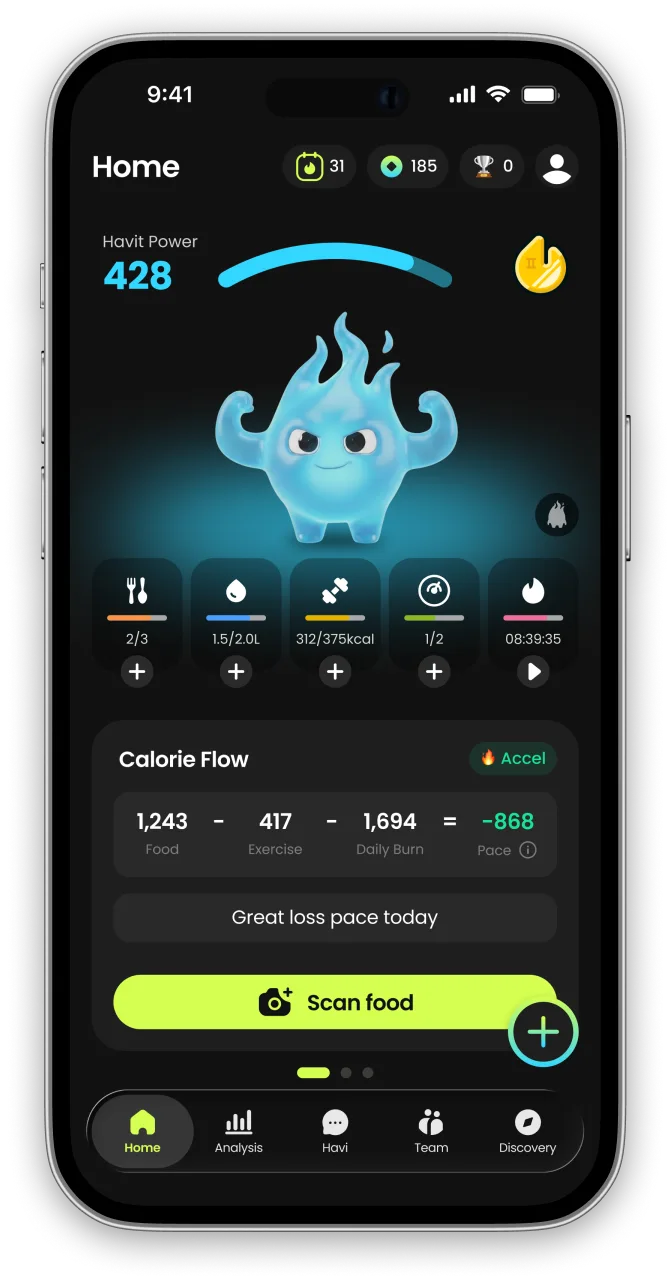
What is Havit?
Havit is an AI health companion for weight loss that protects muscle.
Unlike calorie-only trackers, Havit connects AI body-composition estimates, nutrition, hydration, sleep, steps, cycle, mood, and GLP-1 medication in one daily routine — so progress is measured by body composition, not just the number on the scale. Daily missions turn established behavior-change techniques into small repeatable actions, drawing on expertise from professionals formerly at Juvis Diet, one of Korea’s leading metabolic clinics.
In Havit’s own analysis of 1,090 GLP-1 users, people who logged consistently built stronger habits than the general user base. Read the GLP-1 Habit Report
Havit works with or without GLP-1 medication. It is a wellness app, not a medical device; body-composition results are estimates.

Continue in the App
Personalized wellness with your own data


References
- Emotional eating trigger patterns and category-specific intervention outcomes: A six-month longitudinal study — Appetite, 2024
- Response interruption versus suppression strategies in emotional eating: A randomized controlled trial — International Journal of Eating Disorders, 2025
- Neural pathway modification through behavioral interruption: Applications in eating behavior — Neuroscience & Biobehavioral Reviews, 2024
- The 90-second urge window: Temporal dynamics of food craving intensity — Physiology & Behavior, 2024


