

Cognitive Load and Habit Stacking: Finding Your Personal Capacity Limit in 2026
Your brain has a measurable habit adoption capacity—knowing yours prevents burnout and dramatically improves success rates.
This article is for general informational purposes only and is not a substitute for professional medical advice, diagnosis, or treatment. Always consult a qualified healthcare provider with questions about a medical condition.
My Friend Sarah Adopted Six Habits in January. I Could Barely Manage One.
She started meditating, journaling, cold showers, 10,000 steps, meal prepping, and a 6 AM wake-up time. All at once. By March, all six had stuck. Meanwhile, I tried adding just a daily walk and failed spectacularly by week three.
For years, I thought this was about willpower. She had it. I didn't. Simple.
Turns out, I was wrong. The real difference? Cognitive load capacity—and it varies wildly from person to person.
What Cognitive Load Actually Means for Habit Formation
Your brain treats every new habit like a program running in the background. Each one consumes processing power until it becomes automatic. The catch: we don't all have the same amount of RAM.
Behavioural Brain Research published a fascinating study in 2025 examining 847 participants attempting to form multiple habits simultaneously. The researchers found that individual cognitive load capacity—essentially how much mental bandwidth someone has available for new behaviors—predicted habit success better than motivation, personality type, or past habit history.
The numbers surprised everyone. Some participants successfully automated five new behaviors in eight weeks. Others maxed out at one. The average sat around 2.3 simultaneous habits, but that average masked enormous individual variation.
Think of it like computer memory. Some people are running a MacBook Pro with 64GB of RAM. Others are working with an older laptop that struggles with three browser tabs. Neither is wrong. But the person with limited capacity trying to run five programs will crash.
The Bandwidth Buckets: Where Does Your Capacity Go?
Health Psychology Review's 2024 analysis of multiple behavior change identified four main drains on habit formation bandwidth:
Active stress load consumed the largest share. Someone navigating a divorce, job change, or health crisis had 40-60% less available capacity than someone in a stable period. This isn't weakness—it's basic neuroscience. Stress hormones literally reduce prefrontal cortex function.
Existing habit complexity mattered too. A person maintaining zero current health habits had more available bandwidth than someone already managing a complex medication schedule, specific diet, and exercise routine. Counterintuitive, right? But adding to an already-full plate requires more cognitive coordination.
Sleep quality acted as a multiplier. Participants averaging under six hours showed roughly half the habit formation capacity of those getting seven-plus hours. One researcher described sleep as "the interest rate on your cognitive loan."
Decision fatigue from other life domains rounded out the picture. A parent making hundreds of daily childcare decisions had less remaining capacity than someone with fewer daily choices. A CEO making constant high-stakes calls had less than an entry-level employee with a predictable routine.
Finding Your Personal Number
Here's a practical framework I've adapted from the research. Grab a pen.
Start with a baseline of 3 (the rough population median for simultaneous habit capacity).
Subtract 1 if you're currently experiencing significant life stress—job uncertainty, relationship issues, health concerns, financial pressure, or major life transitions.
Subtract 1 if you're already maintaining three or more intentional health behaviors. Yes, this seems backward, but coordination costs are real.
Subtract 1 if you consistently sleep under 6.5 hours.
Subtract 1 if your job or life circumstances require constant decision-making throughout the day.
Add 1 if you've successfully formed multiple habits before (you may have naturally higher capacity).
Add 1 if you have significant unstructured time in your schedule.
Your number lands somewhere between 0 and 5. Zero doesn't mean you can't form habits—it means you should focus on one extremely simple behavior and consider addressing capacity drains before adding more.
Why Traditional Habit Stacking Often Fails
James Clear popularized habit stacking—linking a new behavior to an existing one. "After I pour my morning coffee, I will meditate for two minutes." Elegant. Effective. Widely recommended.
But here's what most advice misses: stacking multiple habits simultaneously creates exponential, not linear, cognitive load.
The 2025 Behavioural Brain Research study quantified this. Adding a second simultaneous habit didn't double cognitive load—it increased it by roughly 2.4x. A third habit? 3.1x the load of one habit alone. The researchers attributed this to "coordination overhead"—the mental energy required to track multiple new behaviors and their triggers.
This explains why ambitious January resolutions so often collapse as a unit. You're not failing at five separate things. You're failing at one impossible thing: managing five times the cognitive load your brain can handle.
The Serial Success Strategy
If your capacity number came out low, serial habit formation beats parallel attempts every time.
The research suggests waiting until a habit reaches roughly 80% automaticity before adding another. How do you know when you're there? When you do the behavior without consciously deciding to. When skipping it feels stranger than doing it. When you stop congratulating yourself afterward.
For most people, this takes 6-10 weeks per habit, not the often-cited 21 days. The 21-day myth came from a 1960 observation about amputees adjusting to phantom limbs—not habit formation research.
Sarah, my friend with the six simultaneous habits? I eventually learned she'd spent the previous year building foundational behaviors one at a time. By January, she wasn't starting from zero. She had massive available bandwidth because her existing habits ran on autopilot.
Capacity Isn't Fixed—Here's How to Expand It
The good news: cognitive load capacity responds to intervention. Not overnight, but measurably.
Sleep optimization offers the fastest returns. Participants in the Health Psychology Review analysis who improved sleep from under six hours to over seven showed capacity increases within two weeks. Not months. Weeks.
Stress reduction helps, but indirectly. Meditation, therapy, exercise, social support—anything that lowers baseline cortisol frees up bandwidth. One study found that eight weeks of regular meditation practice increased habit formation capacity by roughly 0.7 habits.
Automating existing decisions creates surprising space. Meal planning, capsule wardrobes, automated bill payments—each eliminated decision preserves capacity for new habits. This is why successful habit-formers often seem boring. They've deliberately reduced novelty in some areas to create bandwidth for intentional change in others.
Environmental design reduces the cognitive cost of individual habits. A visible yoga mat, pre-packed gym bag, and phone charging in another room all lower the mental energy required for their associated behaviors. Lower cost per habit means higher total capacity.
The Capacity-Adjusted Approach in Practice
Let's say you want to exercise regularly, eat more vegetables, meditate, and read before bed. Four habits. Your calculated capacity is 2.
Traditional approach: Start all four January 1st. Fail at all four by February.
Capacity-adjusted approach: Start with exercise only—it has the largest downstream benefits on mood, energy, and sleep. Spend 8 weeks building automaticity. Add meditation in March, which synergizes with exercise for stress reduction. By May, add vegetables. Save reading for summer when work stress typically decreases.
Same four habits. Different timeline. Dramatically different success probability.
The 2024 Health Psychology Review found that capacity-matched habit formation showed 73% success rates at one year versus 14% for capacity-exceeding attempts. That's not a marginal improvement. That's the difference between transformation and frustration.
When to Break the Rules
Some habits synergize so strongly that bundling them costs less than separating them. Exercise and improved sleep. Meditation and reduced stress eating. Reading and reduced screen time.
The research calls these "complementary clusters"—behaviors that share underlying mechanisms and reinforce each other. Adopting them together can actually require less total cognitive load than adopting them separately.
How do you identify clusters? Look for habits that address the same underlying need or that naturally create conditions for each other. Morning exercise makes early bedtime easier. Meal prepping reduces decision fatigue that undermines other habits. Meditation builds the self-awareness that supports all behavior change.
Sarah's six habits weren't random. They formed two tight clusters: a morning routine cluster (wake-up, meditation, cold shower) and a health cluster (steps, meal prep, journaling). Three habits, really, if you count clusters.
Your Capacity Changes—Track It
This isn't a one-time assessment. Life circumstances shift. Stress rises and falls. Sleep quality varies. Your capacity number changes with them.
During a work crisis last year, my capacity dropped to essentially zero. Trying to maintain my existing habits felt overwhelming. I scaled back to just one: a daily walk. Everything else went on pause.
Three months later, the crisis passed. Capacity returned. I rebuilt.
This isn't failure. This is intelligent resource management. Knowing when to contract is as important as knowing when to expand.
The goal isn't maximum habits. It's sustainable progress matched to your actual, current capacity. Some months that's aggressive expansion. Some months it's maintenance. Some months it's strategic retreat.
Your brain isn't broken if you can't adopt five habits at once. It's working exactly as designed—with finite resources that require thoughtful allocation. Honor that limit, and those limits become launchpads.
📊 Key Stats
Habit Formation Approaches Compared
| Factor | Parallel Approach | Serial Approach | Capacity-Matched Approach |
|---|---|---|---|
| Starting multiple habits | All at once | One at a time | Based on personal capacity score |
| Cognitive load | Exponential increase | Linear increase | Optimized to individual bandwidth |
| Typical 1-year success rate | 14% | 45% | 73% |
| Time to form 4 habits | Attempts in 2 months | 8-10 months | 6-12 months depending on capacity |
| Stress period adjustment | None | Pause new additions | Active capacity recalculation |
| Best for | High-capacity individuals | Low-capacity or high-stress periods | Everyone seeking sustainable change |
Data synthesized from Behavioural Brain Research 2025 and Health Psychology Review 2024
❓ Frequently Asked Questions
How do I know if I have high or low cognitive load capacity?
Can I increase my cognitive load capacity over time?
Why does adding a second habit more than double the cognitive load?
How long should I wait before adding a new habit?
What are complementary habit clusters?
Should I abandon all habits during high-stress periods?
Why do some people seem to adopt many habits easily?
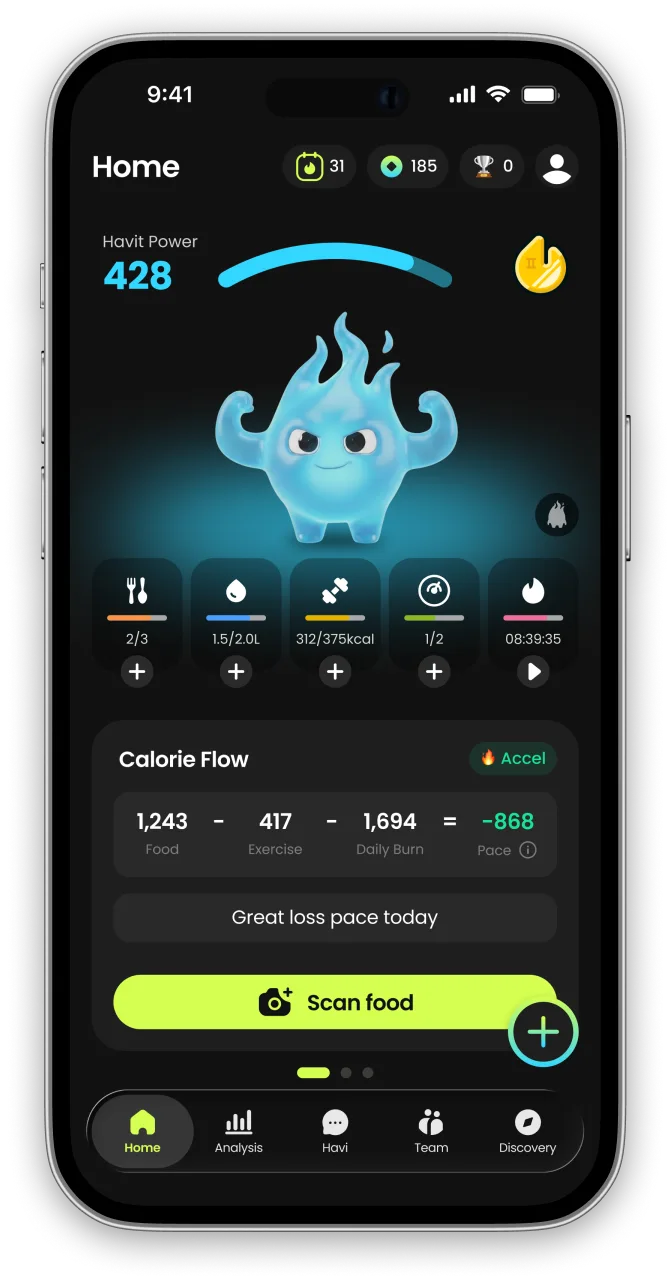
What is Havit?
Havit is an AI health companion for weight loss that protects muscle.
Unlike calorie-only trackers, Havit connects AI body-composition estimates, nutrition, hydration, sleep, steps, cycle, mood, and GLP-1 medication in one daily routine — so progress is measured by body composition, not just the number on the scale. Daily missions turn established behavior-change techniques into small repeatable actions, drawing on expertise from professionals formerly at Juvis Diet, one of Korea’s leading metabolic clinics.
In Havit’s own analysis of 1,090 GLP-1 users, people who logged consistently built stronger habits than the general user base. Read the GLP-1 Habit Report
Havit works with or without GLP-1 medication. It is a wellness app, not a medical device; body-composition results are estimates.
Continue in the App
Personalized wellness with your own data


References
- Cognitive Load Dynamics in Multiple Habit Formation: Individual Differences and Predictive Factors — Behavioural Brain Research, 2025
- Multiple Health Behavior Change: Capacity Limits and Optimization Strategies — Health Psychology Review, 2024
- The Coordination Costs of Simultaneous Behavior Change — Journal of Experimental Psychology: Applied, 2024
- Sleep and Executive Function in Habit Formation — Neuroscience & Biobehavioral Reviews, 2025


