

Body Recomposition in a Calorie Deficit: When You Can Actually Build Muscle While Losing Fat
Body recomposition is real but requires a modest deficit (300-500 calories), high protein (1.6-2.2g/kg), resistance training, and works best for beginners or those returning after a break.
This article is for general informational purposes only and is not a substitute for professional medical advice, diagnosis, or treatment. Always consult a qualified healthcare provider with questions about a medical condition.
The Question That Launches a Thousand Reddit Arguments
Your gym buddy swears it's impossible. Your favorite fitness influencer claims they did it in 8 weeks. Your cousin's trainer says you need to bulk first, then cut. So what's the actual truth about building muscle while losing fat?
Here's the short version: it's real, it's documented in peer-reviewed research, and it happens more often than the "pick one" crowd admits. But—and this is crucial—it doesn't work for everyone, and the conditions matter enormously.
I spent three weeks diving into the latest research, including a 2024 systematic review in Sports Medicine that analyzed 32 studies on body recomposition. What I found surprised me. The science is clearer than the internet debates suggest.
Why Everyone Thinks This Is Impossible
The logic seems airtight at first glance. Building muscle requires a caloric surplus—extra energy to synthesize new tissue. Losing fat requires a caloric deficit—burning more than you consume. These appear mutually exclusive, like trying to fill and empty a bathtub simultaneously.
But this framing misses something important. Your body isn't a simple bank account. It's a complex system with multiple energy substrates. When you eat protein and lift weights, you trigger muscle protein synthesis. When you're in a deficit, your body can tap stored fat to fuel that process.
The key insight: you need an energy surplus for muscle growth, but that surplus doesn't have to come from your fork. It can come from your fat cells.
A 2025 study in the Journal of Strength and Conditioning Research tracked 47 recreational lifters through a 12-week deficit. The group eating 2.0g of protein per kilogram of body weight gained an average of 1.3kg of lean mass while losing 4.2kg of fat. Same deficit, same training program—just more protein than the comparison group eating 1.2g/kg.
The Four Conditions That Make Recomposition Actually Work
Not everyone can pull this off. The research points to four overlapping populations where body recomposition consistently succeeds:
Beginners to resistance training. If you've never lifted seriously, your muscles are primed for growth. They'll respond to almost any stimulus. A 2024 meta-analysis found that untrained individuals in a moderate deficit gained muscle at roughly 60% the rate of those in a surplus. That's not nothing.
People returning after a layoff. Muscle memory is real. The nuclei added during previous training stick around, making regrowth faster than initial growth. Someone who lifted for years, took two years off, and gained 15 pounds can absolutely lose fat and regain muscle simultaneously.
People with higher body fat percentages. If you're carrying substantial fat stores, your body has abundant energy reserves to tap. A 2023 study found that participants starting above 25% body fat achieved recomposition at nearly double the rate of leaner subjects.
Those using optimized protocols. Even intermediate lifters can achieve modest recomposition with the right approach. It's slower, the gains are smaller, but it happens.
The Deficit Sweet Spot: Why 500 Calories Is Your Ceiling
Go too aggressive and you'll sabotage muscle growth. A 1,000-calorie deficit might accelerate fat loss, but it tanks testosterone, spikes cortisol, and leaves insufficient energy for recovery.
The research converges on 300-500 calories below maintenance as the recomposition zone. One telling study compared three groups: 250-calorie deficit, 500-calorie deficit, and 750-calorie deficit. All three lost similar amounts of fat over 10 weeks. But only the first two groups gained any muscle. The 750-calorie group actually lost lean mass despite adequate protein and consistent training.
Here's a practical way to think about it. If your maintenance is 2,400 calories, aim for 1,900-2,100. You'll lose roughly 0.5-1 pound per week. Slower than you want? Probably. But you'll look better at the end than someone who crashed their calories and lost muscle along with fat.
Protein: The Non-Negotiable Variable
Every successful recomposition study shares one feature: protein intake at the higher end of recommendations. We're talking 1.6-2.2 grams per kilogram of body weight daily. For a 180-pound person, that's 130-180 grams.
Why so high? In a deficit, protein serves double duty. It provides amino acids for muscle protein synthesis and it protects existing muscle from breakdown. Skimp on protein and your body will cannibalize muscle tissue for energy.
The timing matters less than total intake, but spreading protein across 4-5 meals seems to optimize muscle protein synthesis. A 2024 study found that 40 grams per meal, four times daily, outperformed 80 grams twice daily for lean mass retention—even though total protein was identical.
One practical tip: front-load your protein. Getting 40+ grams at breakfast sets up your amino acid levels for the day and tends to reduce overall hunger.
Training for Recomposition: Volume Over Intensity
You might assume that heavy, low-rep training is essential for building muscle in a deficit. The data suggests otherwise.
Moderate loads (65-80% of your one-rep max) with higher volume (more total sets) consistently outperform heavy loads with lower volume for recomposition. Why? Recovery. In a calorie deficit, your ability to recover from maximal efforts is compromised. You're better off doing more work at submaximal weights.
A practical framework: 3-4 resistance training sessions per week, 10-20 sets per muscle group weekly, rep ranges of 8-15. Progressive overload still matters—add weight or reps over time—but chasing PRs every session will burn you out.
Cardio? Keep it moderate. Excessive cardio in a deficit compounds the recovery problem. Two to three sessions of 20-30 minutes, or daily walking, supports fat loss without interfering with muscle growth.
The Timeline Reality Check
Recomposition is slow. Excruciatingly slow compared to dedicated bulking or cutting phases.
A realistic expectation for a beginner: 0.5-1 pound of muscle gained per month while losing 1-2 pounds of fat per week. After six months, you might be 12 pounds lighter with 3-5 pounds more muscle. The mirror shows dramatic changes, but the scale barely moves some weeks.
For intermediate lifters, halve those muscle gain expectations. You're looking at maybe 2-3 pounds of muscle over six months. Still worth it if you're not in a rush, but understand what you're signing up for.
The psychological challenge is real. You won't see rapid scale drops. You won't see rapid strength gains. You're playing a longer game.
When to Abandon Recomposition for Traditional Phases
Recomposition isn't always the optimal strategy. Sometimes you should just bulk or cut.
Bulk if: You're already lean (under 15% body fat for men, under 22% for women) and want to maximize muscle gain. The efficiency of muscle growth in a surplus is meaningfully higher.
Cut if: You're significantly overfat and your primary goal is health improvement. A steeper deficit with high protein will preserve most muscle while accelerating fat loss.
Recompose if: You're in the middle—neither very lean nor very overfat—and you're okay with slower progress in exchange for not having to go through distinct phases.
Competitive bodybuilders and athletes with deadlines typically avoid recomposition. The timeline is too unpredictable. But for most people training for general fitness and aesthetics? Recomposition often makes more sense than the bulk-cut-bulk-cut hamster wheel.
Tracking Progress Without Obsessing
The scale lies during recomposition. You can lose 2 pounds of fat and gain 1 pound of muscle in a month, and the scale shows only 1 pound lost. Discouraging if you don't understand what's happening.
Better metrics: progress photos every 2-4 weeks (same lighting, same time of day), how your clothes fit, strength trends in the gym, and waist measurements. If your waist is shrinking and your lifts are maintaining or improving, recomposition is working regardless of what the scale says.
One underrated approach: track your belt notch. It's crude, but it's honest. If you're tightening your belt while maintaining your bench press, you're recomposing.
The Practical 12-Week Protocol
Here's a straightforward approach based on the research:
Weeks 1-2: Find your maintenance calories by tracking intake and weight. Adjust until weight is stable.
Weeks 3-12: Reduce intake by 400 calories below maintenance. Hit 2.0g protein per kilogram daily. Lift 4 days per week with progressive overload. Walk 8,000+ steps daily. Sleep 7+ hours.
Monthly check-ins: Take photos, measurements, and note strength changes. If strength is dropping significantly, reduce the deficit by 100-150 calories. If fat loss stalls completely for 2+ weeks, add one cardio session or reduce intake slightly.
This isn't complicated. The challenge is consistency over months, not complexity of the program.
📊 Key Stats
Recomposition vs. Traditional Bulk/Cut Phases
| Factor | Recomposition | Bulk Then Cut | Cut Then Bulk |
|---|---|---|---|
| Timeline | 6-12+ months | 3-4 months each phase | 3-4 months each phase |
| Calorie approach | Small deficit (300-500) | Surplus then deficit | Deficit then surplus |
| Best for | Beginners, returners, higher body fat | Experienced lifters, competitors | Those prioritizing health first |
| Psychological demand | High (slow visible progress) | Moderate (clear phases) | Moderate (clear phases) |
| Muscle gain efficiency | Lower but continuous | Higher during bulk | Higher during bulk |
| Fat loss efficiency | Lower but continuous | Higher during cut | Immediate then paused |
Each approach works—the best choice depends on your starting point, timeline, and psychological preferences
❓ Frequently Asked Questions
How long does body recomposition take to see visible results?
Can intermediate or advanced lifters achieve body recomposition?
Do I need supplements for body recomposition?
What happens if I eat too little protein during recomposition?
Should I do cardio during body recomposition?
Why isn't the scale moving if I'm losing fat and gaining muscle?
Is body recomposition possible for women?
What is Havit?
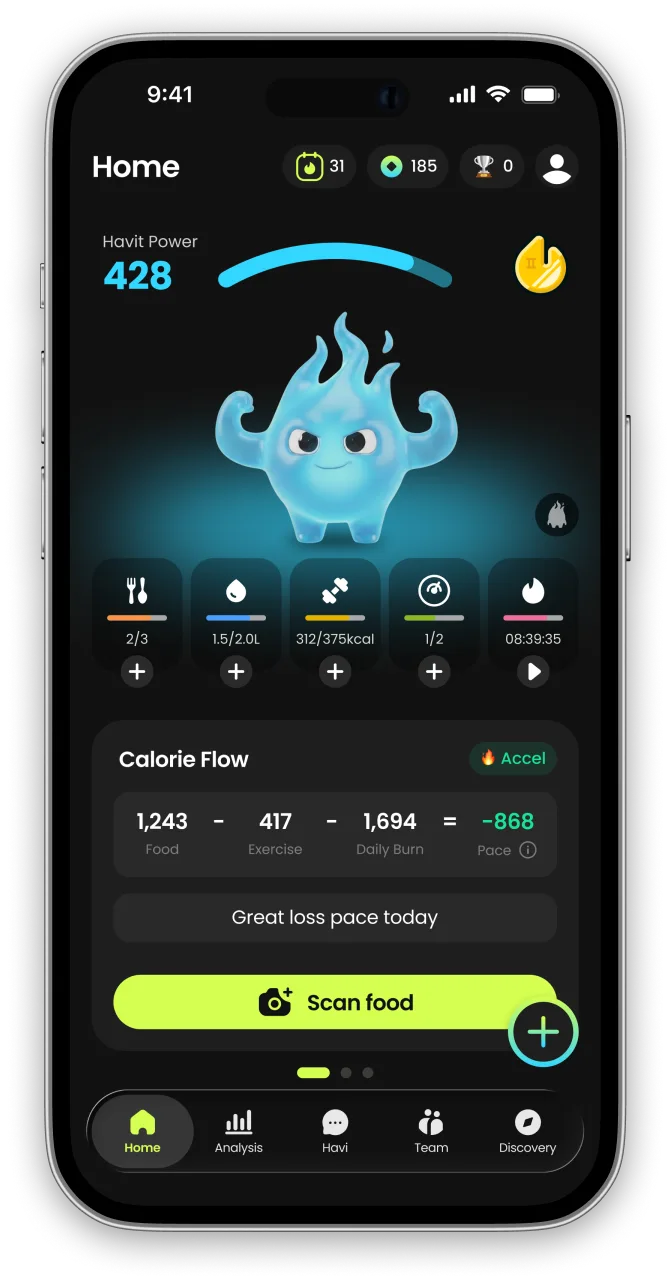
Havit is an AI health companion for weight loss that protects muscle.
Unlike calorie-only trackers, Havit connects AI body-composition estimates, nutrition, hydration, sleep, steps, cycle, mood, and GLP-1 medication in one daily routine — so progress is measured by body composition, not just the number on the scale. Daily missions turn established behavior-change techniques into small repeatable actions, drawing on expertise from professionals formerly at Juvis Diet, one of Korea’s leading metabolic clinics.
In Havit’s own analysis of 1,090 GLP-1 users, people who logged consistently built stronger habits than the general user base. Read the GLP-1 Habit Report
Havit works with or without GLP-1 medication. It is a wellness app, not a medical device; body-composition results are estimates.

Continue in the App
Personalized wellness with your own data


References
- Body Recomposition: Can Trained Individuals Build Muscle and Lose Fat at the Same Time? — Sports Medicine, 2024
- Effects of Protein Intake on Body Composition During Energy Restriction in Resistance-Trained Adults — Journal of Strength and Conditioning Research, 2025
- Concurrent Training and Nutritional Strategies to Promote Body Recomposition — Sports Medicine, 2024
- The Effect of Caloric Deficit Magnitude on Muscle Retention During Weight Loss — International Journal of Sport Nutrition and Exercise Metabolism, 2023


