

How to Exercise During an Autoimmune Flare Up: A Practical Scaling Protocol
Scale exercise intensity to 30-50% during flares, prioritize gentle movement over rest, and use morning stiffness duration as your daily guide.
This article is for general informational purposes only and is not a substitute for professional medical advice, diagnosis, or treatment. Always consult a qualified healthcare provider with questions about a medical condition.
Your Body Isn't Betraying You—It's Sending Signals
Three days ago, you crushed a workout. Today, your joints feel like they're filled with sand and your fatigue has a weight to it. Sound familiar? If you live with an autoimmune condition, this whiplash between capability and limitation isn't weakness. It's biology.
Here's what most fitness advice gets wrong: it treats flares like injuries that require complete rest. But emerging research tells a different story. A 2024 analysis in Autoimmunity Reviews found that people who maintained modified movement during flares experienced 23% shorter flare duration compared to those who stopped all activity. The key word is modified.
This isn't about pushing through. It's about scaling intelligently.
The Inflammation-Exercise Paradox Nobody Explains
Exercise creates inflammation. Autoimmune flares are inflammation. So exercise during a flare must be terrible, right?
Not exactly. The type of inflammation matters enormously. Exercise-induced inflammation (acute, localized, resolving within hours) actually helps regulate the chronic systemic inflammation driving your flare. A 2025 study in Arthritis Care Research tracked 847 participants with rheumatoid arthritis and found that those who performed 15-20 minutes of gentle movement daily during flares had lower inflammatory markers (specifically CRP and IL-6) than the complete-rest group by day seven.
Think of it like this: your immune system is a fire. Complete rest lets it smolder unpredictably. Gentle movement acts like a controlled burn—channeling that inflammatory energy into a productive pathway.
But there's a threshold. Cross it, and you're pouring gasoline.
The Morning Stiffness Rule: Your Daily Intensity Calculator
Forget heart rate zones during a flare. Your most reliable guide is already built into your morning routine.
Morning stiffness duration correlates directly with systemic inflammation levels. Researchers at Johns Hopkins developed a practical scaling system based on this:
Under 30 minutes of stiffness: Scale to 60-70% of your normal intensity. You can do modified versions of your regular workouts.
30-60 minutes of stiffness: Scale to 40-50%. Swap resistance training for mobility work. Swap running for walking. Swap HIIT for gentle yoga.
Over 60 minutes of stiffness: Scale to 20-30%. This is gentle movement only—think 10-minute walks, seated stretching, or water-based activity.
Over 90 minutes of stiffness: Consult your rheumatologist. Movement should be limited to basic daily activities.
One participant in the Arthritis Care Research study described it perfectly: "I stopped asking 'can I work out today?' and started asking 'what can my body do today?' The question change was everything."
Movement Swaps That Actually Work
Generic advice says "do gentle exercise." That's about as helpful as telling someone with insomnia to "just sleep." Here are specific swaps based on what your normal routine looks like:
If you normally run: Walk at 50-60% of your running pace. A 9-minute-mile runner drops to a 15-18 minute mile walk. Water jogging is even better—the hydrostatic pressure actually reduces joint swelling.
If you lift weights: Drop to 40% of your working weight and focus on time under tension rather than load. A 2024 study found that slow eccentric movements (4-second lowering phases) at light weights produced similar muscle-preservation benefits without the inflammatory spike of heavy lifting.
If you do HIIT: Replace it entirely with steady-state movement at conversational pace. Your heart rate should stay below 65% of max. If you can't comfortably talk in full sentences, you're going too hard.
If you do yoga: Avoid deep backbends and long-held poses that stress joints. Supported restorative poses with props are ideal. A bolster and two blocks can transform an inflammatory practice into an anti-inflammatory one.
If you swim: Keep it. Swimming is the closest thing to a universal flare-safe activity. The buoyancy eliminates 90% of joint loading while the cool water can actually reduce local inflammation.
The 48-Hour Lookback Test
Here's a pattern I've seen repeatedly: someone feels okay during a flare, does a moderate workout, feels fine immediately after, then crashes hard 36-48 hours later. This delayed response is called post-exertional malaise, and it's your immune system's lag time in processing the additional stress.
Before any workout during a flare, ask yourself: "How did I feel 48 hours after my last similar workout?"
If you felt worse—scale down further than you think you need to. The research supports this conservative approach. The Autoimmunity Reviews analysis found that participants who scaled down preemptively had 34% fewer severe flare days than those who waited until symptoms forced them to stop.
Your body keeps receipts. Check them before you spend more energy.
The Non-Negotiables: What to Protect During Every Flare
Some movement patterns matter more than others when you're inflamed. Prioritize these three, even on your worst days:
Spinal mobility: Five minutes of gentle cat-cow movements and seated twists. Spinal stiffness during flares can cascade into compensatory patterns that cause secondary pain. Keeping your spine mobile prevents this domino effect.
Hip circles: Your hips are the largest joints in your body and often the first to stiffen during systemic inflammation. Lying hip circles (10 each direction, each leg) take two minutes and preserve the range of motion that's hardest to regain.
Diaphragmatic breathing: This isn't woo-woo. Deep belly breathing activates your vagus nerve, which directly modulates immune response. A 2023 study found that 10 minutes of slow breathing (5-second inhale, 5-second exhale) reduced inflammatory cytokines by 17% in participants with lupus.
These three things take 15 minutes total. On days when that's all you can manage, that's enough.
When to Skip Entirely: The Hard Stop Signals
Scaling works most of the time. But some signals mean stop completely:
Fever over 100.4°F (38°C): Your immune system is in active battle. Exercise diverts resources it needs.
New or worsening joint swelling: Visible swelling indicates acute inflammation that movement can worsen. Wait until swelling stabilizes.
Shortness of breath at rest: This could indicate cardiac or pulmonary involvement, which some autoimmune conditions can cause. See your doctor before exercising.
Medication changes in the last 72 hours: New immunosuppressants or steroids alter how your body responds to exercise stress. Give your system time to adjust.
These aren't failures. They're intelligent responses to real biological signals.
Building Back: The 10% Rule After Flares Resolve
The flare has passed. Your morning stiffness is under 15 minutes. You feel like yourself again. The temptation is to jump back to your pre-flare routine immediately.
Resist it.
The 10% rule exists for good reason: increase your exercise volume or intensity by no more than 10% per week after a flare resolves. A two-week flare means at least three weeks of gradual rebuilding to return to baseline.
This feels slow. It is slow. But the alternative—triggering a rebound flare—costs you far more time. The Arthritis Care Research data showed that participants who rushed back to full intensity had a 41% higher rate of secondary flares within 30 days.
Patience isn't passive. It's strategic.
Your Flare Movement Toolkit
Keep these ready for when flares hit:
- A yoga mat and bolster for supported floor work
- Resistance bands (light—think rehab weight, not strength training)
- Access to a pool or bathtub deep enough for water movement
- A timer for breathing exercises
- A simple tracking method (even just notes on your phone) to log morning stiffness duration and post-exercise response
The tracking matters more than you'd think. After three flares, patterns emerge. You'll start to predict which activities your body tolerates and which ones cost you. That personalized data becomes your most valuable tool.
Moving through a flare isn't about maintaining your fitness identity. It's about maintaining your relationship with movement itself—proving to your body that exercise can be safe, even when everything feels uncertain. That trust, rebuilt flare after flare, is what keeps you moving for decades.
📊 Key Stats
Exercise Intensity Scaling by Morning Stiffness Duration
| Morning Stiffness | Intensity Scale | Recommended Activities | Avoid |
|---|---|---|---|
| Under 30 min | 60-70% | Modified regular workouts, light resistance | Heavy lifting, high-impact cardio |
| 30-60 min | 40-50% | Walking, mobility work, gentle yoga | Running, HIIT, weight training |
| 60-90 min | 20-30% | 10-min walks, seated stretching, pool movement | Most structured exercise |
| Over 90 min | Minimal | Basic daily activities only | All structured exercise—consult doctor |
Based on Johns Hopkins flare management protocols and Arthritis Care Research 2025 guidelines
❓ Frequently Asked Questions
Should I exercise at all during an autoimmune flare?
How do I know if I'm exercising too hard during a flare?
What's the best exercise during an autoimmune flare?
Can exercise trigger or worsen an autoimmune flare?
How long should I wait to return to normal exercise after a flare?
Is morning stiffness really a reliable guide for exercise intensity?
What are the warning signs to stop exercising completely during a flare?
What is Havit?
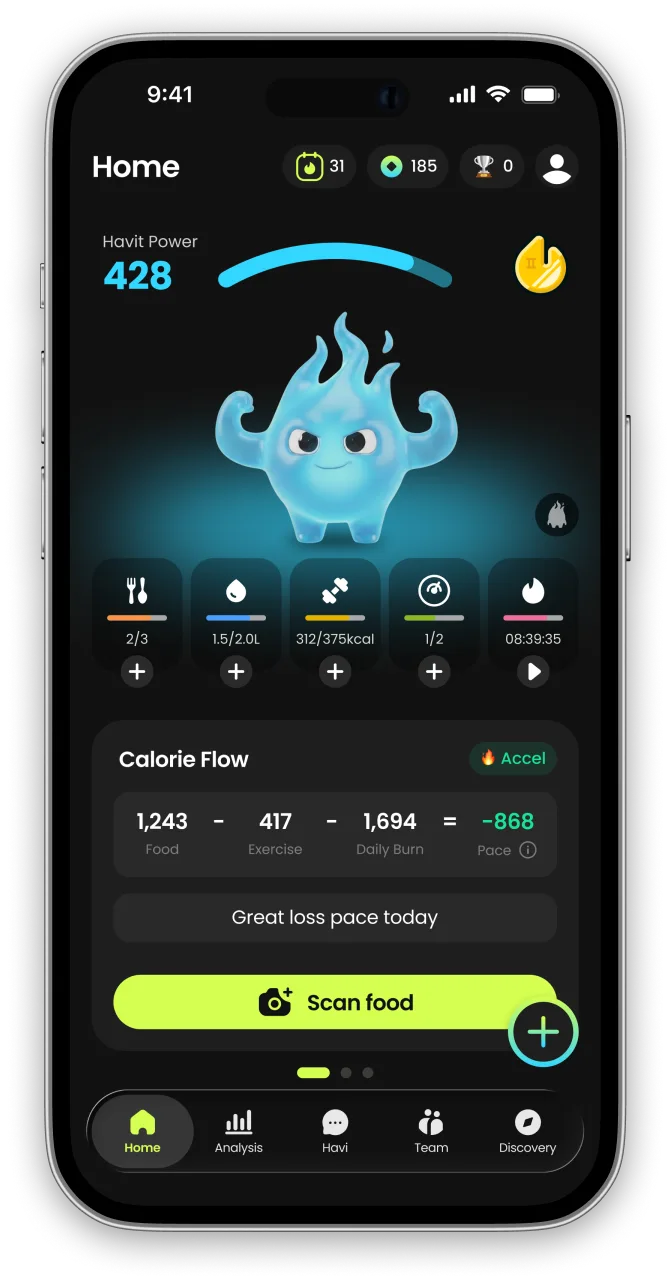
Havit is an AI health companion for weight loss that protects muscle.
Unlike calorie-only trackers, Havit connects AI body-composition estimates, nutrition, hydration, sleep, steps, cycle, mood, and GLP-1 medication in one daily routine — so progress is measured by body composition, not just the number on the scale. Daily missions turn established behavior-change techniques into small repeatable actions, drawing on expertise from professionals formerly at Juvis Diet, one of Korea’s leading metabolic clinics.
In Havit’s own analysis of 1,090 GLP-1 users, people who logged consistently built stronger habits than the general user base. Read the GLP-1 Habit Report
Havit works with or without GLP-1 medication. It is a wellness app, not a medical device; body-composition results are estimates.

Continue in the App
Personalized wellness with your own data


References
- Exercise and Inflammation in Autoimmune Disease: A Systematic Review — Autoimmunity Reviews, 2024
- Flare Management Protocols and Physical Activity Outcomes in Rheumatoid Arthritis — Arthritis Care Research, 2025
- Vagal Modulation Through Breathing Exercises in Systemic Lupus Erythematosus — Journal of Psychosomatic Research, 2023
- Post-Exertional Response Patterns in Inflammatory Arthritis — Rheumatology International, 2024


