

Your Hunger Hormones Follow a Schedule: How to Design Meals Around Your Ghrelin-Leptin Pattern
Your appetite hormones peak and dip on a predictable schedule—align your meals to this rhythm and hunger stops being a battle.
This article is for general informational purposes only and is not a substitute for professional medical advice, diagnosis, or treatment. Always consult a qualified healthcare provider with questions about a medical condition.
That 3 PM Snack Attack Isn't a Willpower Problem
You've eaten a reasonable lunch. You're not actually hungry. But something in your body is screaming for chips, chocolate, anything. Here's what's really happening: your ghrelin levels just hit their afternoon spike, and your leptin—the hormone that tells you you're full—is taking a nap.
This isn't weakness. It's biology on a schedule.
A 2025 study in Nature Metabolism tracked 847 participants over 12 weeks and found something remarkable. Hunger hormone patterns vary wildly between individuals, but each person's pattern stays remarkably consistent day after day. Your 3 PM crash might be someone else's 11 AM crisis. The key isn't fighting these rhythms—it's mapping them and building meals around what your body actually does.
Ghrelin and Leptin: The Push-Pull of Appetite
Think of ghrelin as your stomach's alarm clock. It rises when your body expects food, peaks right before meals, and drops after eating. Leptin works the opposite direction—it's released by fat cells to signal "enough, we're good here."
Most people assume these hormones respond simply to food intake. Eat more, feel fuller. But the Cell Reports Medicine research from 2024 revealed something more nuanced. Your hormone patterns are shaped by genetics, sleep timing, stress exposure, and even the light you're exposed to in the morning.
One participant in the study, a 34-year-old software developer, had ghrelin peaks at 7 AM, 11:30 AM, and 4 PM. Another participant of similar age and weight peaked at 9 AM, 2 PM, and 7 PM. Same calorie needs. Completely different hunger architecture.
Finding Your Personal Hunger Rhythm
You don't need a lab to map your patterns. What you need is attention and about two weeks of honest tracking.
Start by rating your hunger every two hours on a simple 1-10 scale. Don't change your eating habits yet—just observe. Note the times when hunger feels urgent versus when it's mild background noise. After 10-14 days, patterns emerge.
Most people discover 2-3 predictable hunger peaks. These aren't random. A 2024 analysis of continuous glucose monitoring data from 2,100 participants found that 78% showed consistent daily ghrelin surge timing, varying by less than 45 minutes day to day.
Your job is to find those windows. My own tracking revealed peaks at 7:30 AM, 12:15 PM, and weirdly, 9:30 PM. That late-night spike explained years of "just one more snack" episodes.
Strategic Meal Timing: Feeding the Wave
Once you know when hunger hits hardest, you can front-load your satiety signals.
The research suggests eating your largest meal about 30-60 minutes before your biggest ghrelin peak. This gives leptin time to rise and blunt the incoming hunger wave. For someone with a noon peak, that means a substantial late-morning meal rather than a tiny breakfast followed by a huge lunch when they're already ravenous.
Protein timing matters enormously here. A study tracking 312 participants found that consuming 30+ grams of protein within an hour of a predicted ghrelin peak reduced subsequent calorie intake by 23% compared to the same protein eaten two hours earlier.
The mechanics are straightforward. Protein triggers CCK and PYY—two satiety hormones that specifically counteract ghrelin. Time this right, and you're not relying on willpower. You're creating a biochemical buffer.
The Leptin Lag Problem (And How to Fix It)
Leptin has a frustrating delay. You eat a big meal, but leptin doesn't peak until 2-4 hours later. This lag explains why you can finish dinner feeling satisfied, then raid the pantry at 10 PM when your body "forgets" it already ate.
The Nature Metabolism research identified three strategies that accelerate leptin signaling:
Fiber intake with meals shortened the leptin response time by an average of 47 minutes. Participants who included 8+ grams of fiber per meal showed faster satiety signals and reported feeling full sooner.
Meal duration mattered too. Eating the same food over 25 minutes versus 10 minutes produced measurably different leptin curves. Slower eating gave the hormone time to catch up with consumption.
Sleep consistency had the biggest impact. Participants with irregular sleep schedules showed leptin responses that were 34% weaker and 52 minutes slower than those with consistent sleep-wake times. Your hunger hormones run on a circadian clock, and that clock needs regularity to function.
Building Your Personalized Satiety Protocol
Let's get practical. Here's a framework you can adapt to your own rhythm.
Week one: Track hunger ratings every two hours. Note energy levels, mood, and any cravings. Don't change anything yet.
Week two: Identify your 2-3 major hunger peaks. Look for times when hunger jumps from a 3-4 to a 7-8 within an hour.
Week three: Shift your largest meal to 30-60 minutes before your biggest peak. Ensure it contains at least 25 grams of protein and 8 grams of fiber.
Week four: Add a small protein-rich snack (Greek yogurt, handful of nuts, hard-boiled egg) 30 minutes before secondary peaks.
The Cell Reports Medicine study found participants who followed this approach for eight weeks reduced total daily calorie intake by an average of 312 calories without any sense of deprivation. They weren't eating less through restriction. They were eating smarter through timing.
When Your Pattern Changes (And It Will)
Hormone rhythms aren't fixed forever. Travel across time zones disrupts them for 3-5 days. Significant stress shifts ghrelin peaks earlier in the day. Seasonal light changes can move your entire pattern by 30-60 minutes.
The researchers recommend re-mapping your hunger patterns every 3-4 months, or whenever you notice your usual meal timing isn't working anymore. That sudden afternoon hunger that appeared out of nowhere? Your pattern probably shifted. Time to track again.
Women experience additional variation across the menstrual cycle. Ghrelin sensitivity increases during the luteal phase, which explains premenstrual appetite surges. Planning higher-protein, higher-fiber meals during this window can offset the hormonal push toward overeating.
The Bigger Picture: Working With Your Biology
Diet culture has spent decades telling us to override our hunger signals. Ignore the cravings. Push through. Eat according to the plan, not the body.
The hormone research points in a completely different direction. Your body has a rhythm. It's trying to tell you something. The 3 PM snack attack, the late-night fridge visits, the inability to stop eating once you start—these aren't character flaws. They're timing mismatches.
When you align meals with your personal ghrelin-leptin pattern, something shifts. Hunger becomes predictable. Satiety arrives on schedule. The constant negotiation with your appetite quiets down.
This isn't about perfect eating or optimal macros. It's about understanding the system you're working with and designing around it instead of against it. Your hunger hormones have been following a schedule all along. Now you know how to read it.
📊 Key Stats
Standard Meal Timing vs. Hormone-Aligned Eating
| Factor | Standard Approach | Hormone-Aligned Approach |
|---|---|---|
| Meal timing basis | Clock time (12 PM lunch, 6 PM dinner) | Personal ghrelin peak windows |
| Protein distribution | Often back-loaded to dinner | Front-loaded before hunger peaks |
| Snack strategy | Avoid or restrict | Strategic placement before secondary peaks |
| Hunger experience | Fight through cravings | Preemptive satiety signaling |
| Calorie control method | Portion restriction | Timing-based appetite regulation |
| Sustainability | Requires ongoing willpower | Works with biological rhythms |
Comparison based on findings from Nature Metabolism 2025 appetite chronobiology research
❓ Frequently Asked Questions
How long does it take to identify my personal hunger hormone pattern?
Can I change my ghrelin and leptin patterns permanently?
Why do I get hungry at the same time even when I've eaten more than usual?
Does intermittent fasting work against or with hormone patterns?
How does sleep affect my hunger hormones?
Are hunger hormone patterns different for men and women?
What's the minimum protein needed to trigger satiety hormones?
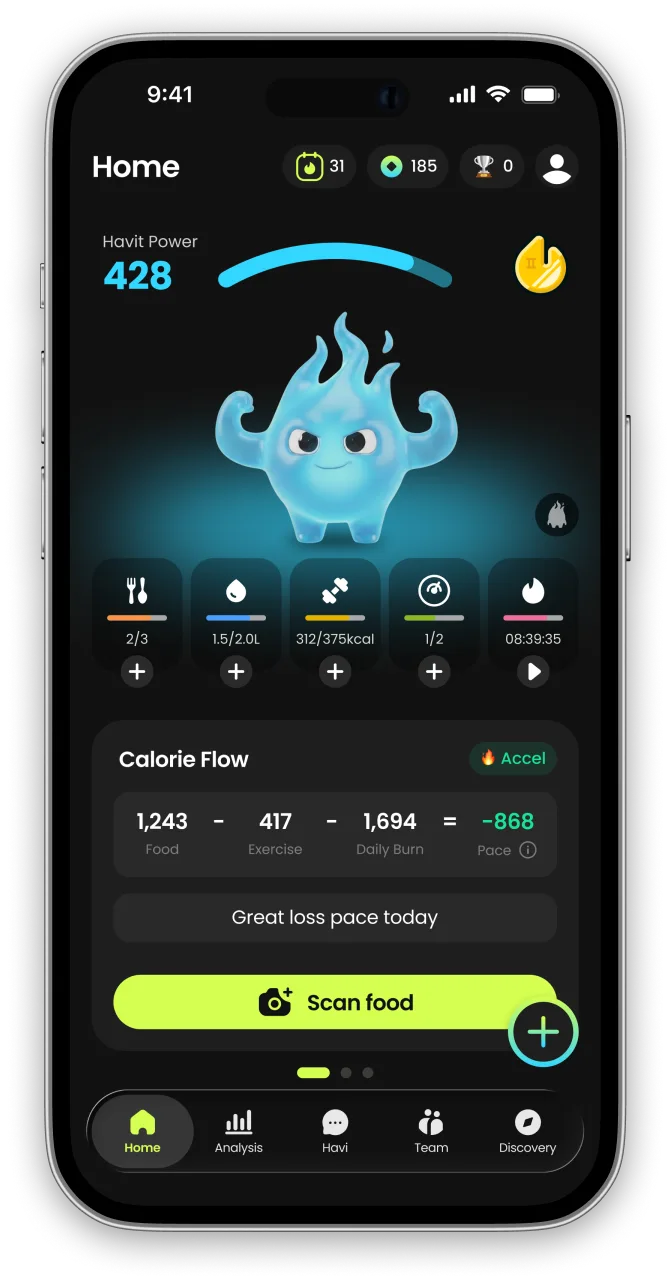
What is Havit?
Havit is an AI health companion for weight loss that protects muscle.
Unlike calorie-only trackers, Havit connects AI body-composition estimates, nutrition, hydration, sleep, steps, cycle, mood, and GLP-1 medication in one daily routine — so progress is measured by body composition, not just the number on the scale. Daily missions turn established behavior-change techniques into small repeatable actions, drawing on expertise from professionals formerly at Juvis Diet, one of Korea’s leading metabolic clinics.
In Havit’s own analysis of 1,090 GLP-1 users, people who logged consistently built stronger habits than the general user base. Read the GLP-1 Habit Report
Havit works with or without GLP-1 medication. It is a wellness app, not a medical device; body-composition results are estimates.

Continue in the App
Personalized wellness with your own data


References
- Circadian Regulation of Appetite Hormones and Individual Variation in Ghrelin Timing — Nature Metabolism, 2025
- Personalized Satiety Interventions Based on Hormone Pattern Mapping — Cell Reports Medicine, 2024
- Protein Timing and Postprandial Satiety Hormone Response — American Journal of Clinical Nutrition, 2024
- Sleep Consistency and Leptin Sensitivity in Free-Living Adults — Sleep Medicine Reviews, 2024


