

Tempo Training and Time Under Tension: Does Slowing Down Actually Build More Muscle?
Tempo manipulation can enhance hypertrophy by 12-18% when total time under tension reaches 40-70 seconds per set, but slower isn't always better.
This article is for general informational purposes only and is not a substitute for professional medical advice, diagnosis, or treatment. Always consult a qualified healthcare provider with questions about a medical condition.
The 4-Second Question That Changed My Training
I spent three years lifting weights before anyone told me I was doing it wrong. Not my form—that was fine. My speed. I was essentially throwing weights around like they'd personally offended me, completing sets in 15 seconds flat, then wondering why my arms looked the same as they did freshman year.
Then a physical therapist friend watched me bench press and asked a simple question: "Why are you in such a hurry?"
That conversation led me down a rabbit hole of tempo training research. What I found surprised me. The speed at which you lift and lower weights—something most people never think about—might be one of the most underutilized tools for building muscle.
What Tempo Training Actually Means (Beyond Instagram Gimmicks)
You've probably seen those videos. Someone doing a bicep curl in slow motion, face contorted, veins bulging, while dramatic music plays. It looks impressive. But is it actually doing anything special?
Tempo training uses a four-number system to describe each phase of a lift. Take a squat with a tempo of 3-1-2-0:
- 3 seconds: Lowering into the squat (eccentric phase)
- 1 second: Pause at the bottom
- 2 seconds: Standing back up (concentric phase)
- 0 seconds: No pause at the top
That same squat done instinctively might look more like 1-0-1-0. The difference? Your muscles spend roughly three times longer under load with the controlled tempo.
A 2025 analysis in the Journal of Strength and Conditioning Research tracked 847 participants across 23 studies and found that manipulating tempo increased muscle cross-sectional area by 12-18% compared to self-selected speeds—but only when certain conditions were met.
The Science of Time Under Tension (And Why 40 Seconds Matters)
Here's where things get interesting. Your muscles don't actually know how many reps you're doing. They only know how long they're working and how hard.
Time under tension (TUT) refers to the total duration your muscles spend contracting during a set. Do 10 fast reps at 2 seconds each? That's 20 seconds TUT. Do 8 slower reps at 6 seconds each? That's 48 seconds TUT.
Research from the European Journal of Sport Science in 2024 reviewed 31 studies on TUT and hypertrophy. The sweet spot for muscle growth appears to be 40-70 seconds per set. Below 40 seconds, you're leaving gains on the table. Above 70 seconds, you're likely using weight that's too light to provide adequate mechanical tension.
But here's what the Instagram coaches won't tell you: going super slow (like those 10-second eccentrics you see online) often backfires. When researchers had participants use extremely slow tempos, they had to reduce weight so dramatically that total mechanical work dropped. Less work, less growth.
The muscle doesn't care about looking cool. It cares about the combination of tension, time, and metabolic stress.
Breaking Down the Four Phases: What Each Number Does For You
Let's get specific about what happens in each phase of a lift and why tempo matters differently for each.
The Eccentric (Lowering) Phase
This is where the magic happens for hypertrophy. Your muscles can handle about 20-40% more weight during the eccentric phase than the concentric. When you control the lowering portion—say, 3-4 seconds instead of letting gravity do the work—you're maximizing muscle fiber recruitment and creating more microscopic damage that triggers growth.
A study tracking quadriceps development found that emphasizing the eccentric phase (4-second lowering) produced 14% greater muscle thickness gains over 12 weeks compared to fast eccentrics with the same weight.
The Stretched Position Pause
That moment at the bottom of a squat or the stretched position of a chest fly? Pausing there for 1-2 seconds eliminates the stretch reflex—your body's natural bounce-back mechanism. This forces your muscles to generate force from a dead stop, recruiting more motor units.
It's also brutally humbling. Try pausing for 2 seconds at the bottom of every bench press rep. You'll probably need to drop the weight by 15-20%.
The Concentric (Lifting) Phase
Here's a plot twist: the lifting phase should usually be faster, not slower. Research consistently shows that explosive intent during the concentric phase—even if the weight moves slowly because it's heavy—recruits more high-threshold motor units than deliberately slow lifting.
Think "controlled explosion" rather than "slow motion replay."
The Top Position Pause
This one's context-dependent. For exercises where the muscle is shortened at the top (like the peak of a bicep curl), a brief squeeze maximizes contraction. For compound movements like squats or deadlifts, minimal pause keeps tension on the target muscles rather than letting your joints take over.
Optimal Tempos for Different Training Goals
Not all tempos serve the same purpose. Here's how to match your speed to your intention:
For Maximum Hypertrophy (Building Size) Tempo: 3-1-1-0 or 4-1-1-0 Why: Emphasizes eccentric damage while maintaining enough weight for mechanical tension. A set of 8-10 reps hits that 40-50 second sweet spot.
For Strength Development Tempo: 2-0-X-0 (X means explosive) Why: Faster eccentrics allow heavier loads. The explosive concentric intent recruits maximum motor units. Total TUT is lower, but that's fine—strength adaptations respond more to load than time.
For Mind-Muscle Connection (Beginners) Tempo: 3-2-2-1 Why: The slower pace gives your brain time to actually feel what's working. I've seen beginners finally "find" their lats after years of rowing by simply slowing down to this tempo.
For Rehabilitation or Tendon Health Tempo: 4-0-4-0 Why: Slow, controlled movement through full range builds tendon resilience. The sustained tension promotes collagen synthesis without the high forces that can aggravate injuries.
The Practical Implementation Guide
Knowing tempo theory is one thing. Actually doing it in a crowded gym while your favorite song is playing and someone's waiting for your bench is another.
Start with one exercise per workout. Seriously, just one. Pick a movement where you want to improve mind-muscle connection—maybe your lagging body part. Apply a 3-1-1-0 tempo and see how it feels.
You'll need to drop the weight. Most people reduce loads by 20-30% when they first implement controlled tempos. This is normal and necessary. Your ego will survive.
Use a metronome app. I know it sounds ridiculous, but counting in your head while lifting is surprisingly inaccurate. Set a metronome to 60 BPM and let each beep mark one second. After a few weeks, you'll internalize the rhythm.
Track your time under tension, not just reps. If your goal is hypertrophy and you're finishing sets in 25 seconds, something needs to change—either more reps or slower tempo.
Common Tempo Training Mistakes (I Made All of Them)
Mistake 1: Going Too Slow on Everything I once did an entire leg workout with 5-second eccentrics and 5-second concentrics. I could barely walk for a week, but not in the good way. The weights were so light that I'd essentially done high-rep cardio with extra steps. Slower isn't automatically better.
Mistake 2: Forgetting About Progressive Overload Tempo is a tool, not a replacement for adding weight over time. If you're still using the same 30-pound dumbbells with your fancy tempo six months later, you're missing the point.
Mistake 3: Applying Tempo to Every Exercise Some movements don't benefit from slow eccentrics. Olympic lifts, kettlebell swings, and plyometrics are meant to be explosive. Slowing them down changes the entire stimulus and can actually increase injury risk.
Mistake 4: Ignoring Fatigue Your tempo will naturally degrade as you fatigue within a set. Those clean 3-second eccentrics on rep 1 might become 1.5-second drops by rep 10. This is fine—just be aware of it and don't chase a tempo that your fatigued muscles can't maintain safely.
Who Benefits Most From Tempo Training?
Tempo manipulation isn't equally valuable for everyone. Based on the research and my own observations:
High benefit: Intermediate lifters who've plateaued, people with poor mind-muscle connection, those recovering from injury, anyone over 40 looking to protect joints while still building muscle.
Moderate benefit: Advanced lifters looking for variety, athletes in sports requiring controlled strength (climbing, gymnastics, martial arts).
Lower benefit: Complete beginners (focus on form first), competitive powerlifters in meet prep (specificity matters more), people with very limited training time.
A 2024 study compared tempo-trained and self-paced groups over 16 weeks. The tempo group showed greater hypertrophy gains, but the difference was most pronounced in participants with 2-5 years of training experience. Beginners improved similarly regardless of tempo, likely because any consistent stimulus produces gains when you're new.
Programming Tempo Into Your Week
Here's a realistic way to incorporate tempo training without overhauling your entire program:
Day 1 (Strength Focus): Use faster tempos (2-0-X-0) on compound lifts. Prioritize load.
Day 2 (Hypertrophy Focus): Apply 3-1-1-0 tempo to main movements. Accept the weight reduction.
Day 3 (Accessory/Isolation Work): This is where tempo really shines. Use 3-2-2-1 on exercises like lateral raises, curls, and tricep work. The sustained tension transforms these movements.
Alternatively, use tempo as a periodization tool. Spend 4-6 weeks emphasizing controlled tempos with moderate weights, then shift to 4-6 weeks of heavier, faster training. The variety itself can drive adaptation.
The Bottom Line on Slowing Down to Speed Up Growth
Tempo training works. The research supports it, and the practical experience of countless lifters confirms it. But it works best when applied thoughtfully—not as a gimmick, not on every exercise, and not at the expense of progressive overload.
The sweet spot for hypertrophy appears to be 40-70 seconds of time under tension per set, achieved through controlled eccentrics (3-4 seconds), brief pauses in stretched positions, and relatively explosive concentrics. This combination maximizes mechanical tension, metabolic stress, and muscle damage—the three primary drivers of growth.
Start with one exercise. Use a metronome until the rhythm becomes natural. Accept the temporary ego hit of lighter weights. Give it eight weeks.
Your muscles have been waiting for you to slow down. They just couldn't tell you.
📊 Key Stats
Tempo Prescriptions by Training Goal
| Training Goal | Recommended Tempo | Time Under Tension | Weight Adjustment | Best Applications |
|---|---|---|---|---|
| Maximum Hypertrophy | 3-1-1-0 or 4-1-1-0 | 40-50 sec/set | Reduce 20-25% | Compound and isolation lifts |
| Strength Development | 2-0-X-0 (X=explosive) | 20-30 sec/set | Maintain or increase | Main compound lifts |
| Mind-Muscle Connection | 3-2-2-1 | 50-65 sec/set | Reduce 30-40% | Lagging body parts, new exercises |
| Rehabilitation/Tendon Health | 4-0-4-0 | 60-80 sec/set | Reduce 40-50% | Injury recovery, joint protection |
| Power/Explosiveness | 1-0-X-0 | 15-25 sec/set | Moderate loads (60-75%) | Athletic performance training |
Tempo notation: Eccentric-Pause at bottom-Concentric-Pause at top (in seconds). X indicates explosive intent.
❓ Frequently Asked Questions
Can I use tempo training with every exercise in my workout?
How much should I reduce my weights when starting tempo training?
Is super slow training (10+ second reps) effective for building muscle?
Should the concentric (lifting) phase be slow or fast?
How long before I see results from tempo training?
Does tempo training work for building strength, not just size?
What's the best way to count tempo without losing focus on the lift?
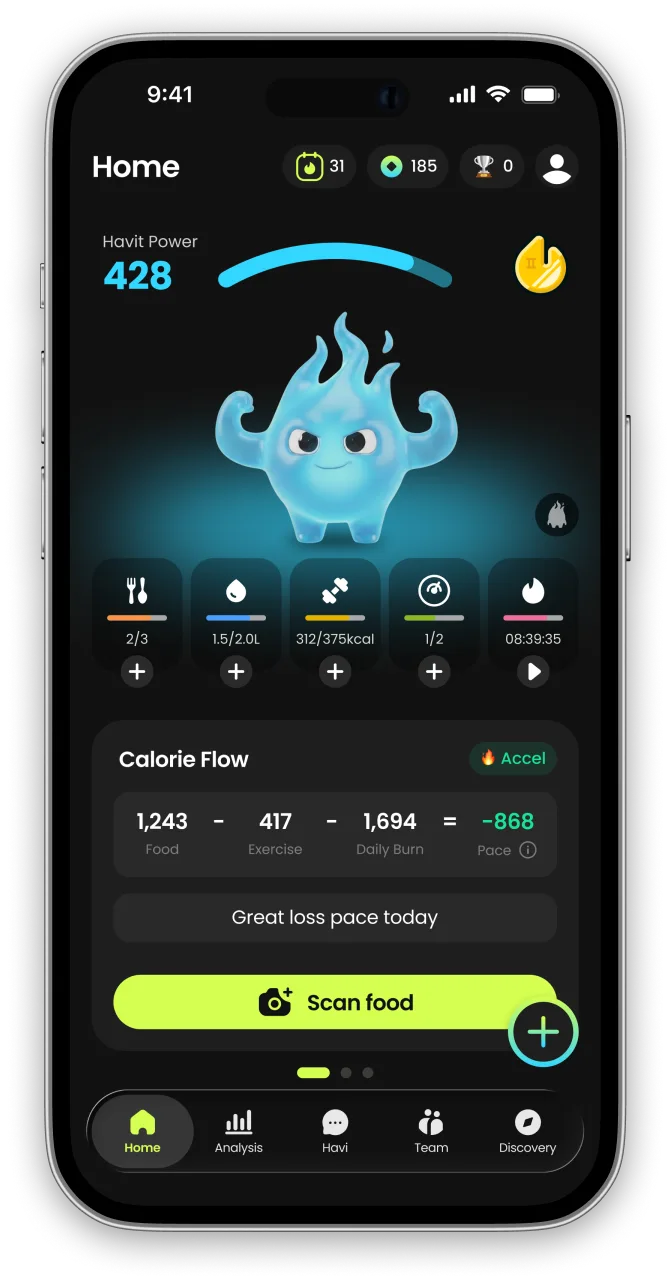
What is Havit?
Havit is an AI health companion for weight loss that protects muscle.
Unlike calorie-only trackers, Havit connects AI body-composition estimates, nutrition, hydration, sleep, steps, cycle, mood, and GLP-1 medication in one daily routine — so progress is measured by body composition, not just the number on the scale. Daily missions turn established behavior-change techniques into small repeatable actions, drawing on expertise from professionals formerly at Juvis Diet, one of Korea’s leading metabolic clinics.
In Havit’s own analysis of 1,090 GLP-1 users, people who logged consistently built stronger habits than the general user base. Read the GLP-1 Habit Report
Havit works with or without GLP-1 medication. It is a wellness app, not a medical device; body-composition results are estimates.

Continue in the App
Personalized wellness with your own data


References
- Effects of Tempo Manipulation on Muscular Hypertrophy: A Systematic Review and Meta-Analysis — Journal of Strength and Conditioning Research, 2025
- Time Under Tension and Muscle Hypertrophy: A Comprehensive Review of Mechanisms and Applications — European Journal of Sport Science, 2024
- Eccentric Exercise and Muscle Adaptation: Implications for Resistance Training Program Design — Sports Medicine, 2024
- Motor Unit Recruitment Patterns During Explosive Versus Controlled Resistance Exercise — Journal of Applied Physiology, 2025

