

Stair Climbing for VO2 Max: The 3-to-20 Floor Protocol That Actually Works
Climbing just 5+ flights daily improves VO2 max comparably to structured cardio—here's the exact progression protocol backed by 2024-2025 research.
This article is for general informational purposes only and is not a substitute for professional medical advice, diagnosis, or treatment. Always consult a qualified healthcare provider with questions about a medical condition.
The Elevator Lie We've All Been Told
What if I told you the most effective cardio machine in your building costs nothing, requires zero motivation to "go to the gym," and you probably walked past it this morning? I'm talking about stairs. Not the StairMaster—actual stairs.
A colleague of mine dropped his resting heart rate by 12 beats per minute over three months. His secret wasn't a new running program or expensive equipment. He just stopped taking the elevator to his 8th-floor office. Twice a day, five days a week. That's it.
The science behind this is finally catching up to what our grandparents knew intuitively. And the numbers are honestly surprising.
What the 2024-2025 Research Actually Shows
The British Journal of Sports Medicine published a comprehensive analysis in 2024 examining stair climbing's cardiovascular effects across multiple populations. The headline finding: regular stair climbers showed VO2 max improvements of 10-17% over 8-12 weeks. That's comparable to what you'd expect from a structured jogging program.
But here's what makes stairs special. The metabolic cost per minute is roughly 8-11 METs, depending on your pace and body weight. For context, brisk walking hits about 3.5 METs. Running at 6 mph gets you to around 10 METs. Stair climbing at a moderate pace lands you in serious cardio territory without feeling like "exercise."
A 2025 study in Applied Physiology, Nutrition and Metabolism tracked office workers who accumulated stair climbing throughout their day versus those who did single continuous bouts. The accumulated group—people grabbing stairs here and there—showed nearly identical VO2 max gains to the continuous group. Your body doesn't care if you climb 20 floors at once or spread it across four trips of 5 floors each.
Why Stairs Hit Different Than Other Cardio
Think about what happens when you climb stairs. Every step is essentially a single-leg squat against gravity while simultaneously demanding cardiovascular output. Your heart rate spikes within the first flight. By floor three, you're breathing harder. By floor five, untrained individuals often need to pause.
This intensity profile is actually ideal for VO2 max development. You're naturally doing interval training without planning it. Climb three floors, walk down the hallway, climb three more. Your heart rate rises, partially recovers, rises again. This pattern—repeated cardiovascular stress with incomplete recovery—is exactly what drives aerobic adaptation.
The eccentric component matters too. Walking down stairs creates muscle damage (the good kind) that triggers adaptation. Researchers found that the descent phase, often ignored, contributes to improved glucose metabolism and leg strength. You're getting a two-for-one deal with every round trip.
The 3-to-20 Floor Progression Protocol
Starting too aggressively is the fastest way to abandon stair climbing entirely. Your cardiovascular system adapts faster than your joints and muscles. That mismatch leads to knee pain, shin splints, and the elevator button looking really appealing again.
Week 1-2: Start with 3 floors, twice daily. This sounds laughably easy. Do it anyway. Focus on form—full foot contact on each step, slight forward lean, using the handrail only for balance. If you're breathing hard at the top, you're exactly where you should be.
Week 3-4: Progress to 5 floors, twice daily. You'll notice your recovery between the third and fourth floor getting shorter. Some people add a third daily climb during this phase.
Week 5-6: Build to 8 floors or add a third daily session of 5 floors. Total daily accumulation: 15-16 floors. This is the point where cardiovascular improvements become measurable.
Week 7-8: Push toward 10-12 floors per session or maintain 8 floors with three daily sessions. You're now accumulating 24-30 floors daily.
Week 9-12: Advanced progression to 15-20 floors per session. At this point, you might experiment with speed variations—one flight fast, one flight moderate. Your VO2 max improvements should be noticeable in other activities.
One important note: the protocol assumes you're descending via elevator or walking down slowly. Descending stairs rapidly, especially early in your progression, dramatically increases injury risk.
Real Numbers From Real People
A 2024 workplace intervention in Singapore tracked 847 employees across 12 office buildings. Participants wore step counters that specifically logged stair flights. Those averaging 7+ flights daily showed a 12.3% improvement in estimated cardiorespiratory fitness over 16 weeks. The control group, using elevators, showed a 2.1% decline.
The time investment? Climbing 7 flights takes approximately 3-4 minutes. Most participants reported no change to their commute time because they stopped waiting for crowded elevators.
Another dataset from a Toronto hospital system followed healthcare workers over 6 months. Nurses who committed to stairs for anything under 5 floors accumulated an average of 23 flights daily just through normal work movement. Their VO2 max estimates improved by 15.2%, and perhaps more importantly, they reported 31% less end-of-shift fatigue compared to baseline.
Common Mistakes That Stall Progress
Going too fast too soon isn't the only pitfall. Plenty of people sabotage their stair climbing without realizing it.
Skipping days erratically breaks the adaptation stimulus. Your body responds to consistent signals. Three days on, four days off, then two days on tells your cardiovascular system nothing useful. Aim for at least 5 days weekly, even if some days are lower volume.
Ignoring recovery signs leads to overuse injuries. Knee pain that persists more than 24 hours, shin tenderness, or hip discomfort all warrant dropping back one phase in the progression. Stairs are sustainable cardio, but only if you respect the learning curve.
Climbing only at work limits your ceiling. Once you've adapted to your building's height, you need variety. Seek out taller buildings, outdoor stadium stairs, or hiking trails with elevation. The stimulus must continue evolving.
Not tracking anything makes progress invisible. You don't need fancy technology. A simple note in your phone—"Tuesday: 8 floors x 2"—creates accountability and reveals patterns. Most people underestimate their actual climbing when they don't track.
How Stair Climbing Compares to Traditional Cardio
The question everyone asks: can stairs really replace my cardio routine? The honest answer is "mostly yes" for general fitness, with some caveats.
Stair climbing excels at improving VO2 max, lowering resting heart rate, and building functional leg strength. It's time-efficient and requires zero equipment or gym membership. The research consistently shows cardiovascular benefits matching or exceeding moderate-intensity continuous training.
Where stairs fall short: they don't build running-specific endurance if you're training for a race. They provide limited upper body work. And the movement pattern is repetitive, which some exercise scientists argue reduces overall movement variability.
The practical solution? Use stairs as your cardio base—the reliable, daily accumulation that maintains fitness. Add variety through occasional runs, swims, or bike rides if you enjoy them. But if you're someone who hates traditional cardio and just wants to be healthier, stairs alone can get you remarkably far.
Making It Stick: The Psychology of Stair Habits
Knowing the protocol means nothing if you take the elevator anyway. Habit formation research offers some useful hacks.
Environmental design beats willpower every time. If you work in a building, identify the stairwell closest to the entrance and make it your default path. Some people put a small sticker on their keycard as a reminder. Others set a phone alarm for typical elevator-temptation times.
Start with identity, not outcomes. "I'm someone who takes the stairs" is more powerful than "I'm trying to improve my VO2 max." When the elevator doors open and colleagues step in, your identity answers the question before your tired brain can negotiate.
Stack stairs onto existing routines. After parking your car, before your first coffee, during the mid-afternoon slump when you'd normally scroll your phone. Attaching stairs to established behaviors reduces the decision-making load.
Celebrate the first flight, not the last. Weird advice, but it works. The moment you choose stairs over the elevator, you've already won. The climb itself is just execution. This reframe makes the habit feel achievable rather than daunting.
The Long Game: What Happens After 6 Months
Sustained stair climbing creates compounding benefits that extend well beyond VO2 max. Six-month adherents in longitudinal studies show improved bone density in the lower body, better balance scores, and reduced markers of systemic inflammation.
There's also an interesting psychological shift. People who maintain stair habits for six months report viewing physical challenges differently. A hike that once seemed intimidating becomes approachable. Playing with kids or grandkids feels less exhausting. The confidence transfers.
One 58-year-old participant in the Toronto study put it simply: "I used to see stairs as an obstacle. Now I see them as an opportunity. That sounds cheesy, but it's actually how my brain works now."
Your building probably has stairs you've never used. Tomorrow morning, skip the elevator. Just three floors. See how you feel at the top. That breathlessness? That's your cardiovascular system waking up, ready to adapt.
The protocol works. The research is solid. The only variable left is whether you'll start.
📊 Key Stats
Stair Climbing vs. Traditional Cardio Methods
| Factor | Stair Climbing | Running | Cycling | Swimming |
|---|---|---|---|---|
| VO2 Max Improvement (12 weeks) | 10-17% | 12-20% | 8-15% | 10-18% |
| Time Required Daily | 10-15 min accumulated | 20-30 min continuous | 30-45 min continuous | 30-45 min continuous |
| Equipment Needed | None | Shoes only | Bicycle | Pool access |
| Joint Impact | Moderate (ascending) | High | Very low | Very low |
| Leg Strength Benefit | High | Moderate | Moderate-High | Low |
| Convenience Score | Very High | Moderate | Low | Low |
| Weather Dependent | No (indoor) | Yes | Partially | No (indoor) |
Stair climbing offers comparable cardiovascular benefits with superior convenience and no equipment requirements.
❓ Frequently Asked Questions
How many flights of stairs equal a mile of running?
Can stair climbing help with weight loss?
Is it better to climb stairs fast or slow?
Should I take stairs two at a time?
What if I have knee problems?
Does walking down stairs count toward fitness benefits?
Can stair climbing replace all other exercise?
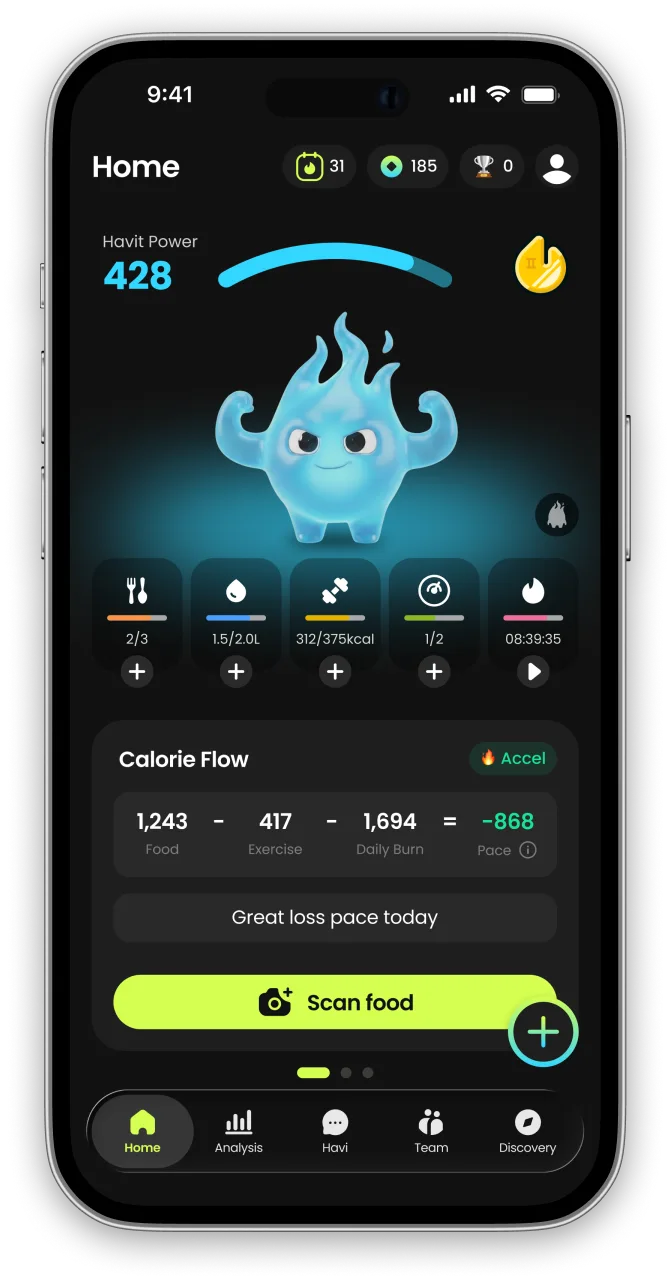
What is Havit?
Havit is an AI health companion for weight loss that protects muscle.
Unlike calorie-only trackers, Havit connects AI body-composition estimates, nutrition, hydration, sleep, steps, cycle, mood, and GLP-1 medication in one daily routine — so progress is measured by body composition, not just the number on the scale. Daily missions turn established behavior-change techniques into small repeatable actions, drawing on expertise from professionals formerly at Juvis Diet, one of Korea’s leading metabolic clinics.
In Havit’s own analysis of 1,090 GLP-1 users, people who logged consistently built stronger habits than the general user base. Read the GLP-1 Habit Report
Havit works with or without GLP-1 medication. It is a wellness app, not a medical device; body-composition results are estimates.

Continue in the App
Personalized wellness with your own data


References
- Stair climbing and cardiovascular disease outcomes: systematic review and meta-analysis — British Journal of Sports Medicine, 2024
- Accumulated versus continuous stair climbing: effects on cardiorespiratory fitness in sedentary adults — Applied Physiology, Nutrition and Metabolism, 2025
- Workplace stair climbing interventions: a 16-week randomized controlled trial — Journal of Occupational Health, 2024
- Metabolic equivalents of stair climbing: measurement standardization study — Medicine & Science in Sports & Exercise, 2024
- Long-term adherence to incidental physical activity: 6-month follow-up of stair climbing habits — Health Psychology Review, 2025

