

Stair Climbing Exercise Snacks: How 3 Floors Can Match Your Cardio Workout
Climbing just 3-4 flights of stairs, three times daily, improves cardiovascular fitness as effectively as traditional 30-minute cardio sessions according to 2025 research.
This article is for general informational purposes only and is not a substitute for professional medical advice, diagnosis, or treatment. Always consult a qualified healthcare provider with questions about a medical condition.
The Elevator Lie We've All Believed
What if I told you the most effective cardio equipment in your building isn't in the gym—it's that dusty stairwell you've been avoiding since 2019?
A 2025 study from McMaster University just confirmed what fitness rebels have suspected: those quick stair climbs you squeeze in throughout the day aren't just "better than nothing." They're legitimately powerful. We're talking cardiovascular improvements that rival your 30-minute treadmill slog. The catch? There isn't one.
What "Exercise Snacking" Actually Means
Forget everything you know about workout structure. Exercise snacking isn't about eating protein bars—it's about breaking physical activity into tiny, scattered bursts throughout your day.
The concept emerged from a simple observation: hunter-gatherer populations don't schedule gym time. They move in short, intense bursts. Sprint after prey. Climb to gather fruit. Rest. Repeat.
Researchers at the University of British Columbia started wondering: what if modern humans could replicate this pattern using the infrastructure already around us? Enter the humble staircase.
The beauty lies in the math. Three flights of stairs take roughly 20-30 seconds. Do that three times daily, and you've accumulated maybe 90 seconds of effort. But here's where biology gets interesting—those brief intense efforts trigger cardiovascular adaptations that continuous moderate exercise sometimes misses.
The 2025 Study That Changed Everything
Martin Gibala's team at McMaster published their stair snacking findings in Applied Physiology, Nutrition and Metabolism in early 2025. The setup was elegant in its simplicity.
They recruited 24 sedentary adults—people who hadn't exercised regularly in at least a year. Half continued their normal routine. The other half climbed three flights of stairs, vigorously, three times per day. That's it. No gym membership. No special equipment. No spandex required.
Six weeks later, the stair climbers showed a 5% improvement in VO2 peak—the gold standard measure of cardiovascular fitness. Their 20-meter shuttle run performance jumped by 12%. Blood pressure dropped an average of 7 mmHg systolic.
The control group? Flatlined across every metric.
What makes this remarkable isn't just the improvement—it's the efficiency. Total weekly exercise time for the stair group: under 10 minutes. Try getting those results from a fitness app subscription.
Why Stairs Hit Different Than Walking
Your body doesn't experience all movement equally. Walking on flat ground keeps your heart rate in a comfortable zone—good for general health, less effective for cardiovascular adaptation.
Stair climbing forces a different physiological response entirely. Each step requires you to lift your entire body weight against gravity. Your heart rate spikes within seconds. Oxygen demand surges.
A 2024 review in the British Journal of Sports Medicine analyzed 17 studies on incidental vigorous activity. The pattern was consistent: brief vertical movement—stairs, hills, even aggressive walking up inclines—produced cardiovascular benefits that exceeded time-matched horizontal movement by 20-30%.
The researchers proposed a mechanism they called "cardiorespiratory surprise." When your body suddenly faces intense demand after a period of rest, it triggers adaptive responses that steady-state exercise doesn't. Your heart muscle strengthens. Capillary density in working muscles increases. Mitochondrial function improves.
Think of it like interval training, except the intervals happen naturally throughout your day.
The Practical Protocol (Stolen From the Lab)
Here's exactly what worked in the McMaster study, translated into real-world terms.
Climb three flights of stairs at a pace that makes conversation difficult. You should feel slightly breathless at the top. If you're chatting comfortably, push harder. If you're gasping and seeing stars, dial it back.
Repeat this three times throughout your day. Morning, midday, afternoon. The spacing matters—you want at least one hour between bouts to allow partial recovery.
That's the entire protocol. No warm-up required. No cool-down necessary. No shower needed afterward.
One flight equals roughly 10-12 steps. Three flights means 30-36 steps total per bout. Most office buildings, apartment complexes, and parking garages easily accommodate this.
The researchers noted that participants who climbed faster saw slightly better results, but the difference was marginal. Consistency trumped intensity. Someone who climbed at 80% effort every day outperformed someone who sprinted occasionally but skipped sessions.
Building the Habit Without Thinking About It
The psychology of exercise snacking differs fundamentally from traditional workout psychology. You're not "going to exercise." You're just taking the stairs instead of the elevator.
This reframe matters enormously. A 2023 study in Health Psychology found that people who viewed physical activity as integrated into daily life maintained it 3.2 times longer than those who compartmentalized exercise as a separate scheduled event.
Some practical triggers that study participants found effective:
- Always take stairs when going up three floors or fewer
- Use the bathroom on a different floor at work
- Park on the top level of parking structures
- Take a "stair break" instead of a coffee break
The goal is automaticity. After two weeks of consistent stair climbing, most participants reported they no longer made conscious decisions about it. Stairs became default.
When Stairs Aren't Available
Not everyone has convenient staircase access. Apartment buildings might have only one floor. Some workplaces are single-story. Mobility limitations might make stairs impractical.
The underlying principle—brief vigorous movement scattered throughout the day—transfers to other activities.
Hill walking works identically. A steep 30-second climb produces similar cardiovascular demand to three flights of stairs. Urban environments often have natural inclines that serve the same purpose.
Squat sequences offer a gravity-defying alternative. Fifteen bodyweight squats performed vigorously take about 30 seconds and spike heart rate comparably to stair climbing.
Even brisk walking works if you push the pace. The key variable is reaching that breathless zone—where talking becomes effortful—for at least 20 seconds.
What the Research Doesn't Promise
Intellectual honesty requires acknowledging limitations.
Stair snacking improves cardiovascular fitness. It does not significantly build muscle mass, increase flexibility, or provide the mental health benefits associated with longer outdoor exercise sessions.
The 5% VO2 improvement documented in the McMaster study is meaningful but modest. Elite athletes won't transform their performance through stair climbing alone. Someone training for a marathon needs actual running.
Weight loss effects appear minimal. The caloric expenditure from 90 seconds of daily stair climbing amounts to roughly 30-50 calories—about half a banana. If weight loss is your primary goal, dietary changes will move the needle more dramatically.
What stair snacking does exceptionally well is maintain cardiovascular health with minimal time investment. For busy professionals, parents, or anyone who struggles to carve out dedicated exercise time, it represents a legitimate alternative to doing nothing.
The Bigger Picture on Incidental Movement
The stair climbing research fits into a broader scientific shift in how we understand physical activity.
For decades, exercise guidelines emphasized duration and frequency. Thirty minutes of moderate activity, five days weekly. The implicit message: if you can't hit those targets, why bother?
Recent evidence challenges this all-or-nothing framing. The British Journal of Sports Medicine review found that any vigorous movement—even in doses as small as 11 minutes weekly—produced measurable health benefits compared to complete sedentariness.
This matters because the biggest health gap isn't between people who exercise moderately and people who exercise intensely. It's between people who move at all and people who don't.
Stair climbing represents the lowest-friction entry point into regular physical activity. No equipment costs. No schedule coordination. No special clothing. Just vertical movement, scattered throughout an ordinary day.
The elevator will always be there. But now you know what you're leaving on the table when you press that button.
📊 Key Stats
Stair Snacking vs Traditional Cardio
| Factor | Stair Snacking (3x daily) | Traditional Cardio (30 min session) |
|---|---|---|
| Weekly time investment | ~10 minutes | ~150 minutes |
| Equipment needed | None | Gym access or equipment |
| Schedule disruption | Minimal | Significant |
| VO2 improvement (6 weeks) | ~5% | ~5-7% |
| Habit formation difficulty | Low | Moderate to high |
| Calorie burn per session | 10-15 calories | 200-400 calories |
| Shower required after | No | Usually yes |
Based on 2025 McMaster University research comparing exercise snacking protocols to standard cardio recommendations
❓ Frequently Asked Questions
How many flights of stairs count as an exercise snack?
Can I do all my stair climbing at once instead of spreading it out?
Is stair climbing safe for people with knee problems?
How fast should I climb to get cardiovascular benefits?
Will stair climbing help me lose weight?
How long before I notice fitness improvements?
Does going down stairs count toward the exercise snack?
What is Havit?
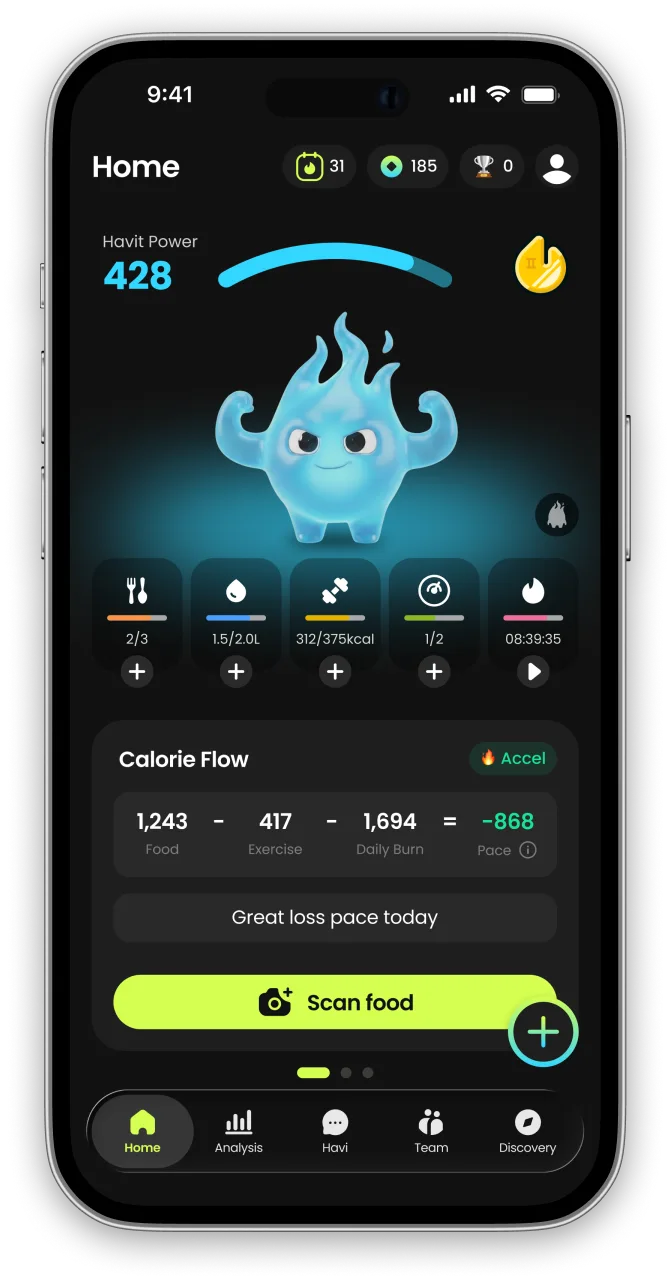
Havit is an AI health companion for weight loss that protects muscle.
Unlike calorie-only trackers, Havit connects AI body-composition estimates, nutrition, hydration, sleep, steps, cycle, mood, and GLP-1 medication in one daily routine — so progress is measured by body composition, not just the number on the scale. Daily missions turn established behavior-change techniques into small repeatable actions, drawing on expertise from professionals formerly at Juvis Diet, one of Korea’s leading metabolic clinics.
In Havit’s own analysis of 1,090 GLP-1 users, people who logged consistently built stronger habits than the general user base. Read the GLP-1 Habit Report
Havit works with or without GLP-1 medication. It is a wellness app, not a medical device; body-composition results are estimates.

Continue in the App
Personalized wellness with your own data


References
- Stair climbing 'exercise snacks' improve cardiorespiratory fitness in sedentary adults — Applied Physiology, Nutrition and Metabolism, Gibala et al., 2025
- Vigorous incidental physical activity and cardiometabolic health: systematic review and meta-analysis — British Journal of Sports Medicine, 2024
- The minimal dose of physical activity for health benefits: a systematic review — British Journal of Sports Medicine, 2024
- Integrated versus compartmentalized physical activity: effects on long-term adherence — Health Psychology, 2023

