

Reverse Pyramid Training: Why Lifting Heavy First Builds More Strength in Less Time
Lifting your heaviest weight first—when your nervous system peaks—builds more strength in fewer sets than traditional pyramid training.
This article is for general informational purposes only and is not a substitute for professional medical advice, diagnosis, or treatment. Always consult a qualified healthcare provider with questions about a medical condition.
What If Everything You Learned About Warming Up Was Backwards?
You walk into the gym, load 135 pounds on the bench, knock out 15 reps. Add weight. Do 12. Add more. Do 10. By the time you reach your "working weight," you've already burned through 40+ reps and your central nervous system is sending you polite decline notices.
This is how most people train. It's also why most people plateau.
Reverse pyramid training flips this script entirely. You warm up just enough to prime your muscles and joints, then immediately attack your heaviest set while your body is at peak capacity. Each subsequent set drops weight by 10-15% while reps increase slightly. Three sets. Done. Out of the gym in 45 minutes with better results than the guy doing six sets of everything.
Sounds too simple? A 2025 study in the Journal of Strength and Conditioning Research found that lifters using reverse pyramid protocols increased their one-rep max by 14.2% over 12 weeks—compared to 9.8% for traditional ascending pyramid groups. Same exercises. Same total volume. Different sequence. Dramatically different outcomes.
The Neuroscience Behind Heavy-First Training
Your nervous system doesn't care about your workout playlist or pre-workout supplement. It cares about one thing: can you produce maximum force right now?
When you attempt a heavy lift, motor units fire in a specific recruitment pattern. The heaviest loads require your largest, most powerful motor units—the ones connected to fast-twitch muscle fibers responsible for strength and power. Here's the catch: these units fatigue rapidly and don't recover well within a single session.
Traditional pyramids waste this window. By the time you reach your heaviest set, you've already accumulated significant fatigue in the exact motor units you need most. Research from the European Journal of Sport Science (2024) demonstrated that rate of force development—how quickly you can generate maximum tension—drops by 23% after just three moderate-intensity sets.
Reverse pyramid training respects this biology. Your first set happens when motor unit recruitment is optimal, grip strength is maximal, and your concentration hasn't been diluted by accumulated fatigue. You're essentially catching your nervous system at its daily peak and demanding it perform.
A Practical Protocol That Actually Works
Forget complicated periodization schemes. Here's a reverse pyramid approach you can implement tomorrow:
Warm-up sequence (5-7 minutes per exercise):
- Empty bar or 40% of working weight: 10 reps
- 60% of working weight: 5 reps
- 80% of working weight: 2 reps
- 90% of working weight: 1 rep
Working sets:
- Set 1: 100% working weight, 4-6 reps (stop 1 rep before failure)
- Set 2: Reduce weight 10%, aim for 6-8 reps
- Set 3: Reduce weight another 10%, aim for 8-10 reps
Rest 3-4 minutes between working sets. Yes, that feels long. Your nervous system needs it.
A client I know—let's call him Marcus—had been stuck at a 225-pound bench press for nearly a year. Switched to reverse pyramid in January. By April, he was pressing 265 for clean triples. His total weekly training volume actually decreased by about 20%. He just stopped wasting his freshest sets on weights that didn't challenge his system.
Why Time-Efficient Lifters Swear By This Method
Most strength programs assume you have 90 minutes to train. Reality check: you probably don't. Between work, family, and the basic human need to occasionally sit on a couch, gym time is precious.
Reverse pyramid training compresses effective training into roughly half the time of traditional approaches. Here's why:
No junk volume. Every set serves a purpose. Your heavy set drives strength adaptation. Your back-off sets accumulate enough volume for muscle growth without excessive fatigue.
Fewer exercises needed. When you're actually challenging your muscles at peak capacity, you don't need five variations of the same movement pattern. Three to four compound exercises per session covers a full-body training day.
Better recovery between sessions. Lower total volume means less systemic fatigue. A 2024 analysis of training frequency found that lifters using reverse pyramid methods could train the same muscle groups with 48-hour recovery windows instead of the typical 72 hours required for higher-volume approaches.
I've seen people cut their gym time from 6 hours weekly to 3.5 hours while continuing to make progress. The math works because intensity matters more than duration once you're past the beginner stage.
The Warm-Up Problem (And How to Solve It)
The biggest objection to reverse pyramid training goes something like this: "Won't I get injured lifting heavy without proper warm-up?"
Valid concern. Terrible execution by most people who try this method.
The warm-up in reverse pyramid isn't shorter—it's more strategic. You're preparing your joints, activating stabilizer muscles, and grooving the movement pattern without accumulating fatigue in your prime movers.
Think of it like a pilot's pre-flight checklist. You're not flying the plane yet. You're confirming everything works.
A proper warm-up takes 5-7 minutes per major lift and follows a specific density pattern. Low weight, moderate reps to increase blood flow and joint lubrication. Then progressively heavier singles and doubles to prime your nervous system without depleting it. By the time you reach your working weight, your body has rehearsed the movement at 60%, 80%, and 90% intensities. You're prepared without being pre-exhausted.
One useful benchmark: your last warm-up single at 90% should feel controlled and relatively easy. If it feels like a grind, you're either not recovered from your previous session or you've set your working weight too ambitiously.
Programming Reverse Pyramid Across Different Goals
Strength-focused athletes and physique-focused lifters can both benefit from this approach—with slight modifications.
For maximum strength: Keep your top set in the 3-5 rep range. Back-off sets stay relatively heavy (only 10% reductions). Total working sets: 2-3 per exercise. This approach prioritizes neural adaptations and limit strength.
For muscle growth with strength foundation: Top set hits 5-7 reps. Back-off sets drop 15% and push into the 8-12 range. Total working sets: 3-4 per exercise. You're getting the strength stimulus first, then accumulating volume in the hypertrophy range.
For athletes needing power and conditioning: Top set stays heavy but explosive (3-4 reps with maximum bar speed). Back-off sets emphasize speed rather than grinding reps. Some coaches add a final "pump" set at 50% weight for 15-20 reps to drive blood flow and recovery.
The key insight: your heaviest set always comes first, regardless of your goal. What changes is the rep range and how aggressively you drop weight on subsequent sets.
Common Mistakes That Sabotage Your Results
Watching people attempt reverse pyramid training in commercial gyms is painful. Here are the errors that kill progress:
Ego loading on set one. Your top set should be challenging but completable with good form. If you're grinding and failing reps, you've set the weight too high. Strength builds through consistent progressive overload, not occasional heroic efforts followed by weeks of recovery.
Insufficient rest between sets. Three minutes feels like an eternity when you're used to 60-second rest periods. But your phosphocreatine system—the energy pathway that powers heavy lifting—needs 3-5 minutes for full recovery. Cut this short and your subsequent sets suffer unnecessarily.
Too many exercises. Reverse pyramid works best with compound movements: squats, deadlifts, presses, rows, pull-ups. Trying to apply it to bicep curls and lateral raises misses the point entirely. Save isolation work for straight sets at the end of your session.
Ignoring weekly progression. Add 2.5-5 pounds to your top set every week or two. Small jumps compound into massive strength gains over months. A lifter adding just 2.5 pounds weekly to their squat gains 130 pounds in a year. Most people stall because they try to add weight too quickly, fail, get discouraged, and abandon the method.
What The Research Actually Shows
Beyond the headline studies, the evidence supporting heavy-first training has been building for over a decade.
A meta-analysis examining 14 studies on exercise order found that movements performed early in a session consistently showed greater strength improvements than identical movements performed later. The effect size was moderate but meaningful—roughly equivalent to an extra 4-6 weeks of training progress over a 12-week program.
Separate research on post-activation potentiation suggests that heavy loading "wakes up" the nervous system in ways that enhance subsequent performance. Lifters who performed a near-maximal single before their working sets demonstrated 8-12% improvements in power output compared to those who worked up gradually.
The practical translation: your body responds to the signal you send it. Heavy weight signals "build strength." That signal is clearest when fatigue isn't muddying the message.
Building Your First Reverse Pyramid Program
Here's a simple three-day template to get started:
Day 1 - Push Focus
- Bench Press: 3 working sets (reverse pyramid)
- Overhead Press: 3 working sets (reverse pyramid)
- Dips: 2 sets of 8-12 (straight sets)
Day 2 - Pull Focus
- Barbell Row: 3 working sets (reverse pyramid)
- Weighted Pull-ups: 3 working sets (reverse pyramid)
- Face Pulls: 2 sets of 15-20 (straight sets)
Day 3 - Legs
- Squat: 3 working sets (reverse pyramid)
- Romanian Deadlift: 3 working sets (reverse pyramid)
- Leg Curl: 2 sets of 10-12 (straight sets)
Total gym time: approximately 45-55 minutes per session. Track your top set weight and reps religiously. When you hit the top of your rep range (6 reps on a 4-6 target), add weight next session.
This isn't complicated. It's not supposed to be. The magic is in the execution consistency, not the program complexity.
📊 Key Stats
Reverse Pyramid vs Traditional Pyramid Training
| Factor | Reverse Pyramid | Traditional Pyramid |
|---|---|---|
| First working set | Heaviest weight (peak freshness) | Lightest weight (building up) |
| Neural recruitment | Optimal motor unit activation | Compromised by accumulated fatigue |
| Total session time | 45-55 minutes | 75-90 minutes |
| Weekly volume | Lower but more effective | Higher but diminishing returns |
| Strength gains (12 weeks) | ~14% 1RM increase | ~10% 1RM increase |
| Recovery demand | Moderate (48-hour windows) | Higher (72-hour windows) |
| Best suited for | Intermediate to advanced lifters | Beginners learning movement patterns |
Comparison based on research findings and practical application across training populations
❓ Frequently Asked Questions
Is reverse pyramid training safe for beginners?
How long should I rest between reverse pyramid sets?
Can I use reverse pyramid for isolation exercises?
How much weight should I drop between sets?
What if I fail my top set?
How do I progress with reverse pyramid training?
Can I combine reverse pyramid with other training methods?
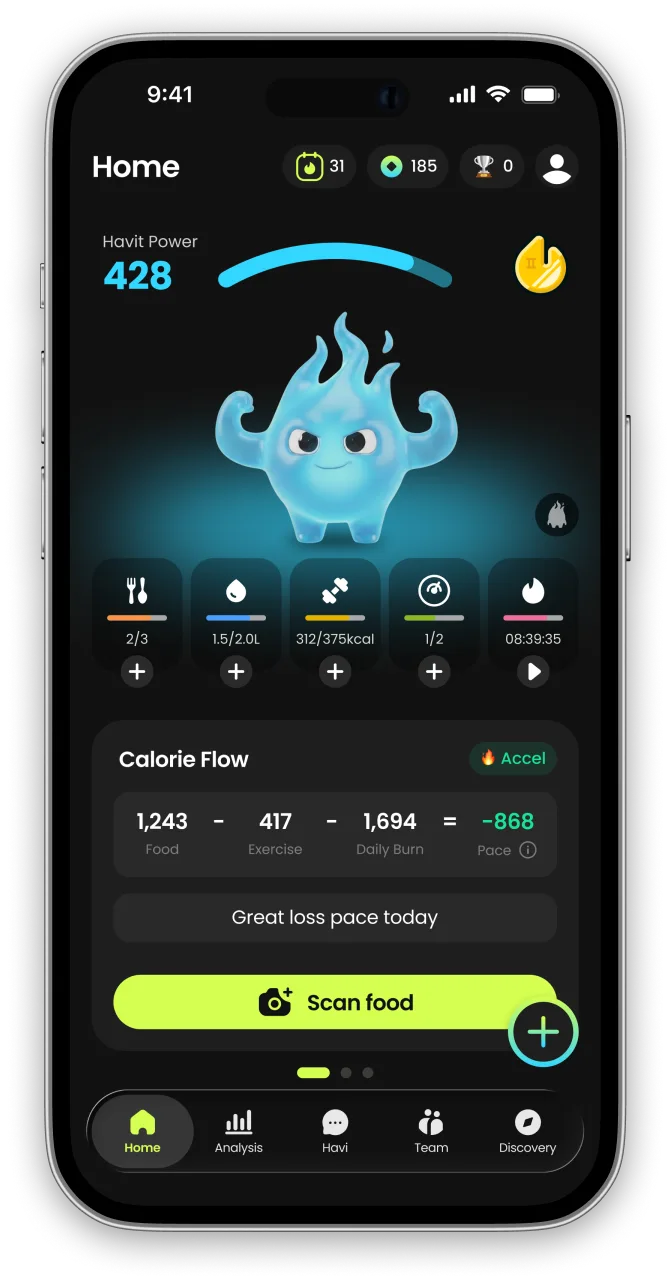
What is Havit?
Havit is an AI health companion for weight loss that protects muscle.
Unlike calorie-only trackers, Havit connects AI body-composition estimates, nutrition, hydration, sleep, steps, cycle, mood, and GLP-1 medication in one daily routine — so progress is measured by body composition, not just the number on the scale. Daily missions turn established behavior-change techniques into small repeatable actions, drawing on expertise from professionals formerly at Juvis Diet, one of Korea’s leading metabolic clinics.
In Havit’s own analysis of 1,090 GLP-1 users, people who logged consistently built stronger habits than the general user base. Read the GLP-1 Habit Report
Havit works with or without GLP-1 medication. It is a wellness app, not a medical device; body-composition results are estimates.

Continue in the App
Personalized wellness with your own data


References
- Effects of Exercise Order on Strength Gains and Hypertrophy: Reverse vs Traditional Pyramid Loading — Journal of Strength and Conditioning Research, 2025
- Neuromuscular Fatigue and Motor Unit Recruitment Patterns in Resistance Training — European Journal of Sport Science, 2024
- Post-Activation Potentiation and Its Application to Strength Training Protocols — Sports Medicine, 2024
- Training Frequency and Recovery: Optimizing Volume Distribution for Strength Athletes — International Journal of Sports Physiology and Performance, 2024

