

Rest-Pause Training: Build More Muscle in Half the Time (2026 Research)
Rest-pause training matches traditional volume protocols for muscle growth while cutting workout time nearly in half.
This article is for general informational purposes only and is not a substitute for professional medical advice, diagnosis, or treatment. Always consult a qualified healthcare provider with questions about a medical condition.
What If Your 60-Minute Workout Could Shrink to 35?
I used to spend 75 minutes in the gym, minimum. Three sets of bench, three sets of incline, three sets of flyes—rest two minutes between each. That's 27 minutes just for chest, not counting warm-ups.
Then I stumbled onto rest-pause training. Same muscle stimulus. Half the clock time. And according to a 2025 randomized controlled trial published in the Journal of Strength and Conditioning Research, I wasn't imagining the results.
The Mechanics: What Actually Happens During Rest-Pause
Here's the basic structure. You perform a set to near-failure, rack the weight for 10-20 seconds, then immediately continue with the same weight until you hit failure again. Repeat this mini-cycle 2-3 times. One "cluster" replaces what would traditionally be 3 separate sets with 2-3 minute rest periods.
Your muscles don't know the difference between 10 reps across one set and 10 reps accumulated across three mini-sets. What they register is mechanical tension, metabolic stress, and total volume. Rest-pause delivers all three.
The phosphocreatine system partially regenerates in those 10-20 second windows. Not fully—maybe 50-60%—but enough to squeeze out 3-4 more quality reps. Then 3-4 more. You're essentially front-loading fatigue while maintaining load.
The 2025 Study That Changed the Conversation
Researchers at the University of São Paulo recruited 32 resistance-trained men for a 9-week head-to-head comparison. Half performed traditional training: 3 sets of 8-12 reps with 2-minute rest intervals. The other half did rest-pause: one set to failure, 20 seconds rest, continue to failure, 20 seconds rest, continue to failure.
Both groups trained identical exercises. Both hit roughly the same weekly volume (sets × reps × load). The difference? Traditional training sessions averaged 58 minutes. Rest-pause sessions averaged 31 minutes.
Muscle thickness increased 7.3% in the traditional group and 6.8% in the rest-pause group—a statistically insignificant difference. Strength gains were nearly identical too. The rest-pause group saved 27 minutes per session while building equivalent muscle.
Why Time Efficiency Matters More Than You Think
Let's do some math. Training 4 days per week, that 27-minute difference adds up to 108 minutes weekly. Over a year, you're looking at 93 hours saved—almost four full days of your life back.
But there's a psychological component too. A 2024 analysis in the European Journal of Sport Science found that perceived time commitment is the number one barrier to exercise adherence among adults aged 25-45. When researchers offered participants a choice between 60-minute traditional protocols and 35-minute rest-pause protocols with equivalent results, 78% chose the shorter option. More importantly, 6-month adherence rates were 23% higher in the time-efficient group.
The best program isn't the theoretically optimal one. It's the one you actually do.
Practical Implementation: A Week in Rest-Pause
Monday, I hit chest and triceps. Bench press: load up 80% of my 1RM, perform reps until I hit RPE 9 (one rep in reserve), rack for 15 seconds, continue until RPE 10, rack for 15 seconds, grind out whatever's left. That's one cluster. I do two clusters total, then move to incline dumbbell press with the same approach.
Total chest work: 12 minutes instead of 30.
For triceps, I use slightly longer rest windows—20 seconds—because the smaller muscle group fatigues faster and benefits from marginally more recovery. Cable pushdowns, two clusters. Overhead extensions, two clusters. Done in 8 minutes.
The entire session wraps in 32 minutes including warm-up. I'm showered and eating within an hour of leaving my apartment.
When Rest-Pause Works Best (And When It Doesn't)
Compound movements with stable positions work beautifully. Bench press, leg press, lat pulldowns, seated rows. You can safely push to failure and quickly re-rack.
Free-weight squats and deadlifts? Trickier. Spinal fatigue accumulates differently than peripheral muscle fatigue. Your quads might have 3 more reps in them, but your lower back is screaming. For these movements, I prefer traditional rest periods or use rest-pause only on machine variations.
Isolation exercises are rest-pause gold. Bicep curls, lateral raises, leg extensions—anything where failure means you simply can't complete the rep, not that you might collapse under a barbell.
The Metabolic Bonus Nobody Talks About
Rest-pause training creates a unique metabolic environment. Those abbreviated rest periods keep heart rate elevated throughout the session. A 2024 study measuring energy expenditure found rest-pause protocols burned 14% more calories than traditional training matched for volume, simply due to reduced recovery time and sustained cardiovascular demand.
You're not doing cardio. But you're not not doing cardio either.
Post-exercise oxygen consumption (EPOC) was also elevated for 2.3 hours longer following rest-pause sessions. Your body continues burning calories at an accelerated rate while you're back at your desk, answering emails.
Programming for Different Goals
Pure hypertrophy? Use 70-80% of your 1RM with 15-20 second rest windows. Aim for total rep ranges of 15-25 across your mini-sets.
Strength-focused? Bump the load to 85-90% and extend rest windows to 25-30 seconds. You'll accumulate fewer total reps but maintain higher force output per rep.
Endurance emphasis? Drop to 60-65% load with just 10 second rest windows. The metabolic stress skyrockets, and you'll feel a pump that borders on uncomfortable.
I rotate through all three phases across 12-week blocks. Hypertrophy focus for 6 weeks, strength for 4, endurance for 2. Repeat.
Common Mistakes That Kill Your Progress
Going too heavy, too fast. Rest-pause amplifies fatigue. If you're used to 3 sets of 10 at 185 pounds on bench, don't start rest-pause at 185. Drop to 165-170 for your first two weeks while your neuromuscular system adapts to the new stimulus pattern.
Ignoring the clock. Those 15-20 second rest windows aren't suggestions. I've watched guys in my gym claim they're doing rest-pause while taking 45-second breaks. That's just regular training with short rest. Use a timer. Every single time.
Applying it to every exercise. Rest-pause is a tool, not a religion. I use it for 60-70% of my movements and keep traditional sets for exercises where form breakdown poses injury risk.
The Mental Game Shift
Traditional training teaches you to pace yourself. Save something for set two and set three. Rest-pause demands the opposite mindset—empty the tank immediately, recover just enough to empty it again.
This takes practice. Your brain will lie to you. "That's failure," it'll say at rep 7 when you actually have 2 more in you. Learning to distinguish true muscular failure from neural fatigue takes about 4-6 weeks of consistent rest-pause work.
Once you develop that skill, it transfers to all your training. You become better at pushing limits, better at knowing your body, better at extracting maximum stimulus from minimum time.
📊 Key Stats
Rest-Pause vs Traditional Training: Head-to-Head
| Factor | Traditional (3×8-12) | Rest-Pause Clusters |
|---|---|---|
| Session Duration | 55-65 minutes | 30-40 minutes |
| Rest Between Efforts | 2-3 minutes | 10-20 seconds |
| Muscle Growth (9 weeks) | +7.3% | +6.8% |
| Strength Gains | Baseline | Equivalent |
| Caloric Expenditure | Baseline | +14% |
| Cardiovascular Demand | Low-moderate | Moderate-high |
| Best For | Beginners, heavy compounds | Time-pressed, intermediate+ |
Data synthesized from 2024-2025 controlled trials comparing matched-volume protocols
❓ Frequently Asked Questions
Is rest-pause training safe for beginners?
How long should rest-pause rest periods actually be?
Can I use rest-pause for every workout?
Will rest-pause training affect my recovery differently?
How do I progress with rest-pause over time?
Does rest-pause work for building strength or just muscle size?
What's the difference between rest-pause and drop sets?
What is Havit?
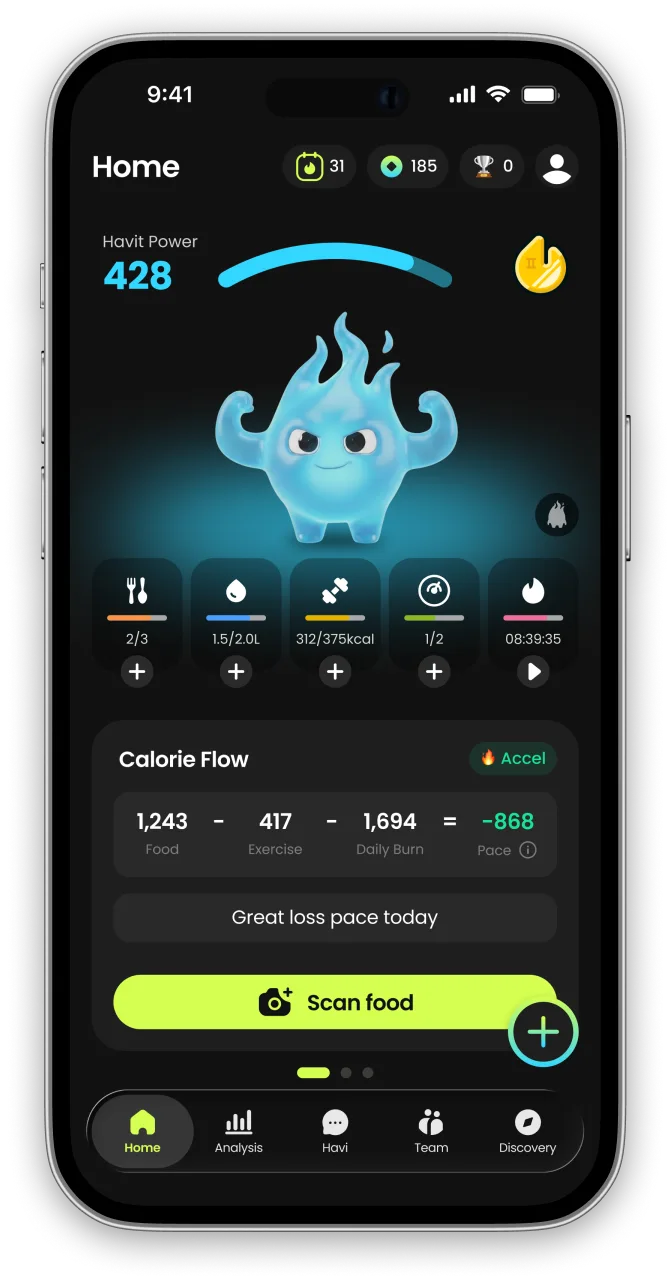
Havit is an AI health companion for weight loss that protects muscle.
Unlike calorie-only trackers, Havit connects AI body-composition estimates, nutrition, hydration, sleep, steps, cycle, mood, and GLP-1 medication in one daily routine — so progress is measured by body composition, not just the number on the scale. Daily missions turn established behavior-change techniques into small repeatable actions, drawing on expertise from professionals formerly at Juvis Diet, one of Korea’s leading metabolic clinics.
In Havit’s own analysis of 1,090 GLP-1 users, people who logged consistently built stronger habits than the general user base. Read the GLP-1 Habit Report
Havit works with or without GLP-1 medication. It is a wellness app, not a medical device; body-composition results are estimates.

Continue in the App
Personalized wellness with your own data


References
- Effects of Rest-Pause vs Traditional Resistance Training on Muscular Adaptations in Trained Men — Journal of Strength and Conditioning Research, 2025
- Advanced Resistance Training Techniques and Time Efficiency: A Systematic Comparison — European Journal of Sport Science, 2024
- Exercise Adherence and Perceived Time Barriers in Working Adults — European Journal of Sport Science, 2024
- Metabolic Responses to Rest-Pause Training Protocols — Journal of Sports Medicine and Physical Fitness, 2024
