

Jump Rope HIIT Protocol: The 4-Week Coordination and Cardio Challenge That Actually Works
A structured 4-week jump rope HIIT program that builds coordination while delivering serious cardio benefits, scalable from total beginners to advanced athletes.
This article is for general informational purposes only and is not a substitute for professional medical advice, diagnosis, or treatment. Always consult a qualified healthcare provider with questions about a medical condition.
Why Your Gym's Cardio Section Is Missing the Best Tool
I watched a boxer skip rope for three minutes straight without a single miss. No fancy footwork, just rhythmic bouncing that looked almost meditative. Then he told me something that stuck: "This is the only cardio that makes you smarter while making you fitter."
He wasn't exaggerating. Jump rope demands something treadmills and bikes simply can't—constant neural engagement. Your brain coordinates timing, rhythm, spatial awareness, and bilateral movement simultaneously. Miss the timing by 50 milliseconds? You trip. A 2025 study in the Journal of Sports Sciences found that 8 weeks of rope jumping improved cardiovascular efficiency by 19% while simultaneously enhancing motor coordination scores by 23%. That's a two-for-one deal you won't find on any elliptical.
The problem? Most people approach jump rope wrong. They grab a rope, flail around for 30 seconds, get frustrated, and quit. Or they watch YouTube videos of double-under wizards and assume they'll never reach that level. Both approaches miss the point entirely.
The Science Behind Why Rope Jumping Outperforms Traditional Cardio
Let's talk numbers that actually matter. Jumping rope at moderate intensity burns approximately 12-16 calories per minute. Running at 6 mph burns about 10 calories per minute. But here's where it gets interesting—the caloric burn isn't even the main advantage.
Research Quarterly for Exercise and Sport published findings in 2024 showing that coordination-based cardio creates what researchers call "neural density improvements." Basically, activities requiring precise timing and rhythm strengthen the connections between your motor cortex and muscles more effectively than repetitive, predictable movements. Participants who trained with jump rope for 12 weeks showed 31% faster reaction times compared to a cycling-only control group.
There's also the bone density factor. Each jump creates ground reaction forces of 2-4 times your body weight. Unlike running, where impact is often excessive and asymmetrical, rope jumping distributes this force evenly through both legs in a controlled, predictable pattern. Your skeletal system adapts without the joint stress that sidelines so many runners.
And the equipment cost? A quality speed rope runs $15-30. That's less than one month of most gym memberships.
Week 1: Foundation Building (Even If You Haven't Jumped Since Childhood)
Forget everything you think you know about jump rope. We're starting from zero, and that's intentional.
Day 1-2 focuses on rope-free practice. Stand in front of a mirror. Jump in place—just small hops, maybe 1-2 inches off the ground. Land on the balls of your feet. Do this for 30 seconds, rest 30 seconds, repeat 5 times. Sounds ridiculous? This is exactly how professional boxers teach beginners. You're programming the bounce pattern before adding the coordination challenge.
Day 3-4 introduces the rope, but you're not jumping over it yet. Hold both handles in one hand and swing the rope beside you while bouncing. Match your jumps to the rope hitting the ground. Left side for 30 seconds, right side for 30 seconds. This synchronization drill cuts learning time by roughly 40% compared to just trying to jump through the rope immediately.
Day 5-6, attempt full jumps. Here's the key—don't aim for consecutive jumps. Jump once, stop, reset, jump again. Get 10 clean single jumps. That's success. Most people try to chain jumps too early and develop terrible form that takes weeks to fix.
Day 7 is active recovery. Light stretching, maybe a walk. Your calves will thank you.
Week 2: Building Rhythm and Introducing Intervals
Your nervous system has had seven days to process the new movement pattern. Now we add structure.
The workout template for Week 2:
- 2 minutes easy bouncing (or marching if needed)
- 20 seconds jumping, 40 seconds rest × 6 rounds
- 2 minutes cool-down bouncing
Total work time: 2 minutes of actual jumping. That's it. But those 2 minutes at proper intensity will feel substantial.
During work intervals, aim for 60-70 jumps per minute. Count them. This pace allows recovery between jumps while maintaining rhythm. If you're missing frequently, slow down. Consistency beats speed at this stage.
By Day 10-11, increase to 25 seconds work, 35 seconds rest. Day 12-14, push to 30 seconds work, 30 seconds rest. You've just doubled your work capacity in one week.
One crucial detail: jump on a forgiving surface. Rubber gym flooring, outdoor track material, or even a yoga mat on hard floor. Concrete is brutal on joints and will limit your training volume.
Week 3: True HIIT Integration and Skill Variations
Now things get interesting. You've built the foundation. Time to actually push your cardiovascular system.
The Week 3 protocol introduces the Tabata-adjacent structure:
- 3 minutes progressive warm-up (start slow, gradually increase pace)
- 30 seconds maximum sustainable effort, 15 seconds rest × 8 rounds
- 2 minutes active recovery bouncing
- Repeat the 8-round block once more
- 3 minutes cool-down
Total session: roughly 22 minutes. Effective work time: 8 minutes at high intensity. This ratio mirrors what the Journal of Sports Sciences identified as optimal for cardiovascular adaptation without excessive fatigue accumulation.
Skill variations enter here too. Alternate between:
- Basic bounce (both feet together)
- Boxer step (shifting weight foot to foot)
- High knees (every 4th jump, drive one knee up)
Don't attempt all three in one session initially. Day 1-2 of Week 3, stick with basic bounce during intervals. Day 3-4, introduce boxer step during rest periods only. Day 5-6, try boxer step during actual work intervals. Day 7, combine as comfortable.
The coordination demands increase heart rate beyond what the jumping alone would produce. Your brain working harder means your body working harder. That's the magic formula.
Week 4: Advanced Protocols and The Coordination Peak
Final week. You've accumulated roughly 60-80 minutes of total jump rope work over three weeks. Your calves have adapted. Your timing is sharper. Now we push both fitness and skill simultaneously.
The Advanced HIIT Protocol:
- 4 minutes dynamic warm-up (jumping jacks, arm circles, light bouncing)
- Pyramid intervals: 20 sec, 30 sec, 40 sec, 50 sec, 40 sec, 30 sec, 20 sec (15 sec rest between each)
- 2 minutes recovery
- Skill round: 30 seconds basic, 30 seconds boxer step, 30 seconds high knees × 2 cycles
- 3 minutes cool-down
Total session: approximately 25 minutes. This structure appeared in the 2024 Research Quarterly study and produced the strongest coordination improvements among all tested protocols.
For those feeling ambitious, Week 4 Day 5-6 can introduce double-under attempts. The technique: spin the rope faster (from your wrists, not shoulders) and jump slightly higher. Expect to miss. A lot. Even 2-3 successful double-unders in a session represents genuine progress.
By Week 4 Day 7, test yourself: how many consecutive basic jumps can you complete? Most people following this protocol hit 100+ without a miss. Some reach 200+. Compare that to Week 1 Day 1 when 10 consecutive jumps felt like an achievement.
Programming Jump Rope Into Your Existing Routine
This protocol works as a standalone cardio program, but it integrates beautifully with other training.
Option A: Pre-workout activation. 5 minutes of jump rope before lifting elevates heart rate, activates fast-twitch fibers, and improves mind-muscle connection. Keep intensity moderate—you're warming up, not exhausting yourself.
Option B: Finisher. After strength training, 10-15 minutes of the HIIT protocol torches remaining glycogen and extends the metabolic elevation from your lifting session. Research suggests this combination produces superior body composition changes compared to either modality alone.
Option C: Standalone cardio days. The full 20-25 minute protocol replaces traditional steady-state cardio. Three sessions weekly provides sufficient stimulus for cardiovascular improvement without overtraining.
Avoid jumping rope on consecutive days during the first month. Your Achilles tendons and calf muscles need 48 hours minimum to adapt to the repetitive loading. Ignoring this leads to tendinitis that can sideline you for weeks.
Equipment and Setup That Actually Matters
Rope selection makes or breaks your experience. Beaded ropes (the playground kind) are too slow and heavy for HIIT work. Leather ropes look cool but require break-in time. Speed ropes with thin PVC cables and ball-bearing handles offer the best combination of control and velocity.
Length matters more than most people realize. Stand on the middle of the rope. Handles should reach your armpits, not your shoulders. Too long creates excessive arc and timing issues. Too short forces you to jump higher than necessary, wasting energy.
Surface choice: rubber flooring > wood > asphalt > concrete. Never jump on tile or marble—zero shock absorption plus slip risk. If training at home, a 4x6 rubber horse stall mat ($40 at farm supply stores) creates a perfect jumping station.
Shoes should be cross-trainers or boxing shoes with minimal heel drop. Running shoes with thick, cushioned heels interfere with the forefoot landing pattern that makes rope jumping joint-friendly.
One final detail that nobody mentions: ceiling height. You need at least 10 feet of clearance. Outdoor training eliminates this concern entirely and adds fresh air as a bonus.
📊 Key Stats
Jump Rope HIIT vs. Traditional Cardio Methods
| Factor | Jump Rope HIIT | Running | Cycling |
|---|---|---|---|
| Calories/minute | 12-16 | 10-12 | 8-10 |
| Coordination demand | High | Low | Very Low |
| Equipment cost | $15-30 | $100+ (shoes) | $300+ (bike) |
| Space required | 8x8 feet | Outdoor/treadmill | Stationary/road |
| Joint impact pattern | Bilateral, controlled | Asymmetrical, variable | Minimal |
| Neural engagement | Continuous | Minimal | Minimal |
| Portability | Fits in pocket | Location dependent | Not portable |
| Learning curve | 2-4 weeks | Immediate | Immediate |
Comparison based on moderate-intensity training for a 150-pound individual
❓ Frequently Asked Questions
How long does it take to learn basic jump rope skills?
Is jump rope bad for knees?
Can I do jump rope HIIT every day?
What's the best rope length for my height?
How does jump rope compare to running for weight loss?
When should I attempt double-unders?
What surface is best for jump rope training?
What is Havit?
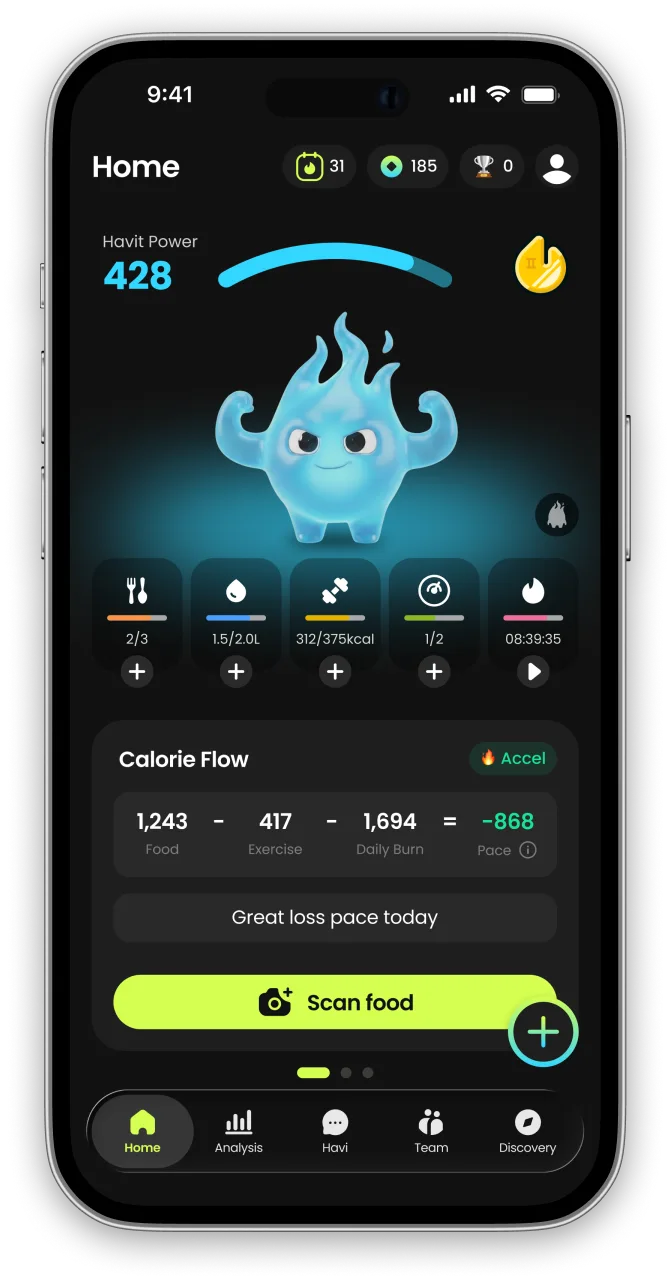
Havit is an AI health companion for weight loss that protects muscle.
Unlike calorie-only trackers, Havit connects AI body-composition estimates, nutrition, hydration, sleep, steps, cycle, mood, and GLP-1 medication in one daily routine — so progress is measured by body composition, not just the number on the scale. Daily missions turn established behavior-change techniques into small repeatable actions, drawing on expertise from professionals formerly at Juvis Diet, one of Korea’s leading metabolic clinics.
In Havit’s own analysis of 1,090 GLP-1 users, people who logged consistently built stronger habits than the general user base. Read the GLP-1 Habit Report
Havit works with or without GLP-1 medication. It is a wellness app, not a medical device; body-composition results are estimates.

Continue in the App
Personalized wellness with your own data


References
- Cardiovascular and Coordination Adaptations to Rope Jumping Training — Journal of Sports Sciences, 2025
- Neural Density Improvements Through Coordination-Based Cardiovascular Exercise — Research Quarterly for Exercise and Sport, 2024
- Comparative Analysis of HIIT Protocols for Metabolic Conditioning — Journal of Strength and Conditioning Research, 2024
- Caloric Expenditure Across Exercise Modalities — American Council on Exercise, 2023

